
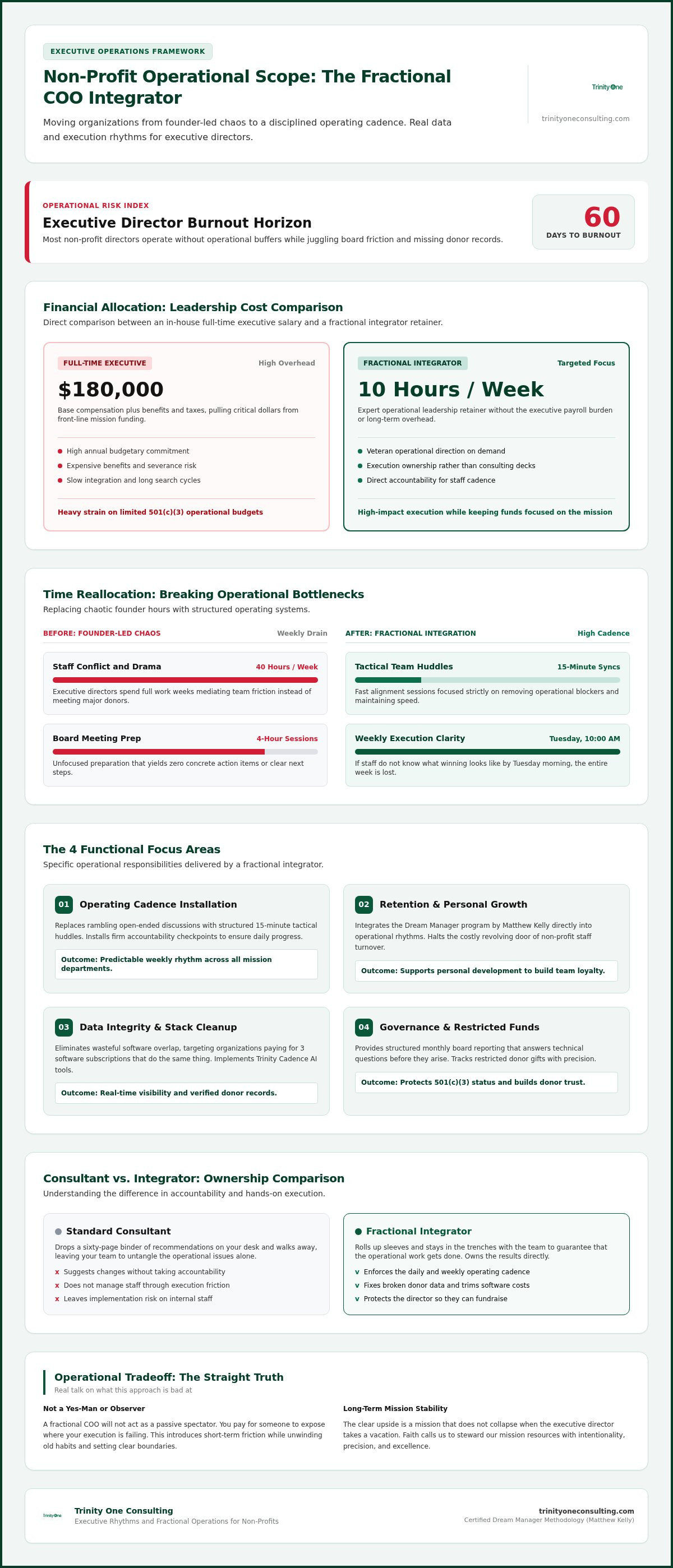
Your Executive Director is likely sixty days away from a total burnout. A fractional COO scope of work for non-profits prevents this by building execution rhythms and managing staff retention through dream management. This role also handles donor data cleanup. Between managing board friction and chasing leads, your actual operations have become a secondary concern.
You know the feeling of a board meeting where the data doesn't match the reality on the ground. Staff turnover is climbing. It's frustrating to watch a mission you love get bogged down by messy donor spreadsheets and a lack of clear direction. Your team feels like they're running a race with no finish line.
You'll understand exactly how a part-time operator stabilizes your mission and synchronizes your team without a six-figure executive salary. This approach builds an operational cadence that actually sticks and gives your leader time back for fundraising. I believe we are called to steward our missions with excellence and precision.
The Trinity Cadence uses AI to keep your data clean while Matthew Kelly's Dream Manager program stops the revolving door of staff turnover. These specific weekly rhythms turn a chaotic office into a high-performing engine. Forget hiring a consultant for a report you'll never read.
Key Takeaways
- Define the fractional COO scope of work as a strategic partnership where the integrator owns the results instead of just providing a list of suggestions.
- Shift from long and unproductive board meetings to a unified operating cadence that uses short huddles to drive daily mission progress.
- Compare the high cost of a $180,000 full-time executive to a fractional retainer that provides ten hours of expert focus without the overhead.
- Reduce staff turnover by integrating the Dream Manager program by Matthew Kelly into your daily operations to support the personal growth of your team.
- Move from disorganized donor data to a clear operational engine using the Trinity Cadence AI-native operating system for real-time visibility.
What does a fractional COO scope of work look like for a non-profit?
A fractional COO scope of work for a non-profit isn't a list of errands for a high-priced assistant. It is a strategic partnership designed to turn a visionary's ideas into a repeatable reality. Most leaders treat operations as an afterthought until the engine starts smoking. I see this when an Executive Director spends forty hours a week on staff drama instead of major donor meetings. You need a partner who can build the tracks while you're still driving the train.
The difference between a consultant and an integrator is ownership. A consultant drops a sixty-page report on your desk and leaves you to figure out the mess. An integrator stays to make sure the work actually gets done. They own the result. This role follows the standard Chief Operating Officer functions but does so on a part-time basis to save your budget. You get the wisdom of a veteran without the $180,000 salary.
Moving from founder-led chaos to system-led growth requires a shift in how you view your mission. You can't scale a personality, but you can scale a process. When a non-profit relies solely on the charisma of its leader, it creates a bottleneck that eventually breaks. I help you document the unspoken rules of your culture and turn them into a functional operating system. This is about moving from "I think we're doing okay" to "I know we're winning."
Core operational responsibilities
I focus on managing the day-to-day execution so you can get back to the work only you can do. This starts with building a fractional COO framework for staff accountability. If your team doesn't know what winning looks like by Tuesday at 10:00 AM, you've already lost the week. We also look at your tech stack. Most non-profits are paying for three software subscriptions that do the exact same thing, which is a waste of your precious donor dollars.
Board and governance support
Board members are often frustrated because they can't see the engine. They see the mission, but they don't see the mechanics. I create clear monthly reports that answer their questions before they ask them. This bridges the gap between their high-level vision and the grit of daily staff execution. We also ensure that every dollar of donor restricted funds is tracked with clinical precision. This level of data integrity is what keeps your 501(c)(3) status safe and your donors confident.
There's a tradeoff to this approach. A fractional COO is bad at being a "yes man" or a passive observer. You're paying for someone to tell you where your systems are failing. It involves short-term friction as we clean up old habits. However, the result is a stabilized mission that doesn't collapse when the Executive Director takes a vacation. I believe we're called to steward our resources with this kind of intentionality.
How does an operating cadence fix non-profit execution gaps?
Execution gaps in a non-profit aren't usually caused by a lack of passion. They're caused by a lack of rhythm. When your team operates without a clear cadence, every task feels like an emergency. I see Executive Directors who spend their entire Monday in four hour board prep meetings that result in zero action items. This is where the fractional COO scope of work becomes tangible by installing a predictable heartbeat for the mission.
The role of the COO as second-in-command is to bridge the gap between what we want to do and what is actually happening. Most non-profit teams are drowning in a sea of emails and Slack messages because they don't have a central place for truth. We replace those wandering, unproductive meetings with punchy fifteen minute huddles. These aren't social gatherings. They're tactical alignment sessions where we identify blockers and move on.
Installing this rhythm is the primary duty of the fractional integrator. We don't just suggest a schedule. We enforce it. This ensures that the engine of your organization is firing on all cylinders every single day. If you want to see how this rhythm fits your specific team, you can schedule a cadence call to map out your current gaps.
Installing the Trinity Cadence
We use an AI-native operating system to see exactly where projects stall in real-time. Instead of waiting for a monthly board report to find out a grant application is late, we see the friction as it happens. We set up weekly scorecards that track leading indicators like donor calls made or volunteer hours logged. This moves your leadership from reactive firefighting to proactive planning.
Synchronizing human and machine operations
AI isn't here to replace your staff. It is here to manage the boring workflows that cause burnout. We integrate AI coaching to help your team manage their own tasks without constant oversight. This reduces meeting fatigue because the status updates are already automated. You get real-time visibility into mission impact without having to grill your staff for data.
I believe that a mission only succeeds when the people running it are not constantly exhausted. A clear cadence provides the structure that allows for rest and creativity. It's the difference between a team that is surviving and a team that is thriving. This shift requires discipline, but the clarity it brings is worth the initial effort.
What specific deliverables should you expect from a fractional integrator?
A fractional COO scope of work focuses on the engine of your mission. I don't trade in vague advice or high-level theories that look good on a whiteboard but fail in the field. You should expect tangible assets that remain in your organization long after my contract ends. These are the gears and circuits that allow your team to function without constant supervision from the top.
Many organizations fall into a trap by underfunding nonprofit infrastructure in favor of immediate program spending. This creates a fragile environment where one staff departure can cripple an entire department. My job is to build the documentation and systems that ensure continuity. We turn tribal knowledge into a shared operational playbook so that your mission isn't held hostage by a single person's memory.
Understanding when to hire a fractional executive is often about recognizing when your internal processes can no longer support your growth. If you're adding staff but seeing less work get done, your engine is stalling. I provide the specific blueprints to fix that. These deliverables reduce the risk of a bad hire because they define exactly what a full-time successor will eventually need to manage.
The operational playbook
I deliver a set of documented standard operating procedures for your core functions. This includes a clear organizational chart that defines who owns what result, not just who reports to whom. We also build a 90-day roadmap for scaling the mission. This roadmap isn't a wish list. It's a tactical schedule of execution that keeps every department aligned with your primary goals.
The Dream Manager framework
People are the fuel for your operational engine. I implement the Dream Manager program created by Matthew Kelly to ensure your staff stays engaged. We coach your team through the twelve dream categories, including physical, emotional, and financial goals. This is a practical retention strategy that links their personal achievement to the organization's success.
I've seen non-profits reduce staff turnover by 30% simply by showing employees that the organization cares about their personal growth. When a team member sees a path to their own dreams, they work with a level of intensity that no paycheck can buy. I believe that a company only becomes its best version when its people are becoming better versions of themselves. This is the ultimate return on your operational investment.
How do you evaluate the cost versus the impact of part-time leadership?
Hiring a full-time COO at a salary of $180,000 plus benefits is a heavy lift for most non-profits. A fractional COO scope of work allows you to secure that same level of expertise for a fraction of the cost. Stop paying for forty hours of physical presence and start paying for ten hours of high-impact execution that actually moves the needle.
There is a specific tradeoff you must accept within a fractional COO scope of work. A fractional leader is bad at being your on-call crisis manager for every minor staff disagreement or office supply shortage. If you need someone to sit in every meeting and nod, this isn't the right fit. We are built for surgical strikes on your operational bottlenecks (the stuff that actually stops your growth).
Consider the difference between an expert and a junior hire. Many non-profits hire an Operations Manager and hope they'll figure it out. That person spends forty hours a week learning on your dime. A veteran operator spends ten hours a week applying 30 years of experience to your specific problems. The ROI is usually higher in the first year because we don't have a learning curve.
Measuring ROI in a non-profit context
ROI in our world goes beyond the bottom line. It's about reducing the cost of replacing a burnt-out program manager. When staff engagement increases through better rhythms, retention follows. We also measure the hours recovered for the Executive Director.
If you can spend ten more hours a week securing major gifts instead of fixing donor data, the retainer pays for itself. Efficiency also comes from better tools. We use AI to handle the repetitive tasks that eat your team's time. A company only becomes the best version of itself to the extent its people are becoming better versions of themselves.
The cost of inaction
Doing nothing has a real price tag. I've seen organizations lose significant grants because their reporting was disorganized and late. That is the cost of poor infrastructure. Founder burnout is another hidden expense that destroys missions. When a leader is too tired to lead because they're managing spreadsheets, the entire organization suffers.
Waiting for the perfect full-time hire is often a trap. You might spend six months searching while your operations continue to decay. A fractional operator starts in days and begins cleaning the engine immediately. We bridge the gap so you can eventually hire that full-time person into a system that actually works. I believe we are called to steward these organizations with excellence.
How does Trinity One align mission with machine operations?
I believe that your mission is only as strong as the people carrying it. The fractional COO scope of work at Trinity One starts with a simple rule: people first, systems second. We don't build technology for the sake of being fancy. We build it to serve the humans who are doing the heavy lifting in your non-profit.
Your leadership team needs a unified view of the organization that doesn't require five different logins. Trinity Cadence acts as the digital engine that keeps your mission on track. It provides real-time data so you can see where a project is stuck before it becomes a disaster. This isn't about micromanagement, it's about clarity.
We don't believe in six-month implementation timelines. Our Launch Sprints are designed to get your operations cleaned up in days. You get immediate wins that build momentum for the rest of the year. This aggressive approach is how we stop the bleeding in a struggling organization.
AI-native people management
We use AI to provide operational coaching to every team member. This ensures that no one feels like a cog in a machine. The technology handles the repetitive tracking so your staff can focus on the empathy and human connection your mission requires. It's about using the machine to make the work more human.
Technology should never get in the way of the heart of your work. We use these tools to remove the administrative friction that causes staff burnout. When the machine handles the data, the people can handle the purpose. This alignment is the core of our fractional COO scope of work.
The Certified Dream Manager advantage
As a fractional Dream Manager, I use the methodology created by Matthew Kelly to align personal goals with professional performance. We look at the twelve dream categories like physical health and financial stability. When you help an employee achieve a personal dream, their loyalty to your mission becomes unshakable.
I've seen this 1-on-1 coaching turn around high-turnover departments in weeks. People work harder when they know their employer cares about their life outside of the office. A fractional COO brings a battle-tested perspective that your internal team simply doesn't have yet. I've been in the trenches of corporate operations and on the sidelines as a football coach, so I know how to build a winning team.
My faith tells me that every person has a unique purpose, and my job is to align that purpose with your organization's execution. We don't just fix spreadsheets, we help people grow. This is the only way to build a mission that lasts.
Secure the future of your mission
Your mission is too important to be stalled by messy donor data or constant staff turnover. A clear fractional COO scope of work provides the structure your team needs to stop reacting and start executing. Clarity is kind. It is the difference between an Executive Director who is drowning and one who is leading with real vision.
We combine the AI-native Trinity Cadence OS with Certified Dream Manager facilitation to ensure your engine is high-performing and your people are growing. This approach eliminates the friction between board expectations and daily staff reality. It's time to build an organization where the mission and the machine work in total harmony.
If you want to see how an AI-native operating system can stabilize your mission, book a call below.
You don't have to choose between operational excellence and human compassion. I believe that when we steward our resources with precision, the impact of our work ripples much further than we can see. Keep pushing forward.
Common Questions About Fractional Operations
What is the typical length of a fractional COO contract for a non-profit?
Most engagements last between six and twelve months. This duration allows me to install the Trinity Cadence and stabilize your internal systems without rushing the process. Some organizations choose to keep a fractional leader on retainer for years as they scale. Shorter contracts often fail because they don't provide enough time to change deep-seated staff habits or clean up years of disorganized data.
How many hours a week does a fractional integrator usually work?
A typical fractional COO scope of work involves five to fifteen hours per week. I focus on high-impact execution rather than just being a warm body in the office. This limited time forces us to prioritize the most critical bottlenecks in your mission. We use AI tools to monitor your team's progress in real-time. This means I can provide leadership without the cost of a forty-hour executive salary.
Can a fractional COO help with non-profit fundraising and donor relations?
I don't personally ask for money, but I build the engine that makes fundraising possible. My role is to clean your donor data and create reporting systems that prove your impact to major givers. This gives your Executive Director twenty more hours a week to focus on relationship building. If your operations are a mess, you'll eventually lose the trust of your biggest supporters. I ensure that never happens.
Does a fractional COO manage the whole staff or just the leadership team?
I primarily manage the leadership team to ensure the visionary's goals are being met. However, the Dream Manager program touches every person in the organization. I coach your directors on how to lead their own teams using our specific execution rhythms. This structure prevents the Executive Director from getting sucked into daily staff drama. It creates a clear chain of command that respects everyone's time and purpose.
What is the difference between a non-profit consultant and a fractional COO?
A consultant gives you a map, but a fractional COO drives the car. Consultants offer advice and then leave you to do the work. As an integrator, I own the result of our operational changes. I am part of your team and responsible for making sure the mission actually hits its targets. This is about active execution instead of passive observation or theoretical suggestions that never get implemented.
How do I know if my non-profit is ready for a fractional integrator?
You're ready when your Executive Director is sixty days away from quitting because of burnout. If your board meetings are spent arguing about inconsistent data, you have an operations problem. High staff turnover is another clear signal that your internal engine is failing. If you have the vision but lack the repeatable systems to achieve it, it's time to bring in an expert to build those tracks.
What software does a fractional COO use to manage non-profit operations?
I use the Trinity Cadence AI-native operating system to provide real-time visibility into your mission. This platform integrates your project tracking with staff engagement data. It replaces the mess of disconnected spreadsheets and endless email chains. We also use DreamCompass to help employees track their personal goals alongside their professional duties. These tools ensure that every team member knows exactly what winning looks like every single Tuesday morning.
How does the Dream Manager program fit into a COO scope of work?
The Dream Manager program by Matthew Kelly is the human side of the fractional COO scope of work. Operations are the engine, but people are the fuel. I coach your staff through the twelve dream categories to ensure they are becoming better versions of themselves. This leads to higher retention and better daily performance. I believe that an organization only reaches its potential when the individuals within it are thriving personally.