
Your business is growing but you've become its primary bottleneck. You'll know you've hit the wall when every minor decision stops at your desk and your best people are leaving because they lack clear direction. These are the primary signs you need a fractional integrator to synchronize your operations so you can lead again.
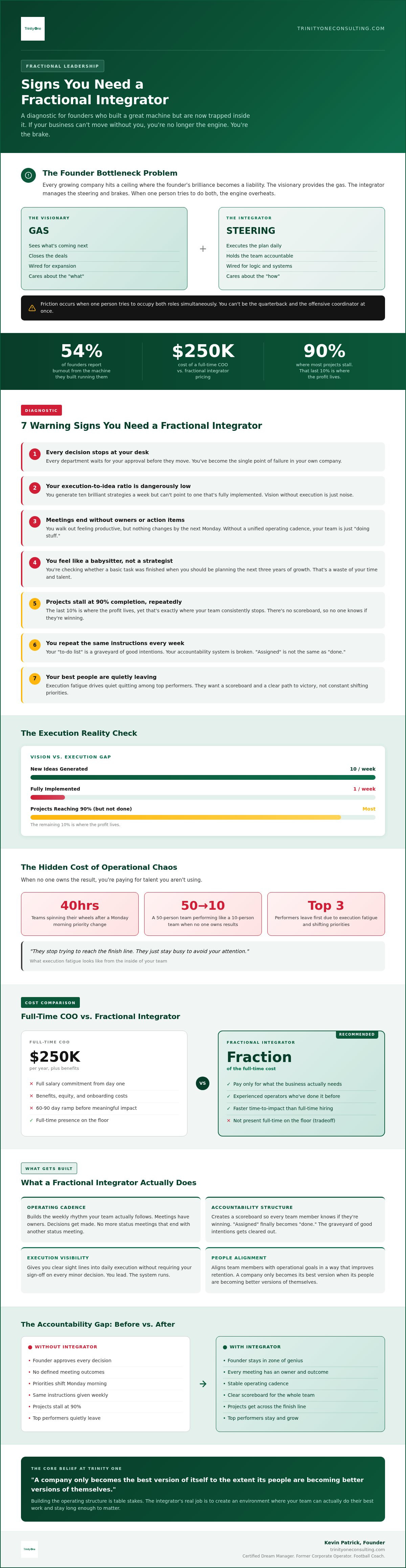
I've seen it on the football field and in the boardroom: a team with a great playbook but no one to call the plays on the ground. It's exhausting to watch projects stall while your calendar fills with meetings that should've been emails. You're feeling the weight of the 54% of founders who report burnout because the machine they built is now running them.
You want a business engine that functions without your constant intervention. I'll show you how to identify the specific friction points that are stalling your growth right now. I believe your company only becomes its best version when your people are becoming their best versions too.
You'll learn how an integrator builds a structure where your team actually finishes what they start. I'll break down the math of your operations and the human side of your alignment. By the end, you'll see how to get clear visibility into daily execution without losing your sanity.
Key Takeaways
- Learn to identify when your role as the visionary has shifted from being the gas to becoming the operational bottleneck.
- Spot the specific signs you need a fractional integrator, like a dangerously low ratio of finished projects compared to new ideas.
- Implement proven strategies to align your team with operational goals, fostering engagement and improving retention.
- Compare the strategic value of fractional leadership against the $250,000 cost of a full-time Chief Operating Officer.
- Build an operating cadence that creates visibility into execution without requiring your intervention in every minor decision.
Why is the founder always the bottleneck in a growing company?
I've seen founders reach a ceiling where their brilliance becomes a liability. You know you're the bottleneck when every department waits for your approval before they can move. This operational drag is one of the primary signs you need a fractional integrator to synchronize your business engine. Without this role, you're the one holding back the very growth you're trying to create.
The visionary provides the gas while the integrator manages the steering and brakes. I've coached enough teams to know that speed without control leads to a crash. Your business engine eventually overheats and stalls when you try to do both. You're likely exhausted because you're trying to be the source of all energy and all order at the same time.
The physics of leadership and operational friction
Visionaries are wired for expansion and big relationships. You're built to see what's coming next and to close the deals that fuel the company. Integrators are wired for logic and systematic execution. They care about the "how" while you care about the "what."
Friction occurs when one person tries to occupy both roles simultaneously. It's a mechanical impossibility in a scaling company. You can't be the quarterback and the offensive coordinator at once. If you're trying to call the plays while you're being chased in the pocket, you're going to miss the open receiver.
Understanding how to improve visionary integrator relationship dynamics is the first step toward freedom. Fractional work offers a way to bring in this specialized talent without the $250,000 price tag of a full-time executive. I'm convinced that we're called to steward our businesses with excellence and integrity. This structure allows you to stay in your zone of genius while someone else builds the tracks for the train.
The hidden cost of unmanaged operational chaos
Lost productivity costs mid-sized businesses thousands of dollars every week. I've watched teams spin their wheels for forty hours because the founder changed the priority on a Monday morning. When your team doesn't know what "done" looks like, they stop trying to reach the finish line. They just stay busy to avoid your attention.
Team members lose confidence when the plan shifts constantly. Execution fatigue leads to quiet quitting among your top performers. These are the people you can't afford to lose. They want a scoreboard and a clear path to victory, not a leader who creates chaos in the name of creativity.
I've seen businesses with 50 people act like they have 10 because no one knows who owns which result. This lack of structure is a choice, and it's a costly one. You're paying for talent you aren't using because you haven't built the system to support them.
What are the signs you need a fractional integrator right now?
Your execution vs idea ratio is dangerously low. I've coached leaders who generate ten brilliant strategies a week but can't point to one that's fully implemented. This gap between vision and reality is one of the clearest signs you need a fractional integrator to filter the noise.
Meetings in your company likely end without clear action items or assigned owners. You walk out of the conference room feeling productive, but nothing changes by the next Monday. Without a unified operating cadence, your team is just "doing stuff" instead of hitting specific targets.
You feel like a babysitter instead of a strategic architect. I know that frustration well. You're checking to see if a basic task was finished when you should be planning the next three years of growth. It's a waste of your time and your talent.
Identifying the accountability gap in your team
Projects in your office often reach 90 percent completion but never cross the finish line. That last 10 percent is where the profit lives, yet it's where your team consistently stalls. Your people are busy, but they don't actually know if they're winning because there's no scoreboard.
If you find yourself repeating the same instructions every week, your accountability system is dead. I've seen teams where the "to-do list" is just a graveyard of good intentions. You need a person who ensures that "assigned" actually means "done."
The modern need for AI native leadership
A major sign is an inability to integrate AI into your daily workflows. You're likely still using manual spreadsheets to track execution and employee engagement. This technical friction is among the physical signs you need a fractional integrator who understands modern systems.
As of 2026, the gap between companies that use AI effectively and those that just talk about it is widening. A great integrator looks to automate the machine so humans can do human work. We use the Trinity Cadence to give you real-time visibility without the manual data entry.
If your operations feel stuck in the past, it's time to schedule a cadence assessment. I believe a company only grows to the extent its people are becoming better versions of themselves. That doesn't happen when they're buried in manual admin work. You need someone to build the integrated circuits of your business so your people can focus on high-value tasks.
How does an integrator balance AI efficiency and human performance?
I've managed teams on the field and in the office, and one truth remains: a company only grows to the extent its people become better versions of themselves. High turnover or low morale are often signs you need a fractional integrator who understands the human element. You can't just fix the plumbing of a business and expect it to run forever without tending to the people who turn the valves.
I use the Dream Manager methodology by Matthew Kelly to bridge the gap between your goals and your team's desires. An integrator manages the machine logic and the human heart simultaneously. It's about showing your staff that their job is the vehicle to reach their personal dreams. When they see that connection, their output naturally changes from a chore to a mission.
The Dream Manager methodology in daily operations
We incorporate the Dream Manager program into your regular operational structure. I guide your leaders through the twelve dream categories established by Matthew Kelly to drive deep engagement. This isn't soft fluff: it's a strategic move to reduce the cost of rehiring and retraining. Personal growth is a leading indicator of professional ROI, and I've seen it stabilize teams that were previously falling apart.
Integrators who ignore the soul of the business are just glorified project managers. If your team feels like they're just spinning wheels, those are signs you need a fractional integrator who can align the machine with the mission. I'm here to ensure that your vision and their dreams are moving in the same direction. My faith is a simple conviction that every person has inherent value, and our business systems should reflect that reality.
Synchronizing the machine with Trinity Cadence
Trinity Cadence provides real-time visibility into execution so you don't have to guess who is doing what. We use AI coaching to help your managers stay on track with their huddles and feedback loops. This technology doesn't replace the human connection, it protects it. By removing the friction of manual reporting, your leaders have more time for actual leadership.
Status updates and manual spreadsheets are the enemies of creativity. Our software automates the data collection so you can focus on the people behind the numbers. It's about building a machine that serves the humans, not the other way around. This synchronization is what allows a business to scale without breaking the spirit of the founder or the team.
Should you hire a full-time COO or a fractional integrator?
A full-time COO often costs $250,000 plus benefits and equity. This is a heavy weight for a company still finding its footing. The financial burden of a C-suite hire is often one of the signs you need a fractional integrator instead of a full-time employee. You don't need a full-time salary to get high-level execution.
Fractional leadership provides high-level strategy without the massive overhead. I've found that fractional leaders are more blunt because they're not political. We aren't worried about the annual review or the Christmas party. Our focus is purely on the integrated circuit of your operations.
If a process is failing, I'll tell you immediately. I'm not here to protect my job. I'm here to protect your business engine. Refer to the 2026 scaling guide to see where your revenue aligns with these roles.
The cost to impact ratio of fractional leadership
You get 100 percent of the wisdom for a portion of the price. This model allows for rapid launch sprints to fix specific broken systems like your sales handoff or your project management software. It is the right choice when your team needs direction but not a full-time babysitter.
Many founders hire a COO because they're tired of managing people, but they end up managing the COO instead. I believe we are called to be good stewards of our resources. Spending $300,000 on a salary when you only need ten hours of strategy a week is poor stewardship.
You're paying for a full-time engine when you only need a high-performance tune-up. The tradeoff is that a fractional leader isn't there to handle every minor fire. You still need a team that can execute the basics. These operational gaps are the exact signs you need a fractional integrator to step in and tighten the bolts.
Objectivity and the lack of corporate bureaucracy
Fractional integrators focus on the business engine rather than office politics. They can push back on the visionary more effectively than a full-time employee. When I step into a business, I'm looking for friction points, not friends. This objectivity is a requirement for growth.
A full-time COO might worry about their bonus if they tell you your new idea is a distraction. I don't have that fear. My job is to protect the mission, not my seat at the table. Trust is built through operational wins rather than tenure.
I've seen full-time executives spend their first six months learning the culture while the business loses money. A fractional operator starts fixing things on day one. We don't have time for a slow ramp-up. I trust that when we build things the right way, the results follow.
How do you get started with fractional leadership at Trinity One?
The first step is a discovery call to find where the friction lives. I don't believe in long, theoretical planning sessions that result in nothing but a thick binder. We look at your current output and find the specific points where your team is stalling. If you've seen the signs you need a fractional integrator, you're already aware that your current pace is unsustainable.
We establish a clear operating cadence before adding more people to the team. Hiring more staff to fix a broken process is like adding more water to a leaky bucket. You just end up with a bigger mess. I've spent 30 years in operations and I know that structure must precede scale.
A 90-day trial ensures the operational fit is right for your culture. I'm not interested in being another consultant who watches from the sidelines. I want to be in the trenches with you. You can explore our fractional COO services to see how this partnership functions.
The 90-day roadmap for operational synchronization
Month one focuses on visibility and the business huddle rhythm. We stop the "emergency" culture by creating a predictable loop of communication. Your team will know exactly what is expected of them by the time they leave the Monday huddle. I've used these same principles on the football field to turn around losing seasons.
Month two integrates the Dream Manager methodology for the team. We use the twelve dream categories defined by Matthew Kelly to connect your business goals to their personal lives. This is where we see turnover drop and engagement rise. When people feel seen, they perform better.
Month three optimizes the machine through Trinity Cadence and AI. We take the manual reporting off your plate. By this point, the business engine is running with machine logic and human heart in balance. You'll have real-time visibility into every project without having to ask for a status update.
Reclaiming your role as the visionary architect
The goal is to move you back into your zone of genius. You started this business to build something great, not to manage spreadsheets and mediate staff disputes. I've seen founders regain their spark once they stop being the primary bottleneck.
You should feel a measurable reduction in stress within the first 30 days. It's the difference between being chased by your business and leading it. My faith tells me that we're meant to live with purpose, not in a state of constant panic.
A unified business engine allows you to focus on expansion and vision. You'll finally have the space to think about the next three years instead of the next three hours. That's the power of having a strategic architect who handles the execution while you handle the future.
Reclaiming your seat as the visionary leader
You've identified the signs you need a fractional integrator, from the persistent decision fatigue to the projects that never quite cross the finish line. I've spent 30 years in the trenches and I know that you cannot scale a business by sheer force of will. You need a machine that runs while you're focused on the future.
I combine the AI-native Trinity Cadence system with Certified Dream Manager coaching to align your operations with your people. This isn't just about logic: it's about stewardship. A company only becomes the best version of itself when its people are becoming better versions of themselves too.
You don't have to carry the operational weight by yourself. I'm here to help you build a business that reflects your highest purpose. Let's find where the friction lives and fix it together.
I'm looking forward to hearing your story and seeing how we can synchronize your engine. It's time to get you back to the work you were meant to do.
Frequently Asked Questions
What is the difference between a project manager and an integrator?
Project managers focus on the timeline of specific tasks and the completion of individual assignments. An integrator manages the entire business engine and the alignment of the team with your vision. They ensure the machine works as a whole rather than just finishing a list of to-dos. I've found that project managers follow the plan while integrators build the system that makes the plan possible.
How much does a fractional integrator typically cost for a mid-sized business?
I don't quote specific fees here but research shows fractional roles cost 40% to 65% less than full-time hires. A full-time COO often requires a base salary between $201,000 and $265,000 plus equity and bonuses. You're paying for high-level strategy on a retainer basis without the massive overhead of a C-suite executive. This model provides the strategic wisdom you need while protecting your cash flow.
Can a visionary also be an integrator for their own company?
It's possible but it usually leads to burnout and operational drag. Visionaries are wired for expansion while integrators are wired for logic and systematic execution. Trying to do both creates internal friction that stalls growth. This conflict is one of the primary signs you need a fractional integrator to take over the daily operations so you can focus on the future.
What are the common mistakes when hiring a fractional executive?
Hiring for task management instead of leadership is a frequent error. You need an operator who can push back on your ideas when they cause chaos for the team. Another mistake is ignoring cultural fit and the human element. If the leader doesn't care about your people becoming better versions of themselves, the operational systems will eventually feel like a cage to your staff.
How does an integrator handle conflict between the visionary and the team?
The integrator acts as a filter that translates high-speed vision into actionable steps for the team. I use the Trinity Cadence to provide real-time visibility that removes the emotion from these conflicts. We focus on the machine logic and the human heart simultaneously. I also use the Dream Manager methodology by Matthew Kelly to ensure everyone's personal aspirations are respected during the scaling process.
What software tools do great integrators use to manage operations?
Great integrators avoid manual spreadsheets because they create data silos and extra work for your managers. We use AI-native systems like Trinity Cadence to automate the huddle rhythm and status reports. Tools like DreamCompass help us track employee engagement alongside operational metrics. The goal is to build a unified business engine that provides clear visibility without requiring constant manual data entry from your team.
How do I know if I am a visionary or an integrator?
Visionaries love the "what" and the "who" while integrators love the "how" and the "when." If you're excited by new markets and big relationships, you're likely a visionary leader. If you get satisfaction from a perfectly tuned process and a clear scoreboard, you're an integrator. Most founders are visionaries who find themselves trapped in the daily execution, which is a waste of their talent.
Does a fractional integrator work on-site or remotely?
Fractional integrators work both ways depending on the specific needs of your business engine. Remote work is common because modern tools provide the visibility needed to lead a team from anywhere in the country. Some launch sprints require being on-site to see the friction in person and build trust with the team. The focus is always on the results and the operating cadence rather than the physical location.