
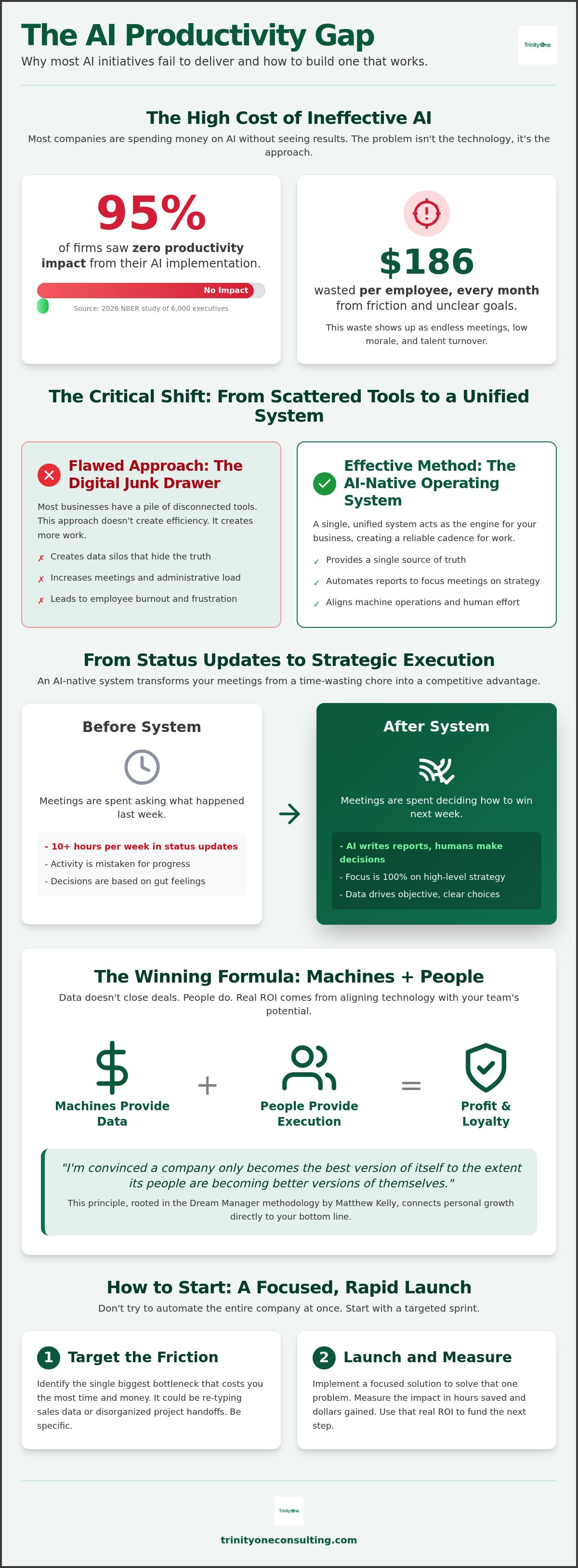
A 2026 NBER study of 6,000 executives found that 95% of firms saw zero productivity impact from AI. You feel this friction every day. I've seen leaders waste money using AI to improve operational efficiency only to get more meetings and less clarity. This waste costs your business $186 per employee every month.
It's frustrating to pay high salaries and still face turnover. Talent leaves. Your people feel like cogs in a broken machine. Most AI implementations fail because they ignore the humans running the tools.
You want real-time data that predicts problems before they happen. I believe a company only becomes the best version of itself to the extent its people are becoming better versions of themselves. Stop treating AI as a technical bolt-on.
It functions best as a systemic engine that aligns machine output with human performance. We need a repeatable operating cadence that produces profit and keeps your team loyal. I'm convinced we are called to lead our people with both truth and grace. Start seeing a real return on your investment.
Key Takeaways
- Stop viewing efficiency as a way to replace your people. Focus on using AI to improve operational efficiency by removing the friction that stops your team from executing.
- Build an AI-native operating system that functions as your business engine. This provides a unified cadence for your meetings and goals instead of a mess of scattered tools.
- Software alone won't fix a culture where people don't care about the results. I'll show you why AI fails when it ignores the human element or tries to mask a broken process.
- Apply the Dream Manager methodology by Matthew Kelly to connect personal growth with company profit. Your company only becomes the best version of itself when your people are growing too.
- Don't try to automate every process at once. Start with a rapid launch sprint to target the specific friction points that are currently costing you time and money.
What does it mean to use AI for operational efficiency?
Efficiency is the absence of waste. In my thirty years of operations, I've learned that most leaders confuse activity with progress. Using AI to improve operational efficiency means removing the friction that stops your team from executing. It doesn't mean replacing your staff with robots.
I define efficiency by the clock and the spreadsheet. I once worked with a CEO who managed a 50-person shop where the office manager spent four hours every Monday just re-typing sales data into a CRM. If your managers spend ten hours a week in status update meetings, you're failing. True efficiency happens when your machine operations and your people management work in the same rhythm. This alignment reduces the mental load on your staff and lets them focus on high-value tasks.
What is the difference between AI tools and an AI system?
Most businesses have a pile of tools but no unified cadence. A tool handles one specific task like writing a summary or generating an email. A system manages the entire flow of information across your company. This requires a fundamental Business process re-engineering mindset. You can't just bolt a new chatbot onto a broken workflow and expect it to run.
A tool is a hammer. A system is the blueprint and the crew. Using AI to improve operational efficiency requires moving beyond individual apps. You need a unified cadence where every piece of software talks to every person on the team. Without this, you just have a digital junk drawer that costs you money every month. This fragmentation creates data silos that hide the real truth of your business.
Why is the human element the missing piece?
Machines provide the data. People provide the execution. If your team is checked out, the best AI in the world won't save your profit margins. I've seen companies spend millions on software only to watch their best people quit because they felt like cogs. You need a system that tracks both machine output and human engagement.
Data doesn't close deals. People do. I believe a company only becomes the best version of itself to the extent its people are becoming better versions of themselves. If your AI shows you that production is down but doesn't tell you that your floor manager is burnt out, the system is useless. Alignment is the goal. My work as a Fractional COO focuses on this exact balance between logic and motivation. I've spent decades in the trenches of leadership seeing how technical fixes fail without human purpose.
How do you build an AI-native operating system?
An AI-native operating system is the engine of your business. It is a structured framework that dictates how information moves from one department to another. Do not confuse this with a simple collection of phone apps. Using AI to improve operational efficiency is only possible when you stop treating technology as an assistant and start treating it as the foundation.
I use Trinity Cadence to give leaders real-time visibility into their company operations. This system replaces the guesswork of traditional management with hard, objective data. You stop relying on gut feelings about whether your team is productive. Instead, you look at a dashboard that shows exactly where the friction is slowing you down. It provides a unified cadence for meetings and goals while managing feedback.
Establishing a unified operating cadence
Your business needs a pulse that everyone can feel. I call this the cadence. It consists of daily huddles and weekly execution meetings that occur with mechanical reliability. Most leaders hate meetings because they are disorganized and waste time. AI changes this by handling the heavy lifting of preparation.
Imagine a weekly meeting where the status reports are already written by an AI agent that scanned your project management software. You don't spend forty minutes asking what the status of a project is. You spend forty minutes deciding how to beat the competition. This automation turns meetings from a chore into a competitive advantage. It ensures that every minute spent together is focused on high-level strategy and execution.
Integrating machine operations with people management
Your KPIs should be visible to everyone in the system. When data is transparent, the excuses disappear. Integrating machine operations with people management is a core part of using AI to improve operational efficiency. AI coaching can help employees stay on track without a manager hovering over their shoulder. The system sends a nudge when a task is overdue or a goal is slipping.
This integration is where you find the real profit. You can see the correlation between machine output and human engagement in real time. If a specific team has high output but their engagement scores are dropping, you can intervene before they quit. You can view your current operating rhythm to see where your team is losing focus. I believe we are called to lead with integrity and purpose, and trust is built on this transparency.
Why do most AI implementations fail to deliver ROI?
ROI is the only metric that matters at the end of the quarter. Most leaders buy software and hope it fixes their culture. This is an expensive mistake. A 2026 NBER study found that up to 95% of firms saw no measurable impact on productivity from their AI investments. I've seen companies spend $50,000 using AI to improve operational efficiency only to have the tools sit gathering digital dust.
No one opened them after the first week. The staff didn't see the point. Software cannot fix a broken process or a team that doesn't care. If your workflow is a mess, AI just helps you create a mess faster. You must have extreme clarity in your goals before you touch a line of code. This clarity is the price of admission for systemic efficiency.
The tradeoff for this speed involves a few hard costs:
- You must document every step of your current manual process.
- You have to define exactly what success looks like in dollars and cents.
- You need to be honest about which team members are willing to grow.
- You must commit to a meeting schedule that doesn't move.
I believe we are called to be good stewards of our resources. Burning cash on unproven tech is poor stewardship. Using AI to improve operational efficiency requires a disciplined approach to implementation. You have to be willing to do the hard work of defining your cadence first.
The high cost of employee resistance
Fear is a powerful motivator for sabotage. Your team likely worries that these new tools are a precursor to layoffs. If they don't see how the technology makes their personal lives better, they will find ways to ignore it. You have to prove that AI handles the boring grunt work so they can focus on the work that actually matters.
Protecting your investment is the priority here. Your team's cooperation is the only way to ensure the system works. If your team spends two hours a day fixing workslop generated by poor AI prompts, you're losing $186 per employee every month. That adds up quickly in a 20-person shop. You need them to buy into the system to see the return.
The trap of the generic consultant
I've seen too many consultants sell generic software bundles without a single day of experience in the trenches. They give you a thick slide deck and leave you to figure out the implementation. You don't need theory. You need a practitioner who understands the logic of a machine and the motivation of a human.
A Fractional Integrator is usually the right choice for a business that needs to scale. They don't just talk about the future. They build the engine that gets you there. This role focuses on the plumbing of your business to ensure the data flows where it belongs.
How can AI help you align employee dreams with company goals?
I believe a company only grows as much as its people grow. This is the core of my philosophy at Trinity One. If your team is merely trading time for a paycheck, you have a transactional problem that will eventually drain your bank account. Using AI to improve operational efficiency works best when the system serves the human, not the other way around.
To bridge this gap, my approach recognizes that every person has a life outside the office. When you help an employee achieve a personal goal, you earn a level of loyalty that a simple bonus can't touch. AI provides the visibility to track these personal milestones alongside the business KPIs. This creates a retention engine that money alone cannot buy.
Paying high salaries won't solve turnover on its own. Your team needs a sense of purpose to stay committed. When your staff sees that their professional output directly fuels their personal dreams, their engagement levels skyrocket. This is how you build a team that actually cares about your profit margins. My work as a Fractional Employee Success Strategist focuses on this exact alignment.
Using the twelve dream categories for growth
Our framework for personal growth utilizes twelve categories to help people define what they actually want out of life. These include physical, financial, and professional goals. I ask employees to list their 100 dreams to break through the mental ice. Most people haven't thought about their own future in years because they are too busy surviving the workday.
When a person sees that their job helps them buy their first house or improve their health, their work takes on new meaning. AI helps us manage this data at scale without it becoming an administrative burden for your managers. We can see which dreams are being met and where the company can provide specific support. This turns the workplace into a place of growth rather than just a place of labor.
Tracking engagement through the Trinity Cadence
Our AI-native OS, the Trinity Cadence, identifies when a team member is losing focus. The software notices subtle shifts in communication speed or task completion rates. These are often early warning signs of burnout that a busy manager might miss. This visibility allows me to step in with coaching before a surprise resignation hits your desk.
Surprise exits are expensive. It often costs six to nine months of an employee's salary to recruit and train a replacement. Using AI to improve operational efficiency means protecting your most valuable asset: your people. We turn the job into a partnership for personal success. I'm convinced that when we lead with this kind of heart, the profit follows naturally.
How do you start using AI to improve your business engine?
Don't wait for a six-month software build that may never finish. I recommend starting with a rapid launch sprint to identify your biggest friction points. This is a surgical approach. You don't try to automate every department at once because that is a recipe for chaos. Focus on the specific areas where your team is currently drowning in manual tasks.
Your meeting rhythm and feedback loops are the best places to begin. Most companies suffer from meeting bloat where high-paid executives sit in silence for hours. Using AI to improve operational efficiency starts by automating the prep work for these sessions. When the data is already summarized before you walk in the room, you can actually lead your people.
You need a Fractional COO to manage this transition while you focus on the vision. You shouldn't be the one configuring software prompts or mapping out data flows. Your job is to protect the vision and keep the team focused on the mission. I handle the plumbing of the AI-native operating system so you can stay in your zone of genius.
The role of the Integrator in AI adoption
The Visionary CEO has the ideas but often lacks the patience for the technical setup. The Integrator builds the systems to make those ideas a reality. AI makes the Integrator more effective by providing real-time visibility into the business engine. We can see exactly where a process is breaking down before it impacts your bottom line.
Scheduling your first discovery call
You don't need a massive budget to start using these systems. A small, disciplined team can outperform a massive, disorganized one every single day. You just need a commitment to a better operating cadence and a willingness to be honest about your results. I've seen teams of five double their output just by cleaning up their data flow.
I can help you map out an AI ROI plan that makes sense for your specific headcount. We will look at your current payroll and identify exactly where hours are being lost to unproductive work. It is an honest assessment of what is working and what is costing you money. My faith gives me the conviction to tell you the truth, even when it's uncomfortable.
Build your business engine for the next decade
Using AI to improve operational efficiency is a strategic choice to stop guessing and start leading. I've seen how the Trinity Cadence provides the real-time visibility you need to stop losing $186 per month in employee workslop. You don't need a massive software budget to fix your friction points. You just need a disciplined cadence that respects the dreams of your people. This is how you win in a crowded market.
Your team will stay loyal when they see their personal growth tied to the company's profit. As a Certified Dream Manager facilitator, I've watched this alignment turn transactional jobs into high-performing partnerships. We are called to lead with both precision and heart. Let's build a system that works for your vision and your staff. It is the only way to scale without losing your soul in the process.
I look forward to helping you find the clarity your business deserves. It's time to get back to the work that actually matters. God bless your efforts as you lead your team forward.
Frequently Asked Questions
How does AI actually save time in daily business meetings?
AI saves time by automating the status reports and prep work that usually eat up the first twenty minutes of a huddle. Instead of asking for updates, your team reviews a machine-generated summary of project data. This allows you to spend the entire meeting solving problems and making decisions. I've seen teams reduce their time spent in meetings by up to 55% using these automated feedback loops.
What are the 12 dream categories defined by Matthew Kelly?
Matthew Kelly defines these categories to help people identify what they truly want out of life. They include physical, emotional, intellectual, and spiritual goals alongside psychological, material, and professional ones. The list also covers financial, creative, adventure, character, and legacy dreams. I use these to help your employees map out their 100 dreams. When their work fuels these categories, they stay engaged and productive. It makes the job feel like a partnership.
Does using AI for efficiency mean I have to fire my staff?
No, using AI to improve operational efficiency is about removing the grunt work that leads to burnout. It allows your current team to focus on high-value execution rather than repetitive clerical tasks. I believe a company only becomes the best version of itself when its people are growing. If you use technology to replace the human soul of your business, you'll lose the loyalty and culture that drive profit.
How long does it take to see ROI from an AI-native operating system?
You can see initial results within the first 30 days of a rapid launch sprint. This period focuses on identifying your biggest friction points and automating the immediate meeting cadence. Full systemic ROI usually takes three to six months as the data begins to predict problems before they happen. The speed depends on your team's commitment to the new operating rhythm and their willingness to let go of old, manual habits.
Can a fractional COO help me implement AI tools?
Yes, a Fractional COO acts as the Integrator who builds the systems to make the CEO's vision a reality. I manage the technical transition and the human alignment so you don't have to. I focus on the plumbing of your business to ensure the AI-native operating system actually produces measurable results. This allows you to stay focused on the high-level strategy while I handle the operational engine. We keep the machine running with precision.
What happens if my team refuses to use the new AI software?
Resistance usually happens because people fear they are being replaced or they don't see the personal benefit. Using AI to improve operational efficiency requires showing them how the system handles the tasks they hate, like status reporting. If the team still refuses, it's often a sign of a deeper culture issue that software won't fix. We use the Dream Manager program to reconnect their personal goals to their professional performance and build trust.
How do I measure the success of a personal development plan?
We measure success by tracking professional KPIs alongside personal development milestones. Our system provides real-time visibility into both machine output and human engagement levels. If an employee is hitting their targets while also checking off dreams from their list, the plan is working. You'll see the result in your retention rates and the overall energy of your weekly execution meetings. It's about seeing the whole person as a partner in success.
Is the Dream Manager program suitable for small businesses?
The program is highly effective for small businesses where every hire is critical to the bottom line. In a small shop, losing one key person can stall your entire operation for months. Helping your staff achieve their 100 dreams creates a level of loyalty that large corporations can't replicate with generic benefits. It's a strategic way to build a battle-tested team that feels their personal success is tied to your growth.