
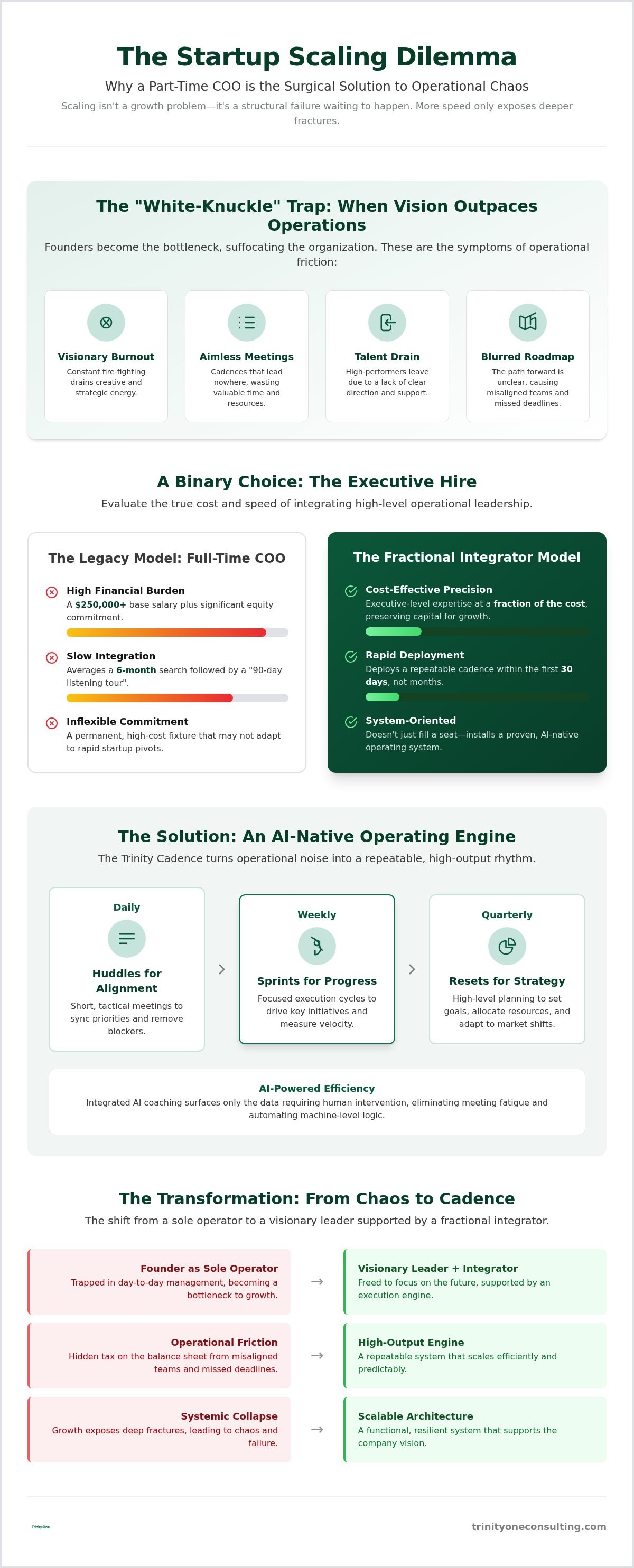
Scaling a startup is not a growth problem. It is a structural failure waiting to happen. Most founders believe that more revenue will solve the internal chaos. In reality, more speed only exposes deeper fractures. You feel the visionary burnout. You see the meeting cadences that lead nowhere. You watch high-performing talent leave because the roadmap is a blur. It is a binary choice: build a functional system that supports your vision, or let the operational friction consume your legacy.
Hiring a part time COO for startups provides the surgical solution to this systemic collapse. You don't need another consultant; you need an integrator who understands that efficiency is a mathematical proof, not a suggestion. This article demonstrates how to engineer an AI-native operating engine that balances clinical precision with the empathetic depth of human leadership. We will examine the Trinity Cadence and the exact mechanics of turning operational noise into a repeatable, high-output engine that scales without breaking.
Key Takeaways
- Escape the "White-Knuckle" trap by shifting from a sole operator to a visionary leader supported by a fractional integrator.
- Install an AI-native operating engine like Trinity Cadence to automate machine-level logic and reclaim human bandwidth.
- Discover how a part time COO for startups delivers executive-level precision at a fraction of the cost of a traditional full-time hire.
- Sync technical efficiency with human purpose using Dream Management to drive higher engagement and lower turnover.
- Execute a 30-day Launch Sprint to hardwire a repeatable cadence into your organization’s core architecture.
The Strategic Shift: Why Startups Need a Part-Time COO in 2026
The traditional executive model is breaking. In the high-velocity market of 2026, where AI startups raised $242 billion in the first quarter alone, the old ways of hiring are too slow. A Chief Operating Officer used to be a permanent, high-cost fixture. Today, a part time COO for startups is a surgical strike. This is a fractional executive who provides high-level strategy and tactical execution without the $250,000 base salary commitment. They are the architects of your internal engine.
Most founders fall into the "White-Knuckle" trap. They believe they can remain the sole operator while scaling to Series A and beyond. This is a structural error. Visionaries are designed to see the future, not to manage the friction of the present. When a founder remains the bottleneck, the organization suffocates. You don't need more ideas. You need an Integrator. This role is the mechanical bridge between your visionary concepts and a functional business engine. It is the difference between a blueprint and a finished building.
The choice is binary. You can accept the risk of a full-time hire, which often involves a six-month search and significant equity. Or, you can choose fractional speed. A fractional leader enters your ecosystem with a proprietary methodology already in hand. They don't just fill a seat. They install a system.
The Cost of Operational Friction
Operational friction is a hidden tax on your balance sheet. It manifests as misaligned teams, missed deadlines, and high employee turnover. These aren't just HR issues. They are technical failures in your operating system. A consultant offers advice and leaves a slide deck behind. A part time COO for startups delivers execution. They own the outcomes. By providing C-suite expertise on a fractional basis, they eliminate the overhead of a full-time executive while solving the root causes of chaos. They turn your "what" into the team's "how."
Scaling Without the Full-Time Commitment
Flexibility is the primary advantage for Seed and Series A startups. You need elite leadership now, not in six months. The legacy corporate world relies on the "90-day listening tour." Modern startups don't have that luxury. Fractional COOs hit the ground running, often deploying a repeatable cadence within the first 30 days. This model allows you to scale your leadership team in lockstep with your revenue. You gain the discipline of a seasoned practitioner while maintaining the lean profile required for aggressive growth. Learn more about Scaling Without a Full-Time COO to understand how this integration works in practice.
The Fractional Integrator Model: Engineering AI-Native Operations
The fractional integrator is not a temporary patch. It is a structural upgrade. As The Rise of Fractional Leadership demonstrates, startups are pivoting toward specialized expertise to navigate volatility. For an AI-native company, this means engineering a system where machine logic and human intuition work in tandem. This is the core of the Trinity Cadence. It is the software that runs your business hardware.
Traditional operations rely on retrospect. You look at last month's data to solve today's problems. That is a lagging indicator. A part time COO for startups installs real-time execution visibility. We replace monthly retrospectives with live dashboards. Machine operations automate the repetitive administrative load. This frees your team for high-value creativity. If a task is predictable, a machine should own it. If it requires nuance, a human must lead it. This is the new standard of efficiency.
Every dollar spent on technology must be a dollar invested in margin. The AI ROI Map provides this clarity. It translates software costs into operational gains. We don't implement AI for the sake of novelty. We implement it for the sake of the engine. By identifying exactly where automated agents can replace manual friction, the modern COO justifies tech spend through measurable throughput.
Establishing a Unified Operating Cadence
An operating cadence is the pulse of startup execution. Without it, the heart stops. The "Rhythm of Business" consists of daily huddles for alignment, weekly sprints for progress, and quarterly resets for strategy. Trinity Cadence integrates AI coaching into these loops. This prevents meeting fatigue by surfacing only the data that requires human intervention. Efficiency is the goal. Precision is the method. When the cadence is hardwired, the team stops guessing and starts executing.
AI Implementation and Strategy
A modern part time COO for startups is the architect of the AI stack. They don't just use tools; they design workflows. This involves integrating machine learning into your weekly leadership meeting structure. The machine handles the data aggregation. The humans handle the decision-making. This binary split ensures that your leadership team stays focused on the horizon, not the spreadsheet. If you are ready to stabilize your growth, consider exploring our Fractional COO Services. You can schedule a strategic consultation to audit your current operating engine.
Beyond Efficiency: The Human Engine and Dream Management
Operational excellence is a binary equation. One side is technical efficiency. The other is human connection. An AI-native operating system provides the structure, but the human engine provides the power. A part time COO for startups recognizes that scaling isn't just about software logic. It's about people logic. If your team feels like replaceable cogs in a machine, they'll act like it. They'll disengage. They'll leave. This is a structural failure that no amount of code can fix.
The Dream Manager concept shifts the paradigm. It links personal aspirations directly to corporate ROI. This isn't a soft HR initiative. It's a hard operational strategy. When a leader invests in an employee's personal future, that employee invests in the company's professional future. This is the physics of loyalty. We use Certified Dream Management to ensure this alignment is measurable and repeatable. It turns a standard workplace into a high-performance ecosystem where growth is mutual. This is how you build a legacy that lasts.
Ambitious entrepreneurs often Use AI to Scale Their Startups, but the most successful ones don't automate away the human element. They use AI to handle the mundane so their people can focus on the meaningful. This balance is what separates a functional business from a legendary one. Retention is not an administrative task. It is an operational metric. High turnover is a sign of a broken engine. A healthy engine retains its best parts because they are integrated into a larger purpose.
Aligning Personal and Professional Goals
Supporting personal dreams drives professional engagement. It's a simple proof. When employees see a path to their own goals through your company's success, their output changes. It moves from compliance to commitment. The business scales because the people within it are scaling. This is why our Dream Manager Program is integrated into the operational cadence. We don't just manage tasks. We manage the humans who perform them. When the personal vision aligns with the corporate mission, friction disappears.
Retention as a Growth Lever
Employee churn is a technical failure. In a startup, the cost of losing a key player is catastrophic. It's not just the recruiting fee. It's the lost momentum and the broken knowledge circuits. A part time COO for startups treats retention as a primary growth metric. By utilizing Dream Manager Coaching, you build a competitive advantage that no competitor can buy. Your human engine becomes your most resilient asset. It becomes the circuit that never shorts out. In a tight talent market, loyalty is your most valuable currency.
Evaluating Your Options: Finding the Right Part-Time COO
Selecting a part time COO for startups is more than a hiring decision. It is a technical audit of your leadership architecture. You aren't looking for a subordinate. You are looking for an Integrator. This individual must possess the technical range to manage AI workflows and the emotional depth to lead human teams. The search is a search for alignment. If the candidate lacks the courage to challenge your vision, the engine will eventually stall.
The primary friction point is the relationship between the Visionary CEO and the Integrator. A true COO translates abstract ideas into concrete execution. They build the circuits that allow your vision to flow. Watch for the "Project Manager Trap." A project manager tracks deadlines and tasks. A COO engineers the systems that make those tasks redundant or automatic. If a candidate focuses only on "getting things done" without discussing "how we build the machine," they are a manager, not an executive.
Don't rely on intuition or a 90-day probationary period. Use Launch Sprints to test operational compatibility. This is a 30-day high-intensity engagement designed to install a basic operating cadence. It provides immediate execution visibility. You will know within four weeks if their methodology integrates with your culture. It is a low-risk, high-data approach to executive placement.
10 Questions to Ask Your Potential Fractional COO
- Execution: "How do you restart a stalled operating cadence when the team loses focus?"
- Technology: "What is your specific framework for mapping AI implementation to measurable ROI?"
- Leadership: "How do you identify the difference between a process failure and a people failure?"
- Integration: "Describe a time you had to tell a Visionary CEO 'no' to protect the business engine."
Fractional vs. Full-Time vs. Consultant
The choice between these models follows a logical proof. An advisor talks about the engine but never touches the wrench. A full-time COO owns the engine but consumes massive capital that a Seed or Series A startup should preserve. The fractional model is the "Goldilocks" solution. It provides the strategic depth of a C-suite executive with the surgical execution of a practitioner.
| Feature | Advisor/Consultant | Full-Time COO | Fractional COO |
|---|---|---|---|
| Focus | Theoretical Advice | Total Management | Systemic Integration |
| Cost | Low to High | Very High ($250k+) | Mid-Range/Retainer |
| Speed | Immediate | Slow (6+ month search) | Immediate (Sprints) |
Launching Your Operational Engine with Trinity One
Scaling is not a mystery. It is a technical discipline. Trinity One provides the architecture to transform your startup from a series of reactive events into a proactive growth engine. We combine 30 years of operational experience with Trinity Cadence, our AI-native operating system designed for the modern era. Hiring a part time COO for startups through Trinity One means you aren't just adding a head to your org chart. You are installing a proprietary methodology that has been refined in the trenches of leadership. It is the end of guesswork and the beginning of precision.
Our Rapid Launch Sprints eliminate the friction of traditional executive onboarding. We don't believe in the 90-day learning tour. We believe in 30-day execution. Within the first month, we transition your team from operational chaos to a repeatable cadence. This is where we identify the circuit breaks in your communication and replace them with automated, AI-driven workflows. By day 31, your business engine is already running cooler and faster. You reclaim your time. Your team reclaims their focus.
The 90-day roadmap follows a logical progression. The first month is dedicated to stabilization. We install the Trinity Cadence and define your execution roadmap. The second month focuses on optimization. Here, we implement AI ROI mapping to justify every technical spend. The third month centers on the human engine. We align personal dreams with corporate goals to ensure long-term retention. It is a methodical, three-phase approach to total operational control. This is how you scale without breaking the culture you worked so hard to build.
The Trinity Cadence Advantage
The Trinity Cadence Advantage provides immediate execution visibility. Our unified platform surfaces the data that matters while AI coaching maintains the business rhythm. It ensures that every team member knows exactly what to do and why it matters. By integrating a Fractional Dream Manager into this system, we protect the psychological well-being of your most valuable assets. Technical efficiency and human connection become a single, unified force. The machine serves the mission, and the mission serves the people.
Next Steps for the Visionary CEO
The path forward is clear. Stop white-knuckling your operations and start leading your vision. The first step is an initial operational audit. We examine your current meeting cadences, team alignment, and AI readiness. Once the fractures are identified, we begin the engineering process. Prepare your team for an AI-native transition that prioritizes throughput and purpose. It is time to stop managing friction and start driving growth. You have built the vision; let us build the engine that carries it.
Engineer your operational engine today
Secure Your Strategic Advantage
Scaling a startup is a binary choice between structural integrity and systemic collapse. A part time COO for startups provides the integration necessary to bridge that gap. You've seen how the Trinity Cadence automates the machine while Dream Management fuels the human engine. This isn't just theory. It is a proprietary methodology built on 30+ years of operational experience. We don't just identify friction. We engineer it out of your system.
Trinity One delivers the clinical precision of AI-native systems alongside the empathetic depth of Certified Dream Management facilitators. We eliminate the noise that stalls growth. We replace visionary burnout with a repeatable, high-output cadence. Your business engine is ready for its next upgrade. It is time to align your technical efficiency with your human purpose.
Stop managing the chaos. Start leading the legacy. Your future state is one audit away. We are ready to help you build the structure your vision deserves.
Frequently Asked Questions
What exactly does a part-time COO do for a startup?
A part-time COO architects and manages your internal business engine. They don't just offer advice; they install the systems necessary to translate a founder's vision into a functional roadmap. This includes designing meeting cadences, aligning team members with organizational goals, and implementing AI-driven workflows. They serve as the mechanical bridge between high-level strategy and daily tactical execution.
How much does a fractional COO cost in 2026?
The cost of a fractional executive is structured as a monthly retainer rather than a permanent salary with equity. This model allows startups to access elite C-suite expertise at a fraction of the overhead required for a full-time hire. By utilizing a fractional model, you eliminate the high search fees and long-term capital commitments of a traditional executive while gaining immediate access to battle-tested operational leadership.
How many hours a week does a part-time COO typically work?
A part time COO for startups usually commits between 10 and 15 hours per week to your organization. This bandwidth is focused on high-leverage activities like stabilizing your operating cadence and managing leadership team alignment. The engagement is measured by throughput and systemic impact rather than total hours logged. It's about precision and efficiency, not filling a desk.
What is the difference between an Integrator and a COO?
An Integrator is a specific type of COO who functions as the mechanical counterpart to a Visionary CEO. While a general COO might focus on specific departments, an Integrator manages the entire organizational engine to ensure total alignment. They harmonize the disparate parts of the business into a unified whole. They are the circuit that ensures the CEO’s vision flows through to every team member.
When is the right time for a startup to hire a fractional executive?
The right time to hire is when operational friction begins to stall your growth. This usually occurs during the transition from Seed to Series A when the founder becomes the primary bottleneck. If you're "white-knuckling" daily operations instead of focusing on long-term strategy, your engine needs an architect. A fractional leader provides the structure you need to scale without the risk of a full-time hire.
Can a part-time COO help with AI implementation?
Yes, a modern COO acts as the architect of your AI-native operating system. They identify repetitive tasks that can be automated through agentic AI and integrate these tools into your standard workflows. This ensures your technology spend translates directly into operational margin and human bandwidth. They build the machine that allows your team to focus on high-value creativity.
How do you measure the ROI of a fractional COO?
ROI is measured through recovered founder time, increased profit margins, and improved team retention. A successful engagement results in a repeatable operating cadence and a clear execution roadmap. You see the results in higher team engagement and the elimination of operational chaos. When the engine runs smoothly, the business can scale at a lower cost per unit of growth.
Does a part-time COO manage the whole team or just the CEO?
The part time COO for startups typically manages the leadership team and the overall business rhythm. While they work in a binary partnership with the CEO to align strategy, their primary responsibility is the engine itself. They ensure every department head is operating within the established cadence and meeting their KPIs. They manage the process so the CEO can lead the mission.