
Your business loses an average of $29,000 per year for every employee stuck in unproductive huddles. A high-performance weekly leadership team meeting agenda fixes this by turning your sessions into a 90-minute engine that synchronizes human talent with AI efficiency. It’s the difference between guessing at your progress and having total visibility into your operational execution.
I know the exhaustion of "death by meeting" firsthand. You sit there watching 73% of your team multitask because the conversation feels disconnected from the actual work. It’s a massive waste of high-level talent and expensive payroll hours. Pure friction. Your company only becomes the best version of itself to the extent your people are becoming better versions of themselves, but they can't do that while drowning in administrative noise.
I’m going to show you how to engineer a repeatable cadence that delivers a real return on your leadership time. We will use the specific structure found in Trinity Cadence to align your people with your goals. You'll get a precise framework that turns your leadership team into a synchronized unit focused on results rather than just showing up. This is about execution.
Key Takeaways
- Define a precise operating cadence to stop your leadership team from drifting into high-level theory when you need tactical execution.
- Master the 90-minute weekly leadership team meeting agenda so your team doesn't drift into multitasking during huddles.
- Use Trinity Cadence to replace manual reporting with real-time visibility into your operational execution.
- Connect professional execution to personal growth using the Dream Manager methodology created by Matthew Kelly to keep your best talent.
- Use a Launch Sprint to install a functional business operating system in weeks instead of years with the help of a Fractional Integrator.
Defining the Operating Cadence: Why a Weekly Leadership Team Meeting Agenda is Your Engine’s Heartbeat
Operating cadence is the heartbeat of your business engine. It is the predictable rhythm that eliminates operational friction. When this heartbeat skips, your execution falters. I've seen companies with brilliant strategies fail because they couldn't maintain a weekly pulse. They treat meetings as interruptions rather than the engine itself. A high-performance weekly leadership team meeting agenda is the diagnostic tool you use to check the health of that engine every seven days.
The Physics of Leadership: Visionaries vs. Integrators
The Visionary lives in the future. They see the long-range goals and the big-picture possibilities. The Integrator lives in the now. They focus on the weekly scorecard and the precision required to hit those targets. These two roles often clash. The Visionary feels held back by details. The Integrator feels overwhelmed by new ideas. They need a neutral ground to synchronize.
A structured meeting keeps the Visionary grounded in execution. It forces a collision between high-level vision and tactical reality. A fractional integrator often owns this rhythm. They ensure the engine stays on track without the overhead of a full-time executive. When the cadence breaks, the costs are high. You miss targets. Your best people burn out because they don't know where the ship is heading. It's a heavy price for a lack of structure.
The ROI of a Synchronized Leadership Team
Unstructured leadership time is a silent profit killer. In 2026, unproductive meetings cost U.S. businesses an estimated $399 billion annually. For an individual employee, meeting time costs an average of $29,000 per year. If your leadership team spends 90 minutes a week in a room without a precise meeting agenda, you are burning thousands of dollars in payroll every month. You can't afford that waste.
A precise agenda reduces the slack in your business operating system. It eliminates the culture of having a meeting just to talk about another meeting. You don't need three hours to get aligned. You need 90 minutes of high-precision focus. This is the minimum effective dose for executive alignment. Any less and you're just skimming the surface of your operational problems. You're ignoring the friction until it causes a breakdown.
Operating cadence is the heartbeat of a business engine. It provides the steady pulse that keeps every department moving in the same direction. Without it, you have a collection of talented individuals working in silos. With it, you have a synchronized unit that understands the cost of every minute spent together.
The Anatomy of a High-Impact Weekly Leadership Team Meeting Agenda
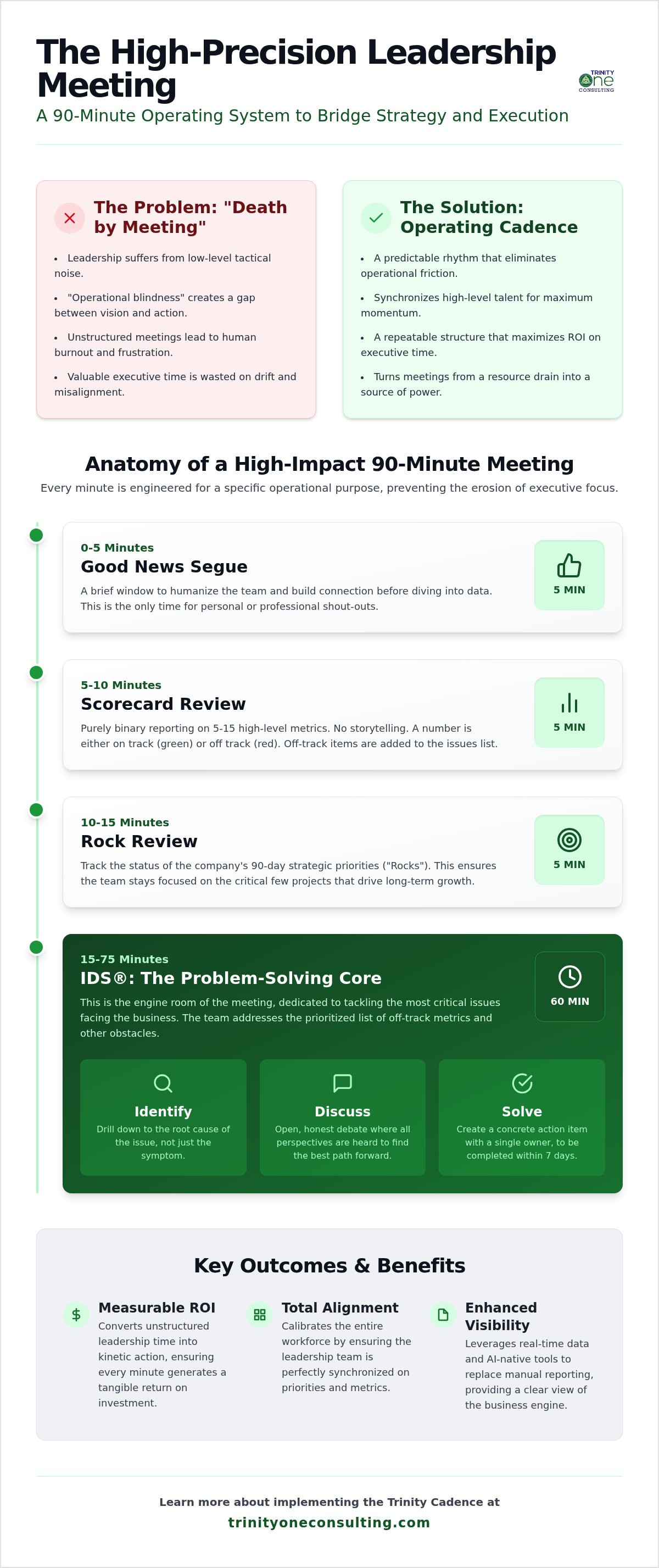
A weekly leadership team meeting agenda isn't a suggestion. It is a rigid structure designed to protect your time and your profit. I've sat in hundreds of these meetings as an Integrator, and the ones that fail always lack a clock. We use a 90-minute block because it is the minimum effective dose to solve real problems without drifting into useless chatter. If you can't run your business in 90 minutes a week, your systems are broken.
The work starts before anyone walks into the room. Every leader reviews the live dashboard in Trinity Cadence the day before, so we never spend meeting time reading numbers out loud. We open with a 15-minute exceptions pass. Each leader names only what is drifting: a metric off target, a commitment at risk, or a customer problem that is about to get expensive. No status reports and no stories. If it is on plan, we don't talk about it.
The core of the meeting is a 55-minute decision block. We pick the two or three issues costing the business the most money or friction and work each one until it has a decision, a single owner, and a date. Then we spend 10 minutes on people and capacity: who is overloaded, who is ready for more, and where someone needs support. The final 10 minutes lock in commitments and settle what the rest of the company needs to hear from this room, and who will tell them.
Root-Cause Problem Solving: Fixing Friction at the Source
The decision block is the core of your meeting engine. Most teams spend 45 minutes talking about a problem without ever finding the root cause. That is a failure of leadership. You must find the real issue first, often by asking "why" until it hurts. Only then do you weigh the options briefly and commit to a decision.
I rank issues based on their impact on the business ROI. We don't solve the easy things first. We solve the things that are costing you the most money or causing the most human friction. The Integrator’s job is to keep this session on track and stop people from repeating themselves. If your current meetings feel like a circle of frustration, you can book a discovery call to see how we install this rhythm.
Accountability and Commitments
Every decision leaves the room with one owner and one due date. If the work will take more than a couple of weeks, it is a project, and projects belong in your quarterly priorities, not in a weekly commitment. I track how often my teams deliver on the date they promised. When that rate slips, it points to a lack of discipline or a lack of clarity in the role.
We use Trinity Cadence to track these tasks in real-time during the meeting. You don't wait until the end of the week to see if someone did their job. The visibility is immediate. This creates a high-performance culture where people do what they say they will do. It eliminates the "I forgot" excuse that kills growth in smaller firms.
AI-Native Synchronisation: How Technology Optimizes Your Operating Cadence
Most leaders spend Sunday night digging through spreadsheets to prepare for Monday morning. That's a waste of executive brainpower. Your weekly leadership team meeting agenda shouldn't start with twenty minutes of "where did this number come from?" In an AI-native environment, your weekly scorecard updates itself. As of July 2026, 47% of U.S. employees report their organizations have integrated AI tools for productivity. If you're still manually typing data into a slide deck, you're running a horse and buggy in a Tesla world.
We are moving past the era of looking back at last week's failures. High-performance engines use predictive issue identification. The goal is to know a quarterly priority is falling behind three weeks before the deadline, not the day before. Trinity Cadence provides this visibility by connecting your operational data directly to your meeting rhythm. It removes the human error of "forgetting" to update a metric before the huddle starts.
Traditional Meetings vs. AI-Native Cadence
Traditional meetings rely on subjective reporting. An owner asks how sales are going, and the manager says "it feels good." Feelings don't pay the bills. Manual data entry is slow and prone to bias. It's a reactive way to run a company that leads to missed targets and confusion. You can't scale a business on "gut feelings" alone.
Trinity Cadence acts as the mechanical part of your business engine. It provides automated visibility into machine operations. You move from subjective opinions to data-driven truth in real time. The shift allows the team to spend ninety minutes solving problems instead of debating whether a number is accurate. This is how you reduce the slack in your operating system.
AI ROI: Measuring the Impact of Your Meetings
We use AI to track the correlation between meeting health and revenue growth. It's not just about finishing the agenda on time. Modern AI coaching tools identify meeting patterns and efficiency gaps that the human eye misses. If your sessions consistently run over or lack clear decisions, the system flags it. This creates a feedback loop for the Integrator to tighten the screws on the process.
- Sentiment Analysis: AI identifies hidden friction in leadership communication.
- Pattern Recognition: Spotting which departments consistently miss their scorecard targets.
- Automated Recaps: Eliminating the need for a manual note-taker.
AI implementation reduces meeting fatigue by eliminating the redundant data-sharing that makes people tune out. When the data is already visible, the conversation stays focused on high-level execution. You stop treating the meeting as a reporting session and start treating it as a performance huddle. This is the only way to maintain a competitive edge in 2026.
The Human Component: Aligning Professional Execution with Personal Dreams
A business engine built on clinical metrics alone will eventually seize up. You can't treat high-level talent like replaceable cogs and expect them to stay. If your weekly leadership team meeting agenda ignores the humans in the room, you are inviting turnover. I've seen teams hit every scorecard target for six months only to have the VP of Sales quit because they felt like a line item on a spreadsheet. That is an expensive failure of leadership.
We use the people and capacity check to track more than just morale. It is a diagnostic for engagement. If a leader has no personal wins to share for three consecutive weeks, they are redlining. They are likely experiencing the meeting fatigue that costs companies $29,000 per employee annually. The Integrator must spot these patterns early. You have to balance the cold efficiency of the scorecard with the empathetic depth of human development.
The Dream Manager concept, created by Matthew Kelly, is the foundation of this approach. It links individual aspirations to the company vision. I believe a company only becomes the best version of itself to the extent its people are becoming better versions of themselves. This isn't soft talk. It's operational reality. When your people see the company as a vehicle for their own dreams, they work with a level of precision that no AI tool can replicate.
Retention through Personal Growth
The 2026 talent landscape is brutal. Professionals are tired of "death by meeting" and disconnected tactics. Dream Management gives you a competitive advantage that a higher salary can't match. Helping an employee achieve one of the twelve dream categories defined by Matthew Kelly drives a higher ROI on human performance than any traditional bonus structure. You are investing in the person, not just the position.
We integrate DreamCompass software into the weekly leadership rhythm. This app, available by invitation, allows us to track progress on personal goals alongside professional quarterly priorities. It ensures that personal growth stays on the agenda. You aren't just building a company. You are building the people who build the company.
Coaching vs. Directing
Managing tasks is for managers. Coaching people is for leaders. You must move from directing every move to coaching for performance. I use 1-on-1 coaching as a critical supplement to the weekly leadership team meeting agenda. This is where we handle the nuanced issues that don't belong in the full group huddle. It's about alignment at the individual level.
You create a culture of loyalty through shared success. When the company wins, the individual must win too. This requires a shift from being a "boss" to being a "coach." It's a strategic choice. If your leadership team feels disconnected from their own growth, your business engine will never reach its full potential.
Establishing Your Precise Rhythm: Implementing Trinity Cadence for Operational Scale
Implementing a business operating system shouldn't take years of expensive discovery sessions. Traditional firms want to bill you for months of talk before you see a single result. We use a Launch Sprint to install your operating cadence in weeks. A Fractional Integrator takes ownership of the process and ensures the weekly leadership team meeting agenda is followed with absolute precision. This is how you move from operational chaos to a synchronized system that actually scales.
You cannot manage what you cannot see. We set up Trinity Cadence to provide real-time visibility into your machine operations. The AI coaching tools within the platform identify efficiency gaps before they become expensive failures in your execution. It removes the need for manual reporting and lets your team focus on solving problems rather than building slide decks. You stop guessing and start leading with data-driven truth.
The 90-Day Onboarding: Installing the Engine
Phase one focuses on defining your weekly scorecard and your quarterly priorities. We identify the handful of metrics that actually move the needle for your revenue. I've seen teams tracking 50 numbers that don't matter while they ignore the three that do. We cut the noise and focus on the signals that indicate the true health of your engine.
Phase two involves training the leadership team to solve problems at the root cause and drive every issue to a decision. It is often the most painful part of the process. It requires blunt honesty and a willingness to name the friction points that people usually ignore. If your team can't be honest about why a target was missed, the engine will never run at full capacity.
Phase three is about hard-wiring the weekly leadership team meeting agenda into your company DNA. It becomes a non-negotiable 90-minute block that happens at the same time every week. We don't move it for "emergencies." The meeting is the tool we use to prevent emergencies from happening in the first place. Consistency is the only way to build a high-performance culture.
Next Steps for the Visionary Leader
As a Visionary, you must focus on the "where" and let the Integrator handle the "how." That split defines the physics of a scaling company. If you are still meddling in the weekly tactics of a 30-person team, you are the bottleneck. You have to trust the system to surface the issues that require your specific genius. It is a difficult transition for most founders, but it's the only way to avoid burnout.
The system is bad at hiding underperformance. Once the scorecard is live, there is nowhere for a low-achiever to hide. You'll have to make hard choices about your people, but you'll also see your best talent thrive with the new clarity. Your company only becomes the best version of itself to the extent its people are becoming better versions of themselves, which is the core of Matthew Kelly’s Dream Manager methodology.
Audit your current meeting cadence with Trinity One
Synchronizing Your Business for High-Precision Execution
Execution is a choice. You can continue burning thousands of dollars in payroll on unstructured huddles, or you can commit to a precise operating cadence. A functional weekly leadership team meeting agenda provides the steady pulse your company needs to scale without breaking. It aligns your technical systems with your human talent to eliminate operational friction.
I've spent 30 years in the trenches as an Integrator and a coach. I know that visibility and loyalty are the two pillars of a high-performance engine. Trinity Cadence gives you the real-time data you need to stop guessing. Certified Dream Management facilitation, using the methodology created by Matthew Kelly, ensures your best people stay for the long haul. When these two forces work in harmony, your business becomes the best version of itself.
You have the vision for where the company needs to go. Now you have the framework to get there. We can install this system in weeks through a Launch Sprint led by a Fractional Integrator. It's time to stop talking about execution and start doing it. You've got this.
Frequently Asked Questions
What is the ideal length for a weekly leadership team meeting?
Ninety minutes is the standard for an effective session. It is the minimum effective dose required to clear your exceptions and spend most of an hour working your highest-cost issues to a decision. If you go longer, your team loses focus and costs you more in expensive payroll hours. If you go shorter, you are likely skipping the root cause of your operational problems.
How does a weekly leadership meeting agenda differ from a daily huddle?
A weekly leadership team meeting agenda focuses on tactical execution and solving issues that block your 90-day quarterly priorities. A daily huddle is a 15-minute stand-up designed for immediate synchronization and identifying daily roadblocks. One is for solving the engine's friction. The other is for making sure the gears are turning today.
Who should facilitate the weekly leadership team meeting?
The Integrator should always facilitate the meeting. This role is responsible for the operational cadence and keeping the team on schedule. The Visionary should participate but should not run the clock. Having a Fractional Integrator lead the session keeps egos out of the room and ensures the process is followed with clinical precision.
How do you solve problems at the root cause in a leadership meeting?
Pick the few issues costing you the most and work each one until you find the real cause, not the symptom. You spend the majority of your time identifying the real problem before you start talking about solutions. Most teams fail because they spend an hour discussing symptoms and never actually solve anything.
How do you prevent meeting fatigue in a high-growth company?
You prevent fatigue by making the meeting productive. People don't hate meetings. They hate meetings that don't result in clear decisions or action items. Stick to a rigid 90-minute block and use Trinity Cadence to handle the data reporting automatically. When the session is about solving friction instead of just reporting numbers, the exhaustion disappears.
Can a fractional COO help establish a weekly meeting rhythm?
A fractional COO acts as the architect of your operating cadence. I frequently step in as a Fractional Integrator to install the weekly leadership team meeting agenda and train the team on root-cause problem solving. It is a faster way to get a functional business operating system without the cost of a full-time executive salary.
How do you handle a leadership team member who consistently misses commitments?
Use the accountability structure. If a leader repeatedly misses the dates they committed to, it is a performance issue that requires a 1-on-1 coaching session. You have to be blunt about the cost of their delays. If they cannot maintain the pace, they likely don't fit the seat or the culture of your company.
What metrics should be on a leadership team scorecard in 2026?
Your scorecard should be a short list of high-level numbers that provide a pulse on the business. Include cash on hand, sales pipeline value, and employee engagement scores. In 2026, you should also track predictive AI metrics like real-time customer sentiment. Every number needs a clear target and a single owner so you know instantly where you stand.