
Global employee engagement hit a stagnant 20% in 2025, resulting in a $10 trillion drain on the world economy. Most organizations treat this as a vague HR problem. It is actually a mechanical failure. To fix it, you need a high-performance action plan for employee engagement that functions like a synchronized operating system. You don't need more "check-the-box" surveys. You need a structured blueprint that treats human motivation with the same technical precision as an integrated circuit.
You likely feel the friction of disconnected remote teams and the heavy cost of turnover in your key roles. We agree that engagement initiatives often feel hollow because they lack operational weight. This article promises to move you beyond theory. We will provide an AI-native operational blueprint designed for 2026. You'll learn how to implement the Trinity Cadence to achieve real-time visibility into team morale and turn your workforce into a synchronized engine of execution.
In This Article:
- Stop treating engagement as a reactive HR exercise. View it as the byproduct of a high-performance operating cadence.
- Deploy a structured action plan for employee engagement that synchronizes individual "Dreams" with operational execution.
- Shift focus from lagging turnover costs to real-time leading indicators like huddle participation and cadence health.
- Discover how Dream Management serves as the ultimate retention strategy by fueling the human engine with personal purpose.
- Implement an AI-native framework to gain instant visibility into team morale and eliminate the friction of disconnected remote environments.
Beyond the Survey: Why Your Current Engagement Plan is Stalling
Traditional engagement is a ghost in the machine. Most leaders see a drop in productivity and react with a survey. This is a post-mortem, not a strategy. An effective employee engagement strategy isn't a standalone HR program. It is an integrated circuit that connects corporate strategy to individual execution. When this circuit breaks, you face the "Engagement Gap." This is the distance between what leadership expects and what the workforce actually delivers. Closing this gap requires more than a pizza party or a digital badge. It requires a structural overhaul.
The Engagement Gap manifests in three primary ways:
- Execution Lag: Strategy takes months to reach the front lines.
- Talent Leakage: High performers leave for organizations with clearer purpose.
- Communication Noise: Misalignment creates endless meetings with zero output.
The Failure of Annual Pulse Checks
In a 2026 business environment, data from six months ago is an artifact. It doesn't help you lead. Most companies fall into the "Survey Fatigue" cycle. They ask for feedback, fail to act with precision, and repeat. This erodes trust faster than no survey at all. You can't "check the box" on culture. Your action plan for employee engagement must move from reactive post-mortems to proactive operational rhythms. Real-time visibility is the only way to prevent burnout in a high-speed market. If you're waiting for an annual report to find out your team is unhappy, you've already lost them.
Operational Drag vs. People Performance
Disengaged employees act as sand in your business engine. They don't just work slower; they create operational drag that slows everyone else down. The clinical precision of your technology requires the empathetic depth of your people. If you optimize the machine but ignore the operator, the system fails. We see this in the hidden costs of "quiet quitting" and the 16% of the global workforce that was actively disengaged as of 2025. This isn't just an HR metric. It's a technical failure of your operating system.
To fix this, you need a Fractional Integrator to architect a system where human purpose fuels mechanical efficiency. This is where your action plan for employee engagement becomes a competitive advantage. You aren't just making people feel better. You're removing friction from your execution engine. A synchronized workforce is a high-performance workforce. When your people are aligned, the engine runs at peak capacity without overheating.
The Physics of Engagement: Integrating People into Your Operating Cadence
Engagement is not an emotion. It is the kinetic energy produced by a well-timed operating system. Most leaders try to "fix" engagement with psychology. They should start with physics. A business engine requires a precise rhythm to prevent fatigue and friction. Without a steady beat, your team enters a state of operational chaos. This is where a Fractional Integrator steps in. They don't just manage people; they architect the rhythm that makes performance possible. They build the tracks so the train can actually run.
Your action plan for employee engagement must be built into the work itself. It cannot be an "extra" task on a Friday afternoon. When people understand exactly how they contribute to the machine, anxiety drops. Purpose rises. This alignment is one of the key drivers of employee engagement that transforms vague goals into concrete execution. A synchronized workforce is the natural result of a unified operating cadence.
Establishing a Unified Cadence
Execution visibility drives ownership. Uncertainty is the primary cause of workplace stress. A hierarchical rhythm of daily, weekly, and monthly huddles eliminates this noise. Daily huddles align tactical movement. Weekly meetings calibrate strategic progress. Monthly reviews reset the vision. This structured cadence provides the safety people need to innovate. It creates a "rhythm of business" that replaces frantic reactions with steady movement. Clear visibility ensures that no one is left guessing about their performance or their value.
AI-Native Operating Systems as Engagement Hubs
In 2026, the Trinity Cadence functions as an AI-native hub for human performance. It isn't just about tracking tasks. It's about providing real-time feedback through integrated AI coaching. Machine intelligence handles the "busy work" of data entry and status updates. This frees your people for higher-level human development and creative problem solving. The technology works for the person, not the other way around. This machine-human interface ensures that every team member feels supported by the system rather than restricted by it. If your current rhythm feels like noise rather than music, you can schedule a consultation to see how a unified cadence can stabilize your team.
Measuring What Matters: Real-Time Visibility and Leading Indicators
Measuring engagement after an employee resigns is a post-mortem. It tells you what went wrong, but it's too late to fix the engine. Most organizations rely on lagging indicators like turnover rates or annual exit interviews. This is a technical failure. To maintain a high-performance workforce in 2026, you must shift to leading indicators. You need to see the friction before it causes a breakdown. Your action plan for employee engagement must prioritize real-time visibility over historical data.
Leading indicators function like fuel flow sensors in a jet engine. They provide immediate feedback on the health of the system. We track metrics that actually predict performance:
- Huddle Participation: Are team members contributing or just observing?
- Cadence Health: Is the team meeting its rhythm, or are meetings being skipped?
- Execution Velocity: Is the speed of task completion increasing or stalling?
The "Visibility Matrix" allows you to track execution and engagement simultaneously. It maps technical output against human morale. When these two lines diverge, you have an operational crisis. The Trinity Cadence provides this dashboard. It acts as the central nervous system of your business, providing a clear view of the human element alongside machine operations.
Surveying vs. Sensing
There is a fundamental difference between asking how someone feels and seeing how they work. Traditional surveys are prone to bias and timing issues. Sensing is different. By using AI to analyze sentiment and engagement trends within your daily communication channels, you gain an objective view of team health. This isn't about surveillance; it's about support. Real-time Engagement Visibility is the live measurement of team alignment and psychological safety within the daily operating rhythm. This metric allows you to identify burnout weeks before it leads to a resignation letter.
The ROI of Engagement Visibility
Engagement isn't a "soft" metric. It has a direct impact on project completion rates. High engagement leads to high velocity. When employees feel disconnected, execution slows down. This creates a ripple effect that impacts your bottom line. In a fractional executive model, retention is the ultimate cost-saver. Every time a key player leaves, you lose institutional knowledge and momentum. This justifies the investment in Dream Management coaching. By aligning personal aspirations with corporate goals, you secure the loyalty of your top talent. Your action plan for employee engagement becomes the foundation of your financial stability. You aren't just managing people; you're protecting your most valuable operational assets.
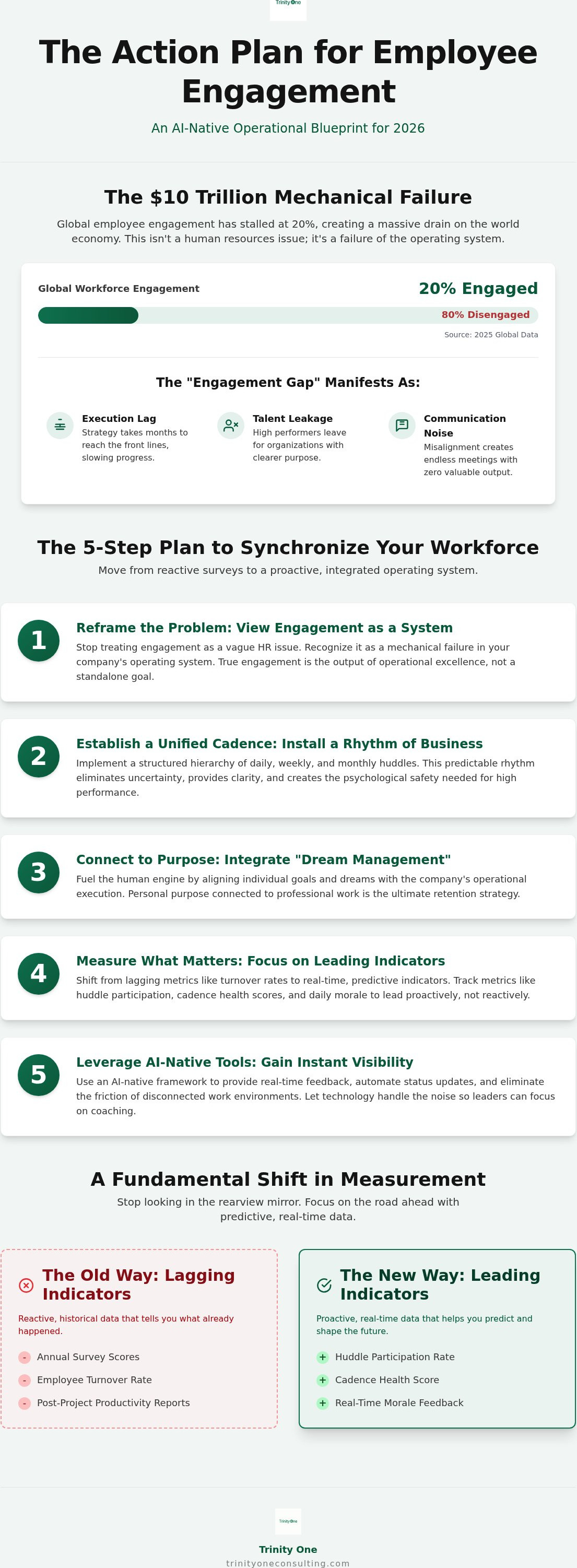
The 5-Step Action Plan for Employee Engagement in 2026
Execution is the only metric that matters. A strategy without a sequence is just a wish. This 5-step action plan for employee engagement is your operational map for 2026. It moves engagement from a vague HR concept into a high-performance engine. You aren't just managing people; you're architecting a system of mutual success. This blueprint ensures that every gear in your organization turns in unison.
- Step 1: Audit your current operating cadence for friction points.
- Step 2: Align individual "Dreams" with company objectives.
- Step 3: Deploy an AI-native OS for real-time tracking.
- Step 4: Implement the "Dream Manager" program for personal growth.
- Step 5: Review and recalibrate the cadence quarterly.
Step 1 & 2: Auditing and Alignment
Friction is the enemy of engagement. You must identify where your team is losing steam. Is it the daily huddle? Is it the weekly reporting? Conduct "Dream Discovery" sessions to find out what truly motivates your people. This is the empathetic depth of modern leadership. You must link the Visionary’s long-term goals to the Integrator’s execution plan. This alignment ensures that every team member sees their personal future within the company's success. When an employee's personal growth is tied to company performance, disengagement becomes impossible.
Step 3 & 4: Deployment and Facilitation
The machine needs a framework. Setting up the Trinity Cadence allows you to automate workflows and provide real-time feedback loops. This is the technical efficiency your business requires to scale. However, the machine needs fuel. The impact of Dream Management facilitation on long-term loyalty is undeniable. It transforms the workplace from a transaction into a partnership. Leadership must move from being a "boss" to being a "coach." This shift empowers individuals to take ownership of their roles and their results. Your action plan for employee engagement is only as strong as the people facilitating it.
A blueprint is not static. You must review and recalibrate your cadence quarterly. The market shifts. Your people grow. Your system must adapt to maintain peak performance. This quarterly reset prevents the "check-the-box" mentality that kills most initiatives. It keeps the engine clean and the workforce synchronized. By following this structured path, you turn a vague concept into a clinical reality of high performance.
The Human Engine: Fueling Performance through Dream Management
The machine runs on more than code. It runs on human purpose. Personal growth is the ultimate retention strategy. If you ignore the individual's future, they will eventually ignore yours. Dream Management is the process of linking personal aspirations to organizational objectives. It transforms a job into a vehicle for life achievement. This is the final, most critical component of your action plan for employee engagement. You aren't just hiring a worker. You are investing in a human engine.
Expert facilitation is often the missing link in modern leadership. A Fractional Dream Manager provides this expertise without the overhead of a full-time executive. They act as the strategic architect of human potential. We see the ROI in real-time. When employees achieve personal milestones, their operational output increases. Loyalty is the byproduct of being seen and supported. It is a logical proof: satisfied people produce superior results. They don't just stay; they execute.
The Psychology of the Dream Manager
Shift the focus from job satisfaction to life satisfaction. This creates the "Loyalty Loop." When you help an employee buy their first home or master a new skill, their commitment to the company hardens. They no longer work just for a paycheck. They work for their own future. The DreamCompass software tracks these personal milestones alongside technical KPIs to ensure holistic performance visibility. This integration eliminates the friction between work and life. It creates a unified path forward for the person and the business.
Scaling Culture with Intent
Scaling requires intensity. During rapid launch sprints, culture often breaks under the pressure of technical efficiency. You must build a culture of execution that people actually want to join. This isn't about perks. It is about alignment. A synchronized workforce remains stable even under high pressure. Your action plan for employee engagement must be resilient enough to handle rapid growth. It should be the foundation of your scaling strategy, not an afterthought. When the human engine is fueled by dreams, the business engine becomes unstoppable.
Engineering your business engine for 2026
Architecting Your Execution Engine for 2026
Engagement isn't a feeling. It's the byproduct of a synchronized system. We've moved beyond the era of annual surveys and reactive HR. Performance now requires a clinical approach to human motivation. You've seen how a unified operating cadence eliminates friction and how real-time visibility turns lagging indicators into leading ones. This is the difference between guessing and knowing.
Deploying a structured action plan for employee engagement is no longer optional. It's the only way to protect your business from the global drain of disengagement. Our battle-tested operational practitioners use the Trinity Cadence AI-native operating system to stabilize your workforce. We combine this technical precision with certified Dream Management to ensure your people thrive while they execute. You aren't just managing a team; you're architecting a high-performance engine.
The distance between your strategy and your execution is closing. You have the blueprint. Now, you just need to start the engine. Your team is ready to be more than just a workforce. They're ready to be a synchronized engine of growth.
Frequently Asked Questions
What is an employee engagement action plan?
An employee engagement action plan is a structured operational blueprint designed to align individual motivation with organizational execution. It moves beyond generic surveys to establish a repeatable rhythm of business. This action plan for employee engagement identifies specific friction points in your current cadence and implements technical solutions to remove them. It functions as the central nervous system for your workforce's productivity and execution velocity.
How often should we update our engagement action plan?
You should recalibrate your action plan for employee engagement every quarter. Business environments in 2026 shift too rapidly for annual reviews to remain relevant. A quarterly cadence allows you to adjust for market changes and team growth. It ensures your operational engine stays clean and efficient. Regular maintenance prevents the "check-the-box" fatigue that kills long-term initiatives and erodes trust across the organization.
Can AI really help with employee engagement?
Yes, AI serves as the technical interface that enables real-time visibility into team morale. It automates the "busy work" of tracking status updates; this allows leaders to focus on human development. AI-native systems like Trinity Cadence analyze sentiment trends across communication channels. This provides objective data to identify burnout before it leads to turnover. Technology supports the person. It does not replace them.
What is the role of an Integrator in employee engagement?
The Integrator acts as the strategic architect who builds the rhythm that makes performance possible. While the Visionary sets the goal, the Integrator designs the operating cadence to reach it. They ensure that engagement isn't a standalone HR program but an integrated part of the daily workflow. They remove the operational drag that causes employee frustration. They turn chaos into a synchronized engine of execution.
How do we measure the ROI of engagement initiatives?
ROI is measured through execution velocity and retention costs. High engagement directly correlates with faster project completion rates and lower turnover expenses. You track leading indicators like huddle participation and cadence health to predict financial outcomes. In a fractional executive model, maintaining institutional knowledge through high engagement is the ultimate cost-saving measure. Efficiency is the financial proof of a healthy and aligned company culture.
What is the "Dream Manager" concept in business?
The Dream Manager concept is a proprietary methodology that links an employee's personal aspirations to the company's success. It moves the conversation from job satisfaction to life satisfaction. By facilitating personal goal achievement, the organization earns deep loyalty. This isn't a "perk"; it's a strategic alignment of human purpose and corporate performance. It turns the workplace into a vehicle for individual growth and psychological well-being.
How do we handle disengaged employees during a turnaround?
Turnarounds require clinical precision. You must first identify if the disengagement is a result of a broken system or a lack of individual alignment. Implementing a clear blueprint provides the structure needed to stabilize the team. If the system is fixed and the friction remains, the individual may no longer fit the machine. Clarity in expectations is the kindest form of leadership during a crisis.
Is a fractional executive better for engagement than a full-time HR manager?
A fractional executive often provides higher operational authority than a traditional HR manager. They focus on the Integrator role, building the systems that drive performance. While HR handles compliance, a fractional COO architects the actual operating cadence. This provides a battle-tested perspective that aligns machine operations with human motivation. It offers expert facilitation without the full-time overhead costs typically associated with high-level leadership.
Turn insight into execution
Bring your real operating bottleneck to one practical conversation.
Book a discovery call →