
What is a rapid launch sprint? It’s a focused, project-based engagement that helps a team move a specific launch forward. The work might include clarifying who owns a customer handoff or deciding what message customers should hear.
I’ve seen unresolved assumptions turn into wasted effort. A clear project boundary helps you decide what needs attention now and what can wait.
Focused work has a cost. Leaders need to set aside time, and other priorities may move more slowly while they do.
A sprint can bring decisions into view. It can’t guarantee customer demand or commercial success. Its value is helping your team see the next move more clearly.
Key Takeaways
- Understand what a rapid launch sprint covers, and separate focused launch work from promises of market success.
- Use workflow setup to clarify who owns each launch task and how work passes between people.
- Compare a focused sprint, internal self-management, and fractional COO support by scope, ownership, continuity, and tradeoffs.
- Before committing, name the launch decision to resolve, who can make it, what evidence you have, and how much team capacity is available.
- Trinity One’s fixed-fee sprint covers initial workflow setup, brand systems, and custom AI ROI mapping.
What is a rapid launch sprint in a business context?
For a leader asking what is a rapid launch sprint, the answer is a focused, project-based engagement to move a specific business launch forward. It gives the team a defined piece of work to address, such as deciding who owns the handoff from sales to service or clarifying the message customers will hear.
The phrase doesn’t have one universal meaning. In industrial products, “Rapid Launch” can refer to systems for managing manufacturing changeovers or recipes. In software, a sprint is a short, focused work period within an iterative framework such as Scrum (software development). In business consulting, a launch sprint applies focused project work to launch decisions and operating needs.
At Trinity One, a rapid launch sprint is a project-based, fixed-fee engagement. A defined project has a specific focus and endpoint. A fractional COO or Integrator role, by contrast, provides ongoing operational ownership as work continues.
What problem is a launch sprint meant to address?
A sprint may fit when launch work has stalled because decisions sit with different people, documents don’t agree, or nobody owns a key step. For example, marketing may have drafted a launch message while operations still hasn’t decided who answers customer questions after purchase. Work is happening, but the handoff is unresolved.
The sprint creates a bounded project around a defined launch problem. The tradeoff is that work outside the agreed scope may remain untouched. A sprint also doesn’t replace ongoing leadership when the launch needs continued operational ownership. If the core issue is persistent coordination across the business, a project alone may not be enough.
What does the word sprint mean here?
Here, “sprint” signals concentrated project work. It doesn’t establish a standard calendar, number of meetings, or fixed sequence of stages. The work and its boundaries depend on the launch problem. Trinity One’s stated engagement areas include initial workflow setup, brand systems, and custom AI ROI mapping. Those areas describe the work, not guaranteed commercial results.
A sprint can help a team make decisions and prepare operating work with a clear project focus. It can’t establish that customers will want the offer, adopt it, or make it commercially successful. Those outcomes depend on the market and what happens after launch, not the name of the engagement.
A launch sprint can focus the work, but it can’t promise the market’s response.
What work can a rapid launch sprint include?
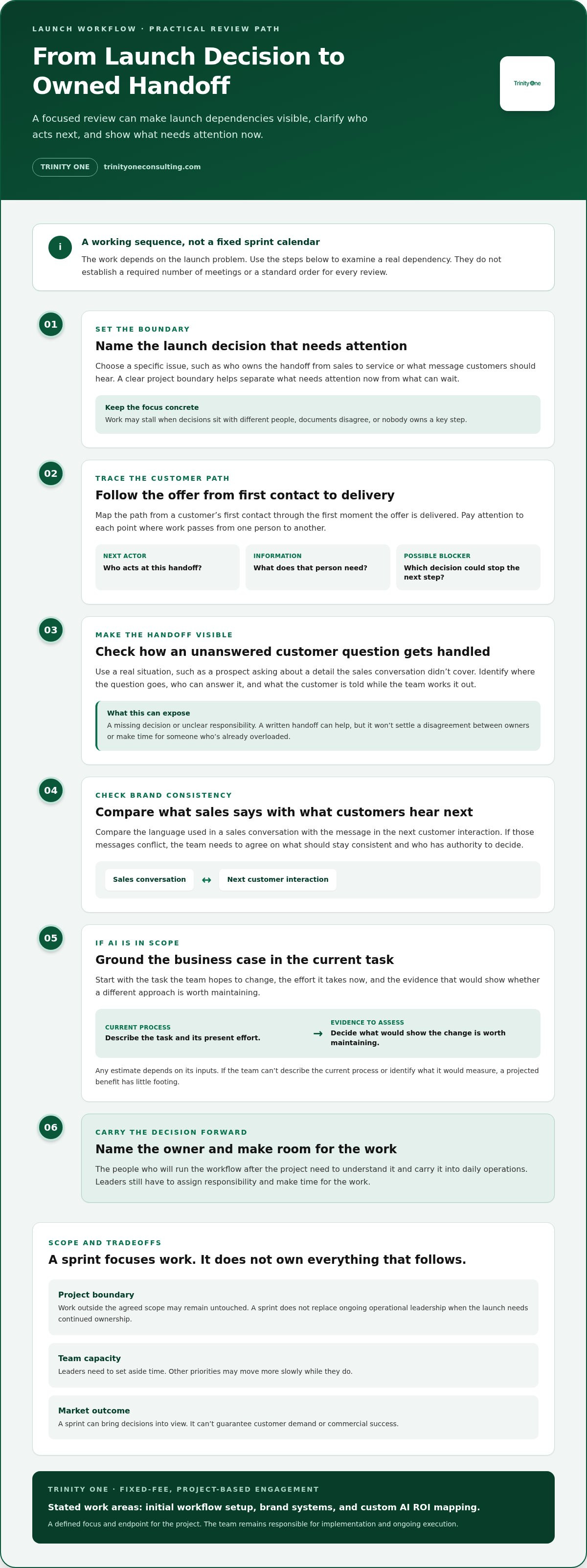
Start by asking how a launch decision affects the next person who has to act on it. A team can agree on an offer, then discover that sales describes it one way while the person responsible for delivery understands it another way. That gap sits in the handoff. Focused project work can make it visible before it becomes a customer-facing problem.
Trace one customer path from first contact through the first moment the offer is delivered. At each handoff, identify who acts, what information they need, and what decision could stop the next step. The aim is a usable picture of dependencies, not a pile of process documents.
How can workflow setup support a launch?
Start with a real operating situation, such as a prospect asking about a detail the sales conversation didn’t cover. Identify where that question goes, who can answer it, and what the customer is told while the team works it out. This can expose a missing decision or unclear responsibility without confusing launch coordination with customer research or product development.
A launch decision only becomes actionable when the next owner knows what to do with it. A written handoff can help, but it won’t resolve a disagreement between owners or make time for someone who’s already overloaded. Leaders still have to assign responsibility and make room for the work.
How do brand systems support launch work?
Brand decisions matter when people explain the offer and set expectations. Compare the language used in a sales conversation with what a customer sees in the next interaction. If those messages conflict, the team needs to agree on what should stay consistent and who has authority to decide.
This review concerns how the business manages its brand choices. The practical test is whether the people speaking for the business can explain the offer in a way that reflects the same decision.
What does custom AI ROI mapping contribute?
When AI is under consideration, leaders need to distinguish a useful business case from enthusiasm for a tool. Start with the task the team hopes to change, the effort it takes now, and the evidence that would show whether a different approach is worth maintaining. Those questions make assumptions discussable without pretending the answer is already known.
Any estimate depends on its inputs. If the team can’t describe the current process or identify what it would measure, a projected benefit has little footing. For more on evaluating value after implementation, see measuring AI implementation ROI.
These reviews don’t need to follow one fixed order. Atlassian’s explanation of Agile sprints describes focused work within a framework. For a business launch, choose the work that resolves a real dependency, then make sure the people responsible can carry the decision into daily operations.
How does a rapid launch sprint compare with other ways to launch?
The choice comes down to the ownership your launch needs. A focused sprint concentrates work on a defined project. Internal self-management keeps control with your team. Ongoing fractional COO support adds continuing operational leadership. Each approach takes time from your people, so weigh the work against what will have to wait.
A sprint can clarify and organize launch work, but your team still owns implementation. The people who will run the workflow after the project need to understand it and carry it forward. Outside project support doesn’t take responsibility for day-to-day execution.
| Approach | Scope | Ownership | Continuity | Main tradeoff |
|---|---|---|---|---|
| Focused sprint | A defined launch problem and related project work | Project work is concentrated, while your team retains implementation responsibility | Bounded to the engagement | Requires concentrated leadership time and attention away from other priorities |
| Internal self-management | Launch tasks handled within existing roles and routines | Your team sets direction and executes the work | Continues through internal ownership | Preserves company context, but launch work competes with daily operations |
| Fractional COO support | Ongoing operational leadership across continuing needs | A fractional leader supports execution ownership with your team | Continues beyond a single project | Calls for an ongoing commitment of time and budget, rather than a bounded project |
When is a focused sprint a better fit than doing it internally?
A sprint may fit when you can name the launch problem but the work keeps losing ground to daily demands. For example, leaders may need focused time to decide who owns a customer handoff before the team can build that step into its regular process. Internal work preserves useful context, but if the same people are already carrying full operating responsibilities, the launch may keep slipping behind them.
Outside support isn’t necessary for every company. If your team has a clear decision owner, enough capacity, and the experience to resolve the issue, managing it internally may be the sensible choice. A sprint makes more sense when concentrated project attention is worth the disruption it creates elsewhere.
When does ongoing operating support make more sense?
One defined project may not address repeated execution problems. If launch work needs ongoing coordination after the project ends, or ownership must continue across multiple operating priorities, consider fractional COO and Integrator support. The tradeoff is a continuing commitment, but it may suit work that needs a consistent operating owner rather than a one-time focus.
Keep market testing distinct from operational support. The Lean Startup Methodology emphasizes learning from market feedback. A sprint can organize launch work around a test, but it doesn’t replace the test or decide what customers’ responses mean.
How can you tell if your business is ready for a rapid launch sprint?
Readiness starts with a launch question your team can answer through a decision or a test. “We need to make the launch work” is too broad to guide focused effort. “We need to decide which customer group to approach first” gives the team something concrete to examine.
Use this sequence to check whether the work has a workable starting point:
- Name the offer and audience. State what you plan to bring to market and who it’s for. If the offer is still changing, identify what needs to be settled before launch work can proceed.
- Describe the blockage. Point to the specific decision or task holding progress back. A clear issue gives the team a boundary for the work.
- Sort evidence from assumptions. Write down what you’ve learned from prospective customers, then mark what the team is still guessing. Missing evidence may mean the next task is learning from customers, not assuming a sprint will provide those answers.
- Name the decision owner and available time. Identify who can make the call and who needs to act on it. Leaders must set aside attention for the work, even if that means moving another priority back.
What should you clarify before work begins?
Make sure the offer, intended audience, current obstacle, and decision owner can each be described plainly. Then check whether the people involved can give the work the attention it needs. If they can participate only between competing responsibilities, the project may produce decisions without enough follow-through.
“Ready” doesn’t mean every detail is settled. It means your team can distinguish what it knows from what it needs to learn, and has someone accountable for acting on the answer.
What are signs that a sprint may be premature?
An offer that keeps changing, a decision with no clear owner, or no room to act on findings can make focused work premature. These conditions don’t automatically rule out a sprint. They show where leaders may need to make a choice or free up attention first.
A sprint can’t create customer evidence your business hasn’t gathered, or make an executive decision for you. Before concentrating launch work, name the person who can turn a finding into a decision.
What does a rapid launch sprint with Trinity One look like?
If you’re deciding what is a rapid launch sprint for your business, start with the scope. Trinity One’s sprint is a project-based, fixed-fee engagement focused on launch work your team can define and act on. The fee structure sets the project basis. It doesn’t guarantee customer demand, adoption, or a particular commercial result.
The stated work areas are initial workflow setup, brand systems, and custom AI ROI mapping. They’re areas the engagement can address, not a prescribed sequence every business must follow. The right emphasis depends on what’s holding your launch back and what decisions your team needs to make.
How does the sprint connect people, decisions, and operating work?
A launch decision has to reach the people responsible for carrying it out. If leaders agree on a customer handoff but no one knows who owns the next operating step, the decision may stay in a meeting note instead of becoming part of daily work. Workflow setup can make ownership and movement between steps clearer.
I look at the human side of execution as well as the process. A workable system depends on people knowing what they own, where to raise a blocker, and how their work connects to the launch. The process should help the team act on decisions, not bury them under more documentation.
That connection matters after a project ends. Launch tasks may become part of regular operations, so leaders need to know who will keep each responsibility moving. Your fractional COO or Integrator can provide ongoing operating leadership when execution needs an owner beyond the project engagement.
What do the stated work areas mean for your launch?
Initial workflow setup focuses on how launch tasks pass between owners and operating steps. For example, your team may need to clarify who handles a customer inquiry after it arrives and what happens next. The goal is to make the work and ownership visible, not to assume that a process document alone changes behavior.
Brand systems organize the brand-related work involved in the launch. They can help your team bring brand decisions into the way launch work is managed.
Custom AI ROI mapping considers potential AI use against the business value and effort involved. It gives leaders a way to examine assumptions before committing resources. Mapping potential value doesn’t guarantee a return, and it doesn’t remove the need for people to judge the evidence and own the decision.
What is the next step if the scope fits?
Bring the launch problem you want to address, the decision that’s stuck, and the people who need to own the work. I can use a discovery call to discuss the problem and whether a project-based sprint fits your business. A clear conversation about scope comes before a commitment.
The discovery-call page is available here.
Put the next launch decision in motion
Knowing what is a rapid launch sprint means for your team starts with a decision you can name. Decide who needs to weigh in, what evidence will inform the choice, and what work can begin once it’s made.
I’ve seen plans lose momentum when people leave a meeting with different assumptions about who owns the next move. A useful launch discussion puts responsibility in plain terms and gives your team room to raise concerns before they become operating problems. A company can only become better to the extent its people become better at making and carrying decisions together.
You don’t need every answer before you talk through the scope. You do need an honest picture of the launch problem, what your team can take on, and where a focused project might help.
The booking page above is another way to view the discovery-call option.
Frequently Asked Questions
Does a rapid launch sprint guarantee product-market fit?
No. A sprint can’t establish product-market fit by itself. Fit depends on how intended customers respond to an offer over time. Before testing, decide what behavior would count as useful evidence, such as a qualified buyer agreeing to a paid pilot, then compare what customers do with what your team assumed. Positive comments can be encouraging, but they don’t necessarily show that buyers will pay.
Can a rapid launch sprint work for a service business?
Yes. A service business can use a sprint to prepare a new advisory offer or test a different onboarding approach. The test might examine whether prospects understand the offer and whether the delivery process works after someone agrees to buy. For example, your team could track where a prospective client pauses between an inquiry and a booking. The sprint can organize the test, but customer conversations and service delivery remain your team’s work.
How much does a rapid launch sprint cost?
Trinity One offers rapid launch sprints as fixed-fee, project-based engagements. There isn’t one price that applies to every launch. The cost depends on defining the project scope, including which work is covered and what decisions the team needs to address. A narrower scope can limit the project commitment, but may leave related launch needs outside the engagement. Agree on the work’s boundaries before assessing its cost against other priorities.
Who needs to be involved in a rapid launch sprint?
Involve the people who can make launch decisions and carry them into daily work. The executive with authority over the offer or budget needs to participate, along with the person responsible for execution. Bring in customer-facing staff when their conversations or handoffs are part of the test. A large group can slow decisions, while leaving out a delivery owner can conceal practical problems. Assign each person a clear role before work begins.
Can AI be part of a rapid launch sprint?
Yes, if an AI use case connects to the launch problem. For example, your team could assess whether AI might help prepare first drafts of common customer responses, then consider the staff time involved and how to judge whether the tool is useful. Custom AI ROI mapping can frame that evaluation. It can’t guarantee a return, and a person still needs to review customer-facing work before it’s used.
Is a rapid launch sprint the same as a software deployment framework?
No. In business consulting, a rapid launch sprint focuses on launch decisions and the operating work needed to carry them out. A software deployment framework concerns how a software team plans, builds, tests, or releases software. The two may intersect if software is part of the offer, but they address different needs. A deployment approach alone won’t settle who the offer serves or who owns the customer experience.
Book a discovery call with Kevin to discuss the launch decision your team needs to resolve.