
Adopting new technology in the workplace challenges usually stem from a lack of operational alignment rather than bad software. Most founders see a tool as a solution. Their employees see it as another chore that adds an hour to their Friday. I've watched companies spend $60,000 on a production build only to have the floor staff ignore it because it didn't fit their rhythm.
You've likely felt the sting of wasted seat costs and the silent resentment of tool fatigue. It's frustrating to watch your vision of efficiency die in a pile of unused login credentials. You want a team that uses tools to win. You don't want a team that works for the tools.
I'm going to provide a battle-tested framework to fix this disconnect. We'll look at how to build a unified operating cadence to ensure your tech investments actually pay off. I'll show you how to turn software from a source of friction into an engine for human growth.
Key Takeaways
- Shift your focus from software alone to an integrated business engine that aligns people with machines.
- Address adopting new technology in the workplace challenges by identifying the psychological friction that turns your staff against new tools.
- Hire a fractional integrator to fix the structural gaps that usually kill a software rollout before it starts.
- Link tool adoption to personal development through the Dream Manager program, a methodology by Matthew Kelly, to ensure your people want the company to succeed.
- Establish a clear operating cadence to track measurable ROI so you don't keep paying for software seats that nobody uses.
The Architecture of Resistance: Defining Adopting New Technology in the Workplace Challenges
Tech adoption is the bridge. It connects potential to profit. Most founders see a software demo and buy the dream. They ignore the reality of the floor. Adopting new technology in the workplace challenges start when the "buy" button is clicked without a plan for the "do" part. You can't just throw software at a broken process and expect a miracle.
Technical implementation is the act of installing software. Human performance is the act of using that tool to move the needle. These are two different disciplines. If you don't align them, you're just buying expensive shelfware. Your team needs to know how the tool fits into their specific seat.
Strategic vision usually lives in the C-suite. Daily execution lives on the floor. Friction happens in the gap between them. Your team isn't lazy. They're just protected by a legacy operating system that values the old way of doing things. You can't run a high-speed AI motor on a rusted frame.
The High Cost of Operational Friction
Unused software licenses are a cancer on your P&L. Research shows full production AI builds for mid-sized firms cost between $15,000 and $250,000 (Source: NeoBram, July 2024). If your adoption rate is low, you've effectively set thousands of dollars on fire. This creates technical debt. Your team builds manual workarounds to avoid the tool. These workarounds become permanent and clunky. Morale drops because employees feel like management is out of touch. They see another tool as another burden on their already full plates. It leads to burnout and higher turnover.
Why Traditional Change Management Fails
Most change management is a top-down mandate. It's a memo or a one-day workshop. These fail because they don't change the operational cadence. Leadership is excited about the future. Employees are anxious about their jobs. You have to bridge that gap with a human performance engine. Forget getting buy-in. Focus on showing the operator how the tool makes their life better. It's about integration over instruction. If the tool doesn't help them hit their personal goals, they will find a way to break it. You need a system that aligns the machine's output with the human's ambition.
Legacy Culture vs. Digital Velocity: The Psychological Barriers
Legacy culture acts as a defense mechanism. It is a shield against the perceived complexity of digital velocity. Adopting new technology in the workplace challenges often manifest as passive resistance because your people are afraid. They fear AI will replace their seat. They won't tell you they are scared. They will just tell you the software is "clunky" or "doesn't fit the workflow."
Passive resistance is quieter than a strike but just as damaging. It looks like employees "forgetting" to log into a new dashboard or reverting to Excel sheets behind your back. This happens because the psychological load of learning a new system while maintaining a full workload is heavy. It is like trying to rebuild an engine while the car is moving at sixty miles per hour. You cannot expect people to embrace a tool that feels like a threat to their competence or their job security.
Transparency is the only antidote to this implementation anxiety. You must show them how the tool protects their future rather than replacing it. Visibility kills the rumors that grow in the dark. When every operator sees how the machine helps them win, the friction starts to melt. If you are tired of guessing why your team is resisting, let's look at the mechanics of your operation during a brief strategy session.
Overcoming the "Unproven Risk" Fallacy
I often hear founders say that what they have works well enough. This is a lie. In the physics of leadership, standing still is actually regressing. Global enterprise AI spending is projected to reach $407 billion in 2026 according to AI Business Weekly. The average US company is spending $2,068 per employee on AI this year. The gap between adaptive organizations and stagnant ones is widening. If you aren't moving forward, you are becoming obsolete at a rate of 34.8% per year.
Engaging Managers as Adoption Catalysts
Middle management is where most tech adoption goes to die. These managers are often the most squeezed by the psychological load of new systems. If their incentives are tied to old metrics, they will view new technology as a distraction. You must align their personal success with tool proficiency. Give them real-time visibility into how their team is performing. When a manager can see exactly where the bottleneck is, they stop being a bottleneck themselves. They become the architect of the rollout rather than its biggest obstacle.
Structural Hurdles: Training, Time, and Technical Debt
The "Time Paradox" is the silent killer of growth. Your team is buried under 50 hours of manual work every week. You buy a tool to save them 10 hours. They tell you they don't have the time to learn it. This is one of the most common adopting new technology in the workplace challenges I see in the field. If you don't carve out the space for learning, your tech investment is dead on arrival.
Static training is another structural failure. You can't expect a one-day workshop to change how someone works for the next three years. It doesn't stick. When the trainer leaves, the old habits return. You need a unified operating cadence to track implementation progress every single week. Without a weekly scorecard, you're just guessing if the tool is working.
New software often clashes with outdated manual processes. You can't layer a digital interface over a paper-based mindset. It creates a mess of technical debt that slows everyone down. You have to rebuild the process to fit the tool. If you don't, your team will just find ways to work around the system you paid for.
The Fallacy of the "Quick Fix" Implementation
Many executive teams use a "buy and hope" strategy. They pay for the software and hope the team figures it out. This is a recipe for wasted capital. A full production build can cost up to $250,000 for mid-sized companies (Source: NeoBram, July 2024). Instead of a long, drawn-out rollout, I recommend rapid Launch Sprints. These are condensed bursts of activity that focus on immediate usage. You need custom ROI mapping before the first person even logs in. If you can't name the exact dollar amount a tool will save or generate, don't buy it.
Static Training vs. AI-Driven Coaching
Traditional manuals are useless in a fast-paced shop. They sit on a shelf and gather dust. AI-native coaching, like Trinity Cadence, provides real-time guidance while the work is happening. This reduces the cognitive load on your employees. They don't have to memorize a 50-page PDF. The system guides them through the process. This turns tech adoption into an ongoing evolution rather than a one-time event. You're building a culture that values learning because the learning is integrated into the daily engine of the business.
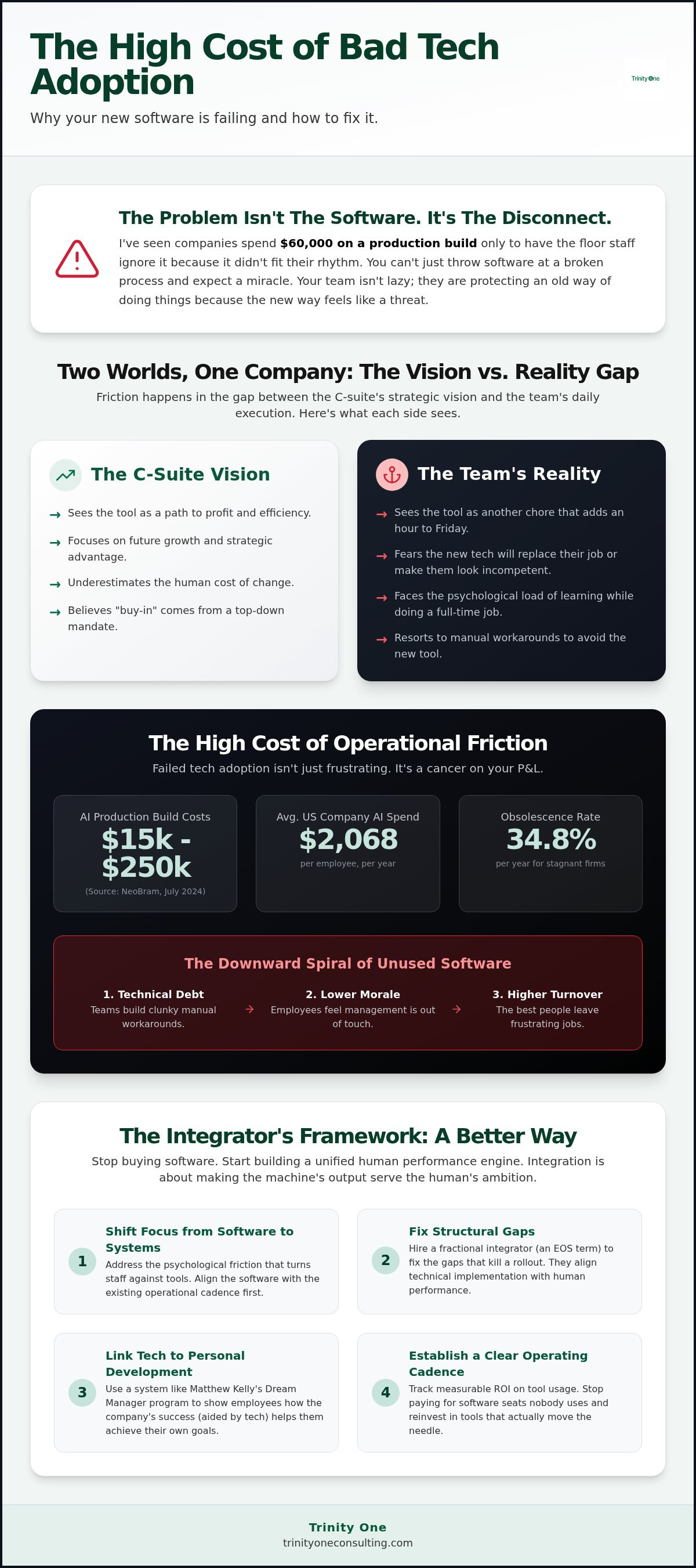
The Integrator’s Framework for Seamless Tech Adoption
Adopting new technology in the workplace challenges usually boil down to a leadership gap. The Visionary CEO sees the potential of a tool. They buy the software. But they shouldn't be the one managing the rollout. Visionaries are great at seeing what's next. They are often terrible at the repetitive, clinical work of ensuring a tool is actually used. You need an Integrator to turn that vision into a functional engine.
The Visionary vs. Integrator dynamic matters here. The Integrator is the glue that holds the business together. They take the big ideas and translate them into actionable steps for the floor. A Fractional COO brings the clinical precision needed for these high-stakes changes. They don't get distracted by the next shiny object. They focus on the machine's output.
When a Visionary CEO tries to manage a rollout, they usually get bored after the first two weeks. They've already moved on to the next big idea. This leaves the team in a state of confusion. The software becomes a ghost in the machine. It's there, but nobody knows what to do with it. The Integrator stops this cycle by creating a clear accountability structure that defines who owns the tool.
Success requires a unified operating cadence. This is the rhythm of your business. If tech adoption isn't part of your weekly scorecard, it won't happen. You can't just hope people use the software. You have to measure it. You have to see the execution in real-time.
The Integrator as the Adoption Architect
A fractional integrator is the architect of your digital transformation. They bridge the gap between cold software logic and messy human motivation. Most tech failures happen because the "why" isn't clear to the person in the seat. A battle-tested practitioner knows how to handle implementation friction. They've seen these failures before. They know how to pivot when the team pushes back.
Calibrating Your Business Rhythm for Change
You must use daily huddles and weekly cadences to monitor adoption. Don't wait for a quarterly review to find out a tool is failing. That's too late. You've already burned the cash. Look for red flags like low login rates or a sudden spike in manual workarounds. These are signs of a system rejection. If you see a 20% drop in usage on Tuesday, you need to know why by Wednesday morning.
Link tech usage to your core KPIs. If the tool is supposed to increase output, the scorecard should reflect that immediately. Are they hitting the target number of prompts? Is the output quality meeting the standard? Visibility is the only way to hold teams accountable for the change you're paying for. This level of granularity is what separates a successful rollout from a $250,000 mistake.
Beyond Software: Aligning Human Purpose with AI Execution
Adopting new technology in the workplace challenges are fundamentally human problems, not software bugs. You overcome them by aligning the tool's output with the employee's personal growth. When a team sees that mastering a tool helps them achieve their own dreams, the friction of adopting new technology in the workplace challenges disappears. ROI becomes measurable when the operator and the owner move in the same direction.
I believe a company only becomes the best version of itself to the extent its people are becoming better versions of themselves. This is a conviction rooted in my faith and 30 years of operational experience. If you want your team to adopt your vision, you must first adopt theirs. You have to care about the person behind the keyboard.
The Dream Manager: The Ultimate Buy-In Strategy
Most employees ask one question when you roll out a tool: "What's in it for me?" The Dream Manager program answers that question by focusing on their personal ambitions. This methodology, created by Matthew Kelly, identifies twelve dream categories including physical, emotional, spiritual, and financial goals.
When you help a technician buy their first home, they stop seeing new tech as a threat. They see it as the fuel that funds their future. Mastering software is the tactic. Dream Manager coaching is the strategy that ensures they stay engaged. This reduces resistance by building a culture of mutual growth between the owner and the operator.
The Future is AI-Native Operations
By 2026, you cannot afford to run a business where AI and humans work in silos. They must function as a single, integrated circuit. Trinity Cadence is the AI-native operating system designed to provide this level of visibility. It serves as a single source of truth for execution. You move from surviving tech change to leading it.
With the average US company spending $2,068 per employee on AI in 2026, you can't afford to have that capital sitting idle. Trinity Cadence ensures every dollar spent on tech actually moves a human toward a result. We aren't replacing people with bots. We are using machines to handle the rote tasks so your people can do the high-level work they were meant for. You are building a unified business engine that runs on both logic and purpose.
Building Your Unified Business Engine
Adopting new technology in the workplace challenges don't have to be the end of your growth. You've seen how the friction between software logic and human motivation can burn through thousands of dollars in implementation costs. It's time to stop buying tools and start building a unified operating cadence. This isn't about the latest app but about the engine that drives your entire operation.
I've spent 30 years in the trenches as a Fractional Integrator and a football coach. I've learned that machines only run as fast as the people operating them. By combining AI-native operational coaching with Certified Dream Management facilitation, a methodology by Matthew Kelly, you can align your team's personal ambitions with your company's technical vision. This creates a culture where people want to use the tools you provide.
You have the vision to lead your industry. Now you just need the architecture to support it. Let's get your engine running at full capacity and turn your tech investments into real-world results.
Common Questions About Tech Adoption
What is the number one reason employees resist new technology?
Employees resist when they feel the tool is a threat to their seat or adds work without reward. Adopting new technology in the workplace challenges often boil down to this hidden fear. They won't tell you they're scared of being replaced. They'll just tell you the software is broken or doesn't fit the way they work.
How can I measure the ROI of a new technology implementation?
You measure ROI by comparing the production build cost against the actual reduction in manual labor hours. Use a weekly scorecard to track these numbers every week. If you don't see a measurable gain in output that covers the software cost within six months, your implementation has failed. ROI must be a hard number, not a feeling.
What is the role of a Fractional COO in digital transformation?
A Fractional COO acts as the Integrator. I build the bridge between the Visionary's software purchase and the floor's daily execution. My job is to ensure the tool fits the machine's rhythm without breaking the people. I provide the clinical precision needed to manage the change without getting distracted by the next shiny object.
How do I overcome tool fatigue in my organization?
You stop the fatigue by removing more than you add. If a new tool doesn't eliminate three manual steps, it shouldn't be in your stack. Focus on a unified operating cadence so your team isn't jumping between ten different dashboards to do one job. Adopting new technology in the workplace challenges are often just a symptom of a cluttered, uncoordinated tech stack.
Can AI actually help with employee engagement during tech changes?
AI improves engagement by reducing the cognitive load on your staff. Instead of forcing people to read 50-page manuals, systems like Trinity Cadence provide real-time answers while they work. This helps employees win at their jobs faster. When people feel competent and supported, their engagement naturally goes up.
How does the Dream Manager concept help with technology adoption?
It aligns the company's tech needs with the employee's personal goals. When you use the Dream Manager methodology by Matthew Kelly, you show the operator how the tool helps them hit their own targets. If the software helps them get home an hour earlier to see their kids, they will use it. You're investing in their dreams so they invest in your tools.
What is an AI-native business operating system?
It is an operating system like Trinity Cadence that integrates machine logic with human performance. It provides real-time visibility into every quarterly priority and weekly metric. This isn't just a dashboard. It is the engine of the business that treats AI and humans as a single, functional circuit.
How long does it typically take to see results from a new tech rollout?
You should see initial results within 30 days if you use a Launch Sprint. Long rollouts are where momentum dies and resentment grows. I focus on quick wins that prove the tool's value to the team immediately. If a rollout takes six months to show any value, your team will have already checked out.