
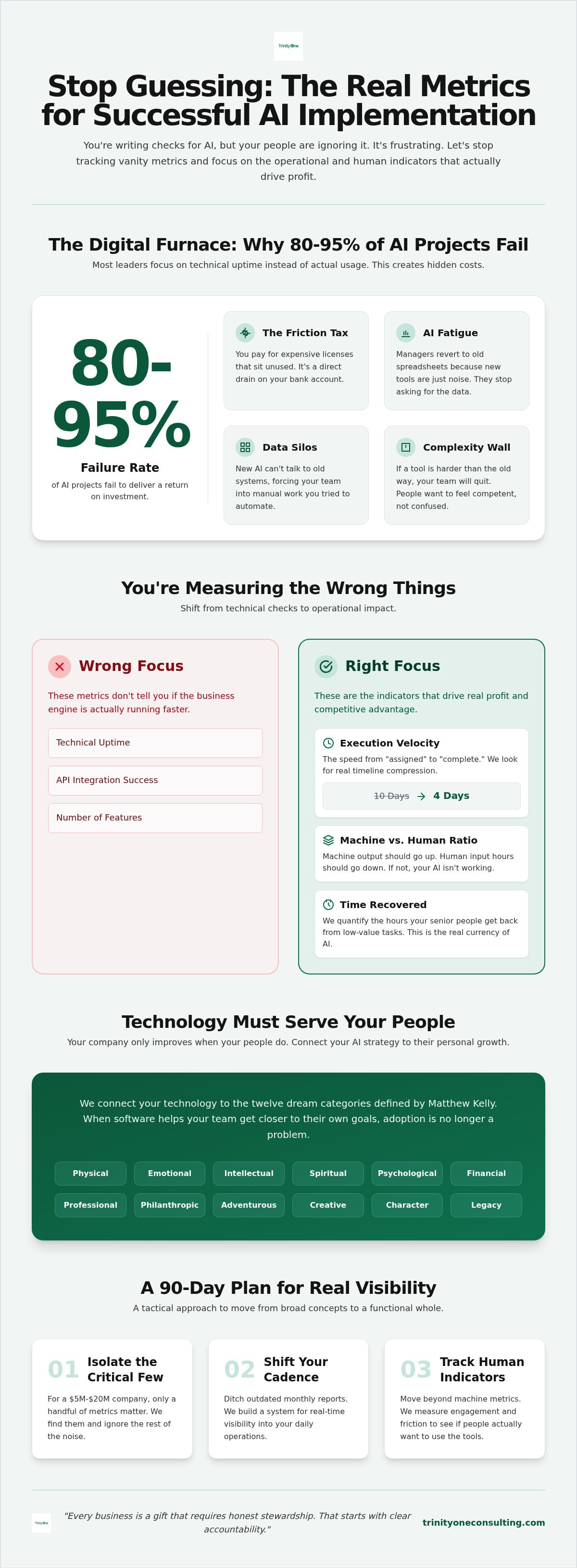
An estimated 80 to 95 percent of AI projects fail to deliver a return on investment in 2026. You likely feel that friction in your own business engine as software costs climb while your team treats the new tools like a burden. Determining the right metrics for successful AI implementation requires looking past technical uptime to see how machine output actually moves the needle on your bottom line. I've seen too many operators pour 100,000 dollars into a departmental rollout only to watch it stall because of data silos and human resistance.
It's frustrating to write checks for technology that doesn't clear the path for your people. You want a clear view of execution, not another dashboard that nobody uses. I'll show you how to stop guessing and start tracking the precise operational and human indicators that drive real profit. We'll move from broad strategic concepts to the tactical applications that make your business a functional whole.
Success happens when machine operations align with the personal growth of your staff. We'll use the Trinity Cadence to get real-time visibility into engagement. You'll learn to connect your AI strategy to the twelve dream categories defined by Matthew Kelly. This approach ensures your technology serves the people who keep the engine running.
Key Takeaways
- Identify the Friction Tax to stop burning cash on software licenses that your team ignores.
- Focus on Execution Velocity and the Machine Output vs. Human Input ratio as the primary metrics for successful AI implementation.
- Connect technical tools to the twelve dream categories defined by Matthew Kelly to ensure your team actually wants to use the software.
- Start a 90-day plan to isolate the Critical Few metrics that matter for a 5 million to 20 million dollar company.
- Shift your Operating Cadence to provide real-time visibility instead of relying on outdated monthly reports.
What are the primary indicators of a failed AI rollout?
You can't fix what you don't measure. Most leaders focus on technical uptime instead of actual usage, which creates a "Friction Tax" where you pay for unused AI licenses that do nothing but drain your bank account. Establishing clear performance metrics is the only way to see if the engine is actually turning. Without these metrics for successful AI implementation, you're just throwing cash into a digital furnace.
Technical success is cheap. Operational failure is expensive. You might have a perfectly integrated API, but if your team avoids the dashboard, you have zero ROI. I've seen companies celebrate a "successful" launch while the actual operators were still using paper notes behind the scenes.
AI Fatigue hits leadership teams hard. You'll notice it when managers stop asking for AI-generated insights and go back to their old, comfortable spreadsheets. They stop caring about the metrics for successful AI implementation because the noise has become too loud. Finally, they delegate the AI strategy to a junior staffer who lacks the authority to change the business engine.
Lack of ownership leads to metric drift. An AI tool without a dedicated operator or an Integrator is just a digital paperweight. You need one person responsible for the output, or the data will eventually stop reflecting reality. I believe every business is a gift that requires honest stewardship, and that starts with clear accountability.
The high cost of technical silos
Data islands are the silent killers of a 20-person company. When your CRM AI doesn't talk to your project management system, your team spends more time syncing data than doing work. I've watched firms waste 5,000 dollars every month on software with zero adoption because the tools couldn't communicate. This isolation prevents you from seeing the total health of your business engine and forces your people to do the manual labor the machine was supposed to handle.
Why your team stops using new tools
Every piece of software has a Complexity Wall. If a tool makes a task harder than the old manual way, your team will quit using it. This is a psychological barrier, not a technical one. Humans prefer a slow, known process over a fast, confusing one. They want to feel competent in their roles, and clunky software strips that feeling away.
We track this through a Friction Score. If onboarding a new AI tool takes more than 15 minutes of mental effort, you've already lost the room. Your people want to be better versions of themselves, but they won't fight a system that adds weight to their day. You must lower the barrier to entry before you can expect a high rate of execution.
Which operational metrics for successful AI implementation actually matter?
Execution Velocity is the pulse of your business engine. It measures the speed at which a task moves from assigned to complete within your workflow. When you track metrics for successful AI implementation, you're looking for a measurable compression of this timeline. If a project that took ten days now takes four, you've gained six days of competitive advantage.
I focus on the Machine Output vs. Human Input ratio. This is a core efficiency metric. You want to see the volume of machine-generated work increase while the hours of human labor remain flat or decrease. If you're paying for AI but your headcount's manual hours aren't dropping, your implementation is failing. You can learn more about measuring ROI of AI implementation to see how these ratios hit your profit and loss statement.
Meeting time is a massive drain on leadership. AI summaries can reduce a 60-minute status meeting to a 10-minute review of action items. This isn't just about saving time. It's about clarity of execution. Many leaders use the Trinity Cadence platform to get real-time visibility into these shifts. It helps you measure AI success by showing exactly where the friction remains in your daily operations.
Tracking time recovered in the business engine
Low-Value Tasks kill the spirit of a senior leader. I'm talking about the hours spent on data entry, basic reporting, and meeting scheduling. When you quantify these hours, you see the true cost of your current systems. Time Recovery is the primary currency of AI. If your VP of Sales saves five hours a week on reporting, they have five more hours for high-stakes coaching. I believe that when we free people from drudgery, they can finally focus on becoming the best version of themselves.
Measuring the accuracy of AI-driven decisions
Decision Cycle Time is the gap between data collection and final execution. AI should shrink this gap by providing immediate, accurate forecasts. Compare your AI-assisted quarterly forecasts with your actual results. If the machine is consistently within 5 percent of the truth, your engine is tuned. Accuracy is an operational metric, not a technical one, because a wrong decision costs just as much whether a human or a machine made it. If you're struggling to see these numbers clearly, we can look at your current operating cadence together.
How do you measure the human side of technology adoption?
Your business engine runs on human motivation. If your team views AI as a threat to their jobs, your metrics for successful AI implementation will crater. I use the Engagement Index to predict if a rollout will actually stick. This index measures how many people are actively using the tool to solve problems versus those just going through the motions.
You have to understand the human side of technology adoption to see real ROI. High technical performance is impossible without human alignment. I believe a company only becomes the best version of itself when its people are becoming better versions of themselves. This is why I use the Dream Manager methodology, which was created by Matthew Kelly.
Matthew Kelly identified twelve dream categories that drive every human being. When you show an employee that AI can help them achieve a personal goal, they stop resisting the change. If you're struggling to get your team on board, Dream Manager Coaching provides the framework to bridge that gap. We focus on the human being before we look at the job description.
I've seen 20-person shops lose their best operators because the CEO forced a new AI tool without explaining the "why." Those operators felt their years of experience were being discarded. When you track the human side, you avoid that friction. I believe God gave us the ability to create, and we shouldn't use tools to stifle that creativity in our staff.
Linking employee dreams to machine efficiency
AI adoption must create space for personal development. Imagine a scenario where a manager saves five hours a week because AI handles their data entry. In a Dream Management framework, that manager uses those five hours to pursue a personal goal, like physical health or financial planning. This alignment makes the technical shift feel like a personal win rather than a corporate mandate.
You're buying back their time instead of just buying software.
The retention metric in an AI-native company
Retention is a critical operational indicator. You should track the turnover rate of employees using AI tools versus those stuck in manual workflows. I've heard operators say, "I'd rather pay 2,000 dollars more a month for a loyal human than 2,000 dollars for a tool that makes my best people quit." People want to work for companies that respect their time and invest in their future.
Career Growth Sentiment usually rises during AI transitions if the team feels the technology helps them grow. Human ROI is the ultimate metric for long-term scale because machines don't build culture. People build culture. If your employees feel like the machine is a teammate, they'll stay.
If they feel like it's a replacement, they'll leave.
How do you align your operating cadence with machine speed?
Your Operating Cadence is the heartbeat of your business. If that heart beats too slowly, the entire engine stalls. Traditional monthly reporting is a relic of a slower age. By the time you see a monthly profit and loss statement, your AI-driven competitors have already run four circles around you. You need metrics for successful AI implementation that update in real time, not every thirty days.
This is where a Fractional Integrator becomes essential. An Integrator doesn't just watch the clock. They maintain the rhythm between your high-speed machine outputs and your human team. I believe we are called to be diligent with the resources we've been given, and that includes the time of our employees. A Unified Operating System blends machine efficiency with human intuition to create a single, functional whole.
Calibrating weekly huddles for real-time data
We use Trinity Cadence to provide AI coaching that actually improves meeting quality. Most weekly huddles are just boring status reports. You don't need a meeting to hear what happened last week. You need a meeting to solve the problems that the machine has already identified. We shift the focus from "What did you do?" to "What is blocked?"
An AI-native Level 10 meeting follows a strict checklist to keep the engine moving:
- Review the machine-generated scorecard for five minutes.
- Spend sixty minutes on real-time problem solving.
- Recap new tasks for five minutes.
This ensures your metrics for successful AI implementation are actually driving weekly behavior.
Managing the rapid launch sprint metrics
A 30-day AI sprint requires its own set of success indicators. During these first four weeks, I track the Adoption Curve of the new tool. If only two out of ten staff members are logging in by day fifteen, the sprint is failing. You can't wait until day ninety to find out that your team hates the software. Speed is the goal here, and sometimes that means sacrificing perfect precision for immediate execution.
Early deployment is often messy. You have to accept a 20 percent error rate in the first two weeks to gain a 50 percent increase in speed. If you demand 100 percent accuracy on day one, you'll kill the momentum. I've seen operators spend 15,000 dollars on a pilot only to abandon it because they were too afraid of a few minor bugs. You have to be willing to adjust the valves while the engine is running.
How do you build a roadmap for measurable AI growth?
You need a 90-day plan to move from technical curiosity to operational reality. Establishing the right metrics for successful AI implementation involves identifying the "Critical Few" indicators like Execution Velocity and Machine Output ratios that directly impact your profit and loss statement. Most operators buy software first and look for value later, which is exactly how you end up with a high Friction Tax. I help leaders create an AI ROI map before they sign a single vendor contract.
For a 5 million to 20 million dollar company, you can't afford to track every data point. You need a lean set of indicators that actually move the needle. Trinity One acts as your partner to map these indicators and ensure they remain aligned with your business engine. We focus on execution over theory to make the complex feel manageable.
Setting the baseline for your business engine
You have to know where you are before you can decide where you're going. I start every engagement with an audit of current manual hours across your leadership team. We look for the friction points in your current operating cadence that cause the most frustration. This data allows us to create a Pre-AI Efficiency Score for your entire firm.
This score is your ground truth. If your managers are spending 15 hours a week on reporting, that's 750 dollars of labor per person per week at a 50 dollar hourly rate. You can't claim success until that number drops significantly. It's a hard, clinical look at your current failures, but it's the only way to build a steady path forward. I believe honest stewardship of your resources starts with this level of precision.
Scaling metrics as the company grows
As you scale from 10 to 50 employees, your metrics for successful AI implementation must evolve. You move from "Efficiency Metrics" like time saved to "Innovation Metrics" like the volume of new products launched. Efficiency gets you in the game, but innovation keeps you there. I've seen 10-person shops find their rhythm only to lose it when they double in size because they didn't adjust their KPIs.
You should track the revenue impact of AI-native offerings. This isn't just about doing the old work faster. It's about doing work you couldn't do before. When your engine is tuned, your team has the space to focus on the twelve dream categories Matthew Kelly describes in the Dream Manager program. This is the ultimate goal: a company that grows because its people are growing.
Scaling requires a shift in how you view your Integrator. At 10 employees, you're looking for survival and basic execution. At 50 employees, you're looking for systemic alignment across multiple departments. I believe that a well-run business is a gift, and scaling your metrics is how you honor that responsibility.
Tuning your engine for operational certainty
Tuning your business engine requires a shift from technical hope to operational certainty. You've seen how to track Execution Velocity and why the human side of adoption determines your final ROI. I've spent decades in the trenches of leadership and coaching. I believe we're called to lead with both clinical precision and human empathy.
Your metrics for successful AI implementation must live in a real-time environment like our Trinity Cadence operating system. This isn't about collecting more data points that nobody reads. It's about isolating the Critical Few indicators that show if your machine output is actually increasing. We use Certified Dream Management facilitation based on Matthew Kelly's work to ensure your team stays aligned with their twelve dream categories.
You don't have to keep guessing if your 2026 technology spend is actually hitting your bottom line. I'm here to help you map the indicators that drive real profit and long-term retention. Let's get your business engine running at its full potential so you can focus on what matters most.
Frequently Asked Questions
What are the most common metrics for successful AI implementation?
Primary indicators include Execution Velocity and the Machine Output vs. Human Input ratio. These metrics for successful AI implementation tell you if your business engine is actually speeding up or just getting noisier. You should also track time recovery for senior leaders. If a task that took five hours now takes thirty minutes, you've won.
How do I calculate the ROI of AI in a service-based business?
You calculate ROI by subtracting the total software cost from the value of recovered hours. If you spend 2,000 dollars a month on AI but save 40 hours of a manager's time valued at 100 dollars per hour, your net gain is 2,000 dollars. It's a clinical calculation. Don't forget to factor in the cost of training and the initial drop in speed during the first two weeks.
Can I measure AI success without a dedicated data scientist?
You don't need a data scientist to track operational success. Most small to mid-market companies just need a clear view of their execution and engagement levels. Platforms like Trinity Cadence provide this real-time visibility without requiring a PhD in statistics. You focus on the business output while the software handles the technical tracking. It's about being a practitioner, not a theorist.
How does AI adoption impact employee retention metrics?
AI adoption can either drive people away or make them stay longer. If you use the Dream Manager methodology by Matthew Kelly, you align the technology with the twelve dream categories of your staff. Employees stay when they see that AI buys them time for personal growth. You'll see this reflected in a lower turnover rate for departments that have successfully integrated these tools.
What is the difference between technical AI KPIs and business AI KPIs?
Technical KPIs focus on model accuracy and latency. Business KPIs focus on profit, speed, and human engagement. A model can be 99 percent accurate but still fail if it adds ten minutes of friction to a workflow. I care more about your bank account and your team's morale than I do about technical benchmarks. Success happens when the machine serves the person, not the other way around.
How often should I review my AI implementation metrics?
You should review your metrics every week during your huddle. Monthly reviews are too slow for an AI-native company. If a tool isn't working on Monday, you need to know by Friday so you can adjust the valves. This rapid feedback loop is what keeps your business engine from stalling. We use these weekly checks to ensure every resource is used with honest stewardship.
What role does a Fractional COO play in tracking AI success?
A Fractional COO acts as the Integrator who keeps the machine and the people in alignment. I've spent decades in the trenches making sure technology doesn't break the culture. The COO ensures that your metrics for successful AI implementation are actually being tracked and acted upon. Without an Integrator, metrics often drift into data silos where they become useless for decision-making.
How do I know if my team is actually using the AI tools I pay for?
You track the Adoption Curve and the Friction Score. If your team stops using a tool after day fifteen, it's usually because the software is too complex or doesn't solve a real problem. I look at the login frequency and the completion rate of AI-assisted tasks. If the numbers are low, it's time for a blunt conversation about whether the tool belongs in your engine.