Replacing a mid-level manager costs your company $50,000 in lost productivity and recruiting fees. Most of that waste happens because people feel like cogs in a machine. You stop this cycle by integrating personal goals into employee development plans. Your team needs to see their job as the vehicle for their own dreams.
I know the friction of looking at a spreadsheet of quarterly targets and seeing zero fire in your team's eyes. It's frustrating to invest in people who leave for a five percent raise. You want a loyal team that executes with precision. You can't get that by only talking about your bottom line.
You'll learn how to align individual aspirations with operational execution to drive retention and performance. This requires a heavy investment of your time. It's bad at providing a quick fix for a toxic culture, but it builds a foundation of trust that lasts.
We'll use the Dream Manager methodology, which Matthew Kelly pioneered, to turn your company into an engine for human growth. I believe we are called to help the people under our care reach their full potential. This is how you get a higher ROI on human capital.
Key Takeaways
- I'll show you why integrating personal goals into employee development plans turns a standard job into a vehicle for individual success.
- You'll learn to use Matthew Kelly's Dream Manager methodology and his twelve dream categories to identify aspirations without crossing professional boundaries.
- Manage the emotional weight of these conversations by acting as a coach rather than a therapist to keep your operations focused.
- Tie business objectives to personal wins, such as a performance bonus that funds a down payment on a house.
- Use the Trinity Cadence system to gain real-time visibility into how engaged your team members actually are.
Why should you care about what your employees do outside of work?
Your people are not machines. They don't leave their personal lives at the door when they clock in. If a team member is worried about their debt or a failing marriage, they aren't focused on your quarterly KPIs. Integrating personal goals into employee development plans is the only way to stop treating your staff like rented equipment.
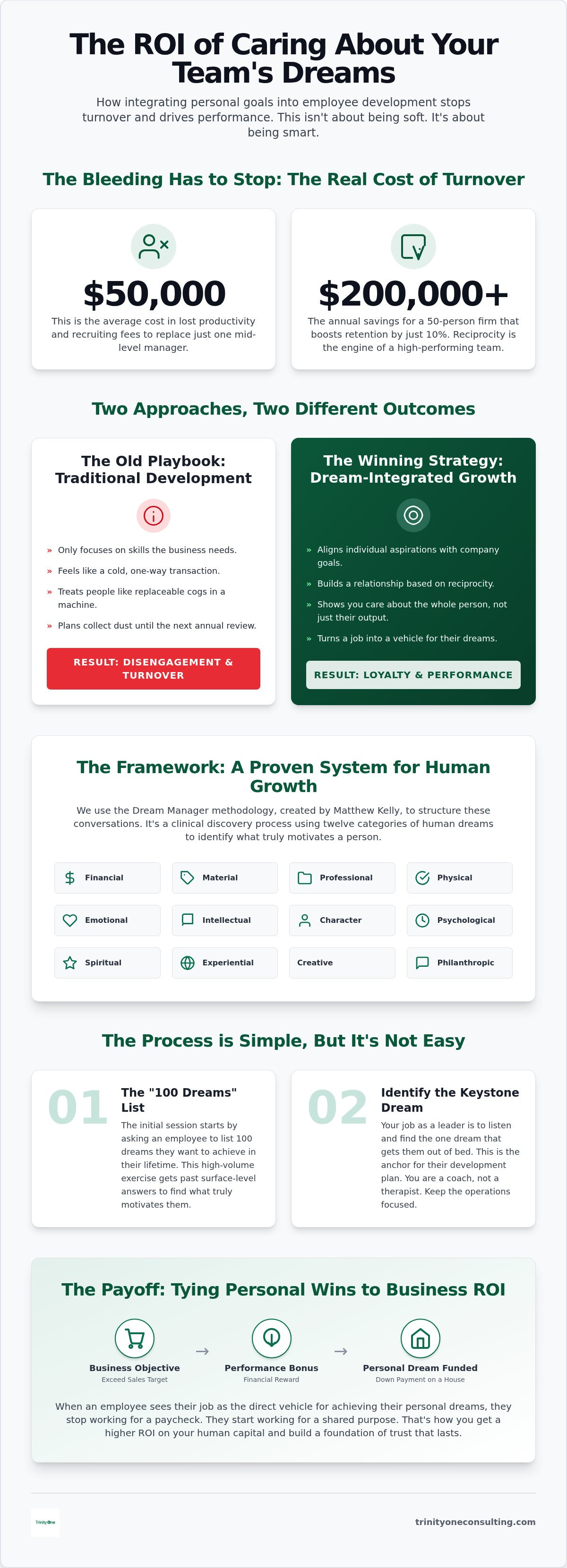
Retention is a math problem where the solution is individual investment. The numbers are clear. Replacing a mid-level manager costs your company $50,000 in lost productivity and recruiting fees. For a 50-person firm, a 10% increase in retention saves over $200,000 annually. You can't afford to ignore the personal lives of the people generating your revenue.
Reciprocity is the engine of a high-performing team. If an employee feels you are helping them get what they want, they will help you get what you want. I've seen this shift happen in dozens of companies. It stops being about the paycheck and starts being about the relationship. You get a team that doesn't just show up, but actually cares about the outcome.
The failure of the traditional development plan
Most companies use a personal development planning model that only focuses on skills the business needs. It's a one-way street that feels like a cold transaction. These plans usually collect dust in a digital folder until the next annual review. They focus on sales quotas or software certifications, which rarely get your employees out of bed with a sense of purpose.
When the plan is only about the company, the employee feels like a cog. Cogs are easy to replace, and they know it. They check out when they see no path to their own happiness within your walls. This lack of engagement is what drives that $500,000 annual turnover bill for a typical mid-sized firm.
The link between personal growth and professional output
A person who is winning at home is more likely to win at the office. Personal discipline in areas like fitness or finance inevitably spills over into project management and client relations. I believe we are called to lead the whole person, not just the part that generates a profit. This is an honest conviction that has guided my coaching for years.
We use the Dream Manager methodology, created by Matthew Kelly, to bridge this gap. It's a structured way to look at the twelve categories of human dreams. By integrating personal goals into employee development plans, you show your people that their growth matters. When you learn how to implement a dream manager program, you start seeing your team as whole humans.
This approach isn't a quick fix. It requires a heavy investment of your time. You have to be willing to sit down and listen to things that aren't on a spreadsheet. It's bad at fixing a toxic culture overnight, but it builds a foundation of trust that lasts for decades.
How do you identify personal goals without overstepping?
You must create a safe space where the conversation is about them, not the company. This is a clinical discovery process. Keep it separate from the performance review. I've spent years as a football coach and corporate operator seeing these conversations change lives. When you stop looking at a player as a stat line and start looking at them as a man with a family, the scoreboard takes care of itself.
Integrating personal goals into employee development plans requires a proven methodology. We use the Dream Manager framework. I attribute this methodology to Matthew Kelly and his work on human dreams. The system focuses on twelve specific dream categories. These include physical, emotional, intellectual, spiritual, and financial goals.
I believe every person has a God-given purpose that extends far beyond their job title. Your role as a leader is to help them find it. This requires a level of vulnerability that most managers find uncomfortable. It's the price of high performance.
The initial dream session
Ask the employee to list 100 dreams they want to achieve in their lifetime. This is a high-volume exercise. It's designed to get past the surface-level answers like wanting a raise. You want the deep-seated motivations. Don't judge the list. Don't try to filter it for work relevance.
Your only job is to find the one dream that makes them get out of bed. Maybe they want to learn to play the guitar or visit every National Park. If you're struggling to start these sessions, you can book a cadence call to discuss the framework. The cost of overstepping is high, but the cost of ignoring these dreams is higher.
Categorizing aspirations for clarity
Group dreams into categories like intellectual, psychological, material, or creative. This mirrors the structure of effective career development planning found in high-performance organizations. It provides a logical proof for what usually feels like a messy conversation. You are building a system. This goes beyond having a casual chat.
Identify short-term wins that can be achieved in 90 days. A 90-day win builds momentum and proves the system works. Use these categories to build a personal roadmap that sits right alongside their professional one. This ensures their work fuels their life. It prevents work from becoming a distraction.
What are the risks of integrating personal goals into employee development plans?
Integrating personal goals into employee development plans isn't a magic pill. It's a high-stakes operational shift that carries real risks. I've seen leaders fail here because they treat it as a checkbox item rather than a commitment. If you go into this half-heartedly, you'll do more damage than good.
Managers often feel overwhelmed by the emotional weight of these conversations. You aren't just talking about spreadsheets anymore. You're talking about someone's debt, their health, or their family. Boundaries can blur quickly. If a leader tries to become a therapist instead of a coach, the relationship breaks.
You have to stay focused on being a coach for their dreams, not a fixer for their trauma. Some employees will be skeptical. They've seen corporate "initiatives" come and go. They might view integrating personal goals into employee development plans as a manipulation tactic to squeeze more work out of them.
Also, this approach is bad at fixing people who simply do not want to grow. You can't want it more than they do. If they're content being a cog, this system will actually frustrate them.
Managing the time commitment
A monthly 30-minute session is the standard for a Dream Manager program. Do the math. If you have 10 direct reports, that is five hours a month of high-intensity coaching. That is time away from "doing the work."
You must decide if five hours is worth keeping your top three performers from quitting. Remember that losing one mid-level manager costs you $50,000. I've spent 30 years in the trenches of leadership. I'll take five hours of coaching over 50 hours of interviewing any day. This is how you build Individual Development Plans that actually matter.
Handling the skeptic in the room
Never force participation. If someone doesn't want to share their dreams, let it go. Forced vulnerability is just an interrogation. Let the results of the early adopters convince the rest of the team. When they see a coworker finally buy that car or run that marathon, they'll get curious.
Be honest about the risks. If an employee grows too much, they might eventually outgrow their current role. That is the cost of doing this right. I'd rather have a world-class operator for three years who leaves for a better opportunity than a mediocre one who stays for ten. You're building people, not just filling seats.
How do you bridge the gap between individual dreams and company ROI?
ROI isn't an accident. It's the result of showing an employee that their success depends on yours. Integrating personal goals into employee development plans is the mechanism for this alignment. You are building a bridge between their personal bank account and your company's P&L.
If an employee wants to buy a house, don't just give them a generic target. Show them how hitting their sales quota triggers the performance bonus needed for that down payment. This turns a corporate KPI into a personal mission. When their dream is on the line, they don't need a manager to motivate them.
Use the 90-day sprint model to keep both sets of goals moving forward. It is short enough to maintain urgency but long enough to see real progress. This is a core part of how to create a business operating system that actually executes.
The 90-day alignment session
Review the personal dream and the professional KPI in the same meeting. This is not a distraction from work. It is the fuel for work. You want your team to see that their professional output is the engine for their personal life.
Identify specific actions the employee will take for both areas. This creates a unified sense of purpose that generic plans lack. It stops the "us versus them" mentality. You are now a partner in their success.
I've seen this lead to a 17% increase in productivity because people finally understand why they are working so hard. Workplace reports from Gallup prove that engagement drives these specific output gains. Performance depends on more than just the numbers.
Tracking progress in the weekly huddle
Give a 30-second shout-out when someone hits a personal milestone. Maybe they paid off a credit card or finally ran that 5k. This builds a culture where people are seen as human beings first.
It signals to the rest of the team that you actually care about their lives. The ROI shows up in lower absenteeism and higher discretionary effort. Gallup reports that highly engaged business units see a 41% reduction in absenteeism.
When people feel supported in their personal growth, they show up ready to win. I believe we are called to be the best versions of ourselves, and that includes how we lead our teams. This is how you turn a group of employees into a loyal team.
How does the Trinity Cadence system manage human performance?
Technology should support human performance. It must never replace the manager's intuition. I've spent three decades in the trenches of leadership. I know that a software dashboard cannot replace a face-to-face conversation. Trinity Cadence functions as the technical engine for human growth. It provides real-time visibility into how engaged your team actually is. This is the difference between guessing and knowing.
Integrating personal goals into employee development plans requires a steady operating rhythm. If your business is in chaos, you'll never find the time for deep coaching. The system handles the repetitive tasks of execution. This clears your schedule for the high-intensity work of building people. You can't lead a dream session if you're stuck in a fire drill.
Using AI to spot engagement trends
Our platform tracks execution patterns. It identifies signals of burnout before they turn into a resignation letter. If a top performer suddenly misses three minor deadlines, the data shows a friction point. This is a mathematical proof of human struggle. Managers get alerts to check in immediately.
This is not about spying. It is about proactive support. AI coaching helps identify when an employee's output is dropping due to personal friction. You can step in as a coach before the turnover cost hits your bottom line. It's about catching the ball before it hits the ground. We use these data points to fuel better conversations, not to replace them.
The role of the Fractional Integrator
A fractional COO can set up this system for you. This allows the Visionary CEO to focus on the big picture. We implement the Dream Management program so you don't have to do it all alone. It's an integrated circuit of technology and human purpose. Most leaders are too busy running the engine to check the oil. We take that burden off your shoulders.
My conviction is simple. Your business engine only runs well when the people inside it are becoming better versions of themselves. We provide the structure for that growth. Faith in your team's potential is the only way to build a company that lasts. This is the path to a loyal team that executes with precision. You get a higher ROI on human capital because you treated people like humans.
Build a team that stays and executes
You've seen the math on turnover. Losing $50,000 every time a mid-level manager walks out is a leak you can't afford. By integrating personal goals into employee development plans, you plug that leak with loyalty. You stop being just a boss and start being a partner in their success.
I've spent 30 years in the trenches of leadership. I know that technology like the AI-native Trinity Cadence platform only works when it serves the human heart. We use Certified Dream Management, based on the work of Matthew Kelly, to help your people win at home. When they win at home, they win at work.
I honestly believe we are called to lead with purpose. When you value the person as much as the profit, the execution follows. It's time to stop treating your team like cogs and start treating them like the architects of your company's future.
I look forward to hearing about your vision and the people you lead. We can build a system that actually works for everyone involved.
Common questions about human performance
What is the Dream Manager concept?
The Dream Manager is a methodology created by Matthew Kelly that focuses on the personal development of the employee. It operates on the belief that a company can only become the best version of itself when its employees are becoming better versions of themselves. I use this framework to help leaders move beyond transactional relationships. It turns the workplace into a tool for achieving human aspirations instead of just a place to collect a check.
How do personal goals impact work performance?
Personal goals provide the fuel for professional execution. When an employee connects their daily tasks to a personal win, like paying off debt or running a marathon, their focus sharpens. Gallup reports that highly engaged business units see a 17% increase in productivity. Integrating personal goals into employee development plans ensures that the "why" of the individual aligns with the "what" of the organization. This creates a team that executes with precision.
Is it legal to ask employees about their personal goals?
It is legal to discuss personal goals as long as the program is voluntary and follows standard non-discrimination laws. You should never force a team member to share details they find uncomfortable. I treat these sessions as coaching opportunities rather than HR interviews. The goal is support, not surveillance. If you maintain clear boundaries and act as a coach rather than a therapist, you stay on the right side of the law.
How much does a Dream Manager program cost?
The primary investment for a Dream Manager program is the time of your leadership team. Trinity One provides this through retainer-based professional service fees for certified coaching and program management. You must also account for the 30 minutes of monthly high-intensity coaching per employee. While there is a professional fee for the system, the cost of doing nothing is much higher. Replacing one mid-level manager typically costs a firm $50,000.
What happens if an employee's dream is to leave the company?
If an employee's dream leads them out of your company, you should support them in leaving well. I've spent 30 years in operations and I know that keeping a disengaged person is a recipe for disaster. Integrating personal goals into employee development plans means being honest about the future. I'd rather have a world-class operator for three years who leaves for a better role than a mediocre one who stays for a decade.
Can I run a dream program without software?
You can start with a notebook, but scaling a dream program requires a technical engine. Trinity Cadence and DreamCompass provide real-time visibility into engagement that a spreadsheet can't match. Our AI-native system tracks execution patterns to identify burnout before it happens. This is proactive support, not spying. Technology should support human performance by keeping the operating cadence steady. This ensures you have the time for deep conversations.
How do I start integrating personal goals if I have never done it before?
Start by sitting down with your top performers and asking about their life outside of the office. Don't make it a formal meeting with an agenda. Just listen to what they actually care about. Use the twelve categories defined by Matthew Kelly to help them think bigger than their next vacation. Once they see you are a partner in their personal success, the professional buy-in will follow naturally without any marketing fluff.
What are the twelve dream categories mentioned by Matthew Kelly?
Matthew Kelly defines twelve categories to help people identify their dreams across all areas of life:
- Physical and Emotional
- Intellectual and Spiritual
- Psychological and Material
- Professional and Financial
- Creative and Adventure
- Legacy and Character