
A fractional leader can walk into a capable team and still create confusion by Friday. Prevent it by explaining why the role exists and making decision authority clear before day one. That’s how to prepare your team for a fractional leader without making the hire feel like a verdict on the people already doing the work.
Your staff may wonder whether their performance has been judged, or who has the final say when priorities collide. Don’t leave those questions to hallway conversations. Tell the team what the fractional leader owns and what remains with current managers. Clear authority lowers friction, but it also means you may need to hand over decisions you’ve held yourself.
The new executive needs a usable starting point, not a folder of old plans and meetings with no owner. Set the first priorities together and establish a consistent operating cadence. Make room for the human context behind the org chart, too. When people understand how their work connects to shared priorities and their own growth, the fractional leader can help the team execute without treating people as cogs.
Key Takeaways
- Learn how to prepare your team for a fractional leader by sharing the role’s purpose and what outcomes the leader owns.
- Separate decisions the fractional leader can make from those that require shared agreement or stay with internal leaders.
- Give the incoming leader one accessible reference with current priorities, operating measures, responsibilities, and known blockers.
- Set a meeting rhythm that gives the leader a regular way to review progress and resolve decision roadblocks.
- See how Trinity Cadence connects weekly execution with team engagement, including through its AI Coach and Dream Plans.
How do you prepare your team for a fractional leader?
To prepare your team for a fractional leader, explain why the role is being added, what the leader will own, and how employees can raise concerns. Do this before the leader starts. Preparation gives the executive useful context and gives the team clarity. It doesn’t promise instant results. The first weeks still involve listening, testing assumptions, and deciding what needs attention first.
Expect questions about reporting changes, whether the appointment signals criticism, who can make decisions, and whether another meeting will land on an already full calendar. Don’t dismiss those concerns as resistance. They’re practical questions from people trying to understand how their work will change.
What should you tell employees before the leader starts?
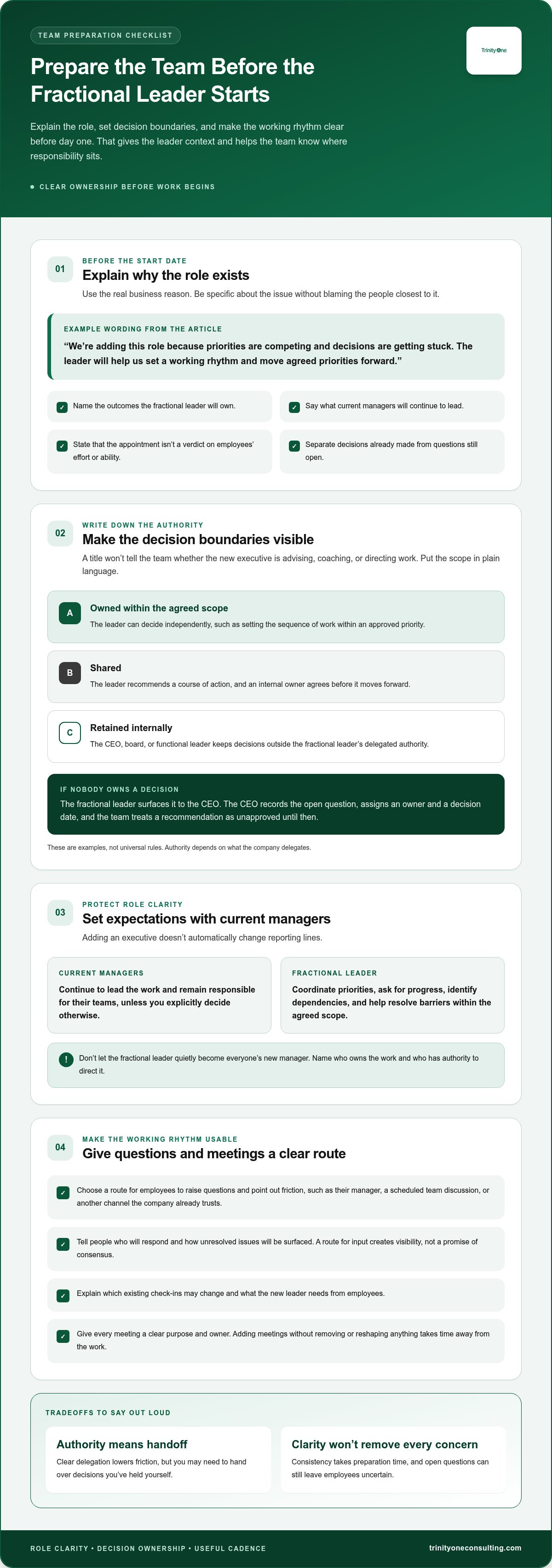
Start with the business reason. For example: “We’re adding this role because priorities are competing and decisions are getting stuck. The leader will help us set a working rhythm and move agreed priorities forward.” Use your real reason, not a polished line that avoids the problem. If you’re bringing in a fractional COO or Integrator, explain the outcomes they’ll own and the areas existing managers will continue to lead.
Then give employees a route to raise questions and point out friction. They might speak with their manager, bring an issue to a scheduled team discussion, or use another channel your company already trusts. Say who will respond and how unresolved issues will be surfaced. Don’t imply every concern will change the plan. A clear route for input creates visibility, not a promise of consensus.
Team readiness means shared understanding of the leader’s role, the priorities they’ll work on, and the rhythm the team will use to work together.
How can you explain the role without creating fear?
Say plainly that the appointment isn’t a verdict on employees’ effort or ability. A leadership gap can be about unclear ownership or work piling up between teams. It can also mean the company needs operating experience that current managers shouldn’t have to provide on top of their existing responsibilities. Be specific about the issue without blaming the people closest to it.
Separate decisions already made from questions still open. For example: “The leader will coordinate the weekly review of our priorities. We’re still working out which reporting changes, if any, are needed.” This is more credible than pretending nothing will change. Understanding interim management offers background on temporary executive roles, but your team needs the specifics of this appointment.
Give managers the same core explanation before they speak with their teams. Otherwise, an unanswered question about reporting can turn into a rumor about job changes. Consistency takes preparation time. It’s a worthwhile tradeoff, though it won’t answer every employee’s personal concern or remove uncertainty while decisions are still open.
Be candid about meetings, too. Tell employees which existing check-ins may change and what the new leader needs from them. Adding meetings without removing or reshaping anything has a real cost: time away from the work. A fractional leader needs enough contact to understand how decisions get made, but every meeting should have a clear purpose and owner.
What should the team understand about the fractional leader’s role?
The team needs to know what outcomes the fractional leader is accountable for, which decisions they can make, and what work stays with current leaders. A title alone won’t answer those questions. Put the scope in writing and explain it in plain language, so employees don’t have to guess whether a new executive is advising, coaching, or directing work.
For example, a fractional COO or Integrator may be responsible for turning agreed priorities into operating follow-through. The specific scope depends on what your company delegates. A fractional COO and Integrator role can be a useful reference, but your team still needs to hear what authority applies inside your business.
Which decisions will the fractional leader own?
Draw a line between delegated authority and decisions that remain with the CEO, board, or functional leaders. Consider recording the boundaries in a short decision guide:
- Owned within the agreed scope: decisions the executive can make independently, such as setting the sequence for work within an approved priority.
- Shared: decisions that need the fractional leader’s recommendation and agreement from an internal owner before action.
- Retained internally: decisions reserved for the CEO, board, or functional leader, such as matters outside the executive’s delegated authority.
These are examples, not universal rules. A fractional leader might own a decision in one company and only advise on it in another. Name the approver for each boundary. If nobody knows who owns a decision, the fractional leader should surface it to the CEO, record the open question, and have the CEO assign an owner and decision date. Until then, the team shouldn’t treat a recommendation as approval.
How will the fractional leader work with current managers?
Make clear that adding an executive doesn’t automatically change reporting lines. Managers still lead the work and remain responsible for their teams unless you explicitly decide otherwise. The fractional leader can coordinate priorities, ask for progress, identify dependencies, and help resolve barriers within the agreed scope. That’s different from quietly becoming everyone’s new manager.
Set a basic information rule. Managers share the current status, name the person responsible for the next action, and raise a blocker while there’s still time to act on it. The fractional leader records decisions and follows up with the assigned owner. Individual contributors should know which decisions they can make themselves and where to take a question that crosses team boundaries.
Alignment with the CEO matters. If the CEO gives one direction and the fractional leader gives another, managers are left to choose whose instruction to follow. Agree on priorities and decision boundaries together, then communicate changes through the same route. For a Visionary and Integrator relationship, this means keeping the vision with the CEO while agreeing on how the Integrator turns that direction into accountable work.
Clarity takes time to establish, and writing down boundaries can feel slower than settling each question in the moment. That short-term cost is usually better than asking managers to absorb conflicting instructions or sending every unresolved decision back through the CEO. As you work out how to prepare your team for a fractional leader, define accountability before the first contested decision arrives.
How should you set authority, priorities, and meeting rhythms?
Write down who can decide what, then give the team a regular place to review priorities and surface problems. If authority lives only in a conversation, people will escalate the same question whenever the usual decision-maker is unavailable. A short decision guide takes time to agree on, and it can go stale when responsibilities change. Review it with affected managers before the fractional leader begins.
How do you make decision rights visible?
For each recurring decision, record who recommends, who decides, who contributes information, and who communicates the result. Use roles or names that employees recognize. For example, a functional manager might recommend a change to a team workflow, the fractional leader might approve it within delegated authority, and the manager might explain the decision to the team. The actual assignment depends on your agreed scope.
A comparison table makes those boundaries easier to scan. Treat the examples as prompts, not automatic assignments.
| Decision category | Who has authority | Example |
|---|---|---|
| Leader-owned | Fractional leader decides within the agreed scope. | Choosing the sequence for work tied to an approved priority. |
| Shared | Fractional leader and internal owner agree before action. | Changing a process that affects another function. |
| Retained internally | CEO, board, or functional leader decides. | A decision reserved to the CEO or board. |
Before the start date, ask managers where ownership is unclear. Set a route for urgent issues that can’t wait for the next scheduled forum, such as contacting the named decision-maker directly and recording the outcome afterward. For disagreements that aren’t urgent, name who will bring the issue forward and who has final authority. “We’ll work it out later” is not an escalation path.
What should the first operating cadence include?
Start with a recurring weekly Huddle to review agreed priorities, commitments, and items that are off track. Keep the existing meeting if it already serves that purpose. Adding a new forum by default costs people time and can split attention between two versions of the same update.
Give every recurring forum a clear operating brief. State its purpose, required participants, what people should prepare, what decisions or outputs it should produce, and who owns follow-up. For the Huddle, participants might bring progress against commitments and the blocker that needs a decision. The owner records the decision, assigns the next action, and names when progress will be reviewed.
A meeting cadence works only when decisions have named owners. Without one, the same issue can return next week with no movement and no clear accountability.
Where it helps, use one shared view of execution health and team engagement so leaders can see work status alongside the people doing the work. Connect each decision to an owner and a next review point. Keep the system light enough that preparing for the meeting doesn’t become another project. That is a practical part of how to prepare your team for a fractional leader: establish a rhythm that supports action without filling the calendar for its own sake.
What should you prepare before the fractional leader’s first week?
Before the fractional leader starts, give them one accessible reference with current priorities, operating measures, team responsibilities, commitments, and known blockers. Assign an owner to assemble it and keep it current. This takes internal time. Without the context, the leader may spend early working sessions piecing together information that your team already has.
Use a short sequence. The goal is a useful starting point, not a polished presentation that hides messy facts. As you consider how to prepare your team for a fractional leader, choose materials that show how work actually moves through the business.
- CEO: Set the direction. Share the current vision and the priorities the business has agreed to pursue. Include existing commitments that could compete for the same people or time. If a priority is still being debated, label it as open rather than presenting it as settled.
- Functional leaders: Show the operating picture. Gather the measures the team already uses to track work and note how often they’re reviewed. Describe each measure in plain language, including what it can and can’t tell you. A number without its definition can send the new leader toward the wrong conclusion.
- Managers: Map responsibilities and friction. Record who owns each important process and where work routinely stalls. For every recurring problem, include a recent example, the person currently responsible for addressing it, and the known consequence. Avoid turning the document into a list of complaints. The point is to give the leader something concrete to investigate.
- Process owners: Share working knowledge. Identify team members who understand a key handoff, customer process, or internal system, then schedule time for them to brief the leader. Don’t expect a document to capture every workaround or exception. A knowledgeable employee can explain what the written process leaves out.
Set the first team sessions around distinct purposes. The introduction establishes the leader’s role and gives employees a chance to ask practical questions. Listening sessions help the leader hear how work happens from the people doing it. The first operating review checks priorities, measures, and ownership against what the leader has learned.
Ask each employee to bring one concrete blocker or decision that needs clearer ownership. That keeps the discussion grounded in actual work. It also gives the leader a chance to hear where a process affects people, not only the operating measure attached to it.
Make room for goals alongside work responsibilities. A discussion about what matters to an employee can add context to how they contribute and what development they’re looking for. Trinity One’s Dream Manager program connects personal goals with the workplace. Keep those conversations distinct from a performance review, so employees don’t mistake personal aspirations for a new test of their job performance.
Preparation has a cost. Managers and process owners must spend time gathering information and making space for the leader to listen. But if that time isn’t invested upfront, the executive can spend early working time chasing documents, reconciling conflicting versions, or repeatedly asking who owns a process. A clean reference won’t answer every question, and it can become stale. Name who updates it as priorities or responsibilities change.
How can a fractional leader connect execution with the people doing the work?
A practical answer to how to prepare your team for a fractional leader is to connect business priorities to a weekly rhythm that also makes team engagement visible. Trinity Cadence is a practitioner-built operating system shaped by 30+ years of operations and ERP leadership. It brings the machine side of execution and the people side of the business into 1 operating cadence.
The point is a shared view of the work, not another layer of reporting. A fractional leader can use the cadence to track priorities and surface obstacles while staying attentive to the people responsible for delivering the work. That connection matters. A plan that ignores capacity or employee concerns can look sound on paper and still stall in practice.
How does Trinity Cadence bring operations and people into one rhythm?
The Blueprint is a living document for vision, anchors, and the people plan. It keeps the direction and the human commitments connected as work moves forward. The weekly Huddle gives the team a recurring place to review priorities, commitments, and off-track items. The Pulse brings execution health and team engagement into a combined view, so leaders can see both the status of the work and how the team is doing.
The AI Coach drafts agendas, flags risks, and nudges conversations. It can help the fractional leader prepare for a useful discussion, but it doesn’t replace judgment or the responsibility to talk directly with employees. The Build Loop is part of Trinity Cadence’s operating system. Used alongside the other components, it sits within the system that turns strategy into a weekly rhythm.
This approach asks the team to keep information current and take part in a recurring review. That takes time. The tradeoff is a more shared picture of progress and engagement, rather than separate conversations that leave leaders piecing together what’s happening. A cadence can’t guarantee that every issue will surface or that every priority will succeed. People still need room to raise concerns directly.
How can team goals remain visible alongside business priorities?
Dream Plans track each team member’s goals alongside work. They give leaders a way to hold context about what matters to an employee without confusing personal aspirations with a business commitment. The Dream Manager methodology and its twelve dream categories are attributed to Matthew Kelly. The structure can support a thoughtful conversation, but it doesn’t remove the need to listen to each person as an individual.
Trinity One states 31% higher retention when dreams are tracked. Treat that as a stated business claim, not a promise of what any one company will achieve. The practical idea is straightforward: people’s goals deserve attention alongside operating priorities, because a company’s progress depends on its people continuing to grow.
Put the first agreement into practice
The first week is a chance to test how your agreements hold up against real work. Choose one active priority and watch where decisions move, where they stall, and who needs information to keep going. Adjust what proves unclear. A short review may take time away from delivery, but it can prevent the same confusion from repeating across the team.
That’s the practical work behind how to prepare your team for a fractional leader: make it easier for people to act with confidence, raise problems early, and understand how their contribution matters. You won’t get every detail right before the leader arrives. You can give the team a clear place to start, then improve the working agreement together as experience reveals what needs to change.
Book a discovery call with Kevin Patrick
Frequently Asked Questions
How do I tell employees a fractional leader is joining?
Tell employees directly, then repeat the same message in the leader’s first team meeting. A useful part of how to prepare your team for a fractional leader is deciding who will answer follow-up questions and how those questions will reach the right person. For example, invite employees to send concerns to their manager before the meeting, then address themes without naming someone who raised a sensitive issue.
Will a fractional leader replace someone on my team?
Not automatically. The role itself doesn’t establish a reporting change. Before the start, compare the fractional leader’s responsibilities with each affected manager’s current work and identify any overlap. If a manager and the executive both appear to own the same result, resolve that before it becomes a conflict over a live decision. If responsibilities may change later, say what is still undecided and who will make that call.
How many hours a week does a fractional leader work?
There’s no single weekly schedule for every fractional engagement. The time commitment depends on the agreed scope and the work the business needs. For the team, practical access matters more than guessing at a standard number of hours. Explain which meetings the leader will attend, where employees should raise an issue between meetings, and where the leader records decisions or follow-up when they aren’t present.
What if employees disagree with the fractional leader?
Give employees a way to challenge a decision with specific evidence, such as a handoff that repeatedly delays an order or a task that lacks a clear owner. The leader should hear the operational impact, then clarify whether the decision is open for discussion or already within their authority. After deciding, they should state the reason and identify who will communicate the outcome. Disagreement deserves a hearing, not an automatic veto.
How can a fractional leader build trust with a team they barely know?
Trust grows when the leader listens, follows through, and explains what happens to information employees share. Give the people closest to a process time to show how the work actually runs before asking them to change it. If an employee flags a problem and the decision is to keep the current process, close the loop and explain why. Silence after someone speaks up teaches the team not to bother next time.
How do I measure whether the team is adapting to a fractional leader?
Agree on observable signs before the engagement begins, then review examples rather than relying on a single score. You might check whether a recent decision had a clear owner, whether an employee knew where to raise a blocker, or whether a manager understood which actions had changed. Ask the team what remains confusing. These signs can reveal friction, but they can’t prove trust or engagement on their own.