
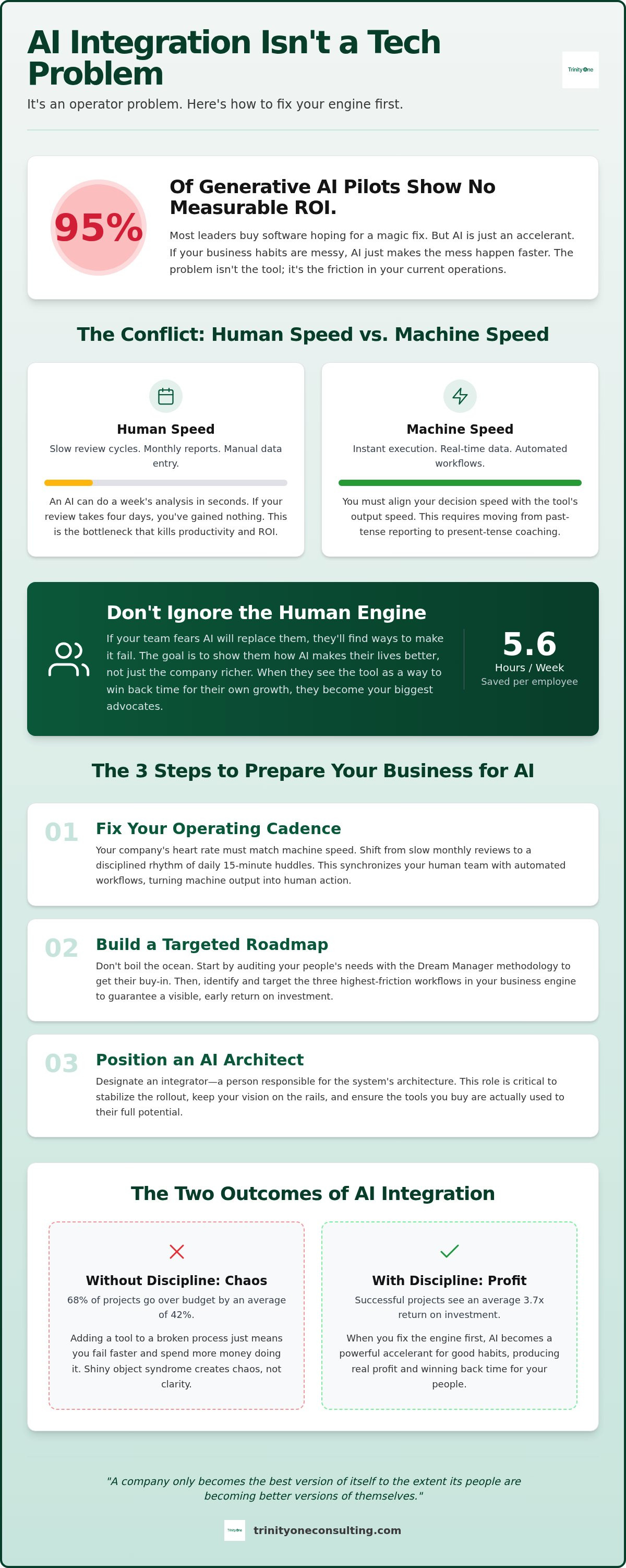
Ninety-five percent of generative AI pilots show no measurable return on investment. Most leaders are throwing money at software while ignoring how to prepare your business for AI integration through actual operational discipline. It's a waste of cash that creates chaos instead of clarity.
I know you feel the pressure to buy every new tool just to keep up with the 89 percent of small businesses already using the technology. You want the 3.7x average return on investment but you're stuck with employee fear and messy workflows. Software can't fix a broken culture or a disorganized engine.
I'll show you the specific operational and human steps required to build a business engine that produces real profit from these tools. My approach focuses on the Trinity Cadence to align your people with these machines. We'll move past the hype to ensure your team stops fearing replacement and starts winning back five hours of their week.
Key Takeaways
- Stop treating AI as a software fix and recognize it as an accelerant for your existing operational habits.
- Transition from monthly reviews to a real-time operating cadence that keeps pace with machine-speed execution.
- Learn how to prepare your business for AI integration by auditing your people and using the Dream Manager methodology to gain their buy-in.
- Build a roadmap that targets the three highest-friction workflows in your engine to ensure you see an actual return on investment.
- Position an integrator as the architect of your AI systems to stabilize your rollout and keep your vision on the rails.
Why does AI implementation usually fail in small businesses?
Ninety-five percent of generative AI pilots fail to show a return. It's usually not a tech problem. It's an operator problem. AI acts as an accelerant for your existing business habits. If your workflows are messy, AI just makes that mess happen faster.
Most owners buy software before they define the work. They see a demo and write a check. This is the cost of shiny object syndrome in 2026. When you add a tool to a broken process, you don't fix the process. You just spend more money to fail at a higher velocity.
You need to know how to prepare your business for AI integration by fixing the engine first. Sixty-eight percent of AI projects go over budget by an average of 42 percent. This happens because leaders ignore the friction between their current systems and machine capability. I've seen companies waste thousands on subscriptions that no one actually uses because the underlying work was never mapped out.
The friction between human speed and machine speed
Machine speed is instant. Human speed is inherently slower. When you mix them without a clear system, you create a bottleneck that kills productivity. AI can produce a week's worth of analysis in seconds, but if your review cycle takes four days, you've gained nothing.
Manual data entry remains the most common point of failure. You can't expect the benefits of Industrial Artificial Intelligence if your team is still manually typing data from one screen to another. These slow cycles stall the very efficiency you paid for. You have to align your decision speed with the output speed of the tools you buy.
Ignoring the human engine behind the tools
Your people are the engine of your company. If they fear a tool will replace them, they will find ways to make it fail. This isn't usually about malice. It's about basic human survival and a lack of personal alignment in your tech rollout.
Employees need to know that how to prepare your business for AI integration involves making their lives better, not just making the company richer. I use a Dream Manager program to bridge this gap. When a worker realizes that AI can save them 5.6 hours a week to focus on their own growth, they become your biggest advocates. A company only becomes its best version when its people are becoming their best versions too.
Is your operating cadence ready for machine-speed execution?
Operating cadence is the heart rate of your company. It is the disciplined rhythm of meetings and metrics. If your heart beats once a month, you are clinically dead. Most small businesses operate on a monthly or quarterly cycle that is far too slow for the current market. This lag is the biggest hurdle when learning how to prepare your business for AI integration.
AI produces data and executes tasks at machine speed. If you only review your progress every thirty days, you are trying to manage a jet engine with a sundial. You need real-time visibility into your operations. You must move from reporting what happened in the past to coaching what is happening in the present.
This shift requires a fundamental change in how you lead. You aren't just looking for errors in a spreadsheet. You are using live data to guide your team through their daily execution. It is the difference between watching game film on Tuesday and calling the right play from the sidelines on Saturday.
Establishing a unified rhythm of business
Daily huddles are the baseline for an AI-driven environment. These meetings should last exactly fifteen minutes and focus on the next twenty-four hours. They synchronize your human team with the automated workflows running in the background. This ensures that machine output actually results in human action.
I use the Trinity Cadence to create this unified rhythm. It aligns machine output with human performance so nothing gets lost in the gaps. This structure ensures your people are actually using the tools you bought instead of letting them sit idle. If your current rhythm feels disjointed, you might need a Fractional COO to audit your engine and rebuild your operating cadence.
Moving from static plans to dynamic execution
Traditional quarterly goals are too slow for 2026. By the time you reach month three, the technology has changed twice and your tactics are likely obsolete. You need a system that allows for mid-week adjustments based on live feedback. This is a critical part of how to prepare your business for AI integration.
AI coaching tools can now flag when team engagement is dipping or when a workflow is stalling. This allows you to step in before a minor friction point turns into a total engine failure. Real-time visibility prevents micromanagement. It gives you the data to provide support the moment your people need it.
When you have this level of insight, you can pivot without causing chaos. You stop guessing and start executing with precision. This is the only way to ensure your business remains agile enough to handle the constant updates in machine capability.
How to prepare your business for AI integration by auditing your people
People only support what they help create. If you drop a new AI tool on their desks without context, they'll view it as a threat to their mortgage. You have to show them how the tech serves their personal mission. This is how to prepare your business for AI integration at a human level.
Audit your engagement and the psychological safety of your team rather than just checking software licenses. High-tech tools fail in low-trust environments. You need a team that sees AI as a partner, not a replacement.
At Trinity One, we advocate for a holistic methodology to address this friction. This approach emphasizes aligning individual aspirations—encompassing financial security, professional growth, personal development, and long-term legacy—with the company's vision. When an employee sees that machine efficiency helps them leave on time for their kid's game, the resistance vanishes.
A people-centric approach to tech adoption
Resistance to new tools is usually a symptom of fear. Employees worry that efficiency leads to layoffs. You must flip the script by linking personal growth to professional performance in every conversation.
If your team is stuck in manual data entry, they aren't growing. They are just functioning as a slow bridge between two databases. Moving them into creative or strategic roles increases their value and your retention.
We've found that personalized coaching is the most effective way to manage this change. It turns a corporate mandate into a personal opportunity for the individual.
Mapping human performance to machine output
You have to be honest about which roles are augmented and which are replaced. Some tasks are simply better handled by an algorithm. Your job as an operator is to create a path for those people to move to higher-value work within your engine.
This transition is psychological. Help your people redefine their professional identity through 1-on-1 coaching. Move them from writing manual reports to auditing AI insights for strategic decisions.
Personal growth drives the ROI of your technology. I believe we are called to lead people, not just manage assets. A company only becomes the best version of itself to the extent its people are becoming better versions of themselves. That is the core of how to prepare your business for AI integration.
What are the specific steps for your AI implementation roadmap?
You can't just buy your way into efficiency. You have to build a roadmap that respects your current engine. The first step in how to prepare your business for AI integration is auditing your existing meeting and execution cadence. If your team is already drowning in poorly run meetings, adding AI will just automate the noise.
Identify the three highest-friction workflows in your engine. These are the tasks, like manual data entry or transcript cleaning, that eat your team's time without adding strategic value. Once identified, create an AI ROI map for each proposed tool. This map should show exactly where the money comes back to the company.
Launch a 30-day sprint for the first integration. This creates a tight feedback loop and prevents the project from dragging on for months. Review your metrics weekly instead of waiting for a quarterly report. Catching small errors in the first week prevents a massive budget overrun by the end of the month.
Mapping the actual ROI of AI implementation
To find the real value, calculate the time saved per head per week. If a $30 monthly subscription for Microsoft 365 Copilot saves an employee five hours of manual labor, the math is simple. Compare that software cost to the cost of those five hours of human labor. This approach is bad at measuring creative quality, but it is excellent for measuring operational speed.
You can find more on Measuring ROI of AI implementation to avoid the failure rate of most pilots.
The 30-day launch sprint methodology
Long-term deployments fail in small companies because they lose momentum. A rapid launch sprint forces you to focus on one specific outcome, which is how to prepare your business for AI integration without overwhelming the staff. For example, aim to reduce meeting prep time by 50 percent within the first month. This narrow scope ensures you actually finish what you start and see immediate results in your bank account.
How can a Fractional Integrator stabilize your AI rollout?
The Visionary CEO sees the future. They read reports showing that 89 percent of small businesses are adopting AI in 2026. But seeing the future is different from building it. The Integrator is the architect who builds the engine to capture that value. This is the final piece of how to prepare your business for AI integration.
AI integration requires an operator, not just a technician. A technician can install the software and connect the APIs. An operator understands how that software changes the way your team talks to each other. They know that if the machine saves an employee 5.6 hours a week, those hours must be redirected toward higher-value work immediately.
Hiring a full-time COO to manage this can put a massive strain on your budget. That is a significant investment before you've even seen a return on your software spend. A fractional role provides the leadership you need without the full-time overhead. You get the benefit of 30 years of operational experience to stabilize your rollout.
An Integrator manages the bridge between your people and your machines. We ensure that the technology serves the human engine, not the other way around. This prevents the operational chaos that usually follows a rushed tech deployment.
Engineering the Visionary and Integrator relationship
Friction starts when a Visionary tries to manage the technical details of AI data. They are built for big ideas, not for auditing meeting cadences or mapping workflows. An Integrator protects the CEO's time so they can stay focused on high-level strategy. I act as the filter that keeps the CEO out of the weeds while ensuring the team hits their marks. My Fractional COO services create the structure needed for the Visionary to lead with confidence.
Maintaining the system after the launch
Between 70 and 90 percent of AI projects fail to deliver their intended value. Most of these tools become shelfware after ninety days because the team stops using them. This is a common failure point in how to prepare your business for AI integration. An Integrator prevents this by enforcing the new operating rhythm every single day.
I use the Trinity Cadence as the single source of truth for the entire company. The cadence ensures that machine speed doesn't outpace human understanding. We review the metrics weekly to catch any drift in performance. This is how we ensure the 3.7x average ROI on AI tools actually hits your bottom line. Faith in the system only comes from consistent, disciplined execution.
Build an engine that outlasts the hype
AI integration requires a skilled operator, not just a line of code. If your business engine is leaking oil, a turbocharger will only blow the gaskets. You've learned how to prepare your business for AI integration by auditing your habits and establishing a real-time operating cadence. Fix the engine first.
People are the heart of the system. I use Matthew Kelly's Dream Manager methodology to ensure your team sees machine speed as a tool for their own growth. When an employee saves five hours a week, they should spend that time becoming a better version of themselves. Alignment is everything.
I've spent thirty years in the trenches as a corporate operator and a football coach. Games are won in the film room. My Trinity Cadence provides the AI-native OS you need to keep your vision aligned with your execution. Stop guessing and start winning.
You have the roadmap. Now it's time to execute. I trust that you'll lead your team with the conviction they deserve.
Common questions about AI integration
How much does it cost to prepare a small business for AI?
Most small businesses spend between $100 and $500 per month on software subscriptions in 2026. This covers the basic tools but ignores the cost of your internal labor spent on setup. You have to account for the time your team spends learning these systems. The real investment is in the operational audit required to ensure these tools produce a return. This audit prevents the 42 percent budget overrun common in most AI projects.
Is my business too small for an AI-native operating system?
Your business is never too small to benefit from a disciplined rhythm. Size doesn't matter when it comes to having a clear heart rate for your company. An AI-native operating system like Trinity Cadence provides real-time visibility regardless of your headcount. It ensures that even a team of three can move with the precision of a much larger organization. You are building an engine that stays stable as you grow.
How do I deal with employees who are afraid AI will take their jobs?
You address fear by showing your people how the technology serves their personal goals. I use the Dream Manager methodology, created by Matthew Kelly, to align their dreams with the company's mission. When a worker sees that AI saves them 5.6 hours a week to focus on their family or health, the fear disappears. You are leading people, not just installing assets. Personal growth is the engine of adoption.
What is the first AI tool I should integrate into my operations?
Start with a tool that fixes your most common friction point, which is usually meeting preparation or documentation. Microsoft 365 Copilot costs an additional $30 per user and integrates with your existing workflow. This is a low-risk way to learn how to prepare your business for AI integration without breaking your current engine. It provides immediate time savings that your team can feel in their daily execution.
Can I implement AI without hiring a full-time technical officer?
You don't need a full-time technical officer to get results. Most small businesses benefit more from an operator who understands how to align software with human performance. A Fractional Integrator provides the leadership and 30 years of experience needed to manage the rollout. This approach avoids the high salary of a full-time hire while keeping your vision on the rails. I focus on execution over theory.
What happens if our current data is messy or unorganized?
AI will act as an accelerant for your messy data. If your workflows are unorganized, the machine will simply produce faster errors. You must clean your internal engine before you start feeding it into a model. This is the primary reason why 95 percent of generative AI pilots fail to show a return. Operational discipline is the only cure for bad data. Fix the process before you buy the tool.
How long does a typical AI implementation sprint take?
A typical launch sprint takes exactly 30 days. We focus on one specific workflow to ensure the team doesn't get overwhelmed. Long deployments usually fail because they lose momentum and become shelfware. A tight 30-day window forces you to identify how to prepare your business for AI integration by achieving one measurable win. This builds the confidence needed to move toward more complex machine-speed operations.
What is the difference between an AI consultant and a Fractional Integrator?
An AI consultant provides a report and a list of suggestions. They tell you what to do but they don't stay to do it. A Fractional Integrator acts as an operator who builds the engine and manages the daily execution. We enforce the operating rhythm and ensure the Trinity Cadence remains the source of truth. I own the result, not just the advice. We build a lasting system.