
A high retainer is not a strategy. A busy calendar is not a result. For many founders, hiring an Integrator feels like a leap of faith into a black box where output is obscured by operational noise. You must know how to measure fractional COO performance with the same clinical precision you apply to your profit and loss statements. Without a clear framework, you are simply paying for expensive advice while your business engine remains stuck in second gear.
It's exhausting to manage the gap between strategic vision and daily execution. We understand that visibility is the only cure for the fear of wasted investment. This guide will help you master the metrics and frameworks needed to evaluate your Fractional COO with both technical accuracy and human depth. We will break down a definitive 90-day scorecard, align your leadership with your long-term vision, and ensure your operational engine is running with total efficiency. It is time to move past the noise and focus on the mechanics of growth.
Key Takeaways
- Stop measuring hours and start measuring impact. The Fractional Paradox demands a shift from time-based tracking to outcome-driven results.
- Discover how to measure fractional COO performance using the Triple-Threat Framework. This approach synchronizes machine efficiency, human development, and operational cadence.
- Balance the scales between data and culture. A high-performing Integrator hits KPIs without burning out the team or sacrificing long-term vision.
- Establish a clear 90-day roadmap. Transition from initial discovery to active AI implementation and system optimization with predefined milestones.
- Replace static dashboards with real-time visibility. Leverage tools like Trinity Cadence to gain a unified view of your company’s operational health and future trajectory.
Beyond the Timesheet: Why Traditional Performance Metrics Fail Fractional COOs
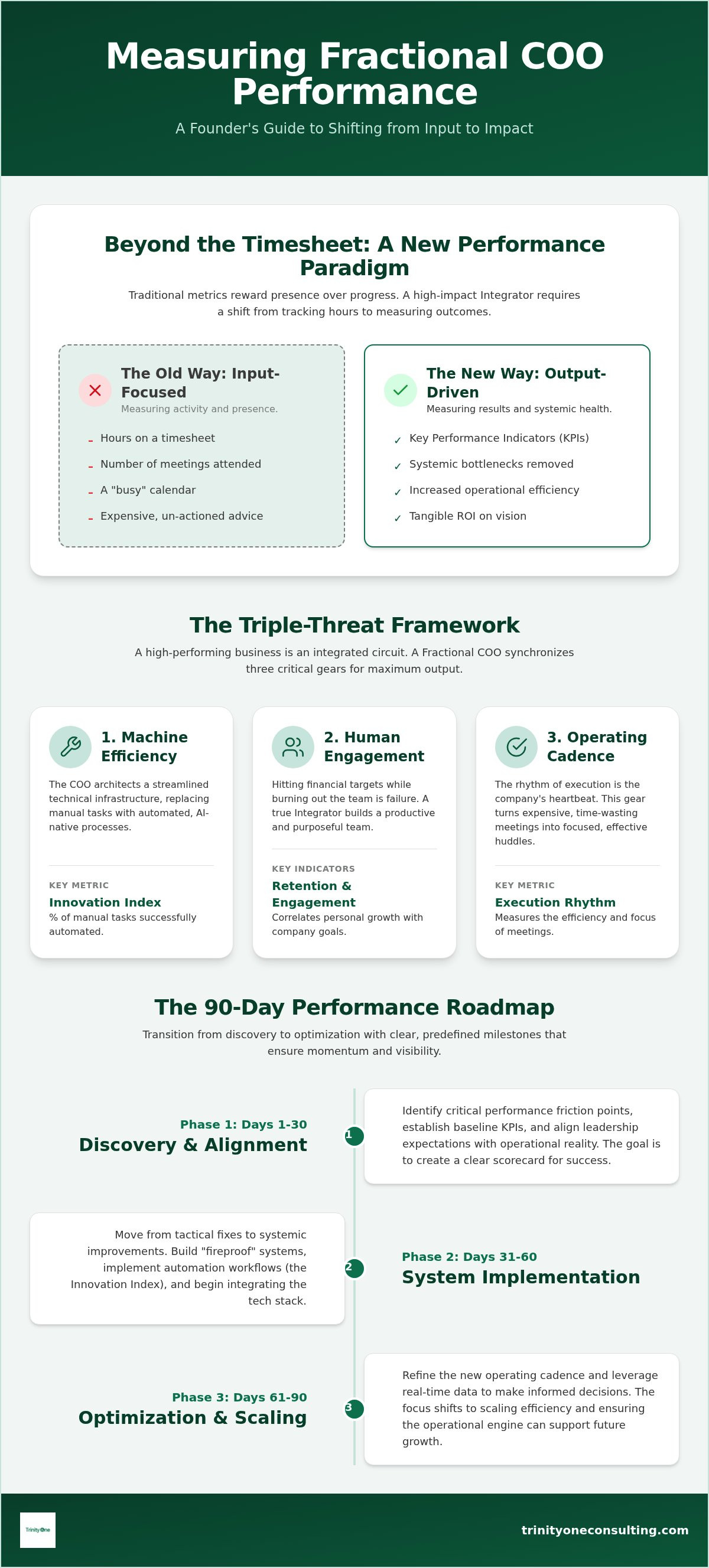
Traditional management relies on the timesheet. It is a legacy system designed for assembly lines, not the C-suite. When you hire an Integrator, using hours as a metric creates a performance vacuum. It rewards presence over progress. You aren't buying twenty hours of time; you are buying the removal of bottlenecks and the engineering of growth. Understanding how to measure fractional COO performance requires abandoning the calendar in favor of the scorecard. Input is a cost. Output is the ROI.
This is the "Fractional Paradox." You need full-time impact on a part-time schedule. Impact is not linear. It is exponential. A true Integrator doesn't just offer advice; they execute. A consultant tells you the engine is broken. A Fractional COO fixes the timing belt and tunes the cylinders. If you treat this role like a consultancy, you will pay for beautiful slide decks that gather digital dust. The first 30 days are critical. Misaligned expectations during this phase lead to expensive friction and "Integrator drift," where the executive becomes a high-priced project manager rather than a strategic architect.
The Shift from Input to Output
Leadership is binary. Either the system works, or it doesn't. Fractional roles require a "done or not done" measurement system that eliminates ambiguity. We move away from tracking activity to tracking a Key Performance Indicator (KPI) that reflects systemic health. Instead of managing people, the focus shifts to engineering systems that manage themselves. Fractional COO performance is the delta between visionary intent and operational reality.
Identifying the Performance Friction Points
Look for red flags early. Meeting fatigue is a common symptom of poor process. Stagnant KPIs suggest a failure in execution. Without a robust operating system, poor performance is easily hidden behind a veil of busy work. You must distinguish between tactical fixes and systemic health. A tactical fix solves a problem once. A systemic improvement ensures the problem never returns. If your Integrator is constantly putting out fires instead of building fireproof systems, they are failing the performance test. How to measure fractional COO performance effectively starts with identifying these friction points before they stall your momentum.
The Triple-Threat Framework: Measuring Machine, Human, and Process Efficiency
A business is not a loose collection of departments. It is an integrated circuit. To master how to measure fractional COO performance, you must evaluate three synchronized gears: Machine Efficiency, Human Engagement, and Operating Cadence. When these gears align, the business engine runs with clinical precision. When they slip, you face operational friction that drains capital and morale. A high-level Integrator doesn't just manage these gears; they synchronize them into a single, high-output system.
Gear 1: Calibrating Machine Efficiency
The modern business engine is powered by automation. A Fractional COO must act as the primary architect of your technical infrastructure. You measure success here through the Innovation Index. This is the percentage of manual, repetitive tasks successfully transitioned into AI-native processes. A battle-tested leader reduces a bloated software budget while increasing total output. They eliminate technical debt and replace it with streamlined workflows. If your tech stack feels like a collection of siloed tools rather than a unified engine, your Integrator has more work to do.
Gear 2: The Human Performance Delta
Technical efficiency is useless without human connection. We measure the "Dream Manager" effect to correlate personal employee goals with company work output. High performance is a byproduct of high engagement. By tracking DreamCompass milestones, a COO ensures that team members are growing alongside the business. Retention rates and internal engagement scores are not "soft" metrics. They are clinical indicators of leadership health. A COO who hits financial targets while burning out the staff is not a builder; they are a liquidator. True ROI comes from a team that is both productive and purposeful.
Gear 3: Precision in the Operating Cadence
The Operating Cadence is the rhythm of your execution. It is the heartbeat of the company. You must evaluate whether your meetings are focused huddles or expensive time-wasters. A Fractional COO should provide total execution visibility. You deserve to see progress in real-time without asking for updates or digging through email threads. This transparency is the hallmark of the Fractional Integrator who is engineering your business for 2026 and beyond. If the "engine" requires your constant intervention to stay on track, the cadence is broken.
Building this framework requires a shift in perspective. If you want to identify the friction points in your current setup, an AI Implementation audit can reveal exactly where your machine efficiency is stalling.
Quantitative vs. Qualitative: A Performance Comparison Table
A balanced scorecard is the only way to avoid the KPI trap. If you focus exclusively on hard data, you risk building a high-output machine that burns out its human components. Conversely, focusing only on culture leads to a feel-good environment that lacks financial discipline. Mastering how to measure fractional COO performance requires a dual-lens approach. You must track the clinical precision of the numbers alongside the empathetic depth of the team's health. This balance ensures that short-term gains don't cause long-term structural damage.
Your business stage determines how you weight these metrics. In a survival phase, you might weight cash flow and cost reduction at 80%. In a scaling phase, you shift that weight toward systems, leverage, and leadership trust. To protect the business, you must set "Guardrail Metrics." For example, if revenue grows by 20% but employee churn exceeds 15%, the growth is unsustainable. The Integrator's job is to keep the engine in the green across both categories.
Hard KPIs: The Financial and Operational Bedrock
These metrics represent the mechanical health of your business engine. They are objective and binary. Either the needle moved, or it didn't.
- Gross Margin Improvement: This is the ultimate proof of operational efficiency. A COO should find ways to deliver the same value at a lower internal cost.
- Reduction in the "Cost of Chaos": Measure the decrease in rework, customer refunds, and internal errors. Chaos is expensive; order is profitable.
- Cycle Time Reduction: Track the speed from Visionary intent to final execution. A high-performing COO shortens the distance between a "good idea" and a "delivered result."
Soft Signals: The Culture and Trust Barometer
Soft signals are leading indicators of future success. They are harder to quantify but impossible to ignore if you want to understand how to measure fractional COO performance with depth.
- The Visionary Freedom Score: Track how much time the CEO spends on high-level strategy versus putting out operational fires. If the CEO is still in the weeds, the COO is not yet in control.
- Team Alignment: Evaluate your weekly leadership meetings. Are they resolving permanent issues or just discussing temporary symptoms? Real alignment produces decisive action.
- Trust Equity: Measure the speed at which the Integrator builds rapport with the existing leadership. Without trust, even the best systems will face internal resistance.
By contrasting these two sets of data, you gain a 360-degree view of executive ROI. It isn't enough to hit the numbers. You must hit them in a way that strengthens the business for the next decade.
The 90-Day Performance Roadmap: Milestones for Your Fractional Integrator
Traditional executive onboarding is a luxury of the past. In a fractional model, speed is the primary currency. You cannot wait six months for a leader to "find their feet" while your overhead continues to climb. A structured roadmap provides the binary proof of value you need to justify the investment. This 90-day blueprint defines how to measure fractional COO performance from the first handshake to full operational integration. It moves from diagnostic discovery to high-speed execution with clinical precision.
Month 1: Identifying the Operational "Debt"
The first thirty days are about mapping the integrated circuit of your business. Your Integrator should identify the top three operational bottlenecks within the first 14 days. This is not a passive observation phase; it is an active audit of your operational debt. They must establish clear baselines for current machine efficiency and human engagement. By auditing your meeting cadence and reporting structures, they reveal where energy is being wasted. If they haven't diagnosed the "Cost of Chaos" by the end of month one, the engine is already stalling.
Month 2: Implementing the Trinity Cadence
Month two is the deployment phase. We move from manual tracking to real-time visibility. This is where the Trinity Cadence takes root. The Integrator standardizes the weekly leadership meeting format to ensure every huddle produces a result rather than just a discussion. Simultaneously, they launch the first Dream Manager huddles to anchor the team's output in personal purpose. You should see the first AI-native workflows reducing manual rework during this window. Execution becomes a visible, measurable rhythm rather than a series of disconnected tasks.
Month 3: Measuring the ROI of Scalability
By day ninety, the diagnostic period ends and the data speaks. You must calculate the hard ROI: compare the time saved across the leadership team against the monthly retainer cost. Review the AI ROI map to verify that new workflows are delivering genuine financial leverage. This is the moment for a definitive "Fit Assessment." If the business engine is running more efficiently and the team's trust equity is rising, the partnership is validated. You now have a long-term scorecard that ensures continuous alignment between visionary intent and operational reality.
If you are ready to stop guessing and start scaling with a battle-tested roadmap, explore how a Fractional COO can engineer your business for immediate impact.
Engineering Real-Time Visibility: Scaling Performance with Trinity Cadence
Static dashboards are a post-mortem. They tell you why you failed last month but offer no guidance for tomorrow. This inherent lag is the primary obstacle in how to measure fractional COO performance with precision. If you are waiting for a monthly report to understand your operational health, you are already behind the curve. High-velocity growth requires real-time execution tracking. It requires a system that functions like an integrated circuit, providing constant feedback loops between your strategic intent and your daily output. Reporting is history; tracking is reality.
Trinity Cadence solves the visibility gap. It is an AI-native operating system that creates a unified view of your business engine. It bridges the distance between machine automation and human motivation. When your Fractional COO is off-clock, the system remains active. AI coaching modules augment the executive's presence, ensuring your team stays aligned with the operating rhythm even when leadership isn't in the room. This is the shift from passive reporting to active engineering. You no longer have to wonder if the engine is running; you can see the RPMs in real-time.
The AI-Native Operating System Advantage
Manual data collection is a friction point that produces "dirty" data. Trinity Cadence automates the gathering of performance metrics, eliminating the human error and bias inherent in traditional reporting. It provides real-time visibility into team engagement and "Dream" progress, linking personal fulfillment to professional output. You can see exactly where a workflow is stalling or where a team member is losing momentum before it impacts the bottom line. The best Fractional COOs insist on a digital operating cadence because it removes the ambiguity of leadership. It turns performance into a transparent, undeniable fact.
Next Steps: Calibrating Your Business Engine
Scaling requires more than just a part-time executive. It requires a systemic upgrade. To accelerate impact, we recommend starting with a Launch Sprint. This intensive phase allows a certified Integrator to map your AI ROI and synchronize your people with your tech stack. You need a leader who understands the clinical logic of software and the psychological depth of human purpose. A unified approach is the only way to achieve sustainable operational ROI. Stop managing the status quo and start engineering your future.
Ready to see the data behind your growth? Schedule your AI ROI mapping session with Trinity One and gain the visibility you deserve.
Turning Operational Insight into Executive ROI
Input is a cost. Output is an investment. By shifting your focus from timesheets to systemic impact, you reclaim control over your company's trajectory. Mastering how to measure fractional COO performance transforms a high-level hire from a potential liability into a predictable asset. You now have the framework to synchronize technical efficiency with human motivation. You have the roadmap to move from initial audit to AI-native execution in ninety days. Clarity replaces chaos.
True operational ROI requires more than just a scorecard. It requires a battle-tested partner. We combine thirty years of leadership experience with our proprietary Trinity Cadence OS and certified Dream Management facilitation. We don't just manage your business; we engineer it for scale. It's time to stop guessing and start leading with clinical precision. Your vision deserves an engine that can keep pace with your ambition.
Calibrate your business engine with a Trinity One Fractional Integrator. The path to a frictionless future is within your reach.
Frequently Asked Questions
How much should a Fractional COO cost relative to their performance?
An effective Fractional COO should deliver a 3x to 5x return on their retainer through cost savings, capacity gains, or revenue acceleration. Typical market rates for experienced executives range from $11,000 to $14,000 per month for standard engagements. You must evaluate the investment based on the "Cost of Chaos" they eliminate. If the Integrator doesn't free up your time or increase gross margin, the cost is too high regardless of the dollar amount.
Can I use weekly operating metrics to measure a Fractional Integrator?
Weekly operating metrics are an excellent foundation, but they only track the pulse of the business. You can use weekly scorecard results and quarterly priority completion rates to understand how to measure fractional COO performance in the short term. However, true leadership ROI goes deeper. You must also track systemic health and the successful integration of machine efficiency into your existing operating framework. Metrics show the pulse; the Integrator manages the engine.
What is the most important KPI for a Fractional COO in the first 30 days?
The most critical KPI in the first thirty days is "Bottleneck Diagnostic Accuracy." Your Fractional COO should identify the top three operational friction points within the first 14 days. Success in the first month is defined by their ability to map your current operational debt. They must provide a clear baseline for your machine and human systems before they begin engineering any new workflows. Discovery must lead to a decisive plan.
How does AI implementation impact the way we measure COO success?
AI implementation shifts the focus from managing headcount to managing output. We measure success by the Innovation Index. This tracks the percentage of manual tasks transitioned to AI-native processes. A high-performing COO reduces the human labor required for repetitive tasks while increasing total accuracy. This allows your team to focus on high-value strategic work rather than administrative maintenance. Success is found in the delta between manual effort and automated result.
What is the "Dream Manager" program and how does it relate to operations?
The Dream Manager program is a human-centric framework that correlates personal goal achievement with professional output. It relates to operations because a team that feels supported is a team that executes with loyalty. By using tools like DreamCompass, the COO ensures your human "engine" is as well-maintained as your technical systems. This directly impacts retention and engagement scores. Personal growth drives professional precision.
Is a Fractional COO responsible for team culture or just processes?
A Fractional COO is responsible for the intersection of culture and process. Process is the mechanical skeleton of your business; culture is the nervous system that makes it move. They must engineer systems that support a healthy culture rather than systems that work against it. If a process is technically perfect but destroys team morale, the COO has failed to build a sustainable engine. They manage the machine and the humans simultaneously.
How do I know if my company is ready for a Fractional Integrator?
You are ready for a Fractional Integrator when the founder becomes the primary bottleneck for growth. If you have a clear vision but lack the technical systems to execute it, you need an operational architect. Signs of readiness include "Integrator drift" among existing staff and a consistent gap between your strategic goals and your team's daily output. When the engine can no longer handle the Visionary's speed, it's time to upgrade.
What happens if the Fractional COO hits the KPIs but the Visionary is still stressed?
If KPIs are met but the Visionary remains stressed, the "Visionary Freedom" score is failing. This suggests that the COO is hitting tactical targets but failing to provide true strategic relief. It often indicates a lack of trust equity or a failure in the operating cadence. You must recalibrate the relationship to ensure the COO is owning the outcome, not just managing the tasks. Alignment is the cure for executive burnout.