
Over 40% of small and mid-market companies in the US will use fractional leadership by the end of 2026. You likely hired one to stop the 60-hour weeks and get out of the weeds. Learning how to manage a fractional integrator is the difference between a business that scales and one that just adds another layer of noise.
It's frustrating to pay a high-level operator while still feeling the need to approve every minor decision. You worry that someone working 15 hours a week will never care about your culture. The tradeoff is clear. You get elite experience for less money, but you lose the physical presence of a full-time hire.
I'll show you how to manage a fractional leader to drive execution without losing your vision or your mind. We'll move past the fear of being out of the loop. You deserve a company that functions without your constant input. It's time to lead.
A predictable cadence built on real-time data and AI acts as the engine for your operations. This turns your integrator into a partner who understands your numbers and your people. I believe we are called to lead with both technical precision and human purpose.
Key Takeaways
- Treat your fractional integrator as a strategic partner who protects your vision rather than a high-level clerk who just files reports.
- Learn how to manage a fractional integrator by implementing a 90-day execution plan that defines exactly what winning looks like for your business.
- Introduce the new leader as a gift to your employees to ensure they see the operational support as a relief instead of a threat.
- Maintain real-time visibility into your business through Trinity Cadence, an AI-native operating system that functions even when your leader is away.
- Evaluate the engagement by the hours you reclaim for deep work and the growth of your staff through the Dream Manager program by Matthew Kelly.
How to manage a fractional integrator without losing control of your vision?
I've watched dozens of founders hire a high-level operator only to treat them like a glorified secretary. They hand over their calendar and expect the problems to vanish. That isn't a strategy. It's an expensive mistake. Knowing how to manage a fractional integrator requires you to stop looking for a clerk and start looking for a partner to protect your vision.
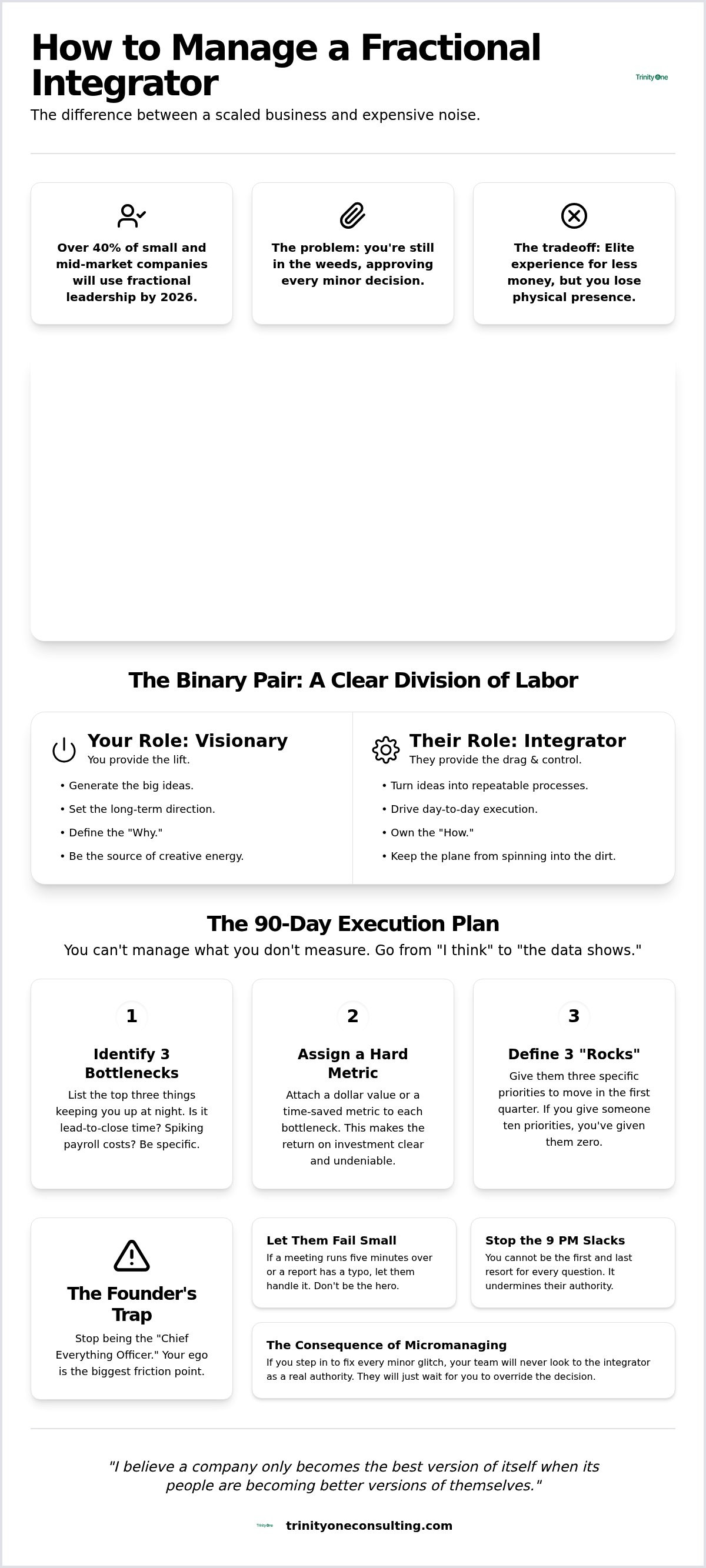
You provide the fuel. They provide the engine. The Entrepreneurial Operating System defines this relationship as a binary pair. Your job is to generate the big ideas and the long-term direction. Their job is to turn those ideas into a repeatable process that doesn't break when you go on vacation.
Managing this role starts with a clear division of labor. I recommend a written contract of authority. This document lists exactly what decisions they can make without calling you first. If they can't spend $5,000 or hire a mid-level manager without your permission, you haven't hired an integrator. You've just hired a bottleneck.
The difference between a partner and a project manager
A partner owns the final outcome. A project manager only owns the tasks on a list. When you hire an integrator, you are paying for their judgment. You are paying for their ability to look you in the eye and say no to your newest, half-baked idea.
I call this the physics of leadership. You provide the lift that gets the company off the ground. They provide the drag and the control surfaces that keep the plane from spinning into the dirt. Without that resistance, you will eventually burn out the engine or fly into a mountain.
Why you must stop being the "Chief Everything Officer"
Your integrator cannot lead if you are still the one answering every Slack message at 9:00 PM. I've found the biggest friction point in this relationship is usually the founder's own ego. You want the freedom of a managed business, but you still want the dopamine hit of being the hero who saves the day.
You have to let them fail on small things. If a meeting runs five minutes over or a report has a typo, let them handle it. If you step in to fix every minor glitch, your team will never look to the integrator as a real authority. They will just wait for you to override the decision.
I believe a company only becomes the best version of itself when its people are becoming better versions of themselves. This is why I use the Dream Manager program by Matthew Kelly to align your staff with your vision. I use a fractional COO approach to build this trust through data. We move the conversation from "I think" to "the data shows."
How do you manage a fractional integrator to ensure they meet expectations?
You can't manage what you don't measure. If you haven't defined what winning looks like, your new leader will spend their time chasing ghosts. I start every engagement with a 90-day execution plan. This is the blueprint that prevents the "what are they actually doing?" question from popping up at week six.
Learning how to manage a fractional integrator requires you to abandon vague goals. I don't care about "better culture" or "improved efficiency" as abstract concepts. Those are outcomes of good systems. I want to see specific, hard numbers that prove the engine is running better.
Give them three specific Rocks to move in the first quarter. These are the big boulders that block your path to growth. If you give someone ten priorities, you've given them zero. Pick the three that will have the biggest impact on your bottom line or your sanity.
Defining the 90-day execution plan
Start by listing the top three bottlenecks that keep you up at night. Maybe your lead-to-close time is dragging, or your payroll costs are spiking without a matching increase in revenue. Assign a dollar value or a time-saved metric to each one. This makes the return on investment clear and undeniable.
I focus on these metrics because they provide the clinical precision needed for growth. You can see how I structure these priorities by reviewing the role of a fractional COO. We move from guessing to knowing by using real data from your operations.
We also use the Dream Manager program by Matthew Kelly to ensure your staff stays engaged while these changes happen. A business is just a collection of people. If their dreams aren't aligned with the company's direction, the best execution plan in the world will fail. Your people need to know that their personal growth matters as much as the quarterly targets.
Setting the "Same Page" meeting rhythm
You need one hour every week where it's just you and the integrator. This isn't a status update. It's a gut check on alignment. I've seen these meetings save companies from expensive strategic drifts that would have cost $100,000 in wasted development time.
This meeting is a deep dive into how executives should be spending their time to stay ahead of the market. If you are both out of sync for even seven days, the team feels it. A quick weekly realignment keeps the vision pure and the execution sharp.
I've coached leaders who skipped these meetings and regretted it when their teams started pulling in opposite directions. It is the most important hour on your calendar. If your leadership team is drifting, book a cadence call to get back on track.
How do you get your team to trust an outside integrator?
Your team will likely view a new, part-time leader as a threat or a temporary annoyance. They've seen consultants come and go with binders full of advice that never gets used. Trust starts after the contract is signed. You build it through consistent support and the removal of the chaos you've been creating.
I tell founders to announce this role as a gift to the staff. This hire adds clarity, not more management. It removes the "Founder Bottleneck" that keeps them from doing their best work. When you explain how to manage a fractional integrator to your team, focus on the relief it provides them.
You must back their decisions publicly even when you disagree privately. If the team sees a crack in your alignment, they will exploit it. Effective Time Management for a CEO means trusting your operator to handle the details so you can focus on the big picture. If you second-guess them in front of the group, you've already lost.
Communicating the hire to your direct reports
Explain that this person is here to clear the path for their success. Don't call them a consultant. That word implies they are just here to talk. Call them the leader of operations or your fractional COO. This gives them the weight of a real executive.
Be honest about why you are doing this. Tell them you realize you've been the one slowing things down. This humility builds rapport immediately. It shows the team that you are serious about becoming the best version of the company. I believe we are called to lead with a spirit of service to those in our care.
I believe people only grow when the environment allows it. This is the core of the Dream Manager program by Matthew Kelly. We use this methodology to ensure your team's personal goals align with the company's growth. When they see the integrator helping them reach their own dreams, the resistance disappears.
Handling the "Wait and See" attitude
Some employees will try to go around the integrator to get to you. They want the old way of doing things because it's familiar. I've found that a simple "Did you talk to the integrator about this?" stops the leak immediately. You have to be the one to enforce the new chain of command.
If you take the bait and solve their problem, you've just undermined your new hire. It takes discipline to stay out of the weeds. I've coached leaders who struggled with this for months. The ones who succeeded were those who stayed firm on the new rhythm. Consistency is the only way to prove this isn't just another flavor of the month.
How does an AI-native operating cadence keep your integrator on track?
A fractional leader is only there part of the time. Your business runs 24/7. This gap is where most founders lose their grip on execution. Knowing how to manage a fractional integrator in 2026 requires more than just a weekly Zoom call. You need a system that works while everyone is asleep.
I use Trinity Cadence to create a unified view of execution and engagement. It acts as the digital nervous system of your company. AI coaching identifies friction in your meetings before they become expensive. You don't need a full-time COO when you have a high-performance business engine that monitors itself.
I believe we are called to lead with both technical precision and human purpose. This means using every tool available to protect the people and the mission. Technology isn't a replacement for leadership. It's the infrastructure that makes leadership possible in a fractional model.
Moving from manual reporting to real-time visibility
Stop waiting for a Friday report to know if you're on track. By the time you read a manual update, the damage is already done. I've seen AI tools catch missed deadlines three days faster than a human operator. This speed keeps your integrator effective even when they are off-site.
You can't afford to be reactive in a market that moves this fast. Real-time data allows you to pivot on Tuesday instead of apologizing on Monday. You can see how to create a business operating system that stays ahead of the curve. This technical setup ensures the "same page" rhythm I mentioned earlier is backed by facts, not feelings.
Calibrating your meeting rhythm with technology
Your integrator should run your Level 10 meetings using a digital scorecard. This keeps the conversation focused on the numbers that drive growth. AI summarizes action items so nothing falls through the cracks. I've found that this reduces meeting fatigue by 30% for most teams.
Efficiency is only half of the equation. I also use the Dream Manager program by Matthew Kelly to monitor the human side of the business. We track the twelve dream categories to ensure your people aren't being ground down by the machine. A business only becomes the best version of itself when the people are growing too.
I've seen too many Visionaries get frustrated because they can't "see" what their part-time leader is doing. Technology solves this visibility problem. It turns management into a data-driven science. When your integrator has real-time visibility, they can hold the team accountable without needing to be in the office 40 hours a week.
This approach is bad at hiding poor performance. If your team is coasting, the AI will highlight the lag immediately. It forces a level of radical honesty that some cultures aren't ready for. But for those who want to win, it's the only way to operate.
How do you know if your fractional integrator is actually working?
The ultimate metric for success is your own calendar. If you are still buried in the $20-an-hour tasks while paying for an executive operator, the engine is broken. You hired a partner to reclaim your time for the big ideas that only you can generate. Success looks like a Tuesday afternoon where you are thinking about 2027 instead of arguing about a software subscription.
I also measure success through employee retention and engagement. A high-level operator should be more than a process builder. They should be a culture builder. Learning how to manage a fractional integrator effectively means looking beyond the spreadsheet and into the eyes of your team.
This approach is bad at providing instant, overnight fixes for a toxic culture. It takes time to rebuild trust and align personal dreams with company goals. The cost is a slower start, but the upside is a company that doesn't fall apart when the economy shifts. I've seen businesses reduce their turnover by 25% simply by shifting the focus from tasks to people.
Linking personal dreams to professional output
Matthew Kelly teaches that helping employees achieve personal goals drives loyalty. I ask integrators to track the 12 dream categories for their direct reports. This isn't just about being nice. It's about building a team that actually wants to be there. You can see the ROI in helping employees achieve personal goals through higher retention rates and fewer missed deadlines.
I believe a company only grows as fast as its people do. When your integrator helps a manager buy their first home or run a marathon, that manager becomes more invested in your success. It turns a job into a mission. This is the core of the Dream Manager program and it's how you build a business that lasts.
The honest conviction of leadership
I've stayed in this business for 30 years because I believe we're called to serve our teams. Your integrator is the primary steward of that service. They are the ones in the trenches ensuring that every person is treated with dignity and pushed toward excellence. I am a man of faith who believes our work should reflect our values every single day.
If your team is becoming better versions of themselves, your integrator is succeeding. You'll hear it in the way they talk about their work and see it in the clinical precision of their output. A healthy business is the natural result of healthy people. When the machine and the mission are in alignment, the results are undeniable.
Build a business engine that runs without you
Managing a fractional leader is a test of your own discipline. It requires moving from a state of constant reaction to one of data-driven precision. When you master how to manage a fractional integrator, you stop being the bottleneck and start being the visionary your company needs.
Success depends on a 90-day execution plan and an AI-native cadence that provides visibility even when your operator is off-site. I've spent 30 years in the trenches of operational leadership and football coaching. I know that a team only wins when the system and the people are in sync.
I use the Dream Manager program by Matthew Kelly to ensure your staff isn't just surviving but thriving. This is the only way to build a business that runs on a predictable rhythm. I believe we are called to lead with a spirit of service to those in our care.
Your business can become the best version of itself. You've done the hard work of building the vision. Now it's time to build the engine that protects it.
Frequently Asked Questions
How much does it cost to manage a fractional integrator?
Industry data for 2026 shows that fractional COO retainers typically fall between $8,000 and $18,000 per month. The actual cost to your business depends on the complexity of your engine and the number of direct reports. You should view this as a capital efficiency play. A full-time executive often costs over $300,000 annually when you include benefits and equity. You pay for the judgment, not just the hours.
What happens if my team doesn't like the new integrator?
Friction usually happens when the team feels threatened or over-managed. I've found that using the Dream Manager program by Matthew Kelly helps bridge this gap. When the integrator focuses on the twelve dream categories of the staff, they become an ally instead of an intruder. If the dislike persists, check if you are publicly backing their decisions. Alignment at the top is the only way to stop team resentment.
Can a fractional integrator handle a team of more than 50 people?
They can manage large teams if they have the right digital infrastructure. A team of 50 or more requires an AI-native operating system like Trinity Cadence to maintain visibility. Without real-time data, a part-time leader will struggle to keep up with the volume of decisions. I've seen fractional operators manage departments of 100 people by focusing on high-level strategy and scorecard metrics. It requires discipline and clear systems.
How many hours a week does a fractional integrator usually work?
Most engagements range from 10 to 20 hours per week. This isn't about punching a clock. It's about driving specific outcomes and moving your quarterly Rocks. A battle-tested operator can often do more in 15 hours than a junior manager can do in 50. The tradeoff is that they aren't there for every water-cooler conversation. You are buying their experience, not their presence for 40 hours.
Is it worth it to hire a fractional integrator for a small business?
It is worth it if you are currently the bottleneck in your own company. If your lead-to-close time is dragging or you're missing deadlines, you need an operator. Small businesses often can't afford a full-time C-suite salary but desperately need the experience. Learning how to manage a fractional integrator allows you to access that elite talent without the $250,000 overhead. It's about buying your freedom back from the daily grind.
How do I know if I'm the one causing the problems for my integrator?
Look at your Slack history and your calendar. If you are still answering technical questions or overriding decisions, you are the problem. I've coached many founders who struggled to let go of the "Chief Everything Officer" title. Your integrator needs the authority to fail on small things so they can succeed on big ones. If you don't step back, they can't step up to lead.
What is the difference between a fractional integrator and a consultant?
A consultant gives you a report, but an integrator gives you a result. Consultants are advisors who stand on the sidelines. Integrators are operators who get in the game and hold your team accountable. They attend your weekly meetings and own the scorecard. You are hiring a partner to run the engine, not a professor to explain how it works. Accountability is the key difference.
Can I use a fractional integrator if I don't use EOS?
You don't need a specific framework to benefit from fractional leadership. While many integrators are trained in the Entrepreneurial Operating System, I use Trinity Cadence to provide a more flexible, AI-driven approach. The goal is a predictable business rhythm, regardless of the specific methodology you choose. You just need a system that aligns your people with your numbers. Results matter more than the acronym on the binder.