
You are likely the bottleneck in your own company. Most founders feel like prisoners to daily operations because they lack a clear division between the big ideas and the actual execution. Understanding the common conflicts between visionary and integrator roles is the first step to reclaiming your time. You aren't a failure, but your business structure probably is.
I've seen this play out in dozens of boardrooms and on the sidelines. You start the week with a list of massive ideas and end it frustrated because none of them crossed the finish line. The friction you feel with your leadership team isn't about personality clashes. It's about misaligned gears in your organizational engine.
A business only grows when the people inside it grow. For real results, it's critical that individual strengths are channeled into appropriate professional roles. If you're a visionary trying to manage spreadsheets, you're suffocating the very thing that makes your company special.
We're going to fix that right now. You will identify your natural leadership archetype and learn why the operational chaos isn't your fault. This is the path to scaling past the current revenue ceiling without burning out your soul.
Key Takeaways
- Identify whether your natural energy aligns with seeing what could be or managing what is right now.
- Understand how common conflicts between visionary and integrator roles signal a need for structural change rather than a search for new staff.
- Discover why forcing yourself to play both roles creates a mental friction that eventually breaks your business engine.
- Learn to audit your five most recent wins to find your true leadership archetype without using a complex quiz.
- See how a fractional integrator provides the operational focus you need to grow while staying in your zone of genius.
What is the core difference between a visionary and an integrator?
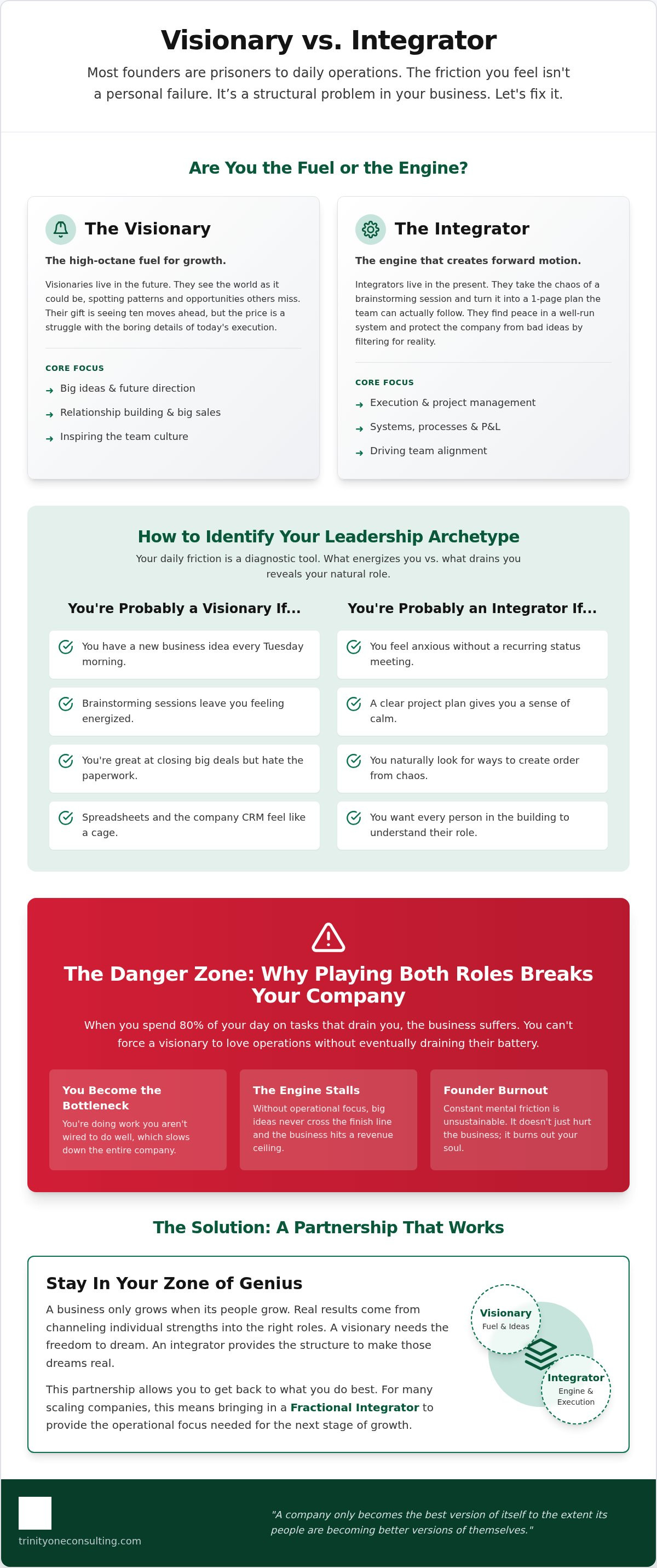
The visionary and the integrator aren't just two different job descriptions. They are two different operating systems. A visionary lives in the future and sees the world as it could be. An integrator lives in the present and sees the world as it is right now.
This tension is the source of the most common conflicts between visionary and integrator roles. One wants to fly at 30,000 feet. The other wants to make sure the landing gear actually works. Without both, the business either stalls or crashes.
Think of the visionary as the high-octane fuel. Think of the integrator as the engine. Fuel without an engine is just a puddle of potential. An engine without fuel is a heavy piece of dead metal. You need the explosion of ideas to move, but you need the mechanical structure to turn that energy into forward motion.
Leaders often drift between different leadership styles, but these core archetypes are usually fixed. A visionary is a leader who sees 10 moves ahead but might forget where they parked their car today. They are wired for growth, not for maintenance.
The visionary mindset and its unique challenges
Visionaries see patterns and opportunities that others miss. They can look at a messy market and spot the one opening that leads to a win. This gift comes with a price. They often struggle with the boring details of daily execution.
Spreadsheets feel like a cage to a visionary. They need space to create without being bogged down by the minutiae of a project plan. When a visionary is forced to manage the day-to-day, they become irritable and ineffective. Their best work happens when they are allowed to stay in the clouds.
The integrator mindset and the need for order
Integrators find peace in a well-run system and a clear cadence. They take the chaos of a visionary's brainstorming session and filter it through reality. They are the ones who turn a 10-page idea into a 1-page plan that the team can actually follow.
A strong integrator protects the visionary from their own bad ideas. Not every thought that pops into a founder's head is a winner. The integrator acts as a filter, ensuring the team only works on the highest-impact tasks. This role is often filled by a fractional COO when a company is scaling past its initial launch.
Integrators crave alignment. They want to know that every person in the building understands their role. This focus on execution creates the stability that allows the visionary to keep dreaming. It's a partnership of opposites that creates a unified whole.
How to know if you are a visionary or integrator based on your daily friction
Your calendar is a diagnostic tool for your leadership health. If you look at your schedule and see back-to-back status updates, your reaction reveals your archetype. A visionary feels trapped by a recurring meeting while an integrator feels anxious without one.
This visceral reaction is at the heart of many common conflicts between visionary and integrator roles. It's not a character flaw. It's a misalignment of your natural energy. You can't force a high-octane visionary to love a 90-minute operations review without eventually draining their battery.
Friction is the best indicator that you are sitting in the wrong leadership seat. When you spend 80 percent of your day on tasks that drain you, the business suffers. You become the bottleneck because you're doing work you aren't wired to do well.
Understanding Visionaries vs. Integrators requires looking at what gives you life. If you leave a brainstorming session feeling like you could run through a brick wall, you're likely a visionary. If you leave a project planning session with a sense of calm because every task has an owner, you're likely an integrator.
Common signs that you are a natural visionary
You probably have a new business idea every Tuesday morning before you've even finished your first cup of coffee. This is your greatest strength, but it often drives your team crazy. They haven't even finished the last three ideas you gave them last month.
You constantly feel like your team is moving too slowly to meet your goals. You are likely great at closing big deals but hate the paperwork that follows. The thrill is in the hunt and the win, not the administrative trail.
If you find yourself avoiding the CRM like it's a contagious disease, you're a visionary. You need someone else to handle the follow-up so you can go find the next opportunity. Your focus is on the horizon, not the dirt under your fingernails.
Common signs that you are a natural integrator
You are the one who actually reads the operating manual for the new project management software. While the visionary is clicking buttons to see what happens, you are mapping out the logic. You find yourself fixing the communication gaps between departments because you hate seeing energy wasted on confusion.
You care more about the how than the what of a new project. A new idea doesn't excite you until you can see the specific steps required to make it real. You find peace in a well-defined process and a clear cadence of accountability.
You are the glue that holds the business engine together during a growth spurt. You prioritize stability and predictable results over the next shiny object. If these descriptions make you realize you're doing the wrong work, it might be time for a quick conversation about your current seat.
Why trying to be both roles will eventually break your company
Scaling a business isn't about working harder. It is about understanding operational physics. You cannot be the gas and the brake at the same time without smoking the engine. Trying to play both roles is a recipe for a permanent plateau.
Operating a business requires two distinct types of mental energy that rarely exist in the same skull. The visionary provides the explosive force for growth. The integrator provides the structural integrity to handle that force. This creates a necessary tension that drives the company forward.
When one person tries to do both, that tension disappears. Instead, you get internal friction that leads to burnout. Many common conflicts between visionary and integrator roles are actually healthy signals that the business is trying to grow beyond the founder's capacity.
Self-integration leads to a ceiling that no amount of grit can break. You eventually run out of hours and brainpower. The business stops growing because you have become its greatest limitation.
The physical limits of the founder-led business
A single person only has so much high-level decision-making capacity per day. Every hour you spend fixing the plumbing is an hour you aren't looking at the horizon. When you do both roles, you inevitably do both poorly. I've seen founders lose 20 percent of their annual revenue because they were too busy managing a software migration to close a major account.
The business engine stalls when the visionary is trapped in the weeds. You cannot lead a team toward a big future if you are worried about office supplies or the daily task list. It's a waste of your natural genius and a disservice to your company's potential.
The cost of operational chaos on your team
Your team needs a consistent cadence to perform at their best. They need to know that the priorities on Monday will still be the priorities on Friday. Visionaries without integrators often create a culture of whiplash that destroys morale and productivity.
I've watched good employees quit because they couldn't handle the "idea of the week" mentality. It's impossible for a person to become the best version of themselves when they're constantly cleaning up after a chaotic leader. You can find more on how to improve your visionary and integrator relationship to protect your culture.
Operational chaos is a silent profit killer. It shows up in missed deadlines, customer complaints, and high turnover rates. Fixing the structure is the only way to stop the bleeding and start scaling again.
How to test your leadership archetype without a complex personality quiz
You don't need an expensive assessment to find your natural seat. Look at your last five major business wins. Analyze if you were the person who sparked the initial idea or the person who stayed late to ensure the delivery was flawless.
I've coached leaders who spent years trying to be something they weren't. They thought they had to do it all. This internal mismatch is the root of most common conflicts between visionary and integrator roles within a leadership team. Your gut already knows the answer.
Think about how you react to a sudden operational crisis. When a key client leaves or a system fails, is your first instinct to pivot the whole company? Or do you immediately look for the specific failure point in your current process? Visionaries want to build a new world while integrators want to repair the one they have.
The blank page versus the broken process test
Give yourself a hypothetical problem and watch how your brain works. A visionary sees a blank page and feels a rush of excitement. They want to create a new product line or a different marketing strategy to solve the issue.
Integrators look at a broken process and feel a drive to fix it. They don't want to blow up the engine. They want to replace the faulty spark plug and get the machine running at 100 percent again. If the thought of writing a new SOP makes you want to take a nap, you are probably not an integrator.
The team feedback loop
Your employees already know which role you are better at. They feel the tension when you try to step into a seat that doesn't fit. Ask them a simple question: "Do you come to me when you need permission or when you need a plan?"
If they come to you for permission, they see you as the visionary who sets the direction. If they come to you for a plan, they see you as the integrator who builds the map. Identifying this distinction helps resolve common conflicts between visionary and integrator dynamics before they turn into full-blown arguments.
I believe every person has a specific purpose, and you can't fulfill yours while sitting in someone else's chair. Scaling requires you to stop being everything to everyone. It requires you to be exactly who you are.
How a fractional integrator helps you get back to your true genius
Hiring a full-time executive is a massive commitment. You might not have the budget for a six-figure salary plus benefits right now. A fractional integrator gives you the same level of talent without the full-time cost.
This outsider brings a neutral perspective to your business engine. They aren't caught up in the office politics or the history of how things used to be. They see the common conflicts between visionary and integrator roles for what they are: structural gaps.
Their job is to act as the lens for your light. You provide the vision. They provide the focus. This partnership allows you to stay on the horizon while they handle the ground level.
Implementing a unified operating cadence
The integrator sets the rhythm of the business. Without a steady beat, the team gets lost in the noise. They establish the huddles and meetings that drive execution.
I use Trinity Cadence to keep this rhythm precise. It uses AI to provide real-time visibility into your operations. You stop guessing if things are getting done and start seeing the data. This eliminates the need for constant status checks that drain your energy.
Managing the human element through Dream Management
A business is only as good as the people inside it. Integrators must care about the people running the machines, not just the output. I use the Dream Manager methodology created by Matthew Kelly to align individual goals with company objectives.
We look at the twelve dream categories Matthew Kelly identified. These range from physical and emotional health to financial and professional aspirations. When employees see the company as a vehicle for their own dreams, their performance changes.
This isn't soft science. It is a logical approach to human motivation. People work harder for their own future than they do for your bottom line. Integrating these dreams into the daily workflow creates a culture of loyalty that money alone cannot buy.
I've spent 30 years in operations and on the football field. I know that games are won in the execution of the plan, not the beauty of the playbook. My faith tells me that we are called to help others become better versions of themselves through our work.
A fractional integrator resolves the friction. They build the systems that let you lead. You get your life back, and the business finally gets the engine it deserves.
Reclaim your seat at the head of the table
Stop treating your business like a hobby and start treating it like the high-performance engine it should be. Common conflicts between visionary and integrator roles are structural failures. They are not personality defects. Your company only becomes the best version of itself when you are in the right seat.
I've spent 30 years in corporate operations and on the football field. I've learned that a team only wins when the right people are in the right seats. You can't lead your people toward a big future if you're stuck in the weeds fixing the plumbing every day.
We use the logic of our AI-native Trinity Cadence platform to give you real-time visibility. We pair that with the human depth of Matthew Kelly's Dream Manager methodology. Your company only becomes the best version of itself to the extent its people are becoming better versions of themselves.
God gave you a vision for a reason. Don't let operational chaos be the thing that keeps you from reaching it. It's time to build the structure that lets you lead.
Frequently Asked Questions
Can a visionary eventually learn to be a good integrator?
You can learn the mechanics, but you can't change your internal wiring. A visionary might learn to build a spreadsheet, but doing it every day will eventually lead to burnout. This mismatch is a primary source of common conflicts between visionary and integrator roles. I've seen leaders force themselves into the integrator seat for years. They end up resentful and exhausted. Hire for your weakness.
Is it possible for a business to have two visionaries at the top?
Two visionaries at the top often lead to a situation with too many cooks. Both leaders will have big ideas that pull the company in opposite directions. This is one of the common conflicts between visionary and integrator dynamics when the roles aren't defined. Without an integrator to filter those ideas into a single plan, the team ends up confused and paralyzed by shifting priorities.
How much does a fractional integrator usually cost for a small business?
Pricing for a fractional integrator depends on the complexity of your business engine and the depth of the engagement. Most firms use a retainer model based on the number of days or hours required to manage your operations. It's a strategic investment that usually costs significantly less than a full-time executive salary. You get high-level operational experience without the overhead of a permanent C-suite hire.
What happens if an integrator tries to act like a visionary?
When an integrator tries to be a visionary, the company loses its stabilizing force. The engine starts to sputter because no one is watching the gauges or the oil pressure. Integrators are wired for execution and order. If they shift their focus to the horizon, the daily operations will inevitably fall apart. Every role has a specific purpose that must be respected for the system to work.
Can AI tools like Trinity Cadence replace the need for a human integrator?
AI tools like Trinity Cadence provide the visibility you need, but they don't replace human leadership. Think of the software as a high-definition dashboard for your business engine. It highlights the friction points and tracks the cadence of your meetings. A human integrator is still required to make the tough calls and coach the team. Technology supports the leader. It doesn't become the leader.
How do I know if my current business partner is the right integrator for me?
Look at the results of your last three major initiatives. If your partner is the right integrator, those projects finished on time and within the budget you set. If you're still doing the heavy lifting on execution, you have a role problem. The right partner should feel like a relief, not another person you have to manage. They should bring order to your chaos.
What is the first step to take after realizing I am a visionary in the wrong seat?
Start by auditing your calendar for the last two weeks. Mark every task that gave you energy and every task that felt like a chore. This simple audit reveals where you're wasting your natural talent. Once you see the data, you can begin offloading the operational tasks to someone else. Reclaiming your time is the only way to get back to the big ideas.
How does the Dream Manager program fit into the visionary and integrator relationship?
The Dream Manager program ensures that your team is actually motivated to execute your vision. Matthew Kelly taught that personal growth drives professional performance. An integrator uses the 12 dream categories to understand what truly moves each employee. When the visionary's goals align with the team's personal dreams, you stop fighting internal resistance. This alignment is the fuel that keeps the engine running at peak capacity.