
Highly engaged employees dropped to 19% in 2026. You're likely paying competitive wages yet watching your best people walk out the door. It's a common operational failure to think money buys loyalty. I'll show you how to implement a Dream Manager program to stop the bleed.
You feel more like a therapist than a leader lately. Managing personalities is exhausting when there's no alignment between their life and your company goals. I've spent thirty years in the trenches of leadership and coaching. I know that a company only becomes its best version when its people are becoming better versions of themselves.
This approach uses the methodology created by Matthew Kelly. We'll walk through the twelve dream categories and the exact rhythm of a monthly coaching session. It requires a 195 dollar kit for every participant and one hour of dedicated coaching time per person each month. I believe God created us to grow, and that growth should happen where we spend most of our waking hours.
Key Takeaways
- Stop treating engagement as a soft HR initiative. It's only when your people grow that your company becomes its best version.
- Select a leader your team trusts with their personal lives. Don't use HR managers who focus on policy.
- Learn exactly how to implement a Dream Manager program using the specific tools and curriculum from Matthew Kelly.
- Connect dream progress to your weekly operating cadence. This ensures the program stays functional rather than theoretical.
- Manage the twelve dream categories by focusing on one area at a time. This avoids overwhelming your staff.
Why does your business need a Dream Manager program?
Disengagement isn't just a morale problem. It's a line item on your profit and loss statement that you're likely ignoring. Most of your staff probably see their role as a simple transaction. They give you forty hours, and you give them a check. That's a fragile foundation for any business engine. Knowing how to implement a Dream Manager program changes that dynamic from a transaction to a partnership.
Matthew Kelly showed that people don't just work for companies. They work for their own lives. If they don't see how their 9-to-5 gets them closer to their personal goals, they'll eventually find a place that does. Your company is the vehicle. It's the engine that powers their ability to buy that first home or pay for a child's tuition. When they realize the company's success is tied to their personal success, the level of employee engagement shifts fundamentally.
The cost of the disengaged employee
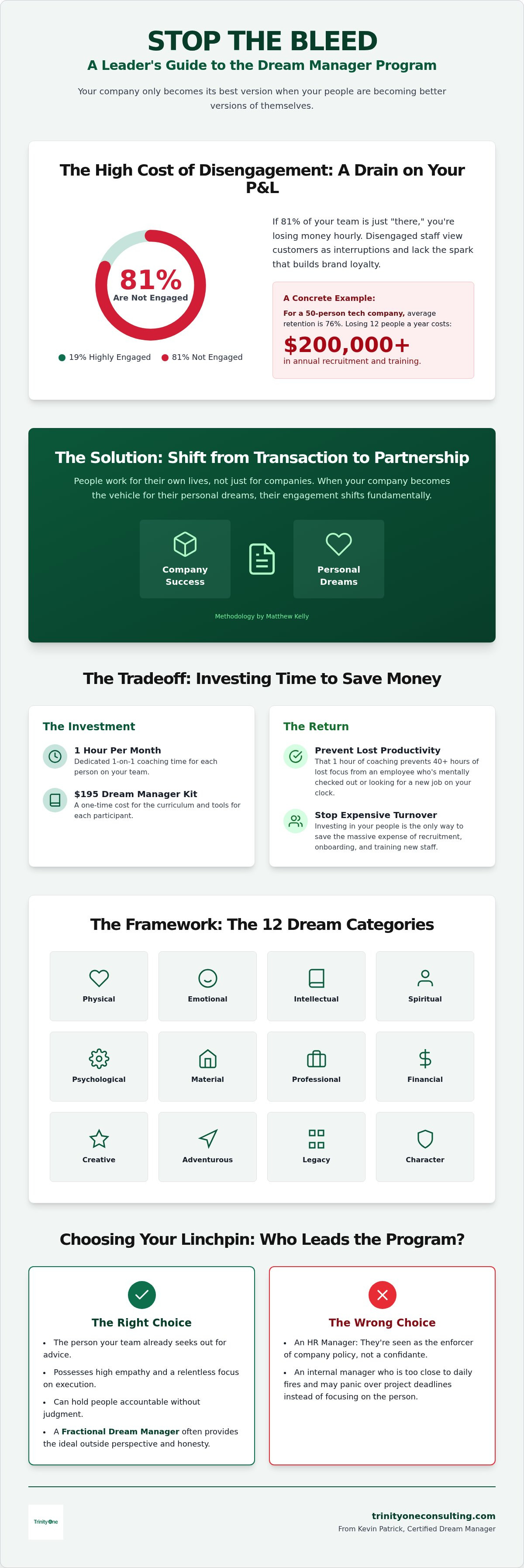
The numbers in 2026 are brutal. Only 19% of employees are highly engaged. If 81% of your team is just "there," you're losing money every single hour. In the tech sector, retention sits at about 76%. If you have 50 employees and lose 12 a year, you're likely spending over 200,000 dollars on recruitment and training costs alone. That's cash that should be on your bottom line.
Disengaged staff treat your customers like interruptions. They follow the script but lack the spark that creates brand loyalty. This creates operational friction. It turns every meeting into a slog where nobody wants to take ownership because they don't feel like they own their future.
The link between personal growth and company ROI
A better version of an employee is a more productive employee. It's that simple. If a team member is drowning in debt or struggling with physical health, they aren't executing at their peak in your office. Personal stability at home leads to better execution at the office. I believe every person has a purpose, and your job as a leader is to align that purpose with the work at hand.
The tradeoff is real. You'll spend about one hour per month coaching each person. That's time away from production. However, that one hour prevents the 40 hours of lost productivity that happens when a distracted employee is looking for a new job on your clock. Investing that time now is the only way to save the massive expense of recruitment later.
How do you identify the right person to lead the program?
Identifying the right leader is the single point of failure when you learn how to implement a Dream Manager program. If your team doesn't trust the person in the chair, they'll give canned, safe answers. You want the truth, not a script. The lead is the linchpin of the entire system.
Avoid choosing an HR manager for this role. HR is often seen as the enforcer of company policy. Employees won't share their private financial struggles or family goals with the person who signs their termination papers. You need a buffer between the "boss" and the human being.
Internal leaders vs fractional facilitators
Internal managers are often too close to the daily fires. They struggle with the confidentiality required for true coaching because they're also responsible for the company's bottom line. If a star player says they're burnt out, an internal manager might panic about the project deadline instead of focusing on the person.
A fractional dream manager brings an outside perspective that encourages absolute honesty. They don't have skin in your office politics. This independence allows them to push employees harder toward their personal goals without the fear of retaliation or judgment from their direct supervisor.
Consider the cost of pulling your best leader away from their primary job. If your top operator spends ten hours a month coaching, that's ten hours they aren't improving your systems. You can discuss facilitator options to see which path fits your current headcount and budget.
The characteristics of a great Dream Manager
Look for the person your team already seeks out for advice. This individual doesn't need to be a senior executive. They just need a high degree of empathy and a relentless focus on execution. I've seen great programs led by office managers and former coaches who know how to listen and follow up.
They must be able to hold people accountable without being judgmental. If an employee's dream is to run a marathon, the manager needs to check in on the training schedule every month. They have to manage all 12 dream categories defined by Matthew Kelly, ranging from physical health to spiritual growth. The role is about helping people become the best version of themselves.
The program is bad at fixing people who don't want to be helped. Even the best leader cannot force an employee to care about their own future. It requires a specific temperament that balances warmth with a blunt demand for progress. I believe we are called to serve our people, and that starts with choosing the right shepherd for their dreams.
What are the steps to launch and implement a Dream Manager program?
Execution is where most culture initiatives die. You can't just announce a program and hope it works. You need a tactical plan. Here is exactly how to implement a Dream Manager program that actually changes the way your team shows up on Monday morning.
The first step is a discovery session. This is where the Dream Manager helps the employee identify their first round of dreams. Most people haven't been asked what they want from life in years. They might struggle to name three things at first. That's why the Matthew Kelly participant kit, which costs 195 dollars, is essential for providing structure to these early conversations.
The initial launch and team introduction
Start by giving every employee a copy of The Dream Manager by Matthew Kelly. This book sets the stage. It explains why you care about their personal lives. Host a lunch where you explain the vision. Be blunt. Tell them you want them to stay because they're achieving their goals here, not because they're stuck.
Participation must be voluntary. If you force people into "mandatory dreaming," you'll create a corporate trap feeling. About 20% of your team might be skeptical at first. That's fine. Let the early adopters prove the value through their own results. When people see their coworkers buying houses or getting healthy, the skeptics will sign up.
The monthly coaching rhythm
Consistency is your only path to success. Set a monthly meeting rhythm that never gets cancelled. These sessions should last 30 to 60 minutes. The focus must remain on the person. If you start talking about project deadlines or quarterly KPIs, the session is a failure. You're a coach in this room, not a boss.
Use the first 10 minutes to review progress on a specific dream. Maybe they saved 500 dollars toward a down payment. Perhaps they finally joined a local gym. End every session with one clear action item for the next 30 days. Small wins build the momentum needed for long-term loyalty.
You need a way to track this without using messy spreadsheets or manual notes. I recommend using DreamCompass to keep the data clean. It provides a simple system to manage the twelve dream categories. It ensures the Dream Manager and the employee stay aligned on the next steps. I believe God made us to be more than just cogs in a machine, and this rhythm proves it to your team every month.
How do you manage the twelve dream categories with your team?
The twelve categories are the technical manual for a human life. When you learn how to implement a Dream Manager program, you realize that a person is more than their job description. They are an integrated circuit of different needs and desires. If one area is short-circuiting, the whole engine fails.
Matthew Kelly defined twelve specific areas to track. Do not try to fix every category at once for every person. That's a recipe for failure. The tradeoff here is depth versus speed. You cannot rush through twelve categories in a single session without the meeting feeling like a cold checklist.
Breaking down the 12 categories
The curriculum covers every facet of the human experience. You must track these specific areas:
- Physical, Emotional, Intellectual, and Spiritual
- Financial, Character, Career, and Creative
- Family, Social, Adventure, and Legacy
This list ensures nothing is missed. It forces the employee to look at their life as a whole system rather than just a series of tasks. It's about alignment, not just achievement.
Coaching through the categories
Start by asking the employee to rate each category on a scale of one to ten. Ask which category is currently a four for them. This identifies the immediate friction point. You aren't there to be a therapist. You are there to help them find a solution that fits their life.
Help them identify one small habit change to raise that score by a single point. If the financial category is the problem, connect it directly to their current role. Show them how their performance and compensation can fund the dream of being debt-free. This creates a logical link between their daily output and their personal peace.
A balanced life supports professional output. If an employee is physically exhausted or socially isolated, their execution at work will drop. I believe we are called to steward the talents of our people. That means looking at the whole person, not just the part that makes you money.
How do you integrate personal dreams into your business operating cadence?
A culture initiative that lives on an island will die on an island. If you want to know how to implement a Dream Manager program that lasts, you must bake it into your existing business engine. It shouldn't be a separate "HR thing" that people do once a month and then forget. It needs to be part of the rhythm of your week.
Link dream progress directly to your weekly operating cadence. When you review your KPIs and quarterly priorities, take five minutes to celebrate a "dream win." If a technician finally saved enough to take their family to Disney, mention it in the huddle. This proves to the team that the company is the vehicle for their success.
Use AI tools to give you visibility into team engagement trends. I use Trinity Cadence to see where the friction is before it turns into a resignation letter. Data doesn't lie. If you see engagement scores dipping in a specific department, you can deploy coaching resources before the engine stalls.
The Integrator role in dream management
The fractional COO is the one who ensures this program does not fizzle out after the first 90 days. I've seen too many leaders get excited about a book and then drop the ball when a big client project hits. An Integrator keeps the cadence consistent. They hold the Dream Manager accountable for the monthly rhythm.
An Integrator knows how to implement a Dream Manager program so it aligns with the company's long-term vision. Integrate dream tracking into your quarterly planning sessions. As you set company goals for the next three months, ask how those goals help your people achieve their twelve categories. This alignment is a core part of my 2026 scaling guide.
Measuring the success of the program
Track the reduction in turnover since the program launch. If your retention rate was 76% and it climbs to 85% after a year, that is a massive operational win. You should also measure the increase in referral hires from existing staff. Happy people who are achieving their dreams will naturally recruit their friends to join the team. This reduces your cost per hire significantly.
Watch for the shift in meeting energy and daily execution. When people feel seen as human beings, they stop acting like cogs. They start taking ownership of their work because they know their work is funding their future. I believe we are called to build businesses that honor the people inside them, and this integration is how you make that a reality.
Build an engine that grows with your people
You can't fix a broken culture with a higher paycheck. Engagement in 2026 is at an all-time low because people don't see a future in their current seat. Learning how to implement a Dream Manager program gives your team a reason to stay that isn't tied to a dollar amount. It turns a job into a partnership.
It requires a disciplined monthly cadence and a leader who actually cares about the twelve categories Matthew Kelly identified. I offer Certified Dream Manager services to take the pressure off your internal team. We use Trinity Cadence AI integration to keep the data clean and the engagement visible.
I believe God put greatness in every person on your payroll. It's your job to provide the vehicle that helps them reach it. Your company will only become its best version when your staff is becoming their best version.
Stop acting like a therapist and start acting like a coach who wins. Your team is ready for the change. You have the tools now to build a business that lasts.
Frequently Asked Questions
How much time does a Dream Manager program take each month?
The program requires 30 to 60 minutes of dedicated 1-on-1 time for every employee each month. I've found that trying to rush these sessions into 15 minutes makes them feel like a performance review. You also need to account for about 10 minutes of prep time per person to review their progress in DreamCompass. It's a small investment compared to the 40 hours of lost productivity from a disengaged worker.
Is the Dream Manager program only for large companies?
This program works for any organization that relies on human effort. Small businesses often see the fastest results because the culture is more concentrated. You don't need a massive HR department to learn how to implement a Dream Manager program. Even a team of five can benefit from aligning their personal dreams with the company's growth.
What happens if an employee does not want to share their dreams?
Participation must remain voluntary at all times because forcing an employee to share private goals builds resentment. Some people are guarded and might take six months to trust the process. That's fine. Let them see coworkers achieving goals like buying a house, and the skeptics will usually come around once they realize the program is for them.
How do you measure the ROI of a Dream Manager program?
You measure ROI by tracking specific operational metrics like your retention rate and cost per hire. In 2026, highly engaged employees dropped to 19% nationally. If your program keeps just two key players from quitting, you've likely saved over 40,000 dollars in replacement costs. I use Trinity Cadence to track these engagement trends in real time.
Do I need to be a certified coach to lead this program?
You don't have to be a certified coach, but you must be a leader people trust. The person leading the sessions needs high empathy and a focus on execution. Many operators find they don't have the internal capacity to manage this. That's why I provide Dream Management facilitation to ensure the program stays consistent and doesn't get pushed aside.
What are the twelve dream categories used in the program?
The methodology created by Matthew Kelly uses twelve distinct categories to cover the whole human experience. These include:
- Physical, Emotional, Intellectual, and Spiritual
- Financial, Character, Career, and Creative
- Family, Social, Adventure, and Legacy
We focus on the one or two areas causing the most friction in an employee's life right now.
Can a small business afford a fractional Dream Manager?
A fractional Dream Manager is often more affordable than the cost of a single bad hire. You aren't paying a full-time salary or benefits for a coach. Instead, you pay for the results and the consistency of the cadence. Hiring an external coach ensures stewardship actually happens without pulling you away from high-level strategy.
How does this program improve employee retention?
People stay where they are growing. When you show an employee that your company is the vehicle for their personal success, they stop looking for the exit. I believe God put greatness in every person on your payroll, and this program helps them reach it. This creates a bond of loyalty that competitive pay alone cannot buy.