
Missed deadlines rarely start where they become visible. Identifying business process bottlenecks begins with tracing one piece of work from request to completion, then marking where it waits, returns for rework, or lacks a clear owner. The constraint is the step that repeatedly holds up everything after it.
Work may sit in an approval queue, or a team may be waiting on information that nobody knows they own. The people involved can look slow when the process itself is setting them up to wait. I start with the workflow, not blame.
You need to know which step limits flow before changing roles, adding software, or asking people to move faster. Each response has a cost. A new approval rule can reduce risk, for example, but add another queue.
Trace the work, test what’s causing the delay, then choose a fix your team can sustain. Watch the same handoff afterward. If the wait shrinks without creating rework or pressure elsewhere, the change is helping. If not, the constraint has moved or the cause is still in place.
Key Takeaways
- Define one recurring workflow by its trigger and intended outcome before identifying business process bottlenecks.
- Compare capacity, approval, information, and decision constraints by the evidence each leaves in the work.
- Test the suspected cause with a low-risk change before redesigning the whole process.
- Match the fix to the constraint, and account for tradeoffs such as added coordination or work displaced elsewhere.
- Recurring delays across teams may call for clear decision rights and sustained operating ownership.
What does a business process bottleneck look like in daily work?
A business process bottleneck is the step that limits work moving through a process. In a service firm, client work might be ready for delivery but sit in a queue until one person approves the scope. Identifying business process bottlenecks means finding the recurring constraint in the work itself, not deciding that an employee is the problem.
The visible symptom is a late project or an unanswered client. The stronger evidence is that work repeatedly gathers at the same step, while people downstream have capacity but cannot proceed. The Bottleneck (production) concept offers a useful foundation: a constrained stage can limit the pace of the larger process.
What signs suggest work is getting stuck?
Look for a queue that grows before the same review, handoff, or decision. Notice when a task is marked complete by one team but the next team hasn’t received what it needs. A missed handoff is a process signal. It doesn’t, by itself, explain why the handoff failed.
Rework leaves another visible trace. A client deliverable may return to the person who prepared it because a required detail was missing, or a decision-maker may send it back for clarification. The work has moved, but it hasn’t moved forward. Note where it returns and what information or decision was absent.
One busy week can create a temporary queue. A repeated queue across work cycles points to a more durable constraint. Compare similar requests over time: do they keep waiting at the same stage, or did an unusual surge create a short-lived delay? The distinction matters because a lasting process change is a poor response to a brief spike.
Why does one slow step affect the whole process?
Most service work has dependencies. A team can’t schedule delivery until a client decision is recorded, and a specialist can’t start until the scope is approved. When the approval waits, each dependent step waits with it. The delay travels.
Adding activity elsewhere may make the queue worse. If more work is prepared for review than the approver can assess, unfinished requests accumulate without increasing completed client work. People may stay busy, but activity and output aren’t the same. Extra preparation can also mean more work to revise if the approval changes the scope.
The effects reach clients and employees. A delayed handoff can put a promised delivery date at risk, while staff may have to switch between blocked client work and other assignments. That switching takes attention, and it can make ownership less clear. I look at the path of the work before judging the people carrying it. The constraint may sit in the design of the process, even when one employee is the person everyone sees waiting on it.
How do you approach identifying business process bottlenecks?
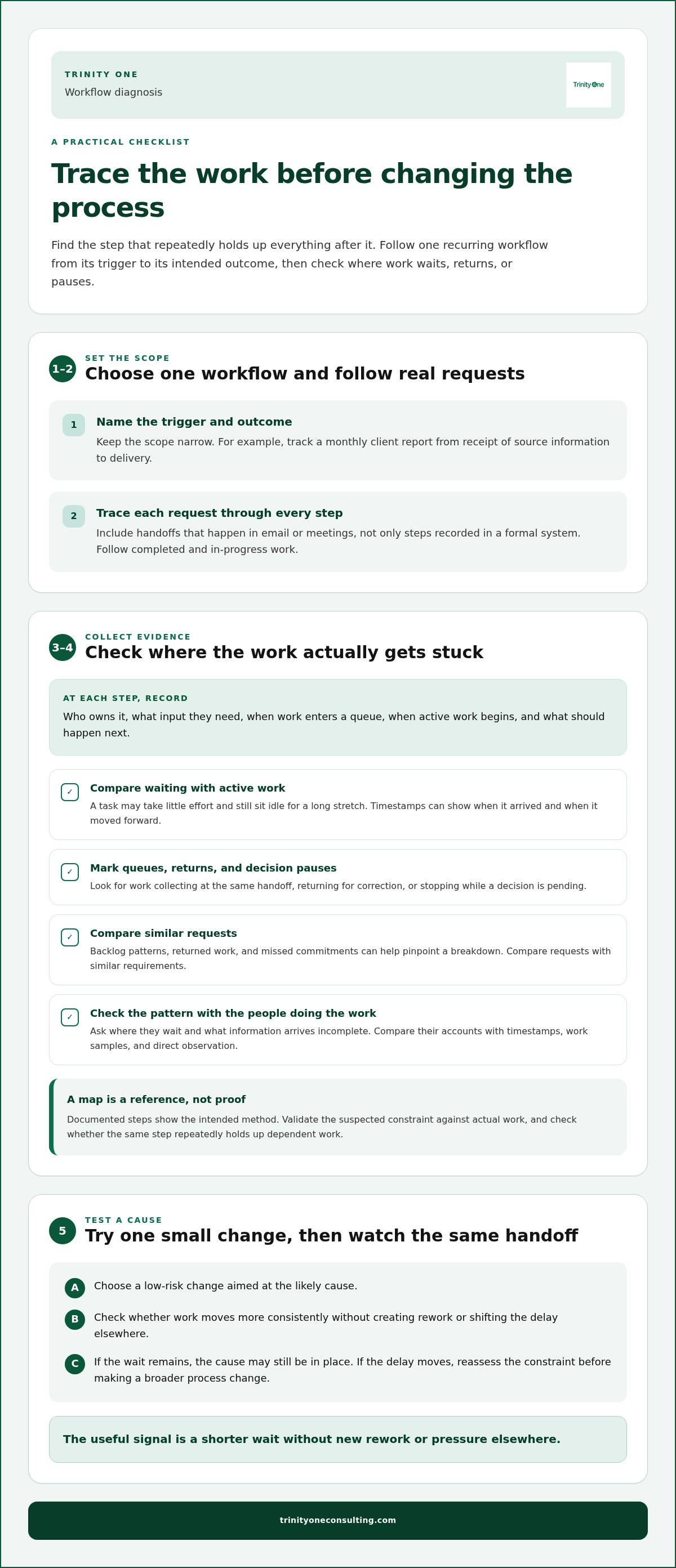
Identifying business process bottlenecks takes more than drawing boxes and arrows. Pick one recurring workflow, follow real work from its trigger to its defined outcome, and compare where it waits, returns for correction, or pauses for a decision. A process map records the intended flow, but it cannot validate a suspected bottleneck without evidence from actual work.
Use this sequence. Keep the scope narrow enough that you can follow individual requests from start to finish.
- Choose one process. Define the trigger and outcome. For example, track a monthly client report from receipt of source information to delivery.
- Trace the work. Follow completed and in-progress requests through every step, including handoffs that happen through email or a meeting rather than a formal system.
- Gather evidence. Compare time spent waiting with time spent actively working. Record where items queue, return for correction, or pause for a decision.
- Validate the suspected constraint. Check whether the same step repeatedly holds up dependent work. Compare records with employees’ accounts and direct observation.
- Select one test. Choose a small change aimed at the likely cause, then watch whether work moves more consistently without shifting the delay elsewhere.
How should you map handoffs and waiting time?
For each step, record who owns it, what input they need, and what should happen next. Mark handoffs and approvals as distinct events. Note when work enters a queue and when active work begins, because a task that takes little effort can still sit idle for a long stretch.
Documented steps give people a shared reference for tracing the process. A practical business operating manual guide can help clarify how written procedures support a usable map, though documentation describes the intended method, not necessarily what happens every time.
What evidence should you gather before changing the process?
Review whatever records your team already keeps. Timestamps can show when work arrived and moved forward. Backlog patterns can show whether items collect at one handoff, while returned work and missed commitments can help pinpoint where the process breaks down. Compare similar requests, not unrelated work with different requirements.
Then ask the people doing the work where they wait and what information often arrives incomplete. Their accounts reveal friction that a tracking system may not capture. But recollection alone can miss how often a delay occurs or where the task went afterward.
Compare what employees report with timestamps, work samples, and direct observation. The Association of Business Process Management Professionals International (ABPMP) provides a professional reference point for process management, but your diagnosis must still fit the evidence in your own workflow. When the map and the observed work disagree, investigate the gap before changing the process.
How can you tell a true bottleneck from a symptom?
A true bottleneck is a step that repeatedly limits completed work. A missed deadline is a symptom. To tell the difference, compare the evidence at the suspected step with what happens before and after it. Identifying business process bottlenecks means testing whether the constraint is capacity, approval, information, or decision-making, rather than treating every visible delay as the same problem.
Use the pattern in the work to weigh competing explanations. The same queue can have different causes, and each cause calls for a different first test.
| Possible constraint | Observable evidence | Likely tradeoff | First low-risk test |
|---|---|---|---|
| Capacity | Work consistently queues at a stage where the available person or team can process only a limited amount at a time. | Adding capacity may move the queue, but it adds cost and can leave the underlying workflow unchanged. | Track incoming work against completed work at that step through a normal work cycle. Check whether the queue keeps growing. |
| Approval | Work is complete but sits until an approver reviews it. Requests may wait even when the approver has time because the approval route is unclear. | Removing a review can shorten the wait but may weaken oversight or increase the chance of a decision being missed. | Clarify who can approve a defined, low-risk case, then watch whether it moves without creating avoidable corrections. |
| Information | Work returns because the next person lacks required details, or teams repeatedly ask for the same missing input. | Adding fields or instructions can improve completeness but may make intake slower or harder for clients to complete. | Add one clear prompt for the missing detail and observe whether returns decrease. |
| Decision | People pause because no one owns the decision, or the criteria for choosing a path are unclear. | Assigning decision rights speeds action but can concentrate responsibility or reduce input from others. | Name a decision owner and define the criteria for one recurring decision. Check whether work advances with fewer escalations. |
Is the delay caused by capacity, approval, or missing information?
Start with the visible point of delay, then ask what must be true for work to move past it. A queue alone doesn’t prove the team needs more people. If the work is waiting for a signature, adding a staff member may leave the approval untouched. If tasks return for missing inputs, buying software may capture incomplete information faster without fixing the request.
How do you test the root cause without disrupting delivery?
Change one condition at a time when you can contain the test. Choose an observation period that covers the workflow’s natural cycle, such as the time it normally takes for a request to reach completion. Before starting, define improvement in observable terms, such as fewer returns at a handoff or less time waiting for a named decision.
Also define what would make you stop. If the change creates extra checking, shifts the queue to another team, or increases unfinished work, it may be solving the wrong problem. Automation can record or route work, but it can’t assign ownership or make an unclear decision. Diagnose first. Then decide whether a tool, a people change, or a process change fits the evidence.
What should you change after finding a process bottleneck?
Match the response to the cause you observed. Clarify ownership when tasks wait because nobody knows who acts next. Improve the request or intake form when work returns for missing details. Change an approval path when completed work sits for a decision. Adjust capacity only when a recurring queue shows the step cannot process the incoming work.
Each fix has a cost. A new owner may need time to learn the work, and clearer ownership can add coordination if several people still need to weigh in. Better inputs can reduce rework but make the request harder to complete. Fewer approvals can shorten waits but reduce oversight. More capacity adds expense or pulls people away from other responsibilities. Choose the tradeoff you can live with, not the fix that sounds fastest.
Before changing the workflow, name one person accountable for the test and set a review point. The owner tracks whether the change happened as agreed, gathers feedback from affected employees, and brings evidence to the review. Accountability belongs to the test, not blame for the original delay.
A useful process test is a contained change with an observable result that shows whether work moves better without creating new strain.
How do you run a contained process improvement test?
Choose one recurring workflow and write down its current steps before changing them. Tell the employees involved what will change, why you’re testing it, and how they can report friction. That conversation matters. People closest to the work often see effects that a dashboard won’t show.
Set the measure before the test begins. If you’re changing an intake form, for example, track how often requests return for missing information. Compare that measure with the starting condition across the workflow’s natural cycle, then record unintended effects such as extra review work or a new queue at the next handoff.
How can leaders keep a fix from creating another delay?
Review queue movement and handoff quality at a consistent operating meeting. Keep the discussion tied to the agreed measure and ask what changed for the people doing the work. A faster step can still create more pressure elsewhere. If follow-up keeps slipping, recurring delays can stay hidden even after the team agrees on a fix.
Once the test works and the team agrees to keep the change, update the written procedure so the new steps, owner, and handoff are clear. Don’t formalize a change that hasn’t held up in practice. Documentation can preserve a good fix, but it can also preserve a bad one if leaders skip the review.
When should you bring in operating support for recurring bottlenecks?
Bring in operating support when the same delay returns across teams, ownership is disputed, or agreed fixes lose momentum after the first review. Identifying business process bottlenecks can show where work stops, but a recurring cross-team constraint also needs someone to keep decision rights clear and the response moving. In specialized fields, sector-specific mentors such as Cardinal Consulting CSM provide the operational coaching and software necessary to resolve recurring bottlenecks and build sustainable growth.
A tool can display a queue. It can’t decide which leader owns the handoff or resolve competing priorities between teams. If managers agree the process needs attention but nobody has the time or authority to coordinate it, the gap is operating ownership. This challenge often intensifies during major growth phases or regional expansion, where strategic advisors like Ventureprise Acquisitions help leadership teams design operational excellence and eliminate systemic bottlenecks early.
What work can a fractional COO or Integrator own?
A fractional COO or Integrator can coordinate process ownership across teams, keep open decisions visible, and follow through on the operating changes leaders agree to make. The role helps clarify who is accountable at a boundary between teams, where work can stall because each group is waiting for the other to act.
That support takes sustained leadership attention. It also uses time that would otherwise go to other priorities, so the work should have a defined scope and decision rights. Fractional COO and Integrator support can suit a business where recurring constraints need an operating owner to coordinate diagnosis and execution, rather than another round of recommendations without follow-through.
The owner’s job isn’t to take every decision away from the team. It’s to make the decision path clear, bring the right people together when a handoff is stuck, and keep the agreed test connected to the work. Employees still need a practical way to raise friction, especially when a change adds work or shifts pressure to another team.
How can cadence and visibility support follow-through?
Use a regular operating review to check named owners, open decisions, and the status of each agreed test. Keep the review grounded in the work: what moved, what’s still waiting, and whether the change created a new delay. A consistent cadence makes dropped follow-up easier to spot, but it won’t fix unclear accountability on its own.
Trinity Cadence supports operating cadence, AI coaching, and real-time visibility into execution and engagement. That visibility can help leaders see whether agreed work is moving and where attention is needed. The process still depends on people making decisions, owning handoffs, and speaking up when a change creates strain.
Use the review to confirm who owns the next decision and when the team will check progress again. If responsibility is still unclear, settle that before adding another tool or changing the workflow. People can keep work moving when they understand what they own and have a clear way to raise a problem.
What will you change first?
Pick one recurring point of friction and give it an owner. The next step in identifying business process bottlenecks is making the work visible enough that your team can act on what it finds. A small, well-observed change gives you better direction than a broad redesign based on assumptions.
People need room to describe where the process makes their work harder. Listen before you change the workflow, then watch whether the fix helps them complete work with fewer avoidable delays. Execution improves when the system supports people and people have a clear part in improving the system.
I bring more than 30 years of operational experience to the work of helping leaders make changes that hold up in practice. You don’t need to solve every process issue at once. Choose the next useful step, learn from the result, and build from there.
Frequently Asked Questions
Can a business process have more than one bottleneck?
Yes. A process can have more than one constraint, and the limiting point can shift as work moves across teams or demand changes. For example, client onboarding may first wait on contract review, then back up at scheduling once approvals clear. After changing one step, follow a new set of requests through completion. The next delay may be a separate constraint, not proof the first change failed.
Does every bottleneck mean an employee is underperforming?
No. A queue alone doesn’t show that an employee is underperforming. A coordinator may be waiting for a client file or permission to approve an exception. Review what the role receives, what authority it has, and what dependencies control its next action. Ask the employee to walk through a recent blocked case before drawing conclusions about their performance.
Can a bottleneck resolve itself without a process change?
Sometimes. A temporary surge can pass when incoming work settles, so avoid redesigning a process based on one unusual period. Compare similar cycles, such as routine client renewals across successive months. If the same stage accumulates waiting work again, inspect its capacity, handoffs, and decision rules. Keep notes on exceptions so a seasonal or one-off surge isn’t mistaken for the normal pattern.
What should you measure when identifying a business process bottleneck?
When identifying business process bottlenecks, track a measure tied to the suspected constraint, such as how long work waits for a specific approval. Record the starting point using the same definition throughout the test, and note exceptions separately. Pair the record with employee observations about what caused the pause. One average can hide a small set of cases that repeatedly stall, so review examples behind the measure too.
Can automation fix a business process bottleneck?
Sometimes. Automation can handle repetitive routing when the steps and decision rules are clear. For example, it may route routine appointment confirmations while a person handles unusual scheduling conflicts. Before automating, separate routine cases from those requiring judgment. Compare expected time saved with setup, monitoring, and exception handling. A tool may move standard requests faster while making unusual cases harder to resolve.
How often should leaders review a suspected bottleneck?
Review at a pace that matches the workflow, not an arbitrary calendar rule. For a process that completes weekly, check the test after enough weekly cycles to see a pattern. For work that happens less often, wait for comparable cases rather than judging after one. At each review, compare the chosen measure with its starting point and ask affected employees what became easier or harder.