
A fractional leader owns agreed business outcomes, not just time on your calendar. Fractional leadership roles and responsibilities should spell out which decisions the leader can make, which work they’ll drive, and what results they’re accountable for. Without those boundaries, you’re paying for executive presence while your team still carries the execution.
The distinction matters. An advisor recommends a fix for a defined problem. An interim executive fills a full-time leadership gap for a period. A fractional executive joins the leadership team part-time and remains accountable for a defined result.
Start with the business need, then set authority, outcomes, and a working rhythm that fit it. A fractional COO or Integrator can help when strategy stalls between leadership meetings and weekly execution. The role should make operating work visible and help managers own clear next steps. A company becomes better only as its people do.
Key Takeaways
- Define fractional leadership roles and responsibilities around a specific business need, with clear decision rights and outcomes.
- Set weekly expectations for decisions, operating rhythm, and follow-through instead of measuring the role by availability alone.
- Separate ongoing fractional ownership from project consulting and temporary interim coverage before agreeing on scope.
- Choose observable signs of progress, such as decisions made, commitments reviewed, and work completed, then agree on when to review them.
- A fractional COO or Integrator can connect strategy to execution. Trinity Cadence supports the operating rhythm, while leaders remain accountable for decisions and follow-through.
What do fractional leadership roles and responsibilities actually mean?
Fractional leadership roles and responsibilities define the outcomes an executive owns, the decisions they can make, and how they work with your team, without requiring a full-time schedule. “Fractional” describes how the role is structured. It doesn’t mean accountability is partial or that the work stops when the leader isn’t present.
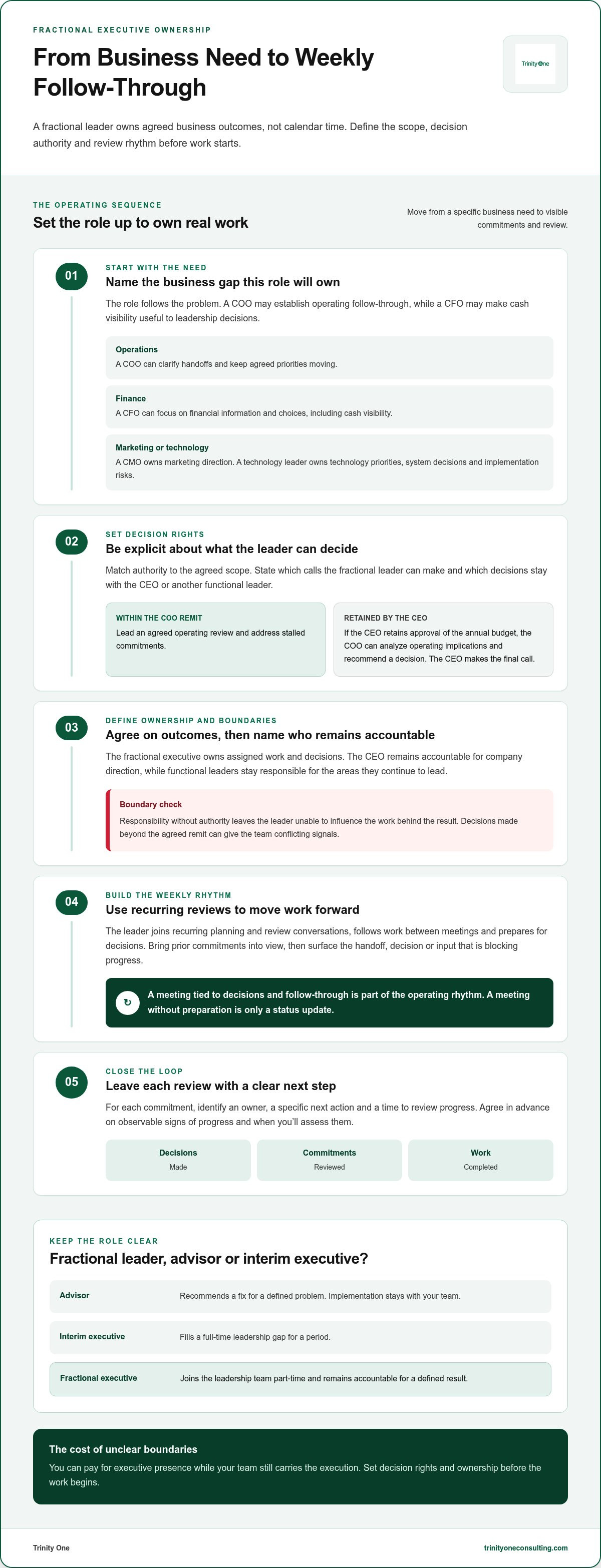
The role takes its shape from the business need. A company may need a fractional COO to establish consistent operating follow-through, while a CFO, CMO, or technology leader will own work tied to their function. Authority should match the scope. Otherwise, a leader can be held responsible for results without the ability to influence the work behind them.
Fractional leadership is an ongoing executive role with defined scope, decision authority, and accountability for agreed business outcomes.
That separates executive ownership from advice. An advisor can identify a problem and recommend a fix, then leave implementation to your team. A fractional leader stays involved in the agreed work, makes authorized decisions, brings the right people into the process, and tracks whether commitments are completed. Advice may be part of the role. It isn’t the whole role.
What makes a leadership role fractional?
A fractional role is built around responsibilities rather than a full-time schedule. The leader joins recurring planning and review conversations, follows work between meetings, and stays connected to the people responsible for execution. That recurring involvement differs from a one-off advisory conversation, where the leader offers input but doesn’t own follow-through.
Put the arrangement in practical terms: which decisions sit with the leader, what outcomes they’re accountable for, and which team members they work through. For example, a fractional COO may lead an agreed operating review and address stalled commitments, while the CEO retains decisions outside that remit. Fractional COO leadership depends on the fit between the business need and the executive’s authority.
Where does a fractional leader’s responsibility stop?
Accountability needs a boundary. The fractional executive owns the work and decisions assigned to the role. The CEO remains accountable for the company’s overall direction, while functional leaders remain responsible for the areas they continue to lead. A fractional leader can coordinate across those areas, but coordination doesn’t automatically transfer every decision or people-management responsibility.
Consider a COO engaged to improve follow-through on operating priorities. The COO can maintain the review rhythm, surface missed commitments, and work with managers on corrective steps. If the CEO has retained approval of a new annual budget, the COO can analyze operating implications and recommend a decision, but the CEO makes the final call.
That boundary protects both sides. If the COO is answerable for execution but can’t set priorities or ask leaders to meet agreed commitments, the role carries responsibility without authority. If the COO makes decisions the CEO expected to retain, the team gets conflicting signals. Define the boundary before work starts, then revisit it when the business need changes.
What does a fractional leader own from week to week?
A fractional leader owns a recurring operating responsibility, not a generic list of tasks. The practical meaning of fractional leadership roles and responsibilities shows up in how the leader prepares for decisions, makes risks visible, and follows agreed work through the next review. A meeting without preparation is a status update. A meeting tied to decisions and follow-through is part of the operating system.
Project advice can end with a recommendation. Recurring executive ownership stays with the work until the next action is clear and someone is accountable for it.
How do functional responsibilities differ by executive role?
The role follows the problem. A COO may coordinate operations across departments, clarify who owns a handoff, and keep agreed priorities moving. That work depends on the company’s actual operating gap, not a standard task list. A fractional COO or Integrator can connect decisions made by different leaders to the work their teams must carry out.
A CFO’s decision domain centers on financial information and choices, such as making cash visibility useful to leadership decisions. A CMO focuses on marketing direction, including how the company sets priorities for its message and campaigns. A technology leader works on technology priorities, system decisions, and implementation risks. These leaders don’t own interchangeable outcomes. Their authority should follow their functional remit and the need the company has agreed to address.
Role boundaries matter where functions meet. A marketing priority may depend on a technology change, but that doesn’t make the CMO the owner of the technology decision. The executive responsible for that function should surface the dependency and bring it to the person with authority.
What does recurring operational ownership look like?
Picture a weekly leadership review. The fractional leader arrives with prior commitments in view, including a priority that’s behind because a handoff hasn’t happened. Instead of letting the issue dissolve into general discussion, the leader identifies the decision or input blocking progress and brings the right owner into the conversation.
The team leaves with a named owner, a specific next action, and a time to review progress. If the action depends on a decision outside the fractional leader’s authority, that dependency is made visible and sent to the executive who can decide. The issue now has a path forward, or a clear reason it remains unresolved.
That rhythm takes preparation and attention from leaders. It’s also a poor way to handle work that needs uninterrupted individual focus, so the meeting should surface blockers rather than become a running commentary on every task. A capable fractional leader makes room to hear when a commitment is unclear or a person is overloaded. Operating health depends on honest information from the people doing the work, not only a dashboard of dates and status labels.
How is a fractional leader different from a consultant or interim executive?
The difference comes down to the work the person owns, not the label on a contract. Fractional leadership roles and responsibilities usually describe an ongoing executive remit with defined outcomes. A consultant may advise on a specific problem, while an interim executive may cover a temporary vacancy. Each model can work. Confusion starts when the work, authority, and expected duration aren’t written down.
| Role | Accountability | Duration | Decision authority | Typical work |
|---|---|---|---|---|
| Fractional leader | Owns agreed ongoing outcomes | Continues while the business need remains | Holds authority defined in the remit | Leads recurring executive work and follow-through |
| Consultant | Delivers an agreed analysis or recommendation | Often tied to a project or defined engagement | Usually advises, unless implementation authority is included | Assesses a problem and provides a deliverable |
| Interim executive | Maintains leadership responsibility during a vacancy | Temporary coverage | Typically holds authority needed to perform the temporary role | Runs the function while the position is vacant |
| Full-time executive | Owns the continuing responsibilities of the role | Ongoing employment | Holds authority assigned to the position | Provides sustained daily leadership |
When is fractional leadership different from consulting?
A consultant might review a broken handoff between sales and operations, map the causes, and deliver recommendations. That can be the right assignment when your team has the capacity and authority to make the changes. The tradeoff is that the consultant may finish the engagement before the new process becomes part of daily work.
A fractional leader has a continuing responsibility for agreed execution. They may help set the operating review, work with the leaders responsible for the handoff, and return to see whether the agreed changes are being used. Some engagements combine analysis and implementation. The written scope should say which work is included, who makes the decisions, and who owns follow-through.
How does fractional leadership compare with interim and full-time roles?
Interim coverage centers on a temporary vacancy. The business needs someone to take on the function while a permanent leader is absent or the position is being filled. Fractional scope starts with an ongoing need that can be owned on a bounded, part-time basis. The need may continue even when there’s no vacancy to cover.
A full-time executive may fit better when the role requires sustained daily presence or immediate decisions throughout the working day. Fractional involvement can limit availability for continuous decisions, so the team needs clear escalation paths and decision boundaries. That’s the cost of a part-time structure. It may be a poor fit if delays between scheduled involvement would leave the business exposed.
Titles vary across companies. I’d give more weight to the written remit than to whether someone calls themselves fractional, interim, or an advisor. Specify the outcomes, authority, duration, and working relationship. Then both sides can tell what the role owns and where it stops.
How should you define scope, authority, and success before hiring?
Begin with the operating problem you need addressed. “Help us execute better” gives an executive nowhere to start. A useful brief names a recurring condition, such as decisions that repeatedly miss the next leadership review or a handoff that leaves customer work waiting.
Use this planning sequence to turn the problem into a workable role:
- Describe the problem in observable terms. Identify where work stalls, what the team sees when it stalls, and why the issue matters to the business.
- Define the work in and out of scope. Name the operating responsibilities the executive will take on, along with adjacent work that remains elsewhere. A narrow remit makes ownership easier to track, but it can leave related problems untouched.
- Map the people involved. List the leaders and teams who contribute information, carry out decisions, or depend on the work. Make reporting relationships clear to everyone affected.
- Choose evidence of progress. Use signs the team can observe, such as decisions completed, recurring blockers resolved, or agreed work reaching its next review. Don’t set targets before you know what the role can influence.
- Set the review rhythm. Agree when you’ll examine the evidence and revisit the remit. The role should change when the business need changes, not through a slow accumulation of unspoken requests.
Which responsibilities belong in the written remit?
Write down the operating problems the executive will own, the work outside the assignment, and the people whose work connects to the remit. Include which decisions stay with the CEO and how the executive should raise a concern beyond the agreed scope. This gives the team a usable reference when a new request appears.
At the agreed review, ask whether the original problem still deserves attention and whether the work has shifted. Expanding a remit may bring related issues under one owner, but it also adds demands on the executive and the team. Keep that tradeoff visible.
How can you tell whether the role is working?
Look for evidence that work is moving differently. Are decisions reaching completion? Do blockers have a documented next step? Can the people involved explain what they own and what happens next? These observations show whether the role is helping the operation without assigning the executive credit or blame for every company result.
Ask team members where work still gets stuck and compare their answers with the review record. Separate changes the executive can influence from results shaped by wider business conditions. That distinction keeps the evaluation fair and helps you decide whether to adjust the remit, the support around it, or the role itself.
The discovery-call page is available here.
How can a fractional COO or Integrator connect strategy, execution, and people?
A Fractional COO or Integrator connects leadership priorities with the work teams carry out each week. The role turns strategy into clear commitments, makes delays visible, and keeps leaders accountable for decisions within their authority. That operating discipline gives fractional leadership roles and responsibilities a practical shape. People can see how their work connects to company priorities.
I’ve spent 30+ years in operations and ERP leadership. That experience informs how I think about the operator’s job: build a reliable rhythm for execution without losing sight of the people doing the work.
How does a Fractional COO or Integrator run an operating cadence?
The work starts by translating company priorities into weekly focus. Leaders review commitments, identify what’s off track, and agree on who will take the next action. The Integrator keeps the conversation tied to execution rather than letting a review become a string of updates with no clear decision or owner. Read more about Fractional COO / Integrator responsibilities and their connection to operating leadership and follow-through.
Trinity Cadence supports that rhythm as an operating system, not a replacement for executive accountability. Its components include The Blueprint, The Huddle, The Pulse, an AI Coach, the Build Loop, and Dream Plans. The Huddle gives leaders a structured weekly meeting where off-track work can be surfaced and addressed. The operator still has to lead the conversation, clarify ownership, and make sure agreed actions return to the next review.
A cadence takes preparation and consistent attention. It’s a poor fit if leaders treat it as another meeting to attend instead of a place to make decisions and take responsibility. The system supports the work. Leaders own it.
How can the operating system include both execution and team goals?
Operating health includes the work and the people carrying it. The Pulse provides a combined view of execution health and team engagement, so leaders can pay attention to progress and how the team is experiencing the work. That view doesn’t remove the need for honest conversations. It gives leaders a reason to ask what’s behind a stalled commitment or a change in engagement.
Dream Plans track team members’ goals alongside work. Trinity One claims 31% higher retention when dreams are tracked. That figure is a company claim, not a promise that tracking goals will produce the same result in every business. The practical point is that people’s growth deserves attention alongside operating priorities. A company can become its best version only to the extent its people are becoming better versions of themselves.
Trinity Cadence addresses 2× sides of the business, machine and people, through 1 operating cadence. The tools can make work and engagement more visible, but they can’t make a leader listen, honor a commitment, or give a team member meaningful ownership. That responsibility stays with leadership.
The discovery-call page also covers operating cadence: view the call details.
Put the role on paper before you bring someone in
Draft a one-page role charter before you start the hiring conversation. Name the business problem, the decisions the leader can make, and the work that stays with you or another executive. Then ask whether the charter describes real ownership or only access to advice.
Clear fractional leadership roles and responsibilities give the executive and your team a shared reference point when priorities shift. That clarity protects the work from quietly expanding beyond the authority, time, and support you’ve agreed to provide.
As a Certified Dream Manager and Fractional Integrator, I believe operating discipline should help people do meaningful work and grow through it. A well-defined role can give your team clearer ownership while keeping leadership accountable for the conditions it creates.
Use the discovery call page to discuss your operating needs with me.
Frequently Asked Questions
Can a fractional leader manage employees?
Yes, if the written remit assigns that responsibility and the organization tells the team who they report to. For example, the leader might set a department’s weekly priorities and coach its manager, while the CEO retains hiring or compensation decisions. The title alone proves nothing. Document who gives direction, handles performance conversations, and resolves issues outside the leader’s authority. This keeps fractional leadership roles and responsibilities clear to employees.
Can one fractional executive support more than one company?
Yes. Fractional work is structured as less-than-full-time leadership, so an executive may serve multiple companies. There’s no standard client count or schedule to assume. Test the proposed availability against decisions that can’t wait, meetings the leader must attend, and the response expectations your team needs. Put those arrangements in writing. A fractional title alone doesn’t establish capacity or guarantee access when an urgent decision appears.
How long does a fractional leadership engagement last?
It lasts as long as the agreed business need and engagement terms support the role. Ongoing operating ownership may continue while the company needs that leadership work, while a defined project ends around its agreed deliverable. Temporary coverage addresses a vacancy instead. Review the remit as responsibilities change, and ask whether the executive still owns work the business needs done. There’s no universal timeline that fits every company or role.
Does a fractional leader need to work on-site?
Work location depends on the business, the role, and the working arrangements agreed with the executive. The practical test is whether the leader can participate in the required operating cadence, reach decision-makers, and communicate with the team in time to keep work moving. For example, if a decision requires a live discussion, the agreement should explain how that discussion will happen. A particular location isn’t inherent to fractional leadership.
Who makes the final decisions when a fractional executive joins?
The engagement scope should name who has final authority for each type of decision. A CEO or board may retain some approvals, while the fractional executive receives authority over decisions within the assigned remit. Write down approval boundaries and the route for escalating an issue. If a decision remains unresolved, specify which executive sponsor takes it back up and how the fractional leader should present the options.
Can a company move from fractional to full-time leadership?
Yes. A company can change its leadership structure when the work or required availability changes. The useful test is whether recurring responsibilities now call for sustained daily ownership, rather than support on a defined part-time scope. For example, a growing volume of daily decisions may warrant rethinking who holds the role. A fractional engagement doesn’t guarantee a permanent hire, so evaluate the business need and responsibilities on their own.
Book a discovery call to discuss the role your business needs.