
You think a $450,000 savior is the only way to stop your meetings from multiplying like a virus. You're likely wrong. Hiring a full-time executive to fix a broken system is often like buying a new engine for a car with a flat tire. When weighing a fractional COO vs full time COO, the choice isn't just about your 2026 budget. It's about whether you need a permanent resident or a structural architect to install a high-speed operating system.
I've seen the fatigue in your eyes when decisions take three weeks instead of three minutes. You're watching employee turnover climb because the vision is blurry and your expensive AI tools are gathering digital dust. It's an operational friction that drains your soul and your bank account. You want a unified rhythm, but you're currently stuck in a cycle of reactive firefighting.
I'll show you the specific tradeoffs between fractional and full-time operational leadership so you can stop guessing and start executing. We'll break down the true cost of a $275,000 base salary and compare it to the surgical precision of an integrator. I believe every company only becomes its best version when its people are growing too. You're about to get the clarity needed to build a functional cadence and get real-time visibility into your execution.
Key Takeaways
- A full-time hire often anchors your current chaos instead of fixing it. You need a structural architect to install systems that stop your meetings from multiplying.
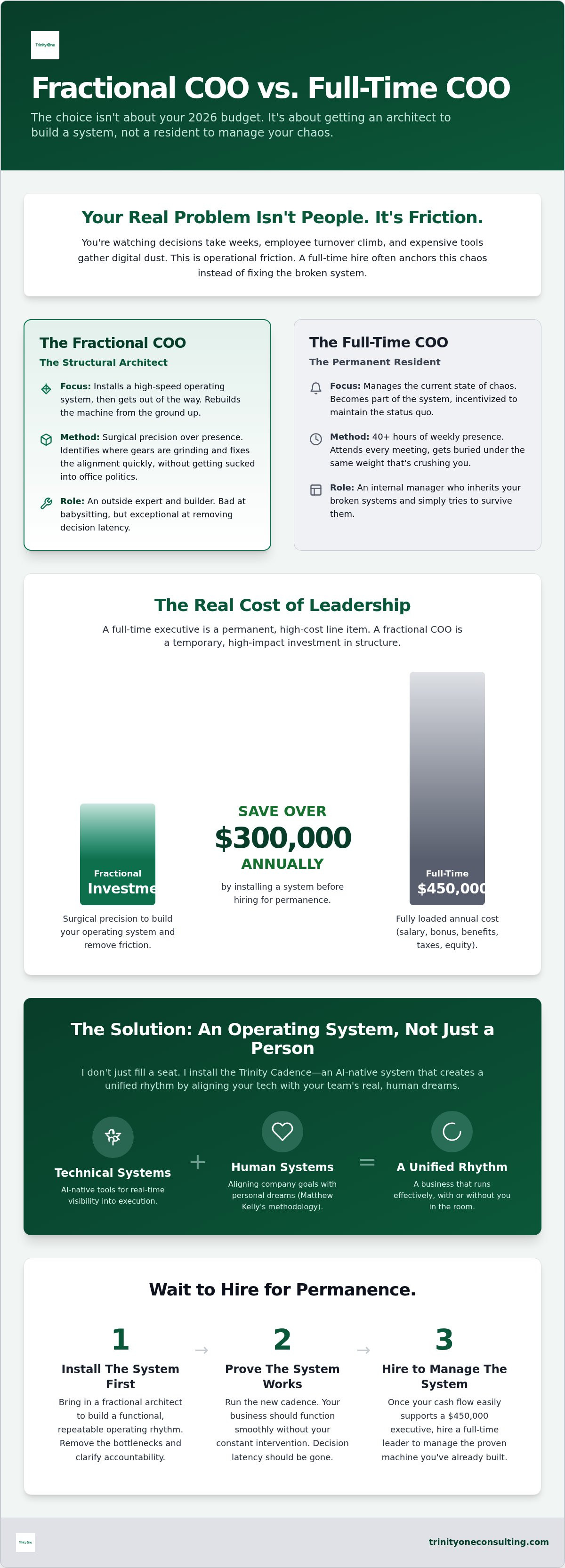
- The fractional COO vs full time COO decision comes down to whether you need a permanent resident or a specialist to install a high-speed operating system. A fractional expert can save you over $300,000 annually while building the machine you actually need.
- Wait to hire for permanence until your operating rhythm functions without you. Your cash flow should easily support a $450,000 fully loaded executive before you make that commitment.
- Modern business engines require an AI-native approach like Trinity Cadence to handle execution. I've found that real performance happens when you align these technical systems with the personal dreams of your team members using the methodology created by Matthew Kelly.
What is the real difference between a fractional COO and a full-time COO?
Hiring a full-time executive often feels like a solution, but it's usually just a very expensive band-aid. When you look at the choice of a fractional COO vs full time COO, you're choosing between a permanent manager of your current mess and an architect who builds a better machine. A full-time hire is a marriage to your current state of chaos. They walk into your office, see the fire, and grab a bucket. They become part of the problem because they're incentivized to manage the status quo rather than rebuild it from the ground up.
I've spent 30 years in the trenches of operations and football coaching. I've seen that presence does not equal performance. You don't need someone sitting in a swivel chair for 40 hours a week just to feel safe. You need an operating cadence that runs whether the leader is in the room or not. A fractional COO brings decades of battle-tested experience to your table for a fraction of the $450,000 total compensation a top-tier full-time executive demands in 2026.
The Integrator vs the permanent manager
Most founders are visionaries with 100 ideas a day. They need an Integrator to filter those ideas and turn them into a functional engine. A permanent manager often inherits your broken systems and simply tries to survive them. They attend every meeting, reply to every Slack message, and get buried under the same weight that's currently crushing you.
I don't just fill a seat. I focus on installing the Trinity Cadence. This is an AI-native operating system designed to give you real-time visibility into your execution. We aren't just managing people. We are aligning their personal dreams with the company's goals. I use the methodology created by Matthew Kelly to ensure your team is becoming the best version of themselves while they build your business. My faith in this human-centric approach is what drives every operational decision I make.
Precision over presence
The 40-hour work week is an industrial relic that doesn't fit modern operational leadership. You don't need 40 hours of "management" to fix your engine. You need five hours of high-impact clarity, accountability, and friction removal. A fractional leader identifies where the gears are grinding and fixes the alignment quickly.
- A fractional leader identifies where the gears are grinding.
- They fix the alignment quickly without getting sucked into office politics.
- Decision latency drops from weeks to minutes.
This approach is bad at babysitting. If you want someone to watch over your employees' shoulders and monitor their lunch breaks, a fractional role will fail you. But if you want a professional who removes decision latency and creates a unified rhythm, precision beats presence every time. The debate over a fractional COO vs full time COO often ignores the reality of how work actually gets done in 2026.
Why the fractional COO vs full time COO decision is about structure
Execution feels heavy because you've outgrown your informal systems. In the early days, you managed by walking around and having quick chats. Now, that proximity is a bottleneck. The debate over fractional COO vs full time COO is actually a debate about structural repair. If your engine is smoking, adding a full-time driver won't fix the pistons. They just become another part of the failing machine.
I see founders trapped in decision latency every week. You're the only one who can pull the trigger on everything from a $500 software purchase to a new hire. This isn't leadership: it is a structural failure. A full-time hire cannot fix a broken engine if they are part of the engine. They'll just get sucked into the same meetings and Slack threads that are currently drowning you.
Structural repair requires an outside perspective with a proven methodology. You need someone who isn't worried about office politics or the upcoming holiday party. You need a builder to rewire the circuit board. I focus on installing a system where the business runs without your constant intervention.
When your current engine hits a ceiling
Complexity grows faster than your intuition can keep up with. Once you hit 15 or 20 employees, your gut feeling starts to fail. Proximity and quick conversations no longer count as a strategy. They are just noise. I look for the specific gap between your machine operations and your people. A business is a series of integrated circuits powered by human energy. If the technical side is cold and the human side is blurry, the engine stalls.
The cost of operational drag
Meetings that multiply are a cry for help. If you're spending 15 hours a week in "sync" meetings, your operating cadence is dead. You're wasting time talking about work instead of doing it. Delegation fails because you have no system for accountability. I often see founders wasting 20 hours a week on tasks a system should handle. This drag costs you more than any executive salary. You can audit your current operational drag to see where the friction is hiding.
Real performance comes from alignment. I believe a company only reaches its potential when its people are becoming better versions of themselves. That's why I use the methodology created by Matthew Kelly to connect personal dreams to the daily grind. We build a machine that serves the people, not the other way around.
How much does a fractional COO cost compared to a full-time hire?
When you look at the fractional COO vs full time COO debate, the numbers tell a clear story. A full-time executive in 2026 usually commands a base salary between $200,000 and $275,000. When you add in the 30.1 percent overhead for benefits and taxes, your fully loaded cost hits $450,000 easily. That is a heavy anchor for a business still finding its operational rhythm.
Fractional retainers usually range from $5,000 to $15,000 per month. You get the same level of strategic thinking without the permanent weight on your payroll. It allows you to test the fractional COO vs full time COO dynamic before you commit to a long-term contract. The real cost goes beyond the salary. You lose 12 months of growth if the full-time hire fails.
I've seen founders spend six months searching and another six months onboarding, only to realize the candidate was a manager, not an architect. You've just burned $225,000 in salary plus the opportunity cost of stagnant growth. A fractional engagement is bad at providing a permanent seat, but it's excellent at proving the role's value before you sign a multi-year deal.
The hidden expenses of permanence
Recruiting isn't free. External agencies often charge 25 percent of the first year's base salary to find a candidate. That's a $62,500 check you write before the executive even starts. Add in severance packages and equity buyouts, and firing a poor fit becomes a financial disaster. Fractional partners provide immediate ROI because you aren't paying for their health insurance or their exit strategy.
Trading equity for execution
Many full-time COOs expect 5 percent of your company. That is a massive tradeoff for someone who hasn't proven they can fix your decision latency. I help you scale the business so you can keep more of what you built. You can check out my guide on when to hire a fractional executive to see if you're ready for this step.
Equity is the most expensive currency you have. Once you give away 5 percent, you can't get it back without a fight or a check. I focus on building the Trinity Cadence so your machine runs on systems, not just on one person's presence. This keeps the value of the business in your hands.
I believe a business only grows when its people grow. Matthew Kelly's methodology shows us that team members perform better when their personal dreams are respected. A fractional leader can install this culture without demanding a piece of your equity. My conviction is that God wants us to be good stewards of our resources and our people.
How do you know when your company is ready for permanence?
You'll know you're ready for a permanent hire when your operating cadence runs without you. Settling the fractional COO vs full time COO choice depends on stability. If you're still telling everyone what to do every morning, you aren't ready for a $450,000 executive. You're ready for an architect to build the machine first.
Cash flow matters. Your roadmap matters more. You reach a point where the system is so large that it requires constant daily supervision to keep the gears turning. At this stage, your fractional leader has likely already built the system and trained your team to use it. You're moving from construction to oversight.
The signals of stability
Stability is more than a feeling. It is a set of measurable data points. You know you've arrived when your execution is predictable and metrics are visible in real time. Your team knows exactly what to do when they show up on Monday morning without waiting for a huddle. You've moved from the high-intensity phase of structural repair to the steady rhythm of consistent maintenance.
Real-time visibility into execution means you stop guessing who is doing what. You see the ROI of your AI implementation because the data is clean and the team actually uses the tools. For those managing industrial facilities, you can visit BRIO to see how specialized platforms integrate safety and maintenance into this real-time rhythm. This clarity is the bridge between structural repair and consistent growth. I believe a company only becomes its best version when its people are becoming better versions of themselves.
This stability allows you to focus on human development rather than just technical survival. When the machine runs well, you can use Matthew Kelly's methodology to help your team chase their twelve dream categories. My conviction is that we are called to lead people, not just manage tasks. We build a machine that serves the people, not the other way around.
Founders often hire a COO to "fix the mess." This is a mistake. A full-time COO needs a system to manage, not a pile of fires to extinguish. If you bring in a permanent hire before you have a process, they will likely quit within six months out of pure frustration. I recommend starting with a fractional COO to build the system first.
I've seen founders burn through three COOs in two years because they didn't have a seat for the person to sit in. They were asking the executive to build the chair while they were sitting in it. It's a waste of $275,000 in base salary and months of momentum. Building the machine first ensures that when you do hire for permanence, that person is set up for success rather than a crash.
The AI-native approach to operational leadership
Operations in 2026 require an AI-native operating system like Trinity Cadence. You can't manage a modern business with 2015 tools and expect 2026 results. The debate between a fractional COO vs full time COO often misses this technological shift. A full-time hire might bring legacy habits that slow you down, while a fractional integrator installs the high-speed circuit your business needs.
I integrate machine efficiency with the personal dreams of your people. Most consultants treat your team like units of production. I see them as humans who want to become better versions of themselves. This is the core of the Matthew Kelly methodology I use. Retention improves when you help employees achieve their personal goals.
We use the Dream Manager methodology to drive performance. It's not about being soft. It's about being effective. When a team member sees that their work helps them buy their first home or run a marathon, they show up differently. I've found that this alignment is the only way to sustain growth without burnout.
Installing the Trinity Cadence
We provide real-time visibility into execution and engagement. You stop wondering if the work is getting done. AI coaching helps your team perform better without constant oversight from you. Our Dream Manager program links personal growth to business ROI. This is how we build an engine that actually lasts.
The system tracks progress on the business goals and the personal aspirations of the team. This dual-track visibility ensures that as the company scales, the culture stays intact. You don't need a 40-hour-a-week manager to watch over shoulders when the system provides the accountability. A fractional COO vs full time COO comparison should always account for the efficiency of the operating system being installed.
The human side of the business engine
A company is only as good as the people becoming better versions of themselves. I believe we are called to be stewards of the talent in our care. We facilitate the twelve dream categories defined by Matthew Kelly. These range from physical and emotional health to financial and professional aspirations.
This approach creates a culture of loyalty that no salary can buy. When you invest in the person, they invest in the mission. You move away from the "quiet quitting" epidemic because people have a reason to stay. It's about building a business that honors the human spirit while hitting every technical milestone.
Build an engine that runs without you
You are at a crossroads where your intuition has hit a ceiling. The choice between a fractional COO vs full time COO involves more than the $306,000 difference in annual overhead. You are deciding if you want to stop managing chaos and start leading a high-speed machine.
I've spent three decades seeing how operational drag kills the human spirit. By installing the Trinity Cadence, you get real-time visibility into your execution while helping your people achieve their dreams. I believe your company only reaches its best version when your team is becoming the best version of themselves.
I use the Dream Manager methodology and the twelve dream categories created by Matthew Kelly to drive performance. This technical and human alignment makes our approach effective. My faith in this process is rooted in the conviction that we are called to be good stewards of the people in our care.
You have the vision. Now you just need the architect to install the circuit board. I'm here to help you get back to the work you actually love.
Frequently Asked Questions
What is the typical cost of a fractional COO in 2026?
A fractional COO typically costs between $4,000 and $12,000 per month depending on the complexity of your engine. This is a consulting relationship. You aren't paying for health insurance, payroll taxes, or 401k matching. By skipping the $450,000 fully loaded cost of a full-time hire, you can save over $300,000 annually. It is a surgical investment in structure rather than a permanent weight on your payroll.
How many hours a week does a fractional COO work for my business?
Most engagements require about 14 hours per week to maintain a high-speed cadence. You don't need 40 hours of management to fix a broken system. You need high-impact clarity and accountability. Some weeks require more time for a Launch Sprint, while other times require five hours of friction removal—much like how 1Executive Car removes travel friction for busy leaders. The focus is on results, and presence in a swivel chair doesn't fix your decision latency.
Can a fractional COO help with AI implementation?
Yes, a modern fractional leader must be AI-native to stay relevant in 2026. I use the Trinity Cadence to provide real-time visibility into your execution. We don't just suggest tools that gather digital dust. We build the circuit board that integrates AI into your daily rhythm. This allows your team to perform at a higher level without adding more headcount. It turns machine efficiency into a competitive advantage.
What is the difference between an Integrator and a COO?
An Integrator is the specific archetype that turns a Visionary's ideas into a functional engine. While many use the terms interchangeably, a standard COO often just manages existing chaos. An Integrator builds the machine itself. When comparing a fractional COO vs full time COO, look for someone who understands this distinction. You need an architect who can rewire your circuits, not just a driver for a car with a flat tire.
How do I know if my business is too small for a fractional COO?
You aren't too small if you've reached a ceiling where your intuition no longer scales. This usually happens around 15 employees or $2 million in revenue. If you're spending 20 hours a week on tasks a system should handle, you need help. It's not about your size. It's about your friction. If your meetings are multiplying and decisions are stalling, you're ready for an operational architect to install a better cadence.
What happens after the fractional COO builds the operating system?
You have two choices once the machine is running smoothly. You can move the fractional leader into a maintenance role with fewer hours. Or, you can hire a permanent executive to manage the system we've built. The goal is to reach a point where execution is predictable and metrics are visible in real time. I help you train your team to run the system so you aren't dependent on any one person.
Does a fractional COO manage my existing team members?
I lead your team by aligning their work with their personal aspirations. I use the methodology created by Matthew Kelly to help them become better versions of themselves. We don't just monitor lunch breaks or watch over shoulders. We create a culture of accountability where people want to perform. My faith drives me to treat every employee as a human with dreams, not just a unit of production.
How do I measure the ROI of a fractional operational leader?
ROI is measured by the reduction in decision latency and the increase in team output. If your sync meetings drop from 15 hours a week to three, that's a massive win. You look at the dollar value of the time you get back as a founder. Higher retention rates and better engagement from the Dream Manager program also show up on the bottom line. Execution speed is the ultimate metric for an operational leader.