
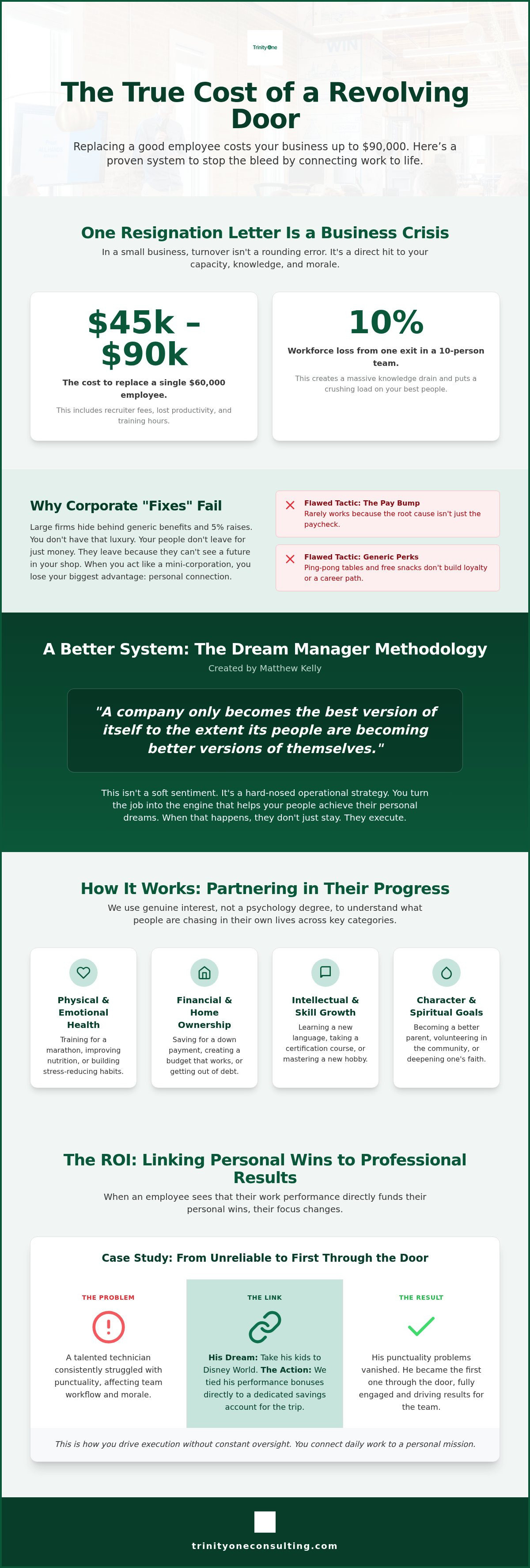
Replacing a $60,000 employee costs your business between $45,000 and $90,000 in lost productivity and retraining fees. You likely feel the weight of every resignation letter. You stop this bleed by using employee retention strategies for small business that connect your daily operations to the personal dreams of your staff. Forget about ping-pong tables or free snacks.
I know the exhaustion of watching institutional knowledge vanish overnight. It's draining. You're stuck in the weeds, spending three hours a day re-checking work because you don't trust the new hire yet. I believe God put us here to grow, and that includes your staff.
A company only becomes its best version when the people inside it are becoming better versions of themselves. You'll learn how to align your company operating cadence with the personal dreams of your people to stop turnover and drive execution. I'll show you how we use the Dream Manager methodology, created by Matthew Kelly, to create deep loyalty. This approach delivers a higher operational ROI.
Key Takeaways
- Stop losing $90,000 per exit by replacing operational chaos with a stable system.
- Connect personal goals to company execution using Matthew Kelly's Dream Manager methodology.
- Apply employee retention strategies for small business that replace burnout with a predictable operating rhythm.
- Build development plans that teach the specific skills needed for personal and professional wins.
- Hire a Fractional COO to manage the business engine while you lead the vision.
Why is employee retention so difficult for small business owners?
Broadly speaking, employee retention is your ability to keep your people from quitting. In a big corporation, one person leaving is just a rounding error. In your business, it's a crisis. When one person out of ten walks out, you just lost 10% of your total workforce capacity in a single afternoon.
The math is enough to keep any owner awake at night. Replacing a $60,000 employee usually costs your business between $45,000 and $90,000. You pay for this in recruiter fees, hours spent on interviews, and the inevitable drop in output. Most owners try to solve this with a 5% raise. It rarely works because people don't just leave for money, they leave because they can't see a future in your shop.
The real cost of a revolving door
Think about a manager role that turns over every six months. You spend three months finding them and another three months training them. By the time they're productive, they're already looking for the exit. This creates a massive knowledge drain. They take the nuances of your customer relationships and your internal processes right out the door with them.
The damage spreads to the ones who stay. Your best workers end up pulling 12-hour shifts to cover the vacant roles. They get tired. They get resentful. Eventually, they start taking recruiter calls too. This is how a single exit turns into a landslide. Effective employee retention strategies for small business must address this cycle before the engine breaks down.
Why big corporate tactics fail in small shops
Large firms use generic benefit packages to mask poor management. They can hide behind a premium dental plan or a corporate discount program. You don't have that luxury. You don't have a corporate veil to protect you from the reality of your leadership style.
Small business is personal. Your people want to know that you care about their lives outside of the office. They want a connection that a 5,000-person company can't provide. If you try to act like a mini-corporation, you lose your only real advantage. You have to build a system that values the person as much as the position.
I believe every person has God-given potential. If your business doesn't help them reach it, they'll find one that does. If you need help stabilizing your business engine to stop this turnover, a Fractional COO can provide the structure you need.
How does helping employees achieve personal dreams stop them from quitting?
I believe a company only becomes the best version of itself to the extent its people are becoming better versions of themselves. This isn't a soft sentiment. It's the foundation of the Dream Manager methodology created by Matthew Kelly. Most owners treat staff like interchangeable parts in a machine, but people have lives, families, and goals that exist outside your office walls.
Effective employee retention strategies for small business must bridge the gap between corporate goals and human desires. If a job is just a paycheck, your people will leave for a bigger paycheck. But if the job is the engine that drives their personal success, they stay. You have to turn the daily grind into a vehicle for their dreams.
The twelve categories of dreams
Matthew Kelly identifies twelve specific categories for personal growth. I make it a point to know what my people are chasing. When a manager knows a staff member is saving for a first home or training for a marathon, the dynamic shifts. You are no longer just a taskmaster. You are a partner in their progress.
Common categories we track include:
- Physical and emotional health goals
- Financial stability and home ownership
- Intellectual growth and new skills
- Character development and spiritual goals
Running these sessions doesn't require a psychology degree. It requires a genuine interest in the person sitting across from you. We talk about what they want to achieve in the next year. It's about setting clear targets for their life, not just their LinkedIn profile. This level of personal connection is one of the most powerful employee retention strategies for small business owners who want to build a loyal team.
Linking personal growth to professional ROI
When an employee sees that their work performance directly funds their personal wins, their focus changes. I once worked with a technician who struggled with punctuality. We found out his dream was to take his kids to Disney World. We tied his performance bonuses to a specific savings account for that trip. He didn't just show up on time after that. He was the first one through the door.
This is how you drive execution without constant oversight. I believe we are called to lead people toward their best selves. You can find more details on the Dream Manager Program here. It's also helpful to read how to implement a Dream Manager program to see the tactical steps. If you want to see how this fits into your specific operating cadence, schedule a time to talk through your team goals.
Most employee retention strategies fail because they focus on the company's needs. You want them to work harder. They want a life. When you align those two forces, the friction disappears and the business grows.
How does a precise operating cadence reduce employee burnout?
Chaos is a silent killer in small business. It creates a state of permanent emergency where nobody knows if they are winning or losing. This lack of clarity is the primary driver of burnout, not the workload itself. People can handle hard work, but they can't handle a lack of direction.
A clear operating cadence acts as the heartbeat of your business engine. It provides a rhythm that your people can rely on every single day. Without this structure, you are just reacting to the loudest fire. Implementing employee retention strategies for small business requires moving from talking about work to actually executing it.
I believe God gives us the strength to build systems that honor the people within them. A disciplined cadence creates a safe space for your team to thrive. It eliminates the "emergency" culture that keeps everyone on edge. When your team knows the plan, they can work with peace of mind.
Eliminating the meeting fatigue
The average small business owner wastes 10 hours every week in meetings that lack a clear purpose. That is a quarter of your work week gone. This inefficiency drains the life out of your best people. They want to produce results, not sit in a conference room listening to you think out loud.
I recommend a 15-minute daily huddle. It is fast. It is focused. We cover what was done yesterday, what is happening today, and where people are stuck. This keeps the engine moving without the drag of long-form meetings.
Clear agendas prevent the "zoom fatigue" that makes your best people want to quit. If there isn't a clear outcome defined before the start, don't hold the meeting. Respecting your team's time is one of the most effective employee retention strategies for small business owners can apply today.
Using AI to coach your team
Trinity Cadence uses AI to provide real-time visibility into your team's performance. It gives your staff instant feedback so they don't have to wait for a quarterly review. This transparency builds trust because everyone knows exactly where they stand. It removes the guesswork from the workday.
This system reduces the pressure on you to be everywhere at once. You can't scale if you are the only one providing coaching. The AI identifies when a team member is struggling with a specific task before it becomes a crisis. It allows for proactive support rather than reactive correction.
Visibility helps you identify a "flight risk" before they hand in their notice. If engagement levels drop, the system flags it. You can then step in as a mentor to address the issue. This is how a Fractional COO helps stabilize your operations and keep your top talent in the building.
What are the best employee development plans for retention?
Generic training is a sinkhole for your capital. You buy a subscription to an online course library and hope your team watches the videos. They don't. Or they watch them and forget everything by Monday morning. A real development plan focuses on the specific skills needed to achieve company goals and personal dreams simultaneously.
You must provide a clear path from a person's current role to a position of higher responsibility. If they can't see where they are going, they'll go somewhere else. I've seen owners lose their best managers because they never sat down to map out a future. This is a primary pillar of effective employee retention strategies for small business.
Development is about coaching, not just attending a seminar. It requires a consistent rhythm of feedback and correction. I believe we are called to be mentors to those we lead. If you aren't helping them grow, you are just renting their time.
The 1-on-1 coaching model
Effective coaching happens in 30-minute sessions focused on execution. We don't waste time on theory. We use a tool called the DreamCompass to track progress over a 12-month period. This keeps the focus on the twelve dream categories defined by Matthew Kelly. It turns the manager into a partner in the employee's success.
This model forces accountability on both sides. The employee has to take action, and the manager has to provide the resources. You can see the details of our Dream Manager Coaching framework here. It's built for operators who need results, not HR fluff.
Scaling your leadership bench
Identify your high-potential employees early. Don't wait for them to ask for more responsibility. Give them specific operational ownership over a project or a department. This is the only way to see if they can lead. It also keeps them engaged because they feel the weight of their own decisions.
There is a tradeoff here. You have to be willing to let them make mistakes. They will mess up a quote or miss a deadline. That is the cost of building a leader. If you step in and fix everything, they'll never learn to think for themselves. They'll just wait for you to tell them what to do.
The cost of not developing leaders is much higher. You stay stuck as the only person in the room who can make a decision. Your 60-hour work week never ends. Eventually, your best people leave because they feel like glorified assistants instead of leaders.
Why do you need an integrator to fix your retention problem?
Most Visionary owners are too busy to manage the details of a Dream Manager program. You have a business to scale. You can't spend your Tuesday mornings checking if every manager updated their DreamCompass. This is where the engine breaks down and turnover begins.
An Integrator or Fractional COO manages the business engine. They take your big ideas and turn them into repeatable systems. While you focus on the next expansion, they ensure your employee retention strategies for small business are actually happening. They make sure the cadence is followed every single week without fail.
The Visionary and Integrator relationship
The Visionary creates the culture. The Integrator builds the systems that sustain it. This partnership prevents the "whiplash" that confuses and frustrates employees. You change the plan on Tuesday. You scrap the new process on Thursday. Your staff is left spinning. Confusion is a primary reason people quit small businesses.
A Fractional COO provides high-level leadership at a fraction of the cost of a full-time executive. You get the wisdom of a seasoned operator without the $250,000 salary. It is a lean way to grow. Check out the 2026 scaling guide on when to hire a fractional executive to see if you are ready for this step.
Rapid launch sprints for culture
You don't have months to wait for a culture shift. You are losing talent now. A launch sprint can set up your entire operating system in weeks. We get the team aligned quickly to stop the bleeding of your best talent. This speed is vital for effective employee retention strategies for small business implementation.
The cost of inaction is higher than the cost of a professional integrator. Losing one manager costs you $90,000. That is money you could have spent on building a permanent system. I believe God wants us to be good stewards of the people in our care.
Stop trying to be the only leader in the room.
Build a business that people never want to leave
You stop the $90,000 turnover bleed by building a system that honors the human being. As a former football coach and corporate operator, I've seen that teams win when every player knows their role and their reward. Your business engine needs a disciplined rhythm to survive.
The most effective employee retention strategies for small business focus on the personal dreams of your staff. We use the Trinity Cadence AI operating system to give you real-time visibility into your team's engagement. I am a Certified Dream Manager because I know that a company only grows when its people grow, a core belief from the Matthew Kelly methodology.
Stabilizing your team requires a commitment to execution over theory. You can't lead a team that is constantly looking for the exit. It is time to align your operations with the future your people actually want.
You have the power to change the trajectory of your business today. I believe your best days are ahead of you.
Common Questions About Keeping Your Best People
What is the most effective employee retention strategy for small business?
The most effective strategy is linking the daily execution of the business to the personal dreams of your staff. When you show a person that their work is the vehicle for their own success, their loyalty shifts. It moves the relationship from a transaction to a partnership. This is the core of successful employee retention strategies for small business because it solves the "why" for the worker.
How do you keep employees engaged without spending a lot of money?
You build a predictable operating rhythm. Chaos is the primary driver of burnout in small shops. When your team knows exactly what winning looks like every day, they stay engaged. You don't need a massive budget to respect their time and provide clear direction. A 15-minute daily huddle can do more for morale than a holiday bonus in a disorganized office.
What is the Dream Manager concept by Matthew Kelly?
The Dream Manager methodology, created by Matthew Kelly, is a system for growing your business by growing your people. It recognizes that a company only becomes its best version when the employees are becoming better versions of themselves. I use this framework to identify what my people want to achieve in their personal lives. We then link those goals to their performance on the job.
How much does employee turnover really cost a small company?
Turnover is a massive drain on your cash flow. Replacing a $60,000 employee usually hits your bottom line for $45,000 to $90,000. These costs come from lost productivity, recruiter fees, and the time you spend on training. In a small company, losing one veteran staff member can also wipe out years of institutional knowledge that is hard to document.
Can a fractional COO help with employee retention?
A Fractional COO stabilizes the operations so your team isn't constantly reacting to emergencies. They manage the business engine and enforce the operating cadence. This prevents the "whiplash" that happens when a Visionary owner changes the plan every week. By creating a stable environment, the Fractional COO reduces the friction that makes your best people want to quit.
How do I create an employee development plan for a small team?
Start by identifying the specific skills your team needs to hit their targets. Link these skills to their personal ambitions using a tool like the DreamCompass. Effective development happens in 30-minute coaching sessions focused on real-world execution. You must provide a clear path to higher responsibility. If they feel stuck in a dead-end role, they will eventually look for a way out.
What are the 12 categories of dreams in the Dream Manager program?
Matthew Kelly defines these categories to help you understand the whole person. They include physical, emotional, intellectual, and spiritual dreams. We also track financial, character, and professional goals. The remaining areas are:
- Material and creative dreams
- Adventure and legacy goals
- Psychological well-being
Why do employees leave small businesses for larger corporations?
People don't usually leave for the corporate dental plan. They leave because they don't see a path for growth in your company. Larger corporations offer a defined ladder and a sense of stability. You can counter this by using employee retention strategies for small business that offer a deeper personal connection. I believe we are called to be stewards of our people. Without a system for their growth, they'll leave.