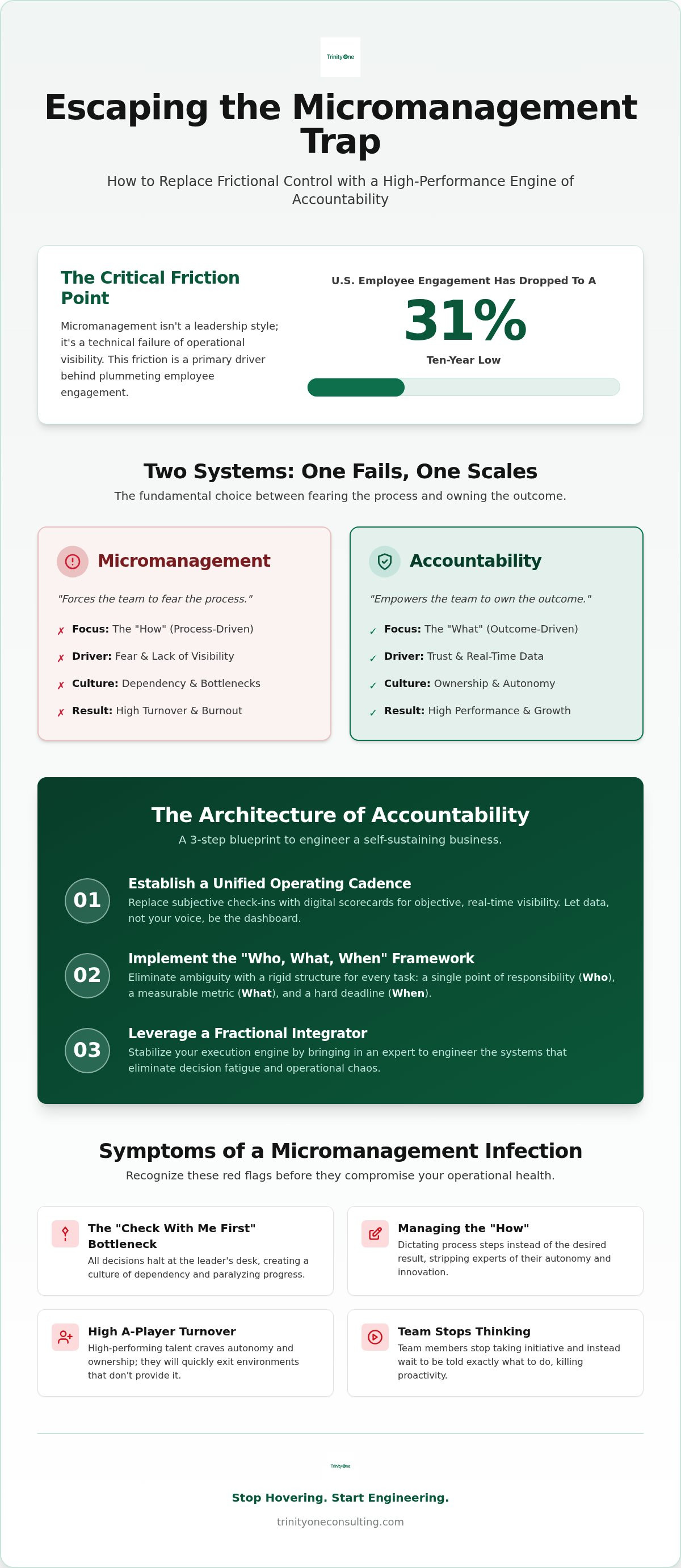
Micromanagement is not a leadership style. It's a technical failure of your operational visibility. When you feel the urge to constantly "check in" on your team, you aren't managing performance; you're compensating for a broken engine. This friction point is a primary reason why U.S. employee engagement has dropped to a ten-year low of just 31 percent. The core of the problem lies in the misunderstood divide between accountability vs micromanagement. One empowers your team to own the outcome. The other forces them to fear the process.
You want a business that runs like an integrated circuit, where every component knows its role and executes with precision. You're likely tired of the decision fatigue and the high turnover that occurs when talent feels watched rather than valued. This article provides the blueprint to solve that. You'll learn the critical structural differences between healthy accountability and toxic control. We'll explore how to implement a unified operating cadence that provides real-time visibility without the need for constant supervision. It's time to stop hovering and start engineering a self-sustaining engine of growth.
Key Takeaways
- Identify micromanagement as a technical failure of visibility and replace it with a system of clinical precision.
- Understand the critical mechanics of accountability vs micromanagement to build a self-sustaining business engine that executes without constant supervision.
- Establish a unified operating cadence using digital scorecards to move from verbal promises to objective, real-time data.
- Leverage a Fractional Integrator to stabilize your execution engine and eliminate the friction of decision fatigue.
- Integrate human purpose with operational ROI by linking personal growth to professional performance through Dream Management.
The Friction Point: Why Leaders Confuse Control with Execution
Leaders often mistake activity for progress. They view control as a safety net, but in reality, control is a friction point that slows the entire engine. Micromanagement is a clinical failure of trust and visibility. It occurs when a leader lacks a clear window into the business. Without real-time data, they resort to hovering. This creates a loop of inefficiency and executive burnout. You cannot scale a business by gripping the steering wheel tighter. You scale by building a system that executes on its own.
The high cost of hovering is measurable. It results in reduced ROI and a team that becomes paralyzed by indecision. When you manage the process rather than the outcome, you trade long-term growth for short-term comfort. The core of high performance is a simple binary: control is an illusion; execution is a metric. Moving from one to the other requires a fundamental shift in how you view the people in your engine.
Defining Accountability in the Modern Workplace
Accountability is the voluntary ownership of a specific outcome. It functions like an integrated circuit where expectations meet results without interference. To build this, you need a rigid "Who, What, When" framework. Every task must have a single point of responsibility, a measurable metric, and a hard deadline. This eliminates ambiguity and prevents the operational chaos that follows vague instructions.
True accountability thrives in an environment of radical transparency. It's not about blame; it's about alignment. When everyone sees the scoreboard, the need for "checking in" disappears. This is where the struggle of accountability vs micromanagement is won. High-performing teams don't need to be watched. They need to be aligned with the mission and given the tools to prove their progress.
The Symptoms of a Micromanagement Infection
Micromanagement is a management style characterized by excessive control or attention to detail. It's an infection that kills autonomy. You'll recognize the "check with me first" bottleneck. This happens when all decisions stop at the leader's desk. It creates a culture of dependency. Your team stops thinking and starts waiting for instructions.
Managers who micromanage focus on the "how" instead of the result. They dictate the specific steps of a process, stripping their team of their expertise. The results are predictable. High-performing A-players crave autonomy. If they don't find it, they leave. This leads to high employee turnover and a brain drain that stalls growth. To fix the engine, you must stop managing tasks and start managing the system that produces them.
The Mechanics of Micromanagement: A System Failure of Visibility
Leaders don't micromanage because they enjoy the minutiae. They do it because they are blind. Micromanagement is a manual process in an automated world. It is a structural defect in the business engine. When a leader lacks real-time visibility into execution, they open the hood and poke at the components. This creates a friction point that stalls growth and creates operational chaos. Hovering is simply a low-resolution proxy for actual data.
Without a unified operating cadence, managers use their voice as a dashboard. They demand updates and schedule "quick syncs." These manual check-ins are the least efficient way to track progress. They interrupt the flow of work and signal a lack of trust. This is the heart of the accountability vs micromanagement struggle. One is a system of empowerment; the other is a symptom of systemic failure. Using a Fractional Integrator can solve this by engineering a system where data, not the leader, provides the visibility needed to scale.
Visionaries often fall into the "Integrator's Trap." They find themselves stuck in the weeds of daily tasks because the execution engine hasn't been synchronized. They believe they are helping, but they are actually creating a bottleneck. Every decision that requires executive approval is a delay in the circuit. Execution is a metric, not a conversation. If you have to ask for the status of a project, your system has already failed.
Fear as a Driver of Micromanagement
Fear of failure leads to toxic over-correction. This anxiety often stems from poor onboarding and a lack of confidence in team competency. When a leader believes "only I can do it right," they stop leading and start doing. This mindset is a terminal diagnosis for any business attempting to scale. It prevents the team from developing the ownership required for high performance. Confidence is built through verified results, not constant oversight.
The Visibility Gap
Fragmented software leads to operational "dark matter." This is the space where work happens but remains invisible to leadership. To close this gap, you need a single source of truth. As of March 2026, nearly 73 percent of U.S. employers utilize employee monitoring software to regain control. However, data from Chanty shows that 23 percent of employees feel constantly monitored, which is correlated with an 18 percent increase in stress and anxiety. High-performance cultures don't need surveillance. They need a unified operating system that aligns machine operations with human performance.
The Architecture of Accountability: Outcome-Based Leadership
Accountability is not a personality trait. It is a structural requirement. To move beyond the friction of micromanagement, you must build a blueprint for execution. This architecture shifts the focus from the individual's activity to the system's output. It is a transition from subjective oversight to objective verification. You're no longer managing people. You're managing the results the people produce.
The "Trust but Verify" model is often misunderstood as a manual audit. In a high-performance culture, verification is digital and instantaneous. You don't need to ask for a status update when the data is already in the circuit. By engineering accountability through clear KPIs and scorecards, you eliminate the need for hovering. You focus the lens on outcomes, not the specific path taken to reach them. This is the fundamental pivot in the debate of accountability vs micromanagement. One relies on the leader's presence; the other relies on the system's integrity.
Building a Scorecard for Success
An effective scorecard defines what "done" looks like before the work begins. It removes the ambiguity that leads to over-correction. You must use leading indicators to predict performance before a failure occurs. Waiting for the end of the month to see a result is reactive. Real-time data allows for proactive alignment. A KPI is a pulse check for the business engine. It provides the diagnostic data needed to ensure every component is functioning at peak efficiency. When the scorecard is green, the leader stays out of the weeds. When it's red, the system signals exactly where the friction lies.
The Power of Radical Autonomy
Autonomy is the fuel for engagement. When you empower teams to solve problems without executive intervention, you increase the velocity of your business. This doesn't mean a lack of control. It means setting clear boundaries. Within those guardrails, creativity thrives. Teams that own their results are more likely to stay and perform at a higher level. In fact, research from 2026 shows that 48 percent of remote workers believe return-to-office mandates are primarily about micromanaging them. By providing radical autonomy, you solve the retention crisis. You transform your employees from passive operators into active owners of the execution engine. This alignment between team autonomy and organizational strategy is the hallmark of a self-sustaining business.
Establishing a Unified Operating Cadence for Autonomy
High-performance cultures don't happen by accident. They are engineered. A business without a rhythm is a business in chaos. When you lack a structured operating cadence, you resort to manual overrides. This is the root of the accountability vs micromanagement conflict. Micromanagement is a manual override. Accountability is an automated system. One is an attempt to force synchronization through sheer will. The other is the byproduct of a system that breathes on its own.
You must implement a rhythm of business that automates execution tracking. Moving from "weekly status updates" to "real-time execution tracking" eliminates the visibility gap. If you have to ask for a status update, your engine has a leak. Systems like Trinity Cadence provide a real-time window into performance. This transition is the definitive solution to the accountability vs micromanagement dilemma. It allows for clinical precision in management without the friction of constant "checking in."
The Components of a High-Performance Cadence
A functional engine requires different speeds for different tasks. Your operating cadence should mirror this complexity. Tactical alignment happens in daily huddles. These are ten-minute pulses that clear the path for the day's execution. Strategic tracking occurs during weekly pulses. We recommend a focused weekly leadership meeting to synchronize team execution and resolve issues without the need for executive hovering. Quarterly sprints provide the space for rapid pivots and scaling.
This structured approach creates a predictable environment. Teams know exactly when and how they will be measured. This certainty reduces anxiety and fosters a culture of ownership. Mastering the Operating Cadence: The Integrator's Role is essential for leaders who want to step out of the weeds and into a visionary role. When the cadence is set, the business runs on data rather than drama.
Integrating AI into the Operating System
AI is the ultimate tool for scaling accountability. By leveraging an AI-native operating system, you automate the "verification" in "trust but verify." AI coaching can identify friction points in your team's workflow before they escalate into crises. It analyzes patterns in execution data that the human eye might miss. This isn't surveillance. It's optimization. It provides the data-driven visibility needed to maintain high team engagement and retention.
You can implement a Trinity Cadence OS to align your human performance with machine-like efficiency. When the system handles the verification, the leader is free to focus on human development and long-term vision. The engine runs. The team thrives. The business scales. There's no need for hovering when the data speaks for itself.
Beyond the Engine: Fractional Leadership and the Dream Manager
Building an execution engine is only half the battle. A machine requires a skilled operator to maintain its rhythm. This is where operational logic meets the human element. Many leaders struggle with accountability vs micromanagement because they attempt to play every role in the circuit. They design the vision, build the system, and then try to turn every gear themselves. This redundancy leads to system failure. To achieve true scale, you must separate the vision from the execution. You must move from being the primary driver to becoming the strategic architect, often by leveraging professional development resources like Intact Academy to master the art of organizational change.
Employee buy-in is the final step in eliminating the friction of control. When your team understands that the system exists to support their success, they stop resisting the data. They move from being passive components to active stakeholders. Trinity One acts as the architect of this integrated system. We provide the structural integrity needed to align human purpose with business ROI. By integrating fractional leadership with human-centric systems, we create a business that executes with clinical precision and empathetic depth.
The Fractional Integrator as the Buffer
A Fractional Integrator serves as the essential buffer between the Visionary and the execution engine. They protect the leader from the reflexive urge to micromanage by providing a reliable layer of professional oversight. This role isn't just about management; it's about maintaining the technical efficiency of the business engine. By offloading operational execution to a professional Fractional COO, you eliminate decision fatigue. You stop managing the "how" and start leading the "why." This structural separation ensures the leader manages the vision while the Integrator manages the machine.
The Dream Manager: The Ultimate Accountability Tool
Accountability thrives when it is mutually beneficial. The Dream Manager concept is a proprietary methodology that links personal growth to professional performance. It acknowledges that employees are individuals with personal aspirations. When you help an employee identify and achieve their personal goals through Dream Management facilitation, you build a level of loyalty that no surveillance tool can replicate. This is the ultimate solution to the accountability vs micromanagement struggle. Ownership of the dream leads to ownership of the task.
This creates a culture where the business serves the people, and the people serve the business. It is a reciprocal engine of growth. As of 2026, the Dream Manager program remains a cornerstone for organizations looking to reverse the ten-year low in employee engagement. By using tools like DreamCompass, you provide your team with a roadmap for their own lives. This alignment transforms work from a chore into a vehicle for personal fulfillment. When an employee sees the business as the engine that fuels their own dreams, accountability becomes their default setting. They don't need to be watched because they are already moving toward a goal that matters to them.
Engineer Your Execution Engine
Leaders often treat business like a manual craft when it should be an automated system. The divide between accountability vs micromanagement is defined by your architecture, not your intentions. You don't need more meetings. You need a unified operating cadence that provides real-time visibility. By implementing scorecards and rigid frameworks, you move from subjective control to objective execution. This shift eliminates the friction of decision fatigue and restores your capacity for vision.
Scaling requires a clinical approach to operations and an empathetic approach to people. We bridge this gap by combining Fractional COO expertise with the Trinity Cadence AI-native operating system. Through certified Dream Management facilitation, we align human purpose with your business engine. When the machine runs on data and the people run on dreams, the business becomes a self-sustaining force for growth.
Building a world-class culture is a technical challenge with a human solution. You've provided the vision. It's time to build the engine that carries it forward.
Frequently Asked Questions
What is the difference between accountability and micromanagement?
Accountability is the voluntary ownership of a specific outcome; micromanagement is the forced interference in a specific process. One empowers the team to drive toward a result using their own expertise. The other forces them to wait for permission at every step. In the struggle of accountability vs micromanagement, the former relies on a functioning system while the latter relies on the leader's constant presence.
How do I know if I am micromanaging my team?
You are micromanaging if you've become the primary bottleneck for every tactical decision in the business. If your team cannot execute without a "quick sync" or your approval on minor details, your engine is failing. Watch for signs like high turnover among A-players and a total lack of creative problem-solving. When you focus on the "how" rather than the "what," you've crossed into toxic control.
Can you have accountability without micromanagement?
Yes, accountability thrives when micromanagement is removed through technical visibility. By engineering clear boundaries and measurable scorecards, you create a "Trust but Verify" environment. This allows you to verify results digitally without hovering over the process. True accountability is the byproduct of a unified operating cadence where every component of the business engine is synchronized and visible.
How does a business operating system improve accountability?
A business operating system like Trinity Cadence replaces manual oversight with automated data tracking. It provides a single source of truth for every KPI and project milestone. This eliminates the need for verbal status updates and constant check-ins. When the scoreboard is visible to everyone in real time, accountability becomes a natural part of the workflow rather than a forced management task.
What is the role of an Integrator in preventing micromanagement?
An Integrator acts as the operational buffer that manages the execution engine so the Visionary leader doesn't have to. They ensure the system is running at peak efficiency and that every team member knows their specific role. By owning the "how" of the business operations, the Integrator prevents the leader from getting stuck in the weeds. This structural separation is the ultimate cure for the urge to control.
How does AI help with team accountability?
AI provides real-time visibility into execution patterns that are invisible to the human eye. It identifies friction points in the workflow before they become operational crises. By automating the verification process, AI removes the emotional weight of accountability vs micromanagement. It allows leaders to manage by exception, only intervening when the data signals a specific technical failure in the circuit.
What should I do if my team isn't meeting their accountability standards?
If standards aren't met, you must first diagnose the system failure before blaming the individual. Check if the expectations were clearly defined in a "Who, What, When" framework. Use your weekly pulse meetings to isolate the issue and identify the root cause without hovering. Accountability isn't about punishment; it's about identifying where the circuit is broken and repairing it to restore flow.
How does the Dream Manager concept reduce the need for micromanagement?
The Dream Manager concept creates internal motivation by linking personal fulfillment to professional performance. When an employee sees the business as the vehicle for their own dreams, they take voluntary ownership of their results. This reduces the need for oversight because the employee is driven by their own vision. It transforms the relationship from a transaction of labor into a partnership of purpose.