
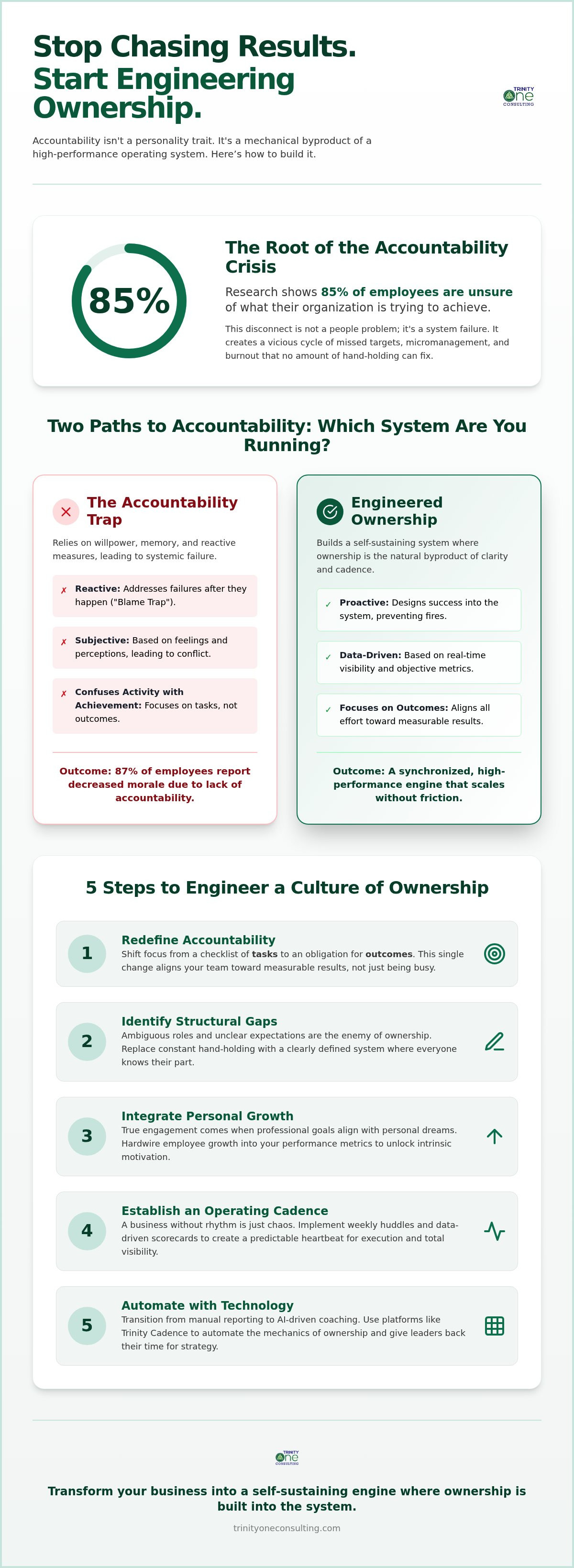
Most leaders treat ownership as a personality trait you either have or you don't. It isn't. It's an engineering problem. When you're drowning in operational friction and missed KPIs, the instinct is to lean in and micromanage. This creates a cycle of CEO burnout and high turnover that feels impossible to break. Research shows that 85% of employees are actually unsure of what their organizations are trying to achieve. This disconnect is the root of most accountability in the workplace issues, leading to a breakdown in execution that no amount of hand-holding can fix.
You shouldn't have to chase your team for results. Accountability should be the natural byproduct of a synchronized operating cadence, not a leadership burden you carry alone. It's time to stop treating symptoms and start addressing the underlying mechanics. You'll discover how to transform your business into a self-sustaining engine where ownership is built into the system. We'll explore how real-time visibility and a structured high-performance operating system can turn your vision into a measurable, mechanical reality.
Key Takeaways
- Redefine accountability as an obligation to outcomes rather than a checklist of tasks to shift your team's focus toward measurable results.
- Identify the structural gaps causing common accountability in the workplace issues to replace constant hand-holding with a self-sustaining business engine.
- Integrate personal growth through Dream Management to ensure employee engagement is hardwired into your company's performance metrics.
- Establish a high-integrity operating cadence using scorecards and weekly huddles to maintain total visibility without the friction of micromanagement.
- Transition from manual reporting to AI-driven coaching with Trinity Cadence to automate the mechanics of ownership across your entire organization.
Identifying the Core Accountability in the Workplace Issues
Accountability is the obligation to own results, not just tasks. Most leaders confuse activity with achievement. This distinction is foundational to understanding What is Accountability? and how it functions within a high-performance engine. When a system lacks this clarity, you encounter a persistent friction known as the Accountability Gap. Leaders perceive a lack of ownership. Employees feel micromanaged. Both are right. The system is broken.
Systemic failure manifests through predictable symptoms. Missed milestones become the norm. Blame-shifting replaces problem-solving. You see "quiet quitting" not as a lack of talent, but as a lack of alignment. These accountability in the workplace issues erode ROI and stall operational speed. Every hour spent hand-holding is an hour stolen from strategic growth. Research indicates that 87% of employees believe a lack of accountability leads to decreased morale. This isn't just a cultural problem. It's a structural one.
- Missed Milestones: Deadlines become suggestions rather than commitments.
- Blame-Shifting: Energy is spent defending positions instead of solving bottlenecks.
- Operational Friction: Constant "check-ins" replace real-time execution.
- Quiet Quitting: High-performers leave when they're forced to carry the weight of under-performers.
The Blame Trap vs. True Ownership
Holding someone accountable is reactive. It's a post-mortem on failure. Fostering ownership is proactive. It's the design of success. Traditional performance reviews fail because they're too late; they measure the smoke instead of preventing the fire. True ownership requires real-time feedback loops and a clear connection between individual effort and organizational vision. Systemic accountability is the bridge between vision and execution.
Why Leaders Struggle with Enforcement
Gallup research indicates that only a minority of leaders are truly comfortable holding their teams accountable. In remote or hybrid environments, the fear of being "the bad guy" intensifies. Without physical presence, leaders often retreat into silence to avoid conflict. This avoidance usually stems from a lack of clear data. When expectations are subjective, enforcement feels like a personal attack. When expectations are data-driven, accountability becomes an objective mechanical adjustment. Leaders don't need more "toughness." They need better visibility into accountability in the workplace issues to make informed decisions without the emotional weight of subjectivity.
The Mechanical Failure: Why Traditional Accountability Models Break
Traditional accountability models are built on a foundation of "good intentions" and "mutual trust." These are admirable values, but they are not operational systems. They rely on human memory and individual willpower. Both are finite resources. When these resources deplete, accountability in the workplace issues emerge as systemic failures. Ownership is not a soft skill. It is a mechanical byproduct of a high-performance operating system.
An engine without a timing belt is just a collection of parts. A business without a defined rhythm is just a group of people reacting to chaos. True accountability requires a consistent Operating Cadence. It is the heartbeat of execution. Without it, your business engine stalls. You move from proactive growth to reactive firefighting. This shift erodes technical efficiency and damages human connection. You can follow 5 Steps To Inspire Positive Accountability, but without the mechanical structure to support those steps, the results will be temporary.
The Lack of a Unified Operating Cadence
Irregular meeting rhythms lead to dropped balls. Period. If your team only discusses goals once a month, they aren't managing performance; they're conducting an autopsy. Machine operations require a precise, predictable pulse. Your business is no different. A consistent weekly heartbeat ensures that small issues are caught before they become catastrophic failures. It transforms "reporting" into a real-time calibration of the business engine.
Ambiguous Role Definitions
Ambiguity is the enemy of ownership. When roles are fuzzy, everyone is responsible, which means no one is. This is especially true in the friction between a Visionary CEO and the execution team. The Visionary generates the fuel. The execution team needs the engine to be tuned. A fractional integrator acts as the accountability circuit breaker in this environment. They filter the Visionary’s chaos into actionable tracks. They ensure every seat is filled by someone who passes a role-fit check: they understand the role, they want it, and they have the capacity to do it. This clarity eliminates the excuses that fuel accountability in the workplace issues.
Moving past surface-level excuses requires "weekly leadership meeting" thinking. This means identifying the root cause of a friction point rather than just treating the symptom. It is a binary process. Either the system worked, or it didn't. If the system failed, we re-engineer the system. If you are ready to stop hand-holding and start scaling, consider how a fractional integrator can install the circuits your business needs to thrive.
The Performance Link: Aligning AI and Personal Dreams
Accountability is not merely a spreadsheet. It is a psychological state. Most accountability in the workplace issues stem from a fundamental misalignment: the company wants results, but the employee wants a life. When these forces pull in opposite directions, the engine seizes. High-performance operating systems solve this by integrating personal aspirations into the professional framework. You cannot expect a team to own your vision if you ignore theirs. True ownership occurs when the job becomes the vehicle for the individual's personal success.
This is the core of the Dream Manager concept. It is a strategic shift from extracting value to creating it. By aligning personal aspirations with business objectives, you create a team culture in which accountability naturally emerges. It is no longer about "holding people accountable" through pressure. It is about enabling people to hold themselves accountable through purpose. When the link between a missed KPI and a missed personal goal is clear, performance becomes self-regulating.
Dream Management as a Retention Tool
Personal growth drives professional loyalty. This is a binary truth. If an employee feels stagnant, they will eventually leave or, worse, stay and disengage. Dream Management facilitation provides the structure for this growth. Through DreamCompass software, leaders gain visibility into the "human" side of the business engine without overstepping boundaries. It tracks progress on personal milestones alongside professional ones. Accountability is easier when the employee sees the job as a vehicle for their own dreams. It transforms the workplace from a site of labor into a platform for personal ROI.
AI-Native Operating Systems
The transition from manual tracking to automated accountability loops is the next frontier of leadership. AI coaching identifies execution bottlenecks before they become catastrophic "issues." Unlike a human manager, AI doesn't nag. It calibrates. It provides objective, real-time feedback that removes the emotional friction from the process. This shift reduces the "nagging factor" for leadership. It allows executives to move away from constant hand-holding and toward high-level strategy.
Trinity Cadence acts as the AI-native solution for this integration. It provides real-time engagement visibility by analyzing execution patterns. If a team member begins to slip, the system flags the friction point immediately. This isn't about surveillance; it's about support. It allows for a proactive intervention that addresses the root cause of accountability in the workplace issues. Machine efficiency and human performance are finally synchronized. The result is a business engine that runs with clinical precision and human depth.
Engineering a Culture of Ownership: 5 Steps to Implementation
Culture is not what you say. It is what you tolerate. Most accountability in the workplace issues survive because the system lacks a diagnostic panel. To move from chaos to a self-sustaining business engine, you must install a clear implementation roadmap. This is a mechanical process. It requires five definitive steps to shift the burden of execution from the CEO to the operating system itself.
- Step 1: Define the Scorecard. Identify the 5-15 numbers that run the business.
- Step 2: Establish the Cadence. Implement high-integrity weekly huddles with zero tolerance for fluff.
- Step 3: Assign the Integrator. Appoint one person to own the "how" of execution.
- Step 4: Automate Visibility. Use Trinity Cadence to track execution in real-time.
- Step 5: Link Performance to Purpose. Integrate the Dream Manager program to hardwire human growth into the engine.
Building the Scorecard
You cannot manage what you do not measure. A scorecard acts as the business's central nervous system. It must distinguish between leading indicators (activity) and lagging indicators (results). Leading indicators tell you if you are going to hit your goal. Lagging indicators tell you if you did. Every team member must own "one number." This creates a binary environment: the number was hit, or it wasn't. The psychological impact of keeping score for oneself is profound. It replaces the fear of "getting in trouble" with the pride of hitting a target. It eliminates ambiguity and provides a clear path for technical efficiency.
The Fractional Integrator Advantage
An internal hire often gets bogged down in office politics or historical baggage. A fractional integrator acts as an external Accountability Architect. They bring an objective perspective that internal teams lack. They manage the Visionary/Integrator relationship for maximum output. The Visionary CEO provides the fuel; the Integrator builds the engine. Using a 90-day sprint approach, they can identify and fix deep-seated accountability in the workplace issues that have stalled growth for years. This isn't a long-term consulting project. It is a surgical intervention designed to install a permanent operating cadence.
Execution is a discipline. If you are ready to stop managing people and start managing a system, it is time to install the right leadership structure. You can begin this transformation by engaging a professional who understands the mechanics of ownership. Experience the power of a fractional COO to turn your operational friction into a streamlined engine of growth.
Implementing Trinity Cadence for Total Operational Visibility
Trinity Cadence is the definitive AI-native solution for accountability in the workplace issues. It replaces the friction of human nagging with the precision of machine-driven visibility. Most leaders spend their days chasing updates. This is a waste of intellectual capital. Through the Trinity platform, the focus shifts from reactive reporting to proactive coaching. You don't just see what happened; you see what's about to happen. Execution becomes binary. Either the circuit is closed, or it isn't.
Deploying such a system requires more than just software. It requires the expertise of a Fractional COO / Integrator who understands how to wire these circuits into your existing culture. They act as the architect of your operating system. They ensure the machine efficiency of AI aligns perfectly with the human performance of your team. This isn't a slow transition. It's a rapid recalibration of how your business functions at its core.
The AI-Native Advantage
Real-time visibility eliminates the "I didn't know that was due" excuse forever. It's an objective record of commitment and execution. Trinity Cadence uses integrated coaching to prompt better behavior before a bottleneck becomes a crisis. It identifies patterns of friction that a human manager might miss. This aligns the machine and the human for a unified operating cadence. The system becomes the "bad guy" so the leader can remain the Visionary. It creates a high-integrity environment where data, not emotion, drives the conversation.
Next Steps for the Visionary CEO
Assess your current framework with brutal honesty. Is your business a self-sustaining engine, or is it a collection of people waiting for your next instruction? If you're seeing persistent accountability in the workplace issues, your system is failing you. The most effective way to reset team expectations is through a Launch Sprint. This intensive process installs the foundational scorecards and huddle rhythms needed to gain immediate control. It clears the operational debt that's been stalling your growth.
Stop managing people. Start managing the system. When the system is engineered for ownership, the people will follow. Accountability isn't a weight you carry; it's the engine of freedom for the leader. It allows you to step out of the trenches and back into the role of the strategic architect. Your vision deserves an engine that can actually finish the race. It's time to build it.
Architect Your Operational Freedom
Accountability isn't a personality trait. It's a structural requirement for scale. By replacing vague expectations with a scorecard-driven cadence, you eliminate the ambiguity that fuels accountability in the workplace issues. You've seen how aligning personal dreams with professional KPIs creates a self-regulating engine. You've learned that AI-driven visibility removes the emotional friction from leadership. Now, the choice is binary. You can continue managing by crisis or begin managing by design.
Trinity One provides the blueprint for this transformation. We offer an AI-native operating system specifically designed for growing companies. Our battle-tested fractional Integrators bring 30+ years of operational experience to your leadership team. We combine technical precision with certified Dream Management facilitation to ensure your team stays engaged while your business scales. The friction you feel today is simply a signal that your engine needs a new circuit.
Engineering your business engine starts here. Explore Trinity One.
The path to operational freedom is paved with high-integrity systems. You have the vision. It's time to build the engine that can carry it to the finish line.
Frequently Asked Questions
What are the most common accountability in the workplace issues?
The most common accountability in the workplace issues include missed milestones, pervasive blame-shifting, and a lack of role clarity. These symptoms indicate a breakdown in the business engine. Without a defined scorecard, employees focus on activity instead of results. This leads to operational friction and CEO burnout. A system without clear metrics is a system that invites failure.
How do you handle an employee who refuses to take ownership?
Use the role-fit check to determine whether the individual understands the role, wants it, and has the capacity to do the job. Ownership cannot be forced; it must be engineered through proper placement. If they fail this binary test, they are in the wrong seat. Clear, data-driven expectations remove the subjectivity from these difficult conversations and focus on the mechanics of performance.
Can software really improve team accountability?
Yes, AI-native operating systems like Trinity Cadence transform accountability from a leadership burden into a mechanical byproduct. Software provides real-time visibility that eliminates the need for constant hand-holding. It creates a high-integrity environment where execution is tracked automatically. There is no room for ambiguity or excuses when the data is visible to the entire team in real-time.
What is the difference between responsibility and accountability?
Responsibility is the obligation to perform a specific task. Accountability is the obligation to own the final result. You can delegate responsibility, but you cannot delegate the ultimate ownership of the outcome. One is about the "doing," while the other is about the "achieving." A high-performance engine requires every team member to understand this distinction clearly.
How does a fractional COO help with workplace accountability?
A fractional COO acts as an Accountability Architect to install the operating cadence your business lacks. They provide the objective perspective needed to enforce scorecards and huddle rhythms. This external leadership ensures the system runs with clinical precision. It frees the Visionary CEO from the trenches, allowing them to focus on high-level strategy while the Integrator manages the execution.
Is accountability the same as micromanagement?
Accountability is the opposite of micromanagement. Micromanagement is a reactive response to a lack of system visibility. It focuses on the "how" of every task. A true accountability system focuses on results, not methods. It provides the leader with the data they need to step back. Systems replace the need for constant intervention with objective, real-time metrics.
How do you build an accountability system for a remote team?
Building an accountability system for a remote team requires a synchronized weekly heartbeat and digital scorecards. You must replace physical presence with data transparency. Using Trinity Cadence ensures that every team member remains aligned with company objectives regardless of location. It creates a unified operating cadence that keeps the engine running smoothly without the need for a physical office.
What is the "Dream Manager" and how does it help with performance?
The Dream Manager program aligns an employee's personal aspirations with their professional performance. It operates on the principle that people only care about your goals when you care about theirs. This certified facilitation improves retention by showing employees that the company is a vehicle for their own success. It hardwires human growth into the mechanics of the business engine for long-term ROI.
By supporting the "whole person," companies help employees navigate personal challenges, such as finding mental health care for their children and teenagers. Resources like Thrive Teen Therapy Alberta allow parents to address these critical family needs, ensuring they can remain focused and accountable in their professional roles.