
Strategy is a blueprint, but blueprints don't build skyscrapers. Most leadership teams treat accountability as a loose social contract when they should treat it as a precision engine. When execution stalls, it's rarely a lack of talent. It's a systemic failure of the circuit. You've likely felt the friction of the "Vision-Execution Gap" where your best ideas die in the huddle. You're exhausted by meetings that feel like autopsies of the past. You want to solve for the future.
True performance is binary: either the system works or it doesn't. This article provides the roadmap to bridge the execution gap using a modern accountability framework for leadership teams. You'll learn how to move from reactive management to a self-sustaining leadership engine that provides real-time visibility. We'll explore how to integrate AI-native cadences with human performance by aligning personal employee dreams with corporate ROI. It's time to stop chasing your team for updates and start engineering high-performance execution.
Key Takeaways
- Bridge the "Vision-Execution Gap" by replacing manual reporting with an integrated business engine.
- Deploy a systematic accountability framework for leadership teams that balances clinical precision with human motivation.
- Integrate "Dream Management" to align individual aspirations with company performance, turning employees into stakeholders.
- Establish a high-performance operating cadence that shifts the focus from past post-mortems to future-focused problem-solving.
- Utilize Trinity Cadence and fractional leadership to provide the real-time visibility required for scaling operations.
Why Leadership Accountability Frameworks Fail in Modern Business
Strategy is a thought experiment. Execution is a biological reality. Most organizations treat an Accountability framework for leadership teams as a static list of tasks rather than an integrated circuit. This creates immediate friction. Visionary ambition collides with operational inertia, and the result is a stalled engine. When the framework is purely manual, it relies on human memory and willpower. Both are finite resources. Modern business moves at a velocity that exceeds the capacity of traditional reporting. If your system isn't automated and integrated, it's already failing.
Fragmented software tools further dilute ownership. When data is trapped in silos, no one sees the whole machine. They only see their specific gear. This lack of transparency leads to "hero culture," where individuals over-perform to compensate for systemic gaps. It's unsustainable. True accountability isn't about chasing people for updates. It's about engineering a system where visibility is the default setting. Without this, leadership is just a series of expensive guesses based on decaying data.
The Vision-Execution Gap
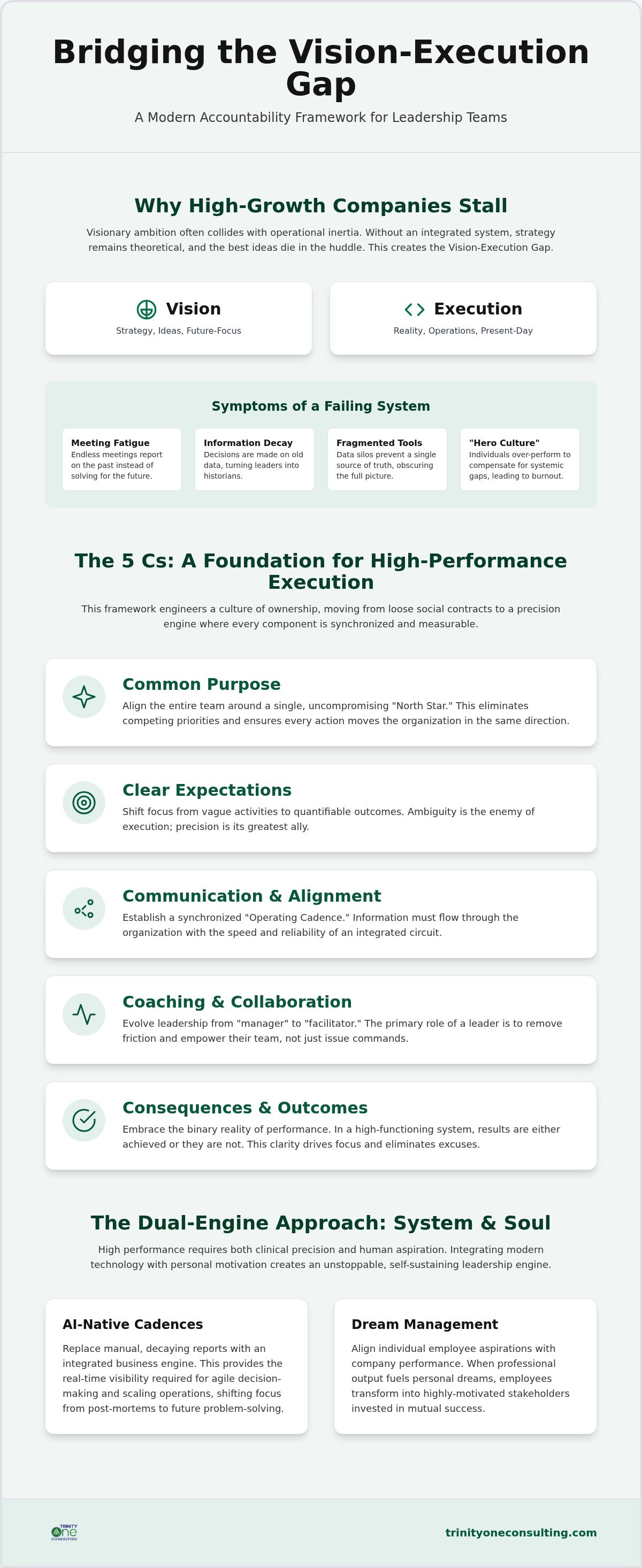
Visionaries live in the future. Their teams live in the present. Without a bridge, strategy remains theoretical. High-growth companies often hit a ceiling because the "Integrator" role is missing or underpowered. Level 10 meetings, intended for high-stakes problem solving, devolve into boring status reports. Leaders spend 90 minutes reporting on the past instead of solving for the future. The gap isn't a lack of talent; it's a lack of structural alignment. Strategy is the "what," but an accountability framework for leadership teams must provide the "how" and the "who" with surgical precision.
Meeting Fatigue and Information Decay
Data has a half-life. Manual reporting creates a dangerous lag in decision-making. By the time an executive reviews a weekly report, the information is already several days old. This delay forces leaders to be historians rather than architects. Consequently, "accountability" becomes a buzzword for micromanagement. Teams fall into the "busy-work" trap. They prioritize checking boxes over driving outcomes because the system rewards activity over impact. This cycle creates meeting fatigue. When meetings don't result in real-time adjustments, they become a tax on productivity rather than a catalyst for it.
The 5 Cs of Leadership Accountability: A Foundation for Execution
High-performance execution isn't a happy accident. It's the result of a rigorous architecture. An effective accountability framework for leadership teams functions like a high-performance engine. If one component fails, the entire system stalls. We utilize the "5 Cs" to ensure every executive is synchronized and every output is measurable. This isn't about management; it's about engineering a culture of ownership.
- Common Purpose: Aligning the team around a single, uncompromising "North Star." This eliminates competing priorities and ensures every gear turns in the same direction.
- Clear Expectations: Shifting the focus from vague activities to quantifiable outcomes. Ambiguity is the enemy of execution.
- Communication and Alignment: Ensuring the "Operating Cadence" is synchronized. Information must flow through the organization with the speed of an integrated circuit.
- Coaching and Collaboration: Moving from "Manager" to "Facilitator." Leaders must remove friction points rather than just issuing commands.
- Consequences and Outcomes: The binary reality of performance. In a high-functioning system, results are either achieved or they aren't. There is no middle ground.
True accountability requires a structured framework for decision-making to prevent strategic drift. If you need a strategic architect to build this engine, a Fractional Integrator can provide the necessary oversight to install these systems correctly.
Defining Quantifiable Ownership
Job descriptions are often too static for high-growth environments. We replace them with "Scorecards" that track specific, weekly KPIs. This provides real-time visibility into who is winning and who needs support. Clear Expectations: The total elimination of ambiguity regarding executive roles and their specific, quantifiable contributions. When expectations are defined by numbers rather than adjectives, the path to success becomes a logical proof.
The Architecture of a Common Purpose
A "North Star" is only useful if it's visible to everyone. You must align individual KPIs with the company's Strategic AI Roadmap to ensure technical efficiency supports human vision. This creates a system where goals are "owned" by the team rather than "assigned" by the CEO. We use a Unified Operating Cadence to maintain this alignment. It transforms a group of talented individuals into a self-sustaining leadership engine. Every meeting and every metric serves the larger whole, ensuring the machine never loses momentum.
Beyond the Basics: Integrating AI and Human Aspiration
Standard management models often fail because they ignore the biology of the user. They treat executives like components in a static machine rather than dynamic human beings. To engineer high-performance execution, you must adopt a dual-engine approach. This often involves working with a regenerative strategist like Jannine Barron to help transition from extractive models to nature-aligned practices. This requires the clinical precision of machine operations and the empathetic depth of human development. When these two forces align, an accountability framework for leadership teams becomes a self-sustaining engine of growth.
Manual tracking is an obsolete technology. It's too slow for the modern market. Information decays the moment it's entered into a spreadsheet. We replace this friction with Trinity Cadence, an AI-native operating system. It provides real-time visibility into every operational circuit. By moving from manual reporting to an AI-native cadence, you eliminate the "lag" that kills momentum. You stop reacting to the past and start solving for the future.
The Physics of Human Motivation
Why do people work? It's rarely for your company's ROI. They work for their own aspirations. We bridge this gap through Dream Management facilitation. By linking personal "Dreams" to company execution via DreamCompass, you create a powerful psychological bond. If an executive sees the organization as the primary vehicle for their personal growth, ownership is no longer a mandate. It's a natural byproduct. Retention becomes the ultimate metric of a functional framework. The "Dream Manager" acts as a strategic catalyst, ensuring that human soul fuels machine efficiency.
AI-Powered Accountability
AI doesn't have bad days. It doesn't have ego. It lacks the emotional intelligence for complex leadership, but it excels at identifying execution friction. Our AI implementation identifies bottlenecks before they ever hit the weekly huddle. This provides a "pre-emptive" strike against failure. Automated coaching offers real-time feedback loops, allowing for immediate course correction. This reduces the manual workload for the Fractional Integrator. It shifts the burden of visibility from human effort to machine logic. The result is a transparent environment where performance is binary and excuses are mathematically impossible.
Current data shows that nearly 88% of organizations have adopted AI in some form as of 2026. However, most only use it for task automation. The real competitive advantage lies in using AI for data-driven decision-making and operational forecasting. This level of integration transforms accountability from a disciplinary tool into a strategic asset. You aren't just managing a team. You're presiding over a high-performance integrated circuit.
Building Your Operating Cadence: A Step-by-Step Implementation Guide
Installation is the bridge between theory and reality. You don't "try" a new methodology. You install it like a piece of critical software. To deploy a functional accountability framework for leadership teams, you must follow a logical sequence that eliminates friction and maximizes output. This is a cold, calculated calibration of your business engine.
- Audit the Engine: Identify where your current processes are grinding. Look for data silos, meeting bloat, and execution lag.
- Establish the Rhythm: Define the heartbeat of the company. This includes daily, weekly, and monthly synchronization points that are non-negotiable.
- Install Trinity Cadence: Replace manual spreadsheets with an AI-native operating system. This ensures data integrity and provides real-time visibility into every circuit.
- Human Calibration: Train your leadership on the Dream Manager facilitation process. This aligns their personal "why" with the company's "what."
- System Calibration: Deploy a Fractional Integrator to monitor the engine and ensure the framework is scaling without breaking.
Implementation doesn't have to be a multi-year slog. If you are ready to stop managing and start engineering, our Launch Sprints can install this entire system in weeks.
Daily and Weekly Synchronization
The Daily Huddle is a 15-minute diagnostic. It isn't for storytelling. It's for identifying "stuck" points. If a gear isn't turning, the team needs to know immediately. Weekly Level 10 meetings then shift the focus to high-level problem solving. You spend 90% of the time fixing the machine, not just looking at the dashboard. This high-frequency rhythm requires a seasoned fractional integrator to facilitate the transition from status reporting to actual execution.
The Rapid Launch Sprint
Speed is a competitive advantage. While traditional consultants take months to "assess culture," a Launch Sprint focuses on immediate operational ROI. You set the initial operating cadence for immediate scale. This is critical because 70% of business leaders state that their primary strategy for the next three years is to be "fast and nimble" according to Deloitte Insights. By integrating AI-native tools early, you measure the ROI of implementation in real-time. You aren't guessing if the accountability framework for leadership teams is working. The data proves it. The engine either hits the target RPM, or it doesn't. There's no room for ambiguity in a high-performance system.
Scaling Accountability with Trinity Cadence and Fractional Integration
Scaling is the ultimate stress test for any business engine. A manual accountability framework for leadership teams might survive a small group of founders, but it will seize under the pressure of rapid growth. Expansion creates complexity. Complexity creates friction. To maintain high-performance execution at scale, you need a strategic architect to design the system and a powerful engine to run it. This is where fractional integration and AI-native operating systems become non-negotiable.
The Fractional Integrator acts as the Strategic Architect of your accountability framework. They bridge the critical gap between the Visionary CEO and the execution team. While the Visionary focuses on the "What" of the future, the Integrator masters the "How" of the present. They install the operational circuits that allow information to flow without decay. This ensures that as you add more people to the machine, the output remains consistent and the visibility remains absolute.
The Integrator as the Accountability Engine
Visionaries are often the primary source of friction in their own companies. Their speed of thought frequently outpaces their team's ability to execute. They need a "Machine" to handle the operational reality. A Fractional COO maintains the integrity of the accountability framework by moving the organization from founder-led chaos to system-led growth. This transition is binary. You are either dependent on the heroics of individuals or you are empowered by the reliability of a system. System-led growth is the only path to sustainable scale. It replaces personality-driven management with data-driven engineering.
Ready for an AI-Native Operating System?
Visibility is the fuel of accountability. If you can't see the friction, you can't fix the engine. Trinity Cadence provides the unified visibility required for high-velocity growth. It eliminates the blind spots that naturally occur when departments scale into silos. It ensures that every KPI is tracked in real-time, providing an uncompromising look at the health of the organization. This level of technical efficiency must be balanced with human connection to prevent burnout and turnover.
We use DreamCompass to transform employee engagement into a measurable asset. By tracking how well the company fuels individual aspirations, you ensure that your best talent stays for the long term. Retention is a byproduct of alignment. When an employee's personal goals are integrated into the company's ROI, ownership becomes the default state. You aren't just scaling a business. You are scaling a community of high-performers who are personally invested in the outcome.
The first step toward this reality is an audit of your current engine. Evaluate your AI readiness and your team's actual engagement levels. If your strategy is dying in the huddle, your framework is broken. It is time to stop managing through spreadsheets and start engineering for scale. Schedule your Rapid Launch Sprint with Trinity One and install a self-sustaining leadership engine that turns vision into high-performance execution.
Engineer Your Execution Engine
Execution is a choice between system-led growth and founder-led chaos. You've seen how a manual approach creates information decay. You understand that true performance requires a dual-engine strategy. It's the clinical precision of an AI-native operating cadence paired with the empathetic depth of human aspiration. Implementing a modern accountability framework for leadership teams transforms your organization from a series of disjointed efforts into a high-performance integrated circuit. It's the difference between a static blueprint and a functional skyscraper.
Don't leave your vision to chance. We bring over 30 years of operational experience to every calibration. Our proprietary Trinity Cadence AI-native OS provides the real-time visibility your team lacks. Our certified Dream Management facilitation ensures your people stay personally invested in the company's ROI. It's time to stop managing through status reports and start engineering for scale. Scale your leadership engine with Trinity One's Fractional Integrator services and turn your strategic blueprint into a biological reality. Your business engine is ready for its next gear.
Frequently Asked Questions
What is the most effective accountability framework for leadership teams?
The most effective accountability framework for leadership teams is an integrated business engine that combines clinical operational precision with human motivation. It's not a static checklist. It's a self-sustaining system. This framework must utilize an AI-native operating cadence to ensure data integrity and real-time visibility. By treating accountability as an engineering problem rather than a management theory, you bridge the gap between visionary strategy and operational reality.
How do the '5 Cs' of accountability improve executive performance?
The 5 Cs provide the structural architecture for high-performance execution. Common Purpose and Clear Expectations eliminate the ambiguity that causes strategic drift. Communication and Coaching shift the leadership role from issuing commands to facilitating solutions. Finally, Consequences establish a binary reality where performance is measured by quantifiable outcomes. This system turns a leadership team into a high-performance integrated circuit where every gear turns in sync.
Can AI really help with leadership team accountability?
AI removes human bias and manual lag from the reporting cycle. Systems like Trinity Cadence provide real-time visibility into operational friction before it stalls the engine. Machine-led logic identifies bottlenecks that human managers often miss. It allows leaders to focus on high-level problem solving instead of chasing status updates. AI doesn't replace leadership; it augments it by providing a transparent, data-driven foundation for decision making.
What is the difference between a Visionary and an Integrator in an accountability framework?
A Visionary CEO focuses on the future and high-level strategy. They provide the "What." The Integrator is the strategic architect who builds the engine to execute that vision. They manage the "How." In a functional accountability framework for leadership teams, this binary partnership is essential. The Integrator ensures that the Visionary's ideas don't die in the huddle by installing the necessary operational circuits for execution.
How do I implement an accountability framework without micromanaging my team?
Micromanagement is a symptom of low visibility. You eliminate it by shifting the focus from monitoring activities to measuring quantifiable outcomes using Scorecards. When your business engine provides real-time visibility into results, you don't need to hover over your team. Accountability becomes an automated byproduct of the system. This creates a culture of ownership where leaders are judged by their output rather than their hours.
What is the Dream Manager concept and how does it relate to accountability?
The Dream Manager concept is the human fuel for the business engine. It involves using DreamCompass to align an employee's personal aspirations with the company's professional ROI. When an executive sees the organization as the primary vehicle for their own growth, ownership becomes a natural state. It transforms accountability from an external disciplinary tool into an internal psychological drive. Retention and performance become the ultimate byproducts of this alignment.
How often should a leadership team meet to maintain a strong operating cadence?
A strong operating cadence requires a daily and weekly rhythm to prevent information decay. Daily huddles should be 15-minute diagnostics focused on identifying immediate "stuck" points. Weekly Level 10 meetings provide 90 minutes of dedicated time for solving high-stakes issues. This frequency ensures that the leadership engine maintains constant momentum. It shifts the focus from reporting on the past to engineering the future.
What are the key characteristics of a great Integrator for a Visionary CEO?
A great Integrator is a battle-tested practitioner who values execution over theory. They possess the clinical precision to manage complex systems and the empathetic depth to lead human beings. They are logical, decisive, and comfortable with the "How" of business operations. They act as the strategic architect who can calibrate a business engine for scale while remaining anchored by traditional values of loyalty and purpose.