
Your vision isn't failing. Your business engine is simply stalled. Most founders hit a ceiling where their strategic brilliance is held hostage by daily operational friction. You feel the weight of every decision. You see the gap between your intent and your team's execution. If growth feels like a constant uphill battle, you're likely missing the signs you need a fractional integrator. This role isn't a luxury. It's a mechanical necessity for any leader who wants to stop being the bottleneck and start being the architect.
It's exhausting to be the only person driving the business forward while managing every granular detail. You know that consistent execution shouldn't feel this difficult. This article identifies the operational friction points holding your vision hostage. You'll learn how a fractional integrator engineers the path to scale by synchronizing your business engine with a high-performance operating cadence. We'll examine seven critical indicators that your current structure is failing you and how to transition toward measurable efficiency and the freedom to focus on big-picture strategy.
Key Takeaways
- Identify the "Founder’s Trap" where your visionary leadership becomes the primary bottleneck to daily execution and scale.
- Audit your business against the seven critical signs you need a fractional integrator to determine if your operational engine has hit its ceiling.
- Evaluate the cost-to-impact ratio of fractional leadership, gaining 100% of executive wisdom at a fraction of the full-time expense.
- Understand how a fractional integrator serves as the architect for AI implementation, mapping workflows to drive machine efficiency.
- Learn how the Trinity Cadence operating system provides real-time visibility and aligns human aspirations with technical performance.
The Visionary Bottleneck: Why Your Growth Has Hit an Operational Ceiling
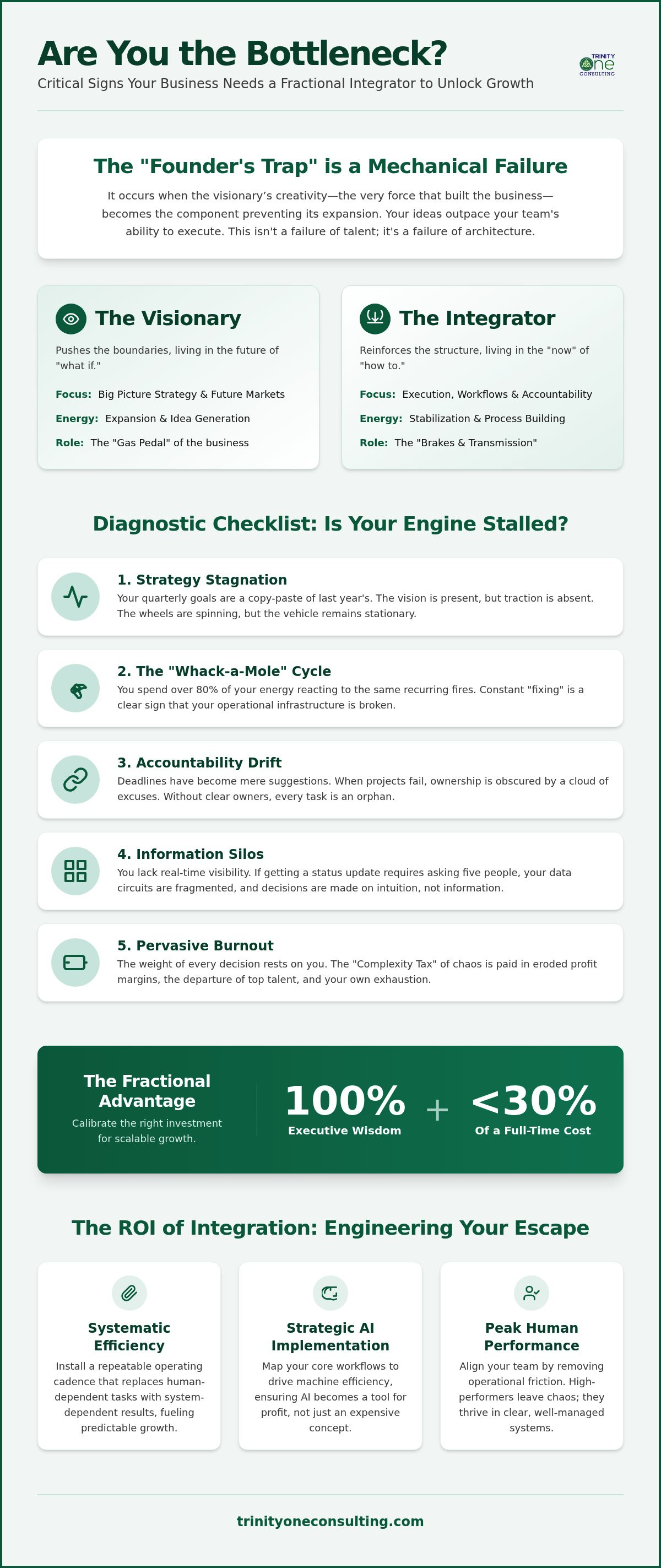
The "Founder's Trap" is a predictable mechanical failure. It occurs when the visionary, whose creativity built the business, becomes the very component preventing its expansion. You have reached a point where your ideas outpace your team's ability to execute. This isn't a failure of talent. It's a failure of architecture. Every business has a maximum load capacity. When you exceed it without a dedicated system for traction, the engine seizes. You become the bottleneck for every decision, every project, and every breakthrough.
An integrator is the steady force that translates high-level vision into daily reality. Functionally, this role serves as a Chief Operating Officer (COO), but with a specific focus on the harmony between the Visionary's goals and the team's output. They are the architect of the "how." While you focus on the horizon, they focus on the engine room. Identifying the signs you need a fractional integrator early prevents the total burnout of the founder and the eventual stagnation of the company.
The 2026 reality demands more than just grit. We are operating in an era of hyper-complexity. AI integration, remote team dynamics, and rapid market shifts have increased the organizational load. Manual oversight is obsolete. If your strategy relies on you being in every meeting, you've built a cage, not a company. Scalability requires a shift from human-dependent tasks to system-dependent results. You need a circuit breaker for the chaos, allowing you to finally step away from the office and experience the world with The Real South Africa Travel and Tourism.
Vision is expansion. Integration is containment. One pushes the boundaries; the other reinforces the structure. These are two distinct, often opposing skill sets. Without vision, the business stagnates. Without integration, it collapses under its own weight. This is the physics of leadership. You cannot be both the gas and the brakes simultaneously without destroying the transmission.
The Distinction Between Visionary and Integrator
Visionaries live in the future. They see possibilities, markets, and disruptions. Integrators live in the organizational "now." They see workflows, bottlenecks, and accountability. Most founders struggle to play both roles effectively as revenue grows because the mental energy required for expansion is the opposite of the energy required for stabilization. When big ideas collide with a lack of process, the result is friction. This friction is one of the primary signs you need a fractional integrator to bridge the gap between "what if" and "how to."
The Hidden Cost of Unmanaged Chaos
Chaos carries a "Complexity Tax." This tax is paid in eroded profit margins and the departure of top-tier talent. High performers don't leave companies; they leave unmanaged friction. If you are the only person who can solve every problem, you aren't a leader. You're a bottleneck. Every time a decision waits on your desk, the business loses velocity. A fractional integrator removes this drag by installing a repeatable operating cadence. They turn the visionary's spark into a controlled, sustained burn that fuels growth rather than consuming the leader.
To prevent this internal "burn" from affecting your physical health, many founders utilize wellness tools, such as a molecular hydrogen generator canada, to support recovery and maintain peak performance during high-growth phases.
A Diagnostic Checklist: 5 Signs You Need a Fractional Integrator
The transition from founder-led growth to systemic scale is marked by specific operational failures. Emotional exhaustion is a symptom, but the root cause is structural. To determine your current load capacity, you must look at the objective data points of your daily operations. These five signs you need a fractional integrator serve as a diagnostic baseline for your business engine. If your leadership feels like a series of reactive corrections rather than proactive maneuvers, the architecture is failing.
- Strategy Stagnation: Your quarterly goals today look identical to your goals from twelve months ago. The vision is present, but the traction is absent. The wheels are spinning, but the vehicle remains stationary.
- The Whack-a-Mole Cycle: You spend 80% of your energy reacting to recurring fires. Systems should prevent fires. If you are constantly "fixing" the same operational leaks, your infrastructure is broken.
- Accountability Drift: Deadlines have become suggestions. When a project fails, the "who, what, and when" are obscured by a cloud of excuses. Without a clear owner, every task is an orphan.
- Information Silos: You lack real-time visibility. If you have to ask five different people for a status update, your data circuit is fragmented. Decisions are made on intuition rather than intelligence.
- Culture Erosion: High turnover is the final warning. Your top talent is exhausted by the friction. They want to win, but the lack of structure makes winning impossible.
Identifying the "Accountability Gap"
Many leaders suffer from the "Great Meeting Runner" fallacy. You hold weekly syncs. You discuss the vision. Yet, nothing changes. Meetings without a defined operating cadence are just performance art. True accountability requires a "Who is doing what?" test. If your team cannot answer this instantly and without hesitation, you have a critical gap in your command structure. This drift is one of the most common signs you need a fractional integrator to restore order.
The Execution vs. Idea Ratio
Measure your "Idea-to-Implementation" speed. In a high-performance engine, the distance between a strategic decision and tactical execution is short. If your "Visionary" energy is actually distracting the team, you are creating noise, not progress. Score your execution consistency on a scale of 1-10. If the number is below an eight, the internal drag is costing you market share. You can audit your current operational health to see exactly where the friction is highest. Scale requires a shift from human-dependent tasks to system-dependent results. An integrator provides the logic for that transition.
Fractional vs. Full-Time: Calibrating the Right Investment for 2026
The math of leadership is shifting. In 2026, the traditional full-time executive model is becoming a legacy burden for mid-market firms. You don't need a permanent fixture; you need a surgical strike. This demand for specialized, high-impact expertise is mirrored in the legal sector, where the Israel Cross Border Law Firm assists businesses in managing the intricacies of US-Israel investments without the need for a massive in-house legal department. Similarly, a fractional integrator provides 100% of the strategic wisdom for approximately 25% of the capital requirement of a full-time hire. This is the difference between purchasing an entire power plant and simply plugging into the grid. You pay for the output, not the overhead.
Speed is the primary variable in this equation. A traditional executive search often consumes four to six months of momentum. Conversely, a fractional integrator arrives with a pre-built operating system and a battle-tested methodology. They don't spend ninety days "learning the culture." They spend the first week identifying the shorts in your operational circuit. As you evaluate the signs you need a fractional integrator, consider the velocity of your growth. If you wait for a full-time hire, the opportunity window may already be closed.
Objectivity is a critical byproduct of the fractional model. An external leader isn't entangled in years of internal politics or founder-led biases. They see the business engine for what it is: a series of interconnected systems that either function or fail. They identify the friction points you've grown accustomed to ignoring. This clarity allows for an uncompromising focus on results, ensuring that every operational shift is driven by logic rather than emotion.
When Fractional is the Superior Strategy
The fractional model is the optimal choice for businesses generating between $2M and $20M in annual revenue. At this stage, the complexity has outgrown the founder, but the budget hasn't yet expanded to support a $400k C-suite salary. It's an "Expertise Injection." You gain access to a veteran practitioner who has scaled multiple companies, providing a level of mentorship and structural integrity that a mid-level manager simply cannot offer. It also serves as a strategic "test-drive," allowing you to refine the integrator dynamic before committing to a permanent organizational change.
The Myth of the "Full-Time Requirement"
Most scaling companies don't actually require 40 hours of integration per week. They require 10 hours of high-level architectural alignment and 30 hours of disciplined team execution. Modern leadership is about "Results-Based Leadership" over "Time-Based Presence." With AI-native systems like Trinity Cadence, manual oversight hours are drastically reduced. The system provides the visibility. The integrator provides the direction. This synergy ensures that your team remains aligned without the need for a constant, hovering executive presence. If your current bottlenecks are structural, adding more "hours" won't fix them; adding the right signs you need a fractional integrator diagnostic will.
The ROI of Integration: Efficiency, AI, and Human Performance
Efficiency is engineered. It is not accidental. A primary indicator among the signs you need a fractional integrator is a business that ceases to function the moment the founder steps away. Scaling requires a fundamental shift from human-dependent hustle to predictable system output. This transition is no longer optional. In 2026, the integration of Artificial Intelligence is the dividing line between market leaders and those who are merely surviving. An integrator ensures your business is a high-performance engine, not a collection of loosely connected parts.
The return on investment for fractional leadership is measured in two currencies: time and clarity. When the operational drag is removed, the Visionary regains the capacity to innovate. The team gains a repeatable cadence that eliminates the anxiety of "what comes next." This structural integrity allows the business to scale without increasing the founder's workload. You move from a state of constant reaction to a state of controlled momentum. You can engineer your operational ROI by installing the right leadership architecture today.
Preparing the Engine for AI Integration
You cannot automate chaos. If your internal processes are fragmented, AI will only accelerate your failures. This is the danger of "Automated Chaos." An integrator acts as the system architect. They map the workflows. They clean the data. They ensure the engine is sound before adding the turbocharger of automation. A fractional leader manages the change of AI adoption, ensuring the team views these tools as extensions of their capability rather than threats to their roles. This preparation is a critical step that most companies skip, leading to expensive technical debt.
Linking Personal Dreams to Professional Goals
Structure creates freedom. When operations are clear, employee anxiety drops and retention rises. This is where technical efficiency meets human development. Through certified Dream Management facilitation, an integrator ensures that personal aspirations align with corporate objectives. High-performance teams stay when they see their personal future reflected in the company's success. Freeing the Visionary from daily fires allows them to focus on the "People" side of the machine. The result is a culture of loyalty and purpose. A focused team is a productive team. When your people win, your business wins.
- Predictable Output: Systems replace "heroics" as the primary driver of results.
- Founder Freedom: The business runs on a cadence, not on the founder's calendar.
- Scalable Talent: New hires integrate faster into a documented, AI-native workflow.
- Strategic Depth: Decisions are based on real-time visibility rather than gut feelings.
Engineering Your Escape: How Trinity One Integrates Your Future
Operational freedom is not a destination. It is a state of constant, calibrated movement. If you recognize the signs you need a fractional integrator, you are standing at a critical junction. You can continue to patch a failing engine, or you can rebuild the architecture of your business. Trinity One provides the bridge between your current friction and a high-performance future. We don't just provide advice. We install an operating system designed for the complexities of 2026.
Our approach combines battle-tested fractional leadership with an AI-native operating system. We move beyond the limitations of traditional frameworks like EOS. While those systems provide a solid foundation, they often lack real-time visibility. They are retrospective. Trinity One is predictive. We synchronize your business engine, your AI strategy, and your people’s personal aspirations into a single high-performance cadence. This is how you move from the "Founder's Trap" to scalable autonomy.
The Trinity Cadence Advantage
Visibility is the antidote to chaos. Trinity Cadence is our proprietary platform that provides a unified operating cadence. It is where machine operations meet human performance. Most leadership tools tell you what happened last month. Trinity Cadence shows you what is happening right now. Our fractional integrators use this software to eliminate the guessing games that plague scaling companies. We track execution and engagement simultaneously. This ensures that your technical efficiency never comes at the cost of your team's psychological well-being. It is a closed-loop system for growth.
Your Transition Plan
We value execution over theory. Our process begins with Rapid Launch Sprints. We move your business from chaos to a calibrated cadence in weeks, not months. We don't believe in long-tail implementations that drain your momentum. We stabilize the engine room first. Over a 90-day integration roadmap, we install the accountability frameworks and AI workflows required for sustainable scale. This is a surgical intervention designed to return the Visionary to their zone of genius while the integrator manages the organizational "now."
The first step is a diagnostic assessment of your current operational load. We identify the specific circuit breaks in your command structure. Once the friction points are mapped, we engineer the solution. You can Schedule your Operational ROI Mapping Session with Trinity One to begin the transition. Stop being the bottleneck. Start being the architect. Your vision deserves a business engine that can keep pace with your ambition.
- Week 1-4: Launch Sprints to stabilize immediate operational fires.
- Week 5-8: Implementation of Trinity Cadence for real-time visibility.
- Week 9-12: Alignment of Dream Management to secure long-term talent loyalty.
Reclaiming Your Role as the Visionary Architect
Scaling a business shouldn't feel like a war of attrition. Growth is a mechanical challenge, not a personal failure. By identifying the signs you need a fractional integrator, you've already taken the first step toward reclaiming your time. You've seen how the "Founder's Trap" stalls progress and how a disciplined operating cadence restores momentum. It's time to stop managing the engine and start directing the vehicle, providing the mental space to focus on long-term family security, including specialized financial guidance for children with special needs at planningfortwolifetimes.com. True scale requires a shift from human-dependent tasks to system-dependent results.
Trinity One brings over 30 years of operational experience to your leadership team. We combine the clinical precision of our AI-native Trinity Cadence platform with the human depth of our proven Dream Management methodology. This synergy ensures that your technical efficiency never ignores your people's purpose. We build the systems that allow you to lead with clarity and scale with confidence. The path from chaos to calibrated growth is a choice of architecture.
Scale your business without the chaos; Explore Trinity One's Fractional Integrator services. Your vision is the fuel. Our integration is the engine. Together, we can build a business that runs as fast as you can think. The future of your company is waiting for the structure to support it.
Frequently Asked Questions
What exactly does a fractional integrator do on a day-to-day basis?
A fractional integrator manages the "how" of your business operations. They facilitate leadership meetings, resolve team friction, and ensure quarterly goals move from the whiteboard to the workflow. Day-to-day, they act as the circuit breaker for organizational chaos. They hold the team accountable to a defined operating cadence. This allows the founder to exit the engine room and focus on high-level strategy without losing visibility into execution.
How much does a fractional integrator typically cost compared to a full-time COO?
Hiring fractional leadership is a high-yield investment. As of July 2026, a typical monthly retainer for a Fractional COO ranges from $4,000 to $12,000. This is a fraction of the $350,000 to $500,000+ total annual compensation required for a full-time C-suite executive. You gain 100% of the strategic wisdom for roughly 25% of the cost. This model allows scaling companies to access veteran leadership while maintaining capital efficiency.
Can a fractional integrator work with my existing EOS implementation?
Yes, a fractional integrator is designed to slot directly into the "Integrator" seat of the Entrepreneurial Operating System (EOS). They provide the discipline required to make that framework function. At Trinity One, we enhance this by moving beyond static tools. We use the Trinity Cadence platform to provide the real-time visibility that traditional EOS implementations often lack. This ensures your visionary ideas actually achieve measurable traction.
How long does it take to see results after hiring a fractional integrator?
Operational stabilization begins within the first thirty days. You'll notice immediate relief as the integrator takes ownership of meeting cadences and recurring fires. By the end of a 90-day integration roadmap, the business should be running on a repeatable, high-performance circuit. The primary signs you need a fractional integrator often disappear during this first quarter as the founder regains strategic freedom and the team finds its rhythm.
What is the difference between a business coach and a fractional integrator?
A business coach advises you from the sidelines; a fractional integrator plays the game with you. Coaches focus on your personal growth and high-level strategy. Integrators focus on organizational execution and system architecture. They are embedded members of your leadership team. They don't just tell you what needs to be fixed. They build the engine, manage the people, and take responsibility for the results.
Is my company too small for a fractional integrator?
Size is less important than complexity. If your revenue is between $2M and $20M, you're likely at the threshold where founder-led management fails. You don't need a massive headcount to justify an integrator. You need one when the operational drag prevents you from scaling. If you're the bottleneck for every decision, your company is the right size for fractional operational leadership. Structure is the prerequisite for growth.
How do I know if I am a Visionary or an Integrator?
Visionaries live in the future. They see possibilities, markets, and disruptions. Integrators live in the organizational "now." They see processes, bottlenecks, and accountability. If you love starting projects but hate finishing the granular details, you're a Visionary. If you find peace in a clear accountability structure and a repeatable system, you're an Integrator. Most founders are Visionaries who are currently exhausted by trying to play both roles.
What software does a fractional integrator use to track progress?
We utilize the proprietary Trinity Cadence platform. It's an AI-native operating system that provides real-time visibility into both machine efficiency and human performance. Unlike static project management tools, it tracks the actual velocity of your strategic goals. This software allows our fractional integrators to identify friction points before they become fires. It ensures every component of your business engine is working in harmony. Visibility is the antidote to chaos.