
Non-profits do not fail from a weak mission. They fail from operational drift and quiet burnout. A fractional COO for non-profits steps directly into that breakdown as a part-time integrator, running your internal cadence and performance metrics so your executive director can stop putting out administrative fires and focus on major donors.
I see this trap across the country every week. Program managers drown because internal communication is fractured. Your board demands clean accountability metrics that your staff cannot produce on time. Worst of all, your budget cannot absorb a six-figure executive salary just to bring order to the day-to-day chaos.
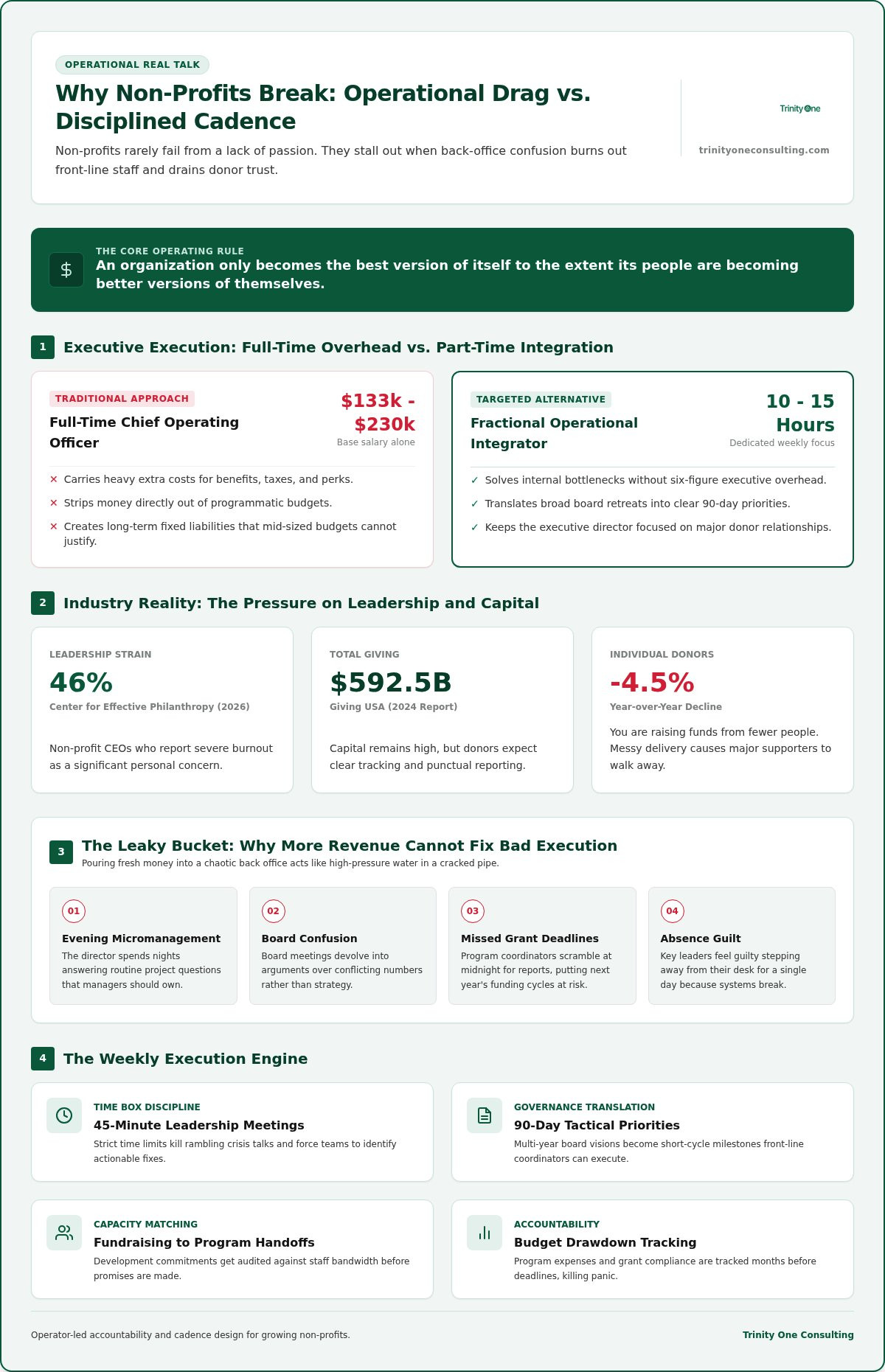
When operational systems break down, good people walk out the door. An organization only becomes the best version of itself to the extent its people are becoming better versions of themselves.
Fixing that breakdown takes disciplined meeting rhythms, honest performance tracking, and direct investment in staff goals. Real operational clarity protects your mission, preserves donor capital, and gives front-line coordinators room to succeed.
Key Takeaways
- Hiring a fractional COO for non-profits gives leadership an experienced integrator who translates board mandates into daily staff execution without draining operational reserves.
- Pouring more donor dollars into broken execution won't fix burnout, it only multiplies the daily pressure on an already exhausted staff.
- A disciplined operational cadence replaces reactive crisis meetings, giving program managers clear targets and keeping coordinators from quitting.
- External operators bring executive execution without six-figure overhead, but you have to understand the real limits of part-time availability before signing an agreement.
- A clear four-step operating sequence ties daily task handoffs to verifiable metrics, protecting both donor trust and staff well-being.
What does a fractional COO for non-profits actually do?
A fractional COO for non-profits is a part-time operational integrator who manages internal systems, meeting cadences, and staff accountability so the executive director can lead without running the back office.
Most boards cast sweeping visions during quarterly retreats. Then nothing happens. That is not because your staff lacks passion. It happens because no one converted broad strategic intent into Monday morning assignments. As an experienced fractional executive, an operator turns high-level governance into tactical execution. They build the engine that drives your mission forward.
Hiring a full-time chief operating officer costs non-profits between $133,000 and $230,000 in base salary alone, before benefits or taxes. Most small to mid-sized organizations cannot justify that line item without stripping programmatic budgets. Targeted part-time leadership gives you seasoned operational direction for ten to fifteen hours a week, focusing strictly on high-impact bottlenecks.
A typical weekly scope centers on execution mechanics:
- Running structured weekly leadership meetings with strict 45-minute limits
- Monitoring program milestones against actual budget drawdowns
- Auditing operational handoffs between fundraising staff and program coordinators
- Removing daily friction points that pull the executive director into weeds
Translating board governance into daily operational mechanics
Volunteer boards speak in multi-year outcomes. Front-line staff work in immediate deadlines. This gap breeds mutual frustration. An operator bridges this disconnect by building transparent scorecards. Instead of fifty-page reports, the board reviews clear numbers tracking program delivery against expenses every month. Multi-year plans get distilled into practical 90-day operational priorities that coordinators can execute immediately.
Managing program delivery, financial reporting, and compliance
When development promises a donor a custom report, the program team usually scrambles. An operational leader establishes clear cross-department handoffs so donor commitments match staff capacity. They tighten grant compliance tracking months before deadlines, killing off the midnight audit panic. If your leadership team is trapped in administrative quicksand, our fractional COO service provides the executive execution needed to protect staff sanity and donor dollars.
When should your non-profit hire an operational leader instead of another fundraiser?
Most boards react to financial stress with a single reflex: hire another development officer. It feels proactive. You bring in a fundraiser, set a dollar goal, and expect revenue to solve your headaches. But when your back office is disorganized, fresh revenue acts like high-pressure water poured into a cracked pipe.
Money amplifies existing habits. If your execution is chaotic at a one-million-dollar budget, doubling that income will not fix the confusion. It only breaks your staff faster. Bringing in a fractional COO for non-profits stops that cycle by establishing firm internal traction before you pour more donor capital into the system.
Executive burnout is the earliest indicator that you need operational leadership rather than more development staff. The Center for Effective Philanthropy found that 46% of non-profit CEOs reported burnout as a significant concern in 2026. Watch for four specific operational symptoms:
- The executive director spends evenings answering routine staff questions about project tasks
- Board meetings devolve into arguments over conflicting financial numbers
- Program staff miss grant reporting deadlines, placing future funding cycles at risk
- Leadership feels guilty taking a single day away from their desk
The leaky bucket problem in non-profit capital allocation
Operational drag inflates administrative overhead silently. Giving USA reported that total giving reached $592.5 billion in 2024, yet individual donor counts dropped by 4.5%. You are raising money from fewer people, which means expectations for stewardship are at an all-time high. When program reports arrive three months late because of messy communication, major donors walk away. Running an aggressive capital campaign on top of broken program handoffs simply wastes restricted contributions.
Breaking the executive director bottleneck
Your executive director should spend at least half of their working hours building donor relationships, speaking in the community, and setting vision. When an audit shows leadership spends under twenty percent of their workweek with donors, operations have swallowed the organization whole. The founder becomes an accidental bottleneck for every minor office decision.
Installing a fractional COO for non-profits creates a dedicated operational firewall. The integrator handles project pacing, runs the weekly staff scorecards, and manages cross-team handoffs. If your calendar is choked with internal task disputes instead of donor dinners, you can schedule an operational review to assess where execution is breaking down.
How does a part-time operator fix execution bottlenecks and staff turnover?
Non-profit leaders often mistake burnout for mission fatigue. That diagnosis is wrong. People rarely leave an organization because they stopped caring about the cause. They leave because bad systems exhaust them.
Fall 2025 survey data revealed that 70% of non-profit employees were considering leaving their positions, with 60% pointing to too much responsibility without enough support. Sector turnover sits between 20% and 22%, nearly double the corporate benchmark. Bringing in a fractional COO for non-profits attacks that breakdown directly. When lines of communication collapse, coordinators absorb the shock. An operator establishes order so staff can breathe again.
Replacing chaotic meetings with a disciplined operating cadence
Unfocused non-profits run on fire drills. An unexpected Slack ping turns into an unscheduled 45-minute video call, derailing the morning. An experienced operator replaces that reactive scrambling with a predictable operating cadence.
We institute a single, structured 60-minute tactical meeting each week. Every agenda item has an assigned owner and a clear finish line. If a problem doesn't touch active 90-day targets, it doesn't hijack the room. Clear communication stops cross-department finger pointing. Staff members finally know what is expected of them, which restores sanity to their daily routine.
Investing in staff retention through personal development
Process alone won't keep your best talent. Checklists without personal investment feel cold. An organization only becomes the best version of itself to the extent its people are becoming better versions of themselves.
That conviction is why I integrate Matthew Kelly's Dream Manager methodology into our operational work. We run structured one-on-one sessions across Kelly's twelve dream categories, addressing areas like personal finance, physical health, and professional goals. I believe God cares about the worker just as much as the work being done. Our Dream Manager program shows that when you build up the person, you stop coordinator turnover at the root.
What should you evaluate before hiring an external integrator?
Not every operational problem calls for part-time executive leadership. A fractional COO for non-profits solves execution drift, but it is not a cure-all. You need to know what this model handles well and where it fails.
External operators excel at building systems, running cadences, and coaching staff. They are poor choices for direct casework, crisis crisis hotlines, or answering routine administrative questions late on a Friday. If your organization simply needs forty hours of hands-on clerical labor each week, hiring an executive integrator will waste your money. An operator builds the machine. Your team still runs it.
Comparing the three primary operational hiring models
Choosing the wrong leadership model creates expensive friction. Here is how the three main paths compare:
| Factor | Staff Consultant | Fractional COO | Full-Time COO |
|---|---|---|---|
| Primary Output | Strategy reports and recommendations | Active system installation and accountability | Total day-to-day organizational leadership |
| Speed to Impact | Slow (weeks of discovery) | Fast (embedded in week one) | Moderate (long hiring cycle) |
| Tradeoff | No implementation accountability | Part-time availability limits weekly hours | High fixed compensation overhead |
Traditional management consultants deliver thick binders of advice and walk away. That leaves execution to an already exhausted staff. Full-time executives offer total presence, but they require substantial overhead commitments that many operating budgets cannot sustain until annual revenues consistently clear five million dollars.
Vetting questions for non-profit board search committees
Search committees often get distracted by corporate credentials that do not translate to mission-driven cultures. When evaluating candidates, ask specific, diagnostic questions:
- How do you handle coordinator resistance when introducing structured task deadlines?
- What specific meeting rhythm will you install during your first thirty days?
- How do you ensure tax compliance under IRS independent contractor rules without acting like an employee?
- Can you balance tight budget drawdowns without burning out our front-line team?
Hiring an external operator requires absolute clarity on both sides. You get seasoned leadership without permanent overhead, provided you respect the boundary of part-time focus.
How does an operational cadence protect your team and your mission?
Mission-driven work attracts generous, dedicated people. When operational systems break down, those workers sacrifice their evenings and weekends to compensate for the gap. That is not dedication. It is systemic failure disguised as passion.
Predictable routines create emotional safety. When program coordinators know exactly how their work is measured, anxiety drops. A fractional COO for non-profits installs an operating rhythm that protects worker dignity and restores order to daily execution.
The 90-day execution roadmap for non-profit operations
Installing discipline requires a methodical sequence over ninety days:
- Step 1: Operational Assessment. Audit internal workflows, software tools, and administrative friction to pinpoint where communication drops.
- Step 2: Cadence Installation. Launch the weekly leadership meeting, establish single-page scorecards, and set ground rules for rapid issue resolution.
- Step 3: Individual Alignment. Connect key coordinators to measurable individual targets, tying daily tasks directly to quarterly program goals.
- Step 4: Process Transfer. Audit system stability, test staff autonomy, and hand long-term ownership of the cadence back to internal leaders.
The goal is never permanent dependency on an outside expert. An operator enters your organization to build structure, train your staff to run the plays, and step back once the cadence runs itself.
Sustaining long-term impact through personal and operational alignment
Orderly operations honor donor sacrifices. When someone writes a check to your non-profit, they expect their money to reach the community, not get burned up in administrative confusion. Systematic tracking proves to your board and major donors that every dollar produces measurable impact.
Serving people effectively requires building an orderly house first. You cannot bring stability to the community while your internal team is drowning in disorganization. Once internal operations are stabilized and leadership is ready to expand external civic impact, discover Lionel Leach for strategic community development and advocacy support. An operational cadence gives executive directors a reliable path out of perpetual crisis mode, building an organization that protects its people and fulfills its mission.
Taking control of your non-profit operational future
Your mission deserves more than survival through exhaustion. Bringing in a fractional COO for non-profits gives your team structural order without burdening your balance sheet with permanent executive overhead. Over 30 years of hands-on operational leadership taught me that good intentions cannot substitute for clear execution. With our Trinity Cadence system, we install predictable meeting rhythms, track honest scorecards, and protect donor capital.
Execution only holds up when you value the people doing the work. Through Certified Dream Management, we invest directly in your staff so they grow as individuals while hitting program targets. An organization only becomes the best version of itself when its workers are becoming better versions of themselves.
Book a 30-minute operational review with Kevin Patrick to look at your current friction and discuss an execution cadence for your team.
Frequently Asked Questions
What is the typical time commitment for a fractional COO in a non-profit?
A fractional COO typically commits 10 to 15 hours each week to your organization. That time is concentrated on vital priorities: running the weekly leadership cadence, reviewing departmental scorecards, and clearing operational roadblocks. They don't sit at a desk waiting for tasks to arrive. Instead, they operate on a structured schedule designed to drive execution without accumulating unnecessary billable hours.
How much does a fractional COO for non-profits cost compared to a full-time hire?
A full-time non-profit COO often commands a base salary between $150,000 and $230,000, not including benefits, payroll taxes, or recruiting fees. Hiring a fractional COO for non-profits eliminates those fixed employment packages and costly contractor taxes. You pay only for the leadership allocation you need, keeping capital focused on your programs while securing seasoned operational direction.
Can a part-time operational leader work effectively with a volunteer board of directors?
Yes, an external operator often improves board relations immediately. Volunteer boards usually struggle because staff reports are either too dense or lacking clear operational metrics. A fractional leader establishes clean monthly scorecards that report project milestones and budget drawdowns clearly. This transparency builds board confidence and lets directors focus on governance instead of micromanaging the staff.
What happens if our staff resists new accountability systems introduced by an outside operator?
Resistance usually happens when accountability feels punitive rather than supportive. I address pushback by tying operational structure directly to personal growth. We use Matthew Kelly's Dream Manager principles to invest in individual goals alongside work responsibilities. When coordinators realize that clear cadences eliminate late-night work and chaotic fire drills, initial skepticism quickly turns into genuine relief.
How does a fractional COO handle non-profit grant reporting and fund accounting requirements?
A fractional operator does not replace your CPA or grant writer. Instead, they build the internal workflow that connects program delivery to financial tracking. They set up milestone deadlines, assign task owners, and ensure your team tracks restricted grant expenses in real time. That rhythm prevents the frantic scramble that typically happens right before annual audits or grant reporting deadlines.
Is a fractional COO responsible for fundraising and donor development?
No. A fractional COO for non-profits focuses inward on operations, systems, and personnel execution. Their primary purpose is freeing the executive director from internal administrative burdens so leadership can cultivate major donors. Expecting an operator to run capital campaigns pulls them away from fixing the broken processes that threaten program delivery in the first place.
How long does a typical fractional COO engagement last before transitioning to internal staff?
Most engagements run between 6 and 18 months. The goal is never permanent dependency on an outside contractor. An integrator steps in to stabilize operations, install a predictable cadence, and mentor rising internal leaders. Once your team owns the daily execution rhythms and your budget justifies a full-time executive, the operator guides a clean transition to permanent leadership.