
Culture shows up in the decision a manager makes when a deadline slips. The benefits of a strong company culture are visible in how teams handle pressure, share responsibility, and make choices when priorities compete. Values on a wall don’t mean much when daily decisions point the other way.
Leaders see the gap in practical ways. A meeting ends without clear ownership, an employee stops speaking up, or a resignation surprises the team. Those moments are evidence of how leadership behavior shapes the workday.
I look at the routines employees experience: how priorities are set, how managers respond to mistakes, and whether personal goals have a place alongside work. Changing those routines takes attention and may slow a decision at first. Start by identifying one recurring moment where your stated values and your team’s experience don’t match.
Key Takeaways
- The benefits of a strong company culture show up in how shared expectations support coordination and influence employees’ decisions to stay.
- Clear standards and consistent follow-through can strengthen accountability, though trust takes candid conversations and ongoing leadership attention.
- Start with one gap between your stated values and employees’ experience, then choose a daily routine where a change can take hold.
- Listen to how employees describe leadership in practice. Their experience can point to where the culture needs attention.
- Trinity Cadence connects business execution with people practices through a weekly operating rhythm and an AI Coach.
What are the benefits of a strong company culture?
The benefits of a strong company culture include clearer coordination, a stronger sense of belonging, and conditions that can support employee retention. These outcomes are more likely when people understand how decisions get made and see leaders apply shared expectations consistently. Culture gives teams a common reference point when work gets complicated, but it can’t guarantee agreement or prevent every employee from leaving.
Company culture is the shared expectations expressed through an organization’s recurring decisions and everyday behavior.
That definition focuses on what people repeatedly experience, not just what the company says it values. Accountability means little if one employee’s missed commitments are ignored while another’s are challenged. The Organizational Culture overview describes the wider factors that shape culture, but leaders can start by examining the choices their teams see each week.
What does company culture look like in daily work?
Look at how a manager responds when someone misses a commitment. Do they clarify what happened, reset the owner and due date, and address a repeated pattern? Or does the issue get quietly reassigned, leaving the team to guess whether deadlines matter? That response teaches people more than a reminder about accountability.
Meetings send the same signal. If a company says it values focus but leaders add priorities without naming what should pause, the team learns that every request is urgent. If people can raise a conflict and leave knowing which work comes first, the stated value has a visible counterpart. Repeated choices build culture. Slogans alone don’t.
How is a strong culture different from a pleasant workplace?
A pleasant workplace can feel welcoming. A strong culture also makes expectations clear, including when someone’s work falls short. Support and standards can coexist: a manager can listen to the circumstances behind a missed target while setting a specific expectation for the next review.
Constant agreement isn’t the goal. Teams need a way to discuss difficult performance issues without turning every disagreement into a personal conflict or avoiding the conversation altogether. Silence may protect comfort in the moment, but it leaves the work problem in place and can make dependable employees carry more than their share.
Belonging grows when people know they’ll be heard and held to the same standard. Retention may benefit when leadership behavior matches the values employees were asked to trust. Neither outcome is automatic. Leaders have to make expectations real, especially when a conversation is uncomfortable.
How does a strong company culture improve execution and retention?
The benefits of a strong company culture can include smoother coordination and a stronger reason for employees to stay, when daily leadership supports clear expectations and meaningful work. The mechanism is practical: people spend less time guessing what matters, who owns the next step, or how a decision will be made. Those conditions can support execution and retention, but they don’t guarantee either outcome.
Consistent expectations let people coordinate work without waiting for repeated direction.
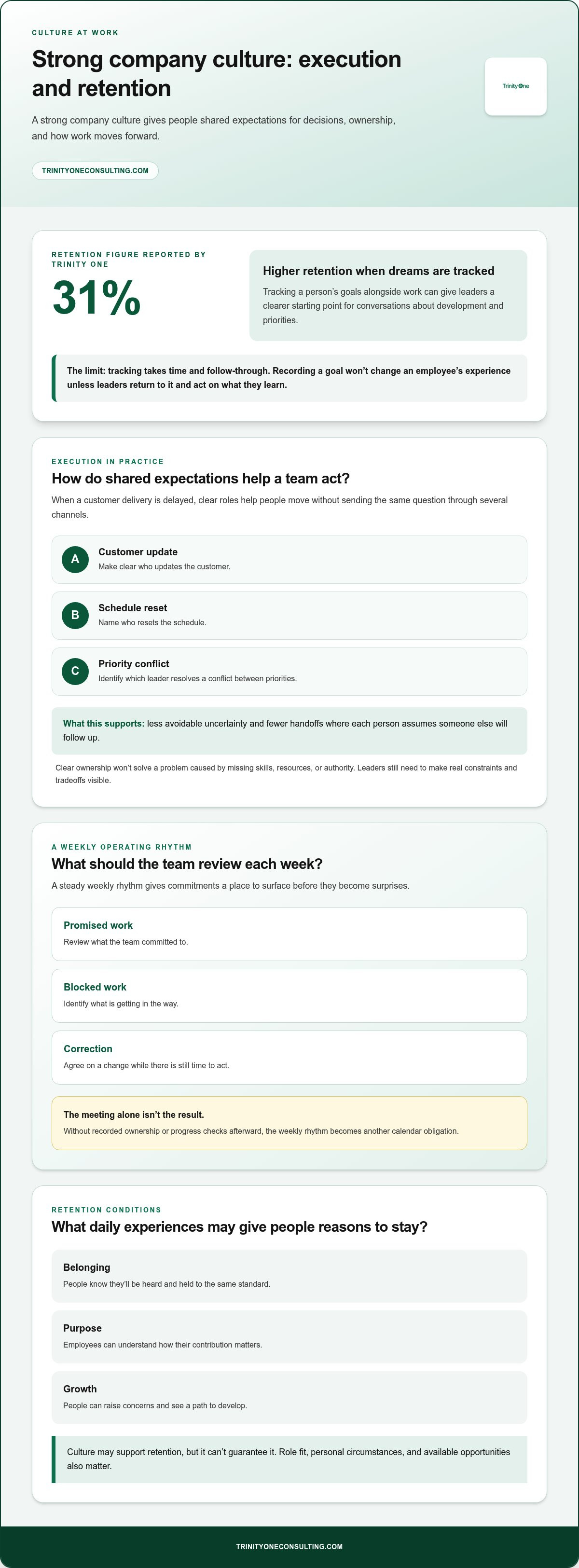
Consider a team handling a delayed customer delivery. If employees know who updates the customer, who resets the schedule, and which leader resolves a priority conflict, they can move forward without sending the same question through several channels. Shared priorities reduce avoidable uncertainty. They don’t remove real constraints, such as limited capacity or conflicting deadlines, so leaders still need to make tradeoffs visible.
Clear ownership also prevents a familiar handoff failure: two people assume the other will follow up, and nobody does. A named owner, a due date, and a place to review the commitment give the team something concrete to act on. This can reduce rework caused by misunderstanding, though it won’t solve a problem rooted in missing skills, resources, or authority.
How does culture help teams execute consistently?
A steady weekly rhythm gives commitments a place to surface before they become surprises. The team can review what was promised, identify what’s blocked, and agree on a correction while there’s still time to act. The meeting itself isn’t the result. If nobody records ownership or checks progress afterward, the rhythm becomes another calendar obligation.
Shared expectations help employees make routine calls with less escalation. A team that knows which customer needs take priority can make that choice in the moment, then flag exceptions. This won’t replace sound judgment. It gives people a common starting point, so the manager can focus on decisions that genuinely need leadership.
How can culture affect employee retention?
Employees form an opinion of work through their daily experience of leadership. Do they understand how their contribution matters? Can they raise a concern without being dismissed? Do they see a path to develop? Belonging, purpose, and growth may strengthen someone’s reasons to stay, while inconsistent treatment can weaken trust. Culture is one influence among others, including role fit, personal circumstances, and available opportunities.
Trinity One reports 31% higher retention when dreams are tracked. Tracking a person’s goals alongside work can give leaders a clearer starting point for conversations about development and priorities. It still takes time and follow-through. Recording a goal won’t change an employee’s experience unless leaders return to it and act on what they learn.
To assess whether these conditions are taking hold, compare what employees say about their experience with work patterns leaders can observe. Look for repeated missed handoffs, unclear ownership, or issues raised too late to address. Those signals won’t explain themselves, but they can show where a manager should ask a direct question and examine whether the team’s expectations are being applied consistently.
Does a strong company culture mean less accountability?
No. A strong company culture can support high standards when expectations are clear and applied consistently. The benefits of a strong company culture depend in part on whether people know what they own and can trust that performance concerns will be addressed fairly. Support should make the standard easier to understand, not easier to ignore.
Psychological safety means people can raise a concern, admit a mistake, or ask for help without expecting humiliation. It doesn’t remove responsibility for the work. A team member can say a deadline is at risk, explain what’s blocking progress, and still own the next step. If speaking up becomes a way to avoid follow-through, leaders need to address that pattern too.
Can a people-focused culture still hold people accountable?
Yes. State the expectation before evaluating performance: name the deliverable, owner, deadline, and how the work will be reviewed. That gives an employee a fair chance to understand the standard. It also gives a manager something specific to discuss instead of relying on vague judgments such as “show more commitment.”
If someone misses a commitment, a manager might say, “We agreed you’d send the revised schedule by Friday. It didn’t arrive, and the team couldn’t confirm the next handoff. What got in the way, and what will you own now?” That’s direct without making the issue personal. Listening to the explanation matters, but it doesn’t transfer ownership away from the person responsible.
Support can include coaching, clearer priorities, or help removing a work obstacle. It doesn’t mean repeated misses carry no consequences. If the expectation was clear and the employee had a fair opportunity to meet it, the leader must explain what happens next. Applying the same standard across the team protects trust. Quietly excusing one person while confronting another damages it.
What does culture work cost leaders?
It takes attention. Leaders have to communicate expectations, check whether commitments were met, and make room for employee development. Those conversations compete with other work, and they can feel slower than fixing a problem yourself. But taking over can teach the team that ownership belongs to the manager.
Avoiding a difficult conversation may feel convenient today. If the same behavior continues, reliable employees may end up covering the gap, while the person missing commitments receives no clear signal to change. Addressing the pattern early requires candor and follow-up. It can also be uncomfortable, and one conversation may not resolve the issue. Consistent accountability means returning to the expectation and responding to what actually changes.
How can leaders strengthen company culture through daily work?
Strengthening culture takes a small number of visible actions repeated consistently. Start with one practical step this week: ask your team where a stated value and their everyday experience don’t match, then listen for a specific behavior you can change.
Use this sequence to turn the answer into action:
- Define expected behaviors. Translate a value such as ownership into observable actions. For example, a person who sees a deadline slipping tells the owner early and brings a revised plan.
- Inspect current routines. Compare written expectations with what happens in meetings, handoffs, and follow-up. Ask employees where the routine supports the stated value and where it gets in the way.
- Reinforce one change. Choose a repeated behavior the team can see, assign someone to follow through, and review whether it’s happening in your regular leadership cadence.
How can leaders find the gap between values and behavior?
Look at a recent missed commitment or disagreement. Did leaders apply the same standard across the team? Did people have a clear way to raise a concern, or did the conversation end once the meeting moved on? These moments offer better evidence than a polished values statement.
Employee feedback is a signal to investigate, not a score to accept without context. If several people say priorities change without warning, review how changes are communicated and who decides what work pauses. Then choose one observable behavior, such as naming the work that will stop when a new priority is added. Don’t try to fix every complaint at once. Too many changes make it hard for employees to tell what leadership means to sustain.
How can a weekly operating rhythm reinforce culture?
A regular leadership meeting can make commitments visible before missed work becomes a surprise. Review what’s off track, identify who owns the next action, and agree on when it will be revisited. If the meeting only reports status, it may add time without clarifying responsibility. Keep the focus on decisions and follow-through.
People’s goals matter alongside business priorities. Matthew Kelly’s Dream Manager methodology gives leaders a structured way to discuss personal aspirations, and a Dream Manager program can connect those conversations with employee growth. Trinity Cadence uses Dream Plans to track team members’ goals alongside work. Those conversations take time and honest attention. A form or meeting alone can’t substitute for a manager who listens and follows through.
For a broader operating rhythm, use recurring meetings to connect priorities with owners and next steps. A meeting can’t compensate for unclear authority or a lack of capacity, so leaders still need to make those constraints explicit. Review the commitments, ask what has changed, and adjust the plan when the facts call for it. I’d rather see one agreed behavior practiced consistently than a long list of values nobody can connect to daily work.
How can Trinity One connect company culture with execution?
Once you’ve identified the behaviors your team needs and the routines that reinforce them, the next question is how to keep both visible. Trinity One’s Trinity Cadence is a practitioner-built operating system designed to turn strategy into a weekly rhythm and embed an AI Coach. It brings the machine side of the business and the people side into 1 operating cadence, without promising that a tool alone will change how leaders act.
The system reflects my experience in operations and ERP leadership spanning 30+ years. It addresses 2× sides of the business, machine and people. The value depends on how leaders use the cadence: priorities still need owners, people still need candid conversations, and teams still need to act on what they learn.
How does Trinity Cadence bring people and operations into one rhythm?
The Blueprint, The Huddle, The Pulse, AI Coach, The Build Loop, and Dream Plans are components of Trinity Cadence. Together, they support a weekly rhythm that connects strategy, execution, and people practices. The Huddle provides a structured weekly meeting to surface off-track items, while The Pulse presents a combined view of execution health and team engagement.
The Build Loop follows a weekly build-ship-learn cycle. That gives a team a recurring point to review what it built, what it shipped, and what it learned before setting the next focus. The cycle can make progress and obstacles easier to discuss. It can’t replace sound decisions about priorities or capacity.
AI Coach is embedded in the operating system. It drafts agendas, flags risks, and nudges conversations. Dream Plans track team members’ goals alongside work, giving managers a way to keep personal development in view as business priorities move forward. That tracking is a prompt for human attention, not a substitute for a real conversation. Matthew Kelly developed the Dream Manager methodology, which informs this people-centered approach.
Where can leadership support fit into culture work?
A Fractional COO / Integrator can help run the cadence and connect strategic priorities with execution. The role is practical: make sure decisions have owners, commitments have follow-up, and leaders address work that keeps slipping. Trinity One’s Fractional COO / Integrator support is relevant when the operating rhythm needs an accountable leader to keep it moving.
Dream Management facilitation gives leaders a structured way to connect personal goals with work and development conversations. A Dream Manager program can make those conversations part of the way the team works, rather than an occasional discussion that disappears when priorities get busy. The tradeoff is time and follow-through. Without both, goals can be recorded without changing the employee’s experience.
I use a discovery call to discuss how an operating cadence could connect your team’s priorities with its day-to-day experience.
What will you make clearer in your next leadership decision?
Culture gets stronger when leaders make a visible change and check whether employees experience it. The benefits of a strong company culture don’t come from declaring better intentions. They depend on whether your next decision matches the expectations you’ve set.
Choose an upcoming decision that affects workload, ownership, or development. State what matters, explain the tradeoff, then ask whether the decision was clear to the team. That gives you a concrete point to learn from, not another slogan to repeat.
Culture work can expose gaps leaders would rather leave alone. That discomfort is useful only if it changes what happens next. Give someone responsibility for checking the change, then bring the team’s observations into a future leadership discussion. A company only becomes the best version of itself to the extent its people are becoming better versions of themselves.
The existing Trinity One booking page is another place to schedule a conversation.
Frequently Asked Questions
What are the main benefits of a strong company culture?
The main benefits of a strong company culture include giving employees a clearer basis for making decisions and helping them understand how their work contributes to the organization. For example, a customer-facing employee can resolve a routine issue more confidently when decision limits are clear. The effect is practical, but it depends on leaders supporting those expectations when a decision carries real tradeoffs.
Can a strong company culture improve employee retention?
Yes, it can contribute to employees’ reasons for staying, but culture alone can’t ensure they’ll remain. A useful way to learn is to ask departing employees what influenced their decision, then look for repeated themes across roles. If people cite limited growth, compare those comments with the development conversations managers actually hold. Treat the pattern as evidence to investigate, not proof that one culture change will prevent future departures.
How do you measure company culture?
Use employee feedback alongside observable work patterns. Ask focused questions about whether people understand decision rights or can raise concerns, then compare answers with examples from recent projects. You might also review recurring issues, such as unclear handoffs or priorities changing without explanation. These signals don’t produce a complete culture score. They help leaders identify where to ask better questions and test a specific change.
What happens if a company's stated values don't match daily behavior?
Employees may stop treating the stated values as a reliable guide to how the company works. For instance, a value of fairness loses credibility if managers handle the same performance issue differently depending on who is involved. The gap can also make decisions harder because employees can’t tell which rules will hold. Leaders should name the mismatch, explain what will change, and follow through where the behavior occurs.
Does a strong company culture mean employees can avoid accountability?
No. A strong culture doesn’t exempt employees from owning their work. If a project owner misses an agreed handoff, the manager can ask what happened, clarify the impact, and set a specific next commitment. Respectful treatment matters, but it doesn’t erase responsibility. If the same issue continues after expectations and support are clear, leaders need to address the ongoing performance problem rather than quietly shifting the work to someone else.
How long does it take to build a strong company culture?
There’s no fixed timeline. A leader can change a meeting practice quickly, but employees need repeated evidence before they trust that the change will hold, especially if previous behavior contradicted the stated expectation. Set a review point for the behavior you’re changing, then check whether people see a difference in their work. Avoid declaring success after one meeting. Consistency over time matters more than a launch announcement.
Can a company improve culture without changing its values?
Yes. A company can keep its values and change the routines that determine whether employees experience them. If “respect” is a stated value, leaders might make space for people to finish raising a concern before a decision is closed. Then observe whether that practice changes how issues are surfaced. If a value is too vague to guide a real choice, clarify its expected behavior without replacing the value itself.