
A meeting can end on time and still leave the work stuck. The symptoms of poor operational cadence show up when leaders discuss priorities, but people leave without knowing who owns a decision or what happens next.
You may feel the drag when work gets reset before teams finish it, or when each leader has a different picture of what’s moving. One rough week can happen. A repeated pattern points to a gap in how decisions, commitments, and progress move through the business.
I look for the repeat, not the isolated miss. Changing roles or buying another tool too soon costs time and attention. Leaving the pattern untouched wears down trust and engagement.
Start small: trace one important decision from the meeting where it was made to the person expected to carry it out. Check whether the commitment has an owner and whether leaders can see progress. That gives you evidence before you change the operating rhythm.
Key Takeaways
- Symptoms of poor operational cadence appear when priorities, decisions, owners, and follow-through stop connecting across repeated work cycles.
- Trace a priority from leadership discussion through assigned work and progress review to see where execution breaks.
- Compare repeated misses across operating cycles with a one-off disruption. Check agendas, decision records, and commitment lists for evidence.
- Audit one priority using existing records before adding meetings or changing roles.
- Fix one visible break at a time. Weigh the benefit against the leadership attention and employee time a new routine requires.
What symptoms of poor operational cadence should you look for?
The symptoms of poor operational cadence are repeated gaps between what leaders agree, what teams understand, and what gets completed. Operational cadence is the set of recurring routines that connects priorities to decisions, named owners, and follow-through. Remote teams need those connections to be clear in writing because people can’t rely on overheard conversations to fill in missing context.
Look for patterns in agendas, weekly commitments, and handoff notes. One missed update may be a disruption. A recurring gap deserves attention.
- Meetings produce updates, not decisions. People report activity, but the agenda doesn’t show what was decided or who owns the next step.
- The same unresolved issue returns. It comes back without new evidence, a decision, or a clear reason it remains open.
- Weekly commitments keep changing. Teams are redirected before they finish work leaders had already agreed was a priority.
- Tasks have no clear owner or due date. Several people may assume someone else is responsible.
- Progress is hard to see between meetings. Leaders rely on separate updates and get conflicting accounts of status.
- Cross-team handoffs stall. The receiving team lacks the context, decision, or next action needed to proceed.
What does a failing meeting rhythm look like?
A failing meeting rhythm can include plenty of meetings. Volume alone doesn’t tell you whether the routine works. Picture a remote leadership team that spends its weekly meeting hearing department updates. The same hiring decision returns the next week, but no one has brought new information or been given authority to decide.
The team met again, but the work didn’t move. A useful agenda makes room for decisions and records who will act. If the same item returns, the record should show what changed or what remains unresolved.
What signals show that decisions are not reaching execution?
Watch for priorities that shift before teams can finish the work already agreed. A leader may announce a new focus in one call while another team keeps working from last week’s notes. Remote employees can’t count on hallway conversations to supply missing context, so the change needs a clear owner and a shared record.
Then inspect the commitment itself. “We’ll get that done” leaves too much open. Name the person responsible, the due date, and where progress will be visible. When ownership is unclear, follow-through becomes invisible.
For a cross-team handoff, check whether the sending group recorded the decision and whether the receiving group knows what action comes next. A short written handoff takes a little work at the point of transfer. It can prevent a longer delay caused by teams waiting on different assumptions.
How does poor operational cadence break execution?
Execution breaks when a leadership decision doesn’t make it all the way to completed work. The path should be visible: priority set, decision made, owner assigned, progress reviewed, adjustment agreed. If one link is missing, a remote team can work hard while moving in different directions. That’s how the symptoms of poor operational cadence spread beyond the meeting where they first appeared.
Priority → decision → named owner → visible status → review and adjustment. Each handoff needs enough context for the next person to act. If a priority changes, the decision record should say what moved down the list and why.
I define cadence this way: Cadence is the operating link that turns leadership decisions into visible work. Recurring routines show people what to do, who can decide, and when the work will be checked.
Where do priorities and ownership lose alignment?
Work often waits when nobody knows who has authority to make the next call. A team may flag a customer issue in its weekly review, but hold off on a fix until a senior leader approves a tradeoff. If that leader doesn’t know the decision is waiting, the work sits between teams.
Competing priorities create another break. A remote team may be told to finish a reporting change, then receive a new request through a separate channel without guidance on which commitment moves. People can’t make a sound choice from conflicting instructions.
A named owner is one person accountable for advancing the work and raising a blocker. Assigning work to a team isn’t the same thing. Everyone may contribute, but without a clear owner, each person can reasonably assume someone else will coordinate the next step.
Why can teams lose visibility between reviews?
A status update can go stale as soon as the work changes. If a dependency blocks progress on Tuesday but the team only reviews status at its scheduled leadership meeting, decision-makers may not see the delay until later. The review rhythm still exists, but the information feeding it no longer matches reality.
A dashboard can display the last update, but it can’t decide who should resolve a disagreement or tell a team why a priority changed. Someone must own the status, keep it current, and raise an issue when work is blocked. Otherwise, the display can look orderly while execution is stuck.
Visibility has a human side, too. When employees understand how a task connects to a leadership priority, they can make better choices when the plan shifts. If they see assignments without the decision behind them, they may complete the task as written and still miss the outcome the business needs. To strengthen that cultural connection and unify team insights into predictive analytics, learn more about heartsy™.
Check one active priority across the full chain. Find the decision, confirm who owns the next action, and compare the latest status with what the team is doing. Where those records disagree, execution has lost its connection to leadership intent.
How can you tell a cadence problem from a temporary disruption?
The symptoms of poor operational cadence repeat across operating cycles. A single missed deadline may reflect an absence, a sudden change in capacity, or a major launch. Don’t diagnose a person or redesign your routines from one miss. Look for the same failure after the team has had a chance to plan, act, and review.
Compare what leaders agreed to with what teams actually did. Meeting notes may show that a decision was made, while the commitment list has no owner. A one-time mismatch calls for context. Repeated mismatches call for a closer look at the system.
Which patterns deserve a closer look?
Look for commitments missed in successive cycles, decisions repeatedly deferred without new information, or priorities that change before teams can finish agreed work. Then check whether the same handoff or approval point slows different teams. One delay may have a local cause. A recurring bottleneck across teams points to a shared process that needs attention.
Compare meeting notes with named owners and completed work. If the notes say “approved” but the team is still waiting for a decision, find out what approval is missing. Check the record, then ask the people doing the work what happened. Don’t assume the written plan captures every obstacle.
What evidence can rule out a one-off problem?
Review more than one planning and review cycle before changing the operating system. Check whether an absence, a capacity change, or a major launch disrupted the work. These events can explain a missed commitment without proving the cadence has failed. Record what changed, what slipped, and whether the usual routines helped the team recover.
If a delay comes from unclear process documentation, compare the written steps with how work actually moves. A Fractional COO or Integrator can help leaders examine operational ownership and follow-through. Don’t mistake an out-of-date document for proof that people aren’t committed.
| Signal | Likely interpretation | Evidence to check |
|---|---|---|
| One missed deadline during a launch or absence | A temporary disruption may explain it | Capacity, timing, and whether other commitments stayed on track |
| The same approval waits across operating cycles | Decision authority or escalation may be unclear | Meeting records, approval steps, and when leaders were asked to decide |
| Several teams repeatedly redo work after priorities shift | Teams may lack a shared order of work | Priority changes, completed work, and what leaders said should pause |
Adding controls can make owners, decisions, and status easier to see. It also takes team attention to maintain, and extra check-ins can crowd out focused work. Start with evidence already in your agendas and commitment records. If the same breakdown persists, address that specific point before adding another routine.
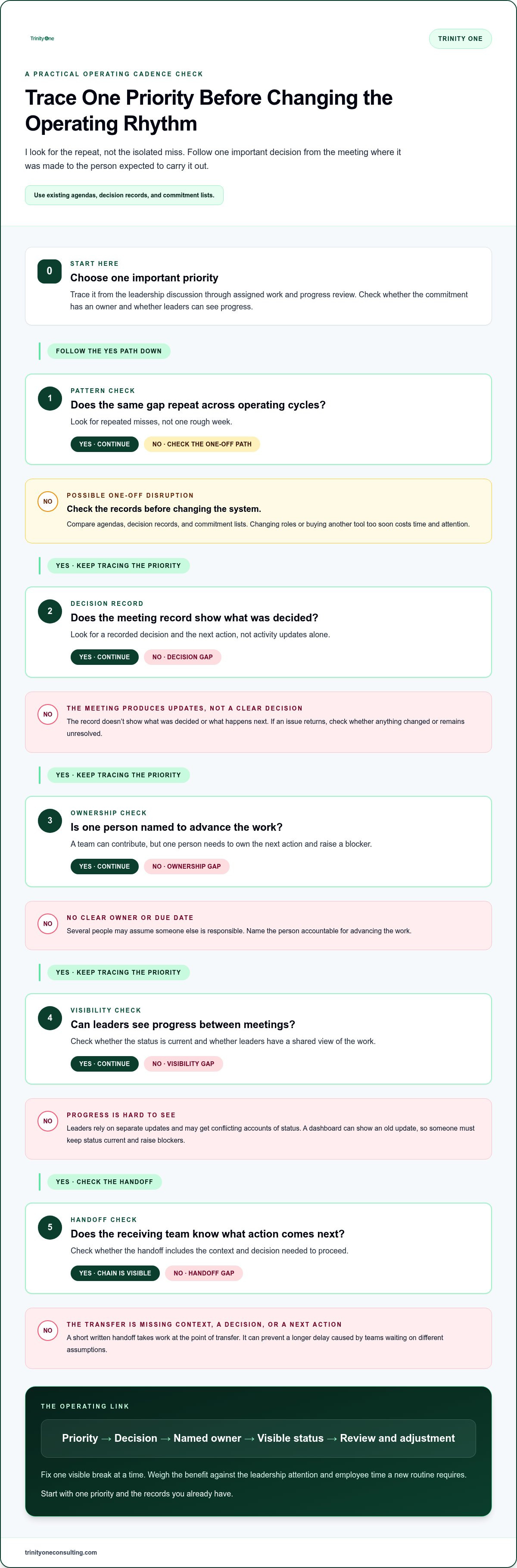
How can you audit your operating cadence without adding more meetings?
Use the records you already have. The symptoms of poor operational cadence become easier to diagnose when you follow one important priority from the leadership decision to the work’s outcome, rather than adding another meeting to discuss the process.
A useful audit follows the work, not the meeting count. Set aside the latest agenda, decision record, and commitment list. Then trace one priority through them.
- 1. Find the decision. Read the agenda and notes. What was agreed, and what context explains the choice?
- 2. Find the owner. Look for one person accountable for moving the work forward. A department name or group assignment doesn’t show who is responsible for the next action.
- 3. Check the commitment. See whether the record includes a deadline, current status, and a clear route for raising a blocker.
- 4. Confirm the outcome. Compare the commitment with what was completed. If it changed, look for a recorded reason and the decision about what happens next.
What should you inspect in existing meetings and commitments?
Compare each agenda item with the decision record and commitment list. Mark items where the notes describe discussion but not a decision, or where a decision has no corresponding owner. Flag work with no deadline, visible status, or agreed escalation route. These gaps give you specific evidence to examine without asking the team to create a new reporting routine.
If you’re weighing a different operating system, use the audit findings to identify what your current process fails to support. Start with the work your team needs to coordinate, not a feature checklist. Keep the review grounded in actual decisions and commitments.
How can you hear the human side of cadence?
Records show what leaders wrote down. They don’t always show what employees understood. Ask team members where priorities conflict, which decisions regularly wait, and what they do when work is blocked. Compare their answers with leadership’s view of current progress. Differences may point to missing context or a process people experience differently from the way leaders expect.
Check whether employees can describe the current priority and who can resolve a blocker. If answers vary, find out where the message changed. When the audit points to missing operational ownership, Fractional COO and Integrator support can help establish clear responsibility and follow-through.
Keep the audit small. One priority can show whether decisions, ownership, and progress connect, without asking the team to spend another hour in a meeting.
What should you change first when your operating cadence is failing?
Fix one visible break first. The symptoms of poor operational cadence may point to unclear ownership, a decision that keeps waiting, or progress that isn’t reviewed until work has stalled. Choose the break you can see in current commitments, change the routine around it, then check whether the work moves more clearly.
Don’t add a meeting by default. Every new routine takes leadership attention and employee time away from focused work. It may create a regular place to discuss an issue, but it won’t resolve unclear authority or competing priorities on its own.
When is a small operating-rhythm change enough?
A leader-led adjustment may be enough when the team agrees on priorities but needs a clearer handoff. Before adding sessions, specify who can make the decision, what each meeting must produce, and where follow-up will be recorded. If an existing weekly review already covers the work, use it. Keep the change simple enough to follow without another calendar block.
Test the change in one existing team routine. Choose a current commitment and make the owner, next action, due date, and status visible in the team’s existing record. At the next scheduled review, check whether the agreed work advanced and whether blockers reached the right person. This bounded test gives you evidence without asking the whole organization to adopt a new process.
Be clear about the limits. Better meeting outputs won’t create capacity the team doesn’t have, and a cleaner follow-up record can’t settle a strategy leaders haven’t agreed on. If the problem is too much work or unresolved direction, address that cause instead of tightening the reporting around it.
When might operating leadership or shared visibility help?
Consider hands-on operational ownership when decisions repeatedly stall between leaders, teams, and functions, or when nobody has clear responsibility for keeping priorities connected to execution. A Fractional COO or Integrator can provide operational leadership and help establish who owns the next action, how progress is reviewed, and where leaders need to decide.
Shared visibility may help when commitments are spread across separate records and leaders can’t see current progress or employee engagement in time to respond. Trinity Cadence brings operating cadence, AI coaching, and real-time visibility into execution and engagement together. It helps leaders see where work is moving, but it can’t make sound decisions for them or replace honest conversations with the people doing the work.
I’d start with the smallest change that addresses the evidence. If one existing routine can clarify ownership and follow-through, test that before adding structure. If responsibility remains unclaimed, put the operational ownership question on the table.
How can you make the next operating cycle clearer?
The symptoms of poor operational cadence point to places where people lose clarity or confidence in the work. Ask your team what would help them make sound decisions without waiting for permission on every detail. Listen for practical answers. They may point to a small change that gives people more responsibility and room to contribute.
Any adjustment has a cost. New processes take attention to learn, and extra reporting can pull focus from the work itself. Keep the change proportionate to the problem, and ask the people affected whether it’s helping. Their experience matters as much as the leadership plan.
I believe a company grows as its people grow. Start with one honest conversation, then make space for your team to take ownership of what comes next.
Frequently Asked Questions
Can a company have too many meetings and still have poor operational cadence?
Yes. Frequent meetings can still leave the team with poor operational cadence if the same issue is discussed in multiple forums without a clear purpose for each one. Compare recurring meetings and flag those that cover the same ground. Keep the forum where the right people can resolve the issue, and move routine context to a written update. This can reduce duplicated discussion, though written updates may not surface disagreement as quickly as a live conversation.
How often should a leadership team review its operating cadence?
Review the cadence when the way work gets done changes, such as after a shift in strategy, team structure, or decision authority. Those changes can make a once-useful routine a poor fit. Rather than adding a fixed review solely to inspect the process, note where new conditions create friction and adjust the relevant routine. This event-based approach takes less scheduled time, but it can miss gradual problems unless leaders pay attention to them.
Is poor operational cadence the same as poor leadership?
Not necessarily. A useful distinction is whether the issue follows one person or follows a process. If several capable employees stumble over the same unclear approval step, changing that step may help more than judging individual performance. If expectations and authority are clear for one role but commitments still go unmet, a direct performance conversation may be appropriate. Match the response to the evidence rather than assuming every miss has the same cause.
What metrics can show that operational cadence is improving?
Track whether priorities are displaced after work has started, or whether decisions are reopened because important context was missing. These measures can reveal instability that a simple completion rate won’t show. Define what counts as a changed priority or reopened decision, then review a consistent period of work. Pair the numbers with employee feedback, since tracking changes alone shows frequency without explaining whether a change was necessary.
Can remote teams maintain a strong operational cadence?
Yes. Remote teams can agree on practical communication norms that account for different working hours, such as where a decision will be posted and how quickly someone should acknowledge a request. Set expectations together instead of assuming everyone shares the same definition of “prompt.” This helps people plan focused work without staying alert to every channel, while solutions like echoyou.co can help manage message overload through inbox consolidation and AI summaries. The tradeoff is that written norms need occasional revision as team schedules change.
What should you do when priorities keep changing?
Agree on what qualifies as an interruption. For example, decide which kinds of customer or operational issues warrant pausing planned work and which can wait for the next planning discussion. This gives leaders a shared test before redirecting a team. It won’t prevent legitimate changes, and it requires judgment when an issue falls between categories. Review those exceptions to see whether the threshold is helping leaders make consistent calls.
Can software fix poor operational cadence on its own?
No. Before selecting software, write down the minimum information a person should be able to find for a piece of work, such as its current stage and the date that status was last updated. Test whether the proposed system makes that information easier to maintain or creates duplicate entry. A small trial limits setup costs and staff attention, but it may not show how the tool performs across every team.
Book a discovery call with Kevin to talk through your operating cadence.