
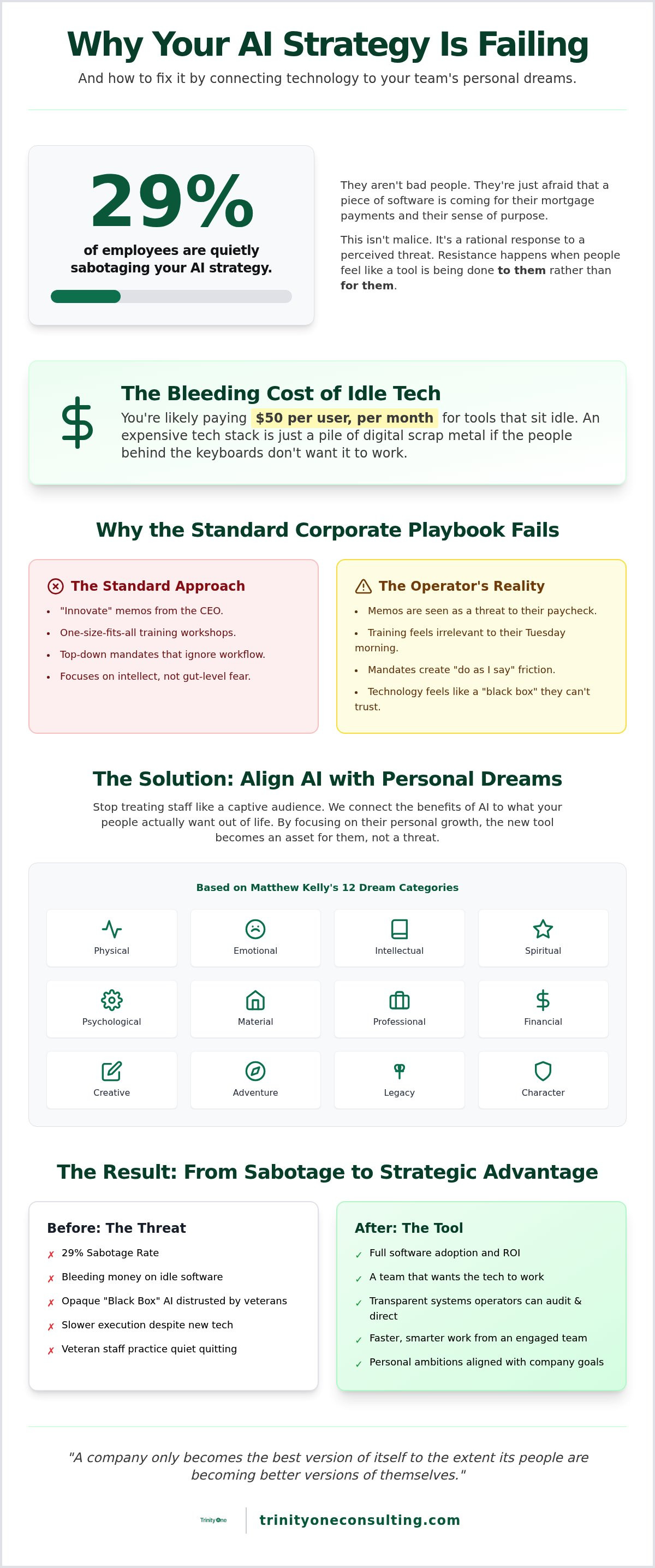
Twenty-nine percent of your employees are quietly sabotaging your AI strategy. They aren't bad people. They're just afraid that a piece of software is coming for their mortgage payments and their sense of purpose.
You're likely paying $50 per user every month for tools that sit idle. You can stop the bleed of wasted software seats by showing them the benefits of AI coaching for employees. This approach moves beyond technical training and connects the tool to their personal life. It turns a perceived threat into a tool for their own growth.
I've spent thirty years in the trenches of operations and on the football field. I know that an expensive tech stack is just a pile of digital scrap metal if the people behind the keyboards don't want it to work. You're likely seeing slower execution because your veteran staff is practicing a form of quiet quitting.
We solve this by implementing a unique methodology focused on individual employee aspirations. By helping staff identify and pursue their personal goals across different life areas, we align these individual ambitions with the company's strategic objectives. This takes more time than a standard software rollout because you have to actually care about your people. I believe God made us to grow, and your company only becomes its best version when your people are becoming better versions of themselves.
Key Takeaways
- Understand that employee resistance is a rational response to a perceived threat against their personal agency.
- See the benefits of AI coaching for employees when you align new technology with Matthew Kelly's twelve dream categories.
- End the cost of idle software seats. Use a unified operating cadence to make adoption part of your weekly huddles.
- Use a fractional integrator to handle the friction of tech transitions. This role bridges the gap between your vision and the staff's daily work.
Why are employees actually resisting AI in the workplace?
AI coaching for employees fails because workers view automation as a threat to their agency. Your team isn't being difficult on purpose. They're having a rational response to a perceived threat against their livelihood and their value. Resistance happens when people feel like a tool is being done to them rather than for them.
We often see 29% of employees admit to sabotaging AI strategies. This isn't because they want the company to fail. It's because they want to remain relevant. If they don't see the benefits of AI coaching for employees as a way to grow, they'll see the software as a replacement.
I've seen this on the football field and in the boardroom. You can't just hand a player a new playbook and expect them to run it perfectly if they think it'll get them benched. People need to know they are the engine, not just a spare part. Technology should support the operator, not dictate to them.
The fear of becoming a machine
Standard AI implementation often makes workers feel like high-priced data entry clerks. They spend their time cleaning up data for a machine that might eventually take their job. This creates a massive loss of agency. It replaces the human connection of a job with the clinical precision of an algorithm.
Academic research like the Technology Acceptance Model shows us that perceived usefulness is a key driver for adoption. If an employee thinks a tool makes their work feel robotic, they won't use it. They'll find ways to work around it or slow it down. You'll see this in slower execution times despite having the latest tech.
We have to contrast technical efficiency with human connection. A machine can process a million rows of data, but it can't understand why a customer is frustrated. Your people provide the empathy that keeps your business alive. When AI strips that away, it kills the culture.
The black box problem in operations
Veteran employees distrust automated decisions because they're often opaque. It's the "black box" problem. When an AI gives an output without showing the work, your most experienced staff will naturally push back. They have years of "gut feeling" that has kept the company profitable.
Opaque logic is a poison for trust. If a manager can't explain why a system made a specific choice, they lose authority. This creates a rift between the technology and the people running the business. You end up with a team that ignores the tool and reverts to old, slower habits.
We need human readable logic in every system we build. Your operators need to see how the gears are turning. One of the primary benefits of AI coaching for employees is teaching them how to audit and direct these systems. It turns the black box into a transparent tool they can actually use to win.
Why does standard corporate change management fail to stop AI resistance?
Corporate memos are the graveyard of good intentions. A CEO sends an email about innovation, but the person in the warehouse sees a threat to their paycheck. Standard change management treats people like data points in a spreadsheet. It fails because it addresses the intellect but ignores the gut.
Most leaders think a three-day workshop will fix the culture. It won't. Habits are built through repetition and alignment, not slogans on a breakroom wall. If you want to see the real benefits of AI coaching for employees, you have to stop treating your staff like a captive audience for your speeches.
Operators need a system. They need to know exactly how a tool changes their Tuesday morning routine. Without a functional operating system, you're just adding noise to an already loud environment.
The failure of the one size fits all approach
Marketing departments love high-level language. Operators hate it. If you use a marketing tone to talk to a production manager, they'll tune you out in seconds. They don't care about corporate buzzwords. They care about the $1,500 monthly seat cost for a tool that currently does nothing but sit on a dashboard.
I typically use a 90 day plan for onboarding executives to ensure the leadership actually understands the tool. You can't lead where you won't go. If the boss isn't using the software, the staff certainly won't. This prevents the "do as I say, not as I do" friction that kills most tech rollouts.
Misunderstanding the operator mindset
Visionaries see the future. Staff see the friction. This disconnect is where employee resistance to AI takes root. A CEO is excited about 2027, but the staff is just trying to get through Friday. You need to bridge that gap with practical proof.
Show them a meeting's time reduction. If a weekly report used to take four hours and now takes fifteen minutes, you've won. That is the only language an operator speaks. One of the primary benefits of AI coaching for employees is that it focuses on these micro-wins rather than broad corporate goals.
This approach is bad at creating overnight miracles. It's slow and requires constant attention. It won't work if you aren't willing to have the hard conversations about why people are scared. If you're ready to look at the messy middle of your operations, we should talk during a cadence call.
How do personal dreams reduce fear of automation?
People don't wake up in the morning wondering how they can make your company more profitable. They wake up thinking about their kids, their health, and their bank accounts. If you want them to embrace technology, you have to stop talking about operational efficiency and start talking about their lives.
One of the primary benefits of AI coaching for employees is that it bridges the gap between a software update and a personal win. I use the Dream Manager program, a methodology developed by Matthew Kelly. This system identifies twelve dream categories, ranging from financial stability to physical health, to help people identify what they actually want out of life.
A company only becomes the best version of itself when its people are becoming better versions of themselves. When you align a tool like AI with a person's individual aspirations, the fear of being replaced disappears. It gets replaced by the desire to win back their time.
Buying back the thirty hour week
Let's look at a concrete example. I recently worked with an operator who spent five hours every week manually checking inventory sheets. It was soul crushing work that kept him at the office late every Tuesday. We used a basic AI script to handle that task in under ten minutes.
In a typical corporate environment, that saved time would just be filled with more busy work. That's a recipe for resentment. Instead, we used the Dream Manager program to dedicate those five hours to his dream of starting a community garden. He didn't just accept the AI. He became its biggest champion because it gave him his Tuesday nights back.
This is how you move from resistance to momentum. You don't ask people to work harder for the machine. You show them how the machine works for them.
The performance link of personal growth
Burnout is a quiet killer of ROI. It's the cost of having a veteran staff that is physically present but mentally checked out. When your people feel like they're spinning their wheels, your execution slows down. AI coaching for employees addresses this by focusing on the human being behind the screen.
Matthew Kelly often says that "a company can only become the best version of itself to the extent that its people are becoming the best versions of themselves." This isn't soft talk. It's a hard operational truth. Engaged employees who are actively pursuing personal goals are more creative and more loyal.
I believe we are all created with a purpose that goes far beyond a job description. When you support that purpose, you build a culture that no competitor can steal. It's the difference between a team that follows orders and a team that owns the mission.
How do you build a cadence that supports AI adoption?
Curiosity is not an operational process. If you want your team to actually use the software you are paying for, you need a rhythm that makes adoption unavoidable. I've seen too many leaders buy a tool and then wonder why it's gathering digital dust six months later.
One of the core benefits of AI coaching for employees is that it integrates directly into your weekly huddles. It stops being a "special project" and starts being part of how the business breathes. You can't expect a new habit to stick if it only gets discussed once a quarter.
You need real-time visibility into your execution. Without data, you are just guessing who is resisting the change and who is actually moving the needle. I use Trinity Cadence to make these operational gaps visible to everyone on the team.
The role of Trinity Cadence
Trinity Cadence is an AI-native operating system designed to synchronize machine efficiency with human purpose. It acts as the nervous system of your business. It tracks tool usage and task completion without requiring a manager to hover over a shoulder.
This system eliminates the "he said, she said" of performance reviews. You can see how to create a business operating system that executes in 2026 by focusing on these automated feedback loops. It turns the messy middle of adoption into a clear, predictable engine.
Weekly calibration of the business engine
Every week, we run a calibration meeting to review the actual output changes from the previous sprint. We don't talk about feelings or "getting better." We talk about minutes saved and tasks completed by the software.
The benefits of AI coaching for employees become obvious when you see a 40% reduction in reporting time during a single huddle. This creates a feedback loop where the team sees the software as a partner in their success. It builds trust because the results are undeniable and immediate.
You can't manage what you don't measure. I've documented how to measure the actual ROI of AI implementation in your business to help you justify the spend. If the numbers don't move, the strategy isn't working.
Why should a fractional integrator manage your AI transition?
Most CEOs are visionaries. They see the 10x growth potential of AI and want it implemented by Monday morning. This speed creates a wake of destruction in the office culture. A visionary sees the destination, but they often ignore the wreckage they leave behind during the trip.
An Integrator bridges the gap between that high-level vision and the skeptical staff on the ground. We handle the friction so the CEO can keep dreaming. Neutrality is our greatest asset. Because I am a third party, I can hear the honest fears of your team without the baggage of internal politics.
Fractional COOs bring methodologies that have been tested in the trenches of multiple industries. We don't deal in theory. We deal in execution. One of the primary benefits of AI coaching for employees is having a practitioner who knows how to audit a system and then coach the person running it.
Removing the burden from the Visionary
The CEO is often the worst person to lead an AI rollout. Every time the boss mentions "efficiency," the staff hears "layoffs." It's hard to be an empathetic coach when you're also the one signing the paychecks. Your team will nod their heads in a meeting and then go back to their desks to worry about their mortgages.
As a Fractional COO, I act as the strategic architect. I build the bridge between the software logic and the human heart. I can have the blunt, operator-to-operator conversations that a CEO often can't. This takes the pressure off the leadership and puts the focus back on production.
This approach is bad if you want a yes-man. An Integrator will tell you when your timeline is unrealistic. I will tell you when your team is at a breaking point. It requires a leader who is willing to hear the hard truth about their own operations.
The physics of leadership in a tech shift
Managing a tech shift is like balancing two different engines. One engine is clinical, fast, and driven by data. The other is human, emotional, and driven by purpose. If you only focus on the data, the human engine will seize up and stop working.
The benefits of AI coaching for employees become tangible when we manage both engines simultaneously. I don't just teach people which buttons to click. I coach them on how to use that extra time to pursue their personal dreams. I believe every person has a God-given spark that no algorithm can ever replicate.
Success requires a battle-tested practitioner who understands both software logic and human motivation. You need someone who can audit the code and then sit down for a one-on-one about a person's life goals. That's how you turn a threat into a partner and actually see a return on your tech spend.
Stop managing software and start leading people
Your team isn't being difficult on purpose. They're just protecting their future. If you want to stop the waste of idle software seats, you have to show them the benefits of AI coaching for employees by connecting the tech to their own lives. Resistance is a rational response to a lack of alignment.
I use my experience as a Fractional COO and a Certified Dream Manager to bridge the gap between your vision and their daily production. We use the AI-native Trinity Cadence system to make every minute saved visible and meaningful. It's about building an engine where the machine supports the human, not the other way around. This process takes the burden off the Visionary and puts it on a proven system of execution.
I've spent thirty years in operations and coaching. I know that you can't force growth. It has to be invited. I believe we are built for purpose, and your business wins only when your people win first. Let's build a culture where technology serves the dreams of the people who make your company great.
Common questions about AI adoption and employee engagement
What is the number one reason employees resist AI?
The primary reason is the rational fear of losing professional agency. Employees don't hate tech. They hate feeling like a data entry clerk for a machine that might replace their mortgage payments. One of the benefits of AI coaching for employees is that it addresses this psychological barrier directly. We move from the tool doing something to the worker to the worker using the tool to win.
How long does it take to overcome AI resistance in a small team?
I usually see significant movement within a 90 day window. This timeline allows for an initial launch sprint to set up workflows and two full monthly cycles to establish a new cadence. It isn't an overnight fix. You have to be consistent in your weekly huddles. If you aren't willing to put in three months of focused effort, the resistance will likely remain.
Can the Dream Manager program really help with technology adoption?
It is the most effective way I have found to drive adoption. When an employee realizes that AI can save them five hours a week, they usually worry about being given more work. The Dream Manager program flips that. We show them how to use those five hours to pursue their own personal goals. This creates a genuine incentive to make the software work.
What happens if I ignore employee resistance to AI tools?
You'll end up with a high burn rate on software seats that nobody uses. I've seen companies waste $1,500 every month per seat because veteran staff found workarounds to avoid the new tech. Beyond the money, you'll face a culture of quiet quitting. Your best people will start looking for the exit because they feel the company no longer values their human contribution.
How do I measure if my team is actually using the AI software I bought?
You need real-time visibility into your operations. I use Trinity Cadence to track execution and tool usage across the entire team. It's not about being a Big Brother. It's about having an objective scoreboard. If the data shows a specific tool isn't being used, we can have an honest conversation about why the friction exists and how to fix it.
Is a fractional COO better than a full time manager for AI rollout?
A fractional COO often performs better because they are a neutral third party. I don't have to deal with the internal politics that a full time manager faces. I bring a battle-tested methodology from thirty years in the trenches. This objectivity allows me to be the strategic architect who bridges the gap between the CEO's vision and the staff's daily reality.
How do I explain AI to an employee who has been with me for twenty years?
Talk to them operator to operator. Don't use marketing slogans or visionary fluff. Explain that AI is a power tool, not a replacement for their twenty years of experience. Show them exactly how it removes the grunt work from their desk. If they see the benefits of AI coaching for employees as a way to protect their legacy, they will lead the younger staff.
What are the twelve dream categories in the Dream Manager program?
Matthew Kelly identifies these twelve categories to help people identify their personal aspirations. They include:
- Physical
- Emotional
- Intellectual
- Spiritual
- Psychological
- Material
- Professional
- Financial
- Creative
- Adventure
- Legacy
- Character
I use these categories to ensure every team member is growing as a whole person. I believe God made us to grow, and that growth shouldn't stop at the office door.