
Only 21% of employees worldwide report being engaged at work. In the United States, engagement has plummeted to an 11-year low of 31%. These figures reveal a systemic failure in how modern leadership builds its engines. Most organizations treat execution and engagement as separate, competing gears. They push for operational precision until the culture breaks, or they prioritize morale until the margins vanish. This binary approach is a recipe for the "Execution Gap," where strategy dies a quiet death at the mid-manager level.
Managing team execution and engagement requires a unified circuit, not a compromise. You don't have to choose between hitting targets and keeping your talent. This article will show you how to synchronize machine-like operational precision with deep human engagement using an AI-native operating cadence. We will explore a system that tracks execution and personal growth simultaneously. You'll learn to reduce the friction between leadership vision and team action while improving retention through alignment. It's time to build a high-performance engine that powers both your results and your people.
Key Takeaways
- High performance requires a dual circuit where operational precision and human fulfillment work in tandem rather than as competing priorities.
- Transition from static spreadsheets to an AI-native operating system to gain real-time visibility into workflows and eliminate the mid-manager execution gap.
- Master managing team execution and engagement by aligning corporate objectives with individual personal growth through professional Dream Management.
- Leverage a Fractional Integrator to architect a unified engine that ensures your strategic vision is translated into consistent, measurable action.
- Audit your operational circuitry to identify the specific friction points where strategy stalls and engagement begins to leak.
The Dual Circuit: Why Execution and Engagement Are Inseparable
High performance is not a compromise between speed and culture. It is a synchronization. Most leaders treat these as opposing forces. They believe they must sacrifice operational rigor to keep people happy, or grind through burnout to hit their numbers. This binary thinking is a failure of architecture. Successfully managing team execution and engagement requires treating these two forces as a single, unified system. Think of your organization as a high-powered engine. Execution is the mechanical assembly. It is the gears, the pistons, and the frame. Engagement is the electrical current. Without the machine, the current has no direction. Without the current, the machine is just cold, dead metal.
The cost of separating these circuits is catastrophic. When you push for execution without engagement, you create friction. Friction generates heat. In a human system, that heat manifests as burnout and turnover. You might hit your KPIs this quarter, but your talent will exit by the next. Conversely, prioritizing engagement without execution leads to a "happy graveyard." People feel supported, but the organization remains stagnant. There is no movement. There is no growth. High performance lives in the integration of both.
Defining the Execution Gap in 2026
The execution gap is the space where strategy goes to die. In 2026, this gap is wider than ever. Leadership sets a vision in the boardroom, but that vision rarely reaches the front line with its intent intact. Mid-managers are the primary failure point. They are buried under fragmented tools and manual reporting. This creates "visibility debt." Executives cannot see what teams are actually doing. Manual oversight is too slow for the modern market. The shift to AI-native oversight is no longer optional. It provides the real-time data needed to turn vague intentions into tracked, visible actions.
The ROI of Synchronized Performance
Synchronized performance has a measurable financial impact. According to Gallup's 2026 research, highly engaged teams are 23% more profitable than their disengaged counterparts. Clarity drives speed. When every team member understands exactly how their daily tasks fuel the larger mission, friction disappears. Retention is not a separate HR initiative. It is a direct byproduct of operational clarity. People stay where they can win. The Dual Circuit is the seamless integration of machine-like operational precision and deep human purpose.
- Execution is the machine: It provides the structure for repeatable success.
- Engagement is the current: It provides the energy that makes the machine move.
- The Circuit is the system: It ensures that energy is never wasted on the wrong gears.
Engineering the Execution Engine with AI-Native Systems
Static spreadsheets are fossils. They offer a rearview mirror perspective when you need a windshield. Managing team execution and engagement requires an upgrade from manual tracking to an AI-native operating system. This is where the machine becomes intelligent. An AI-native system does not just record history. It predicts the future. It identifies bottlenecks before they stall your momentum. It turns the "black box" of operations into a transparent, high-speed engine.
A Fractional Integrator acts as the architect of this engine. They don't just manage; they build the infrastructure. By deploying systems like Trinity Cadence, they automate the mechanical aspects of leadership. Meeting huddles, strategy tracking, and KPI reporting move from time-consuming chores to automated background processes. This allows leaders to focus on high-level strategy rather than chasing status updates. The machine handles the data. The people handle the vision.
The Master Console: Executive Visibility
Most leaders operate in a state of visibility debt. They know the inputs and the outputs, but the middle remains a mystery. AI-native systems provide a master console that eliminates this ambiguity. Real-time data replaces gut feelings. AI coaching tools can scan workflows to identify execution friction before it results in a missed deadline. This visibility is a prerequisite for Boosting Employee Engagement; it connects daily tasks to the company’s broader purpose. When people see their impact, they engage. When they feel invisible, they exit.
Unified Operating Cadence
Execution is a rhythm. It requires a unified cadence that synchronizes daily actions with long-term strategic goals. A rhythmic performance management cycle ensures that the engine never misses a beat. You transition from reactive firefighting to proactive execution. Daily huddles become focused synchronization points rather than rambling status reports. This rhythm creates a sense of psychological safety. Teams know exactly what is expected and how success is measured.
- Automated Huddles: Trinity Cadence pre-populates meeting data so sessions stay under 15 minutes.
- Strategy Tracking: Every individual task is mapped to a quarterly rock or annual goal.
- Real-time ROI: AI Implementation allows you to map the financial impact of team workflows instantly.
The transition is binary. You are either running on a manual, fragmented system that leaks energy, or you are running on an integrated circuit designed for speed. The latter is the only way to scale in a volatile market.
The Human Current: Driving Engagement through Dream Management
Engagement is not a soft metric. It is the fuel that powers the execution engine. Without it, the most sophisticated AI systems will idle. Managing team execution and engagement requires a shift from viewing employees as mere resources to seeing them as individuals with distinct aspirations. This is where a focused approach to nurturing individual aspirations enters the circuit. This strategic framework aligns the personal dreams of your team with the strategic goals of the organization. When an employee sees that their work is the vehicle for their own life's vision, their commitment becomes absolute.
A structured individual vision tool acts as the navigational system for this process. It provides a concrete roadmap for personal and professional growth. We move away from the outdated concept of "employee satisfaction," which is passive and fragile. Instead, we aim for employee flourishing. Flourishing is active. It is resilient. It creates a culture where high-speed execution feels like a byproduct of personal success rather than a tax on it. The human current must be strong enough to sustain the mechanical load of the business.
Retention Engineering for High Growth
Top talent does not leave for a higher salary alone. They leave when they stop growing. In a high-tech, high-pressure environment, the psychological impact of feeling "seen" is the ultimate retention strategy. This human-centric strategy reduces turnover by proving that the company cares about the person, not just the position. This creates a high ROI on human capital. You save the massive costs of recruitment and retraining by investing in the dreams of the people you already have. It's a binary outcome: either your team grows with you, or they grow away from you.
Human-Centric Operations in the AI Era
Efficiency must never come at the cost of empathy. As we integrate AI-native systems to manage workflows, the human element becomes more critical, not less. Digital precision needs a human heart to remain sustainable. Professional 1-on-1 Coaching provides the space for this connection. It ensures that technology supports human performance rather than replacing it. We build systems where the machine handles the mundane, freeing the human to innovate, lead, and dream. This is the balance that defines a modern high-performance organization. You aren't just building a company; you are architecting a community of high-achievers who are personally invested in the collective win.
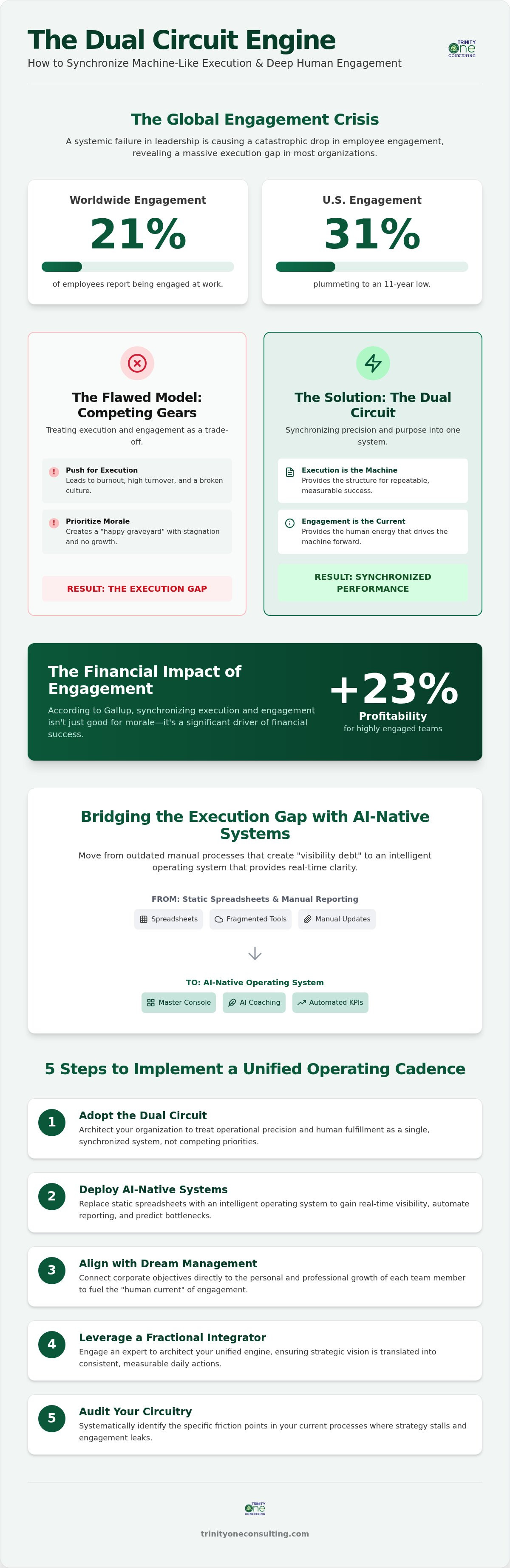
Implementing a Unified Operating Cadence: 5 Actionable Steps
Theory is a blueprint. Implementation is the construction. Moving from a fragmented culture to a high-performance engine requires a methodical approach. You cannot simply flip a switch and expect synchronization. Successfully managing team execution and engagement demands that you rebuild your operational circuitry from the ground up. This process eliminates the "Execution Gap" by ensuring that every task is visible and every person is valued. It is a systematic transition from chaos to clarity.
Step 1: The Operational Audit
You cannot fix what you cannot see. The first step is a clinical assessment of your current execution circuitry. Identify where workflows leak and where communication silos have formed. Most organizations suffer from "visibility debt," where leadership is blind to the daily frictions slowing down the front line. Assess your team's engagement levels against their actual output. Map your potential AI ROI by identifying specific operational bottlenecks that manual processes can no longer solve. This audit provides the diagnostic data required to architect a better system.
Step 2: Deploy AI-Native Infrastructure
Transition your team to a unified operating system like Trinity Cadence. This replaces static spreadsheets with real-time data streams. It provides the master console needed for executive visibility and automated tracking. When the system handles the data, the friction of manual reporting vanishes.
Step 3: Establish a Rhythmic Cadence
Success is a habit, not an event. Implement a strict schedule of daily huddles, weekly synchronizations, and quarterly planning sessions. This rhythm creates psychological safety and ensures that the machine never misses a beat. It keeps strategy and action in constant alignment.
Step 4: The Dream Catalyst
Fuel the human side of the circuit by launching a professional Dream Management program. Use the DreamCompass tool to help team members identify and track their personal aspirations. This is not a soft perk; it is a strategic alignment tool. When an individual's personal growth trajectory aligns with the corporate mission, their daily output transforms into high-velocity traction. Personal fulfillment becomes the primary driver of professional excellence.
Step 5: Appoint an Integrator
Every engine needs an architect. Appoint a Fractional Integrator to oversee the system and ensure the dual circuit remains balanced. They bridge the gap between visionary leadership and tactical execution, maintaining the engine's health over the long term.
If you are ready to stabilize your operational circuitry and drive measurable results, explore our Fractional Integrator services to begin your transformation.
Trinity One: Synchronizing Your People and Processes
Strategy is only as strong as its implementation. Trinity One acts as the architect of your high-performance engine. We don't just provide advice; we provide the mechanical discipline required to scale. Managing team execution and engagement is a technical challenge that requires a human solution. Our methodology integrates AI-native systems with deep human development to ensure that your organization operates as a single, unified circuit. We move beyond theory into the clinical precision of real-world results.
Fractional Leadership for Seamless Execution
A Fractional Integrator is often the missing circuit in a leadership team. Visionaries excel at seeing the future but often struggle with the day-to-day mechanics of execution. We close that gap. By mastering EOS weekly leadership meetings with AI-driven insights, we turn stagnant status updates into high-velocity synchronization points. Our team provides custom AI ROI mapping for your specific business model. We identify exactly where technology can replace manual friction, allowing your leaders to focus on high-level growth. This is the difference between surviving and scaling.
Our AI Implementation services are designed to build your execution engine from the ground up. We deploy the Trinity Cadence platform as your unified business operating system. It is the master console for your entire organization. Through our Launch Sprints, we move your team from friction to traction in weeks, not years. We eliminate the visibility debt that plagues mid-market companies. You gain real-time clarity into every workflow, ensuring that no strategic initiative is lost in the noise.
Ready to Synchronize Your Team?
The Dual Circuit approach is the only way to achieve sustainable high performance. It requires the clinical precision of technology and the empathetic depth of human purpose. You no longer have to choose between hitting your KPIs and keeping your best talent. Fragmented management is a legacy system that no longer functions in a volatile market. It is time to upgrade your operational architecture. Precision meets purpose. Traction replaces friction.
Engineer your high-performance engine with Trinity One and transform the way your organization executes.
Architecting Your High-Performance Future
High performance is not a destination. It is a system. The Dual Circuit replaces friction with traction. Execution provides the machine. Engagement provides the current. Without both, your organization is either a cold engine or a wasted spark. Successfully managing team execution and engagement requires the clinical precision of Trinity Cadence and the human depth of Certified Dream Management. The integration of these forces is the only path to sustainable growth.
Stop settling for fragmented visibility and high turnover. You can synchronize your people and processes today. Our Fractional Integrator expertise bridges the gap between your strategic vision and your team's daily action. This is a binary choice. You can continue with manual, leaky workflows; or you can deploy an AI-native operating system designed for speed. It is time to build an engine that scales without breaking your culture. Your high-performance future is waiting for its architect.
Schedule a Rapid Launch Sprint with Trinity One and stabilize your operational circuitry.
Frequently Asked Questions
What is the difference between team execution and team engagement?
Execution is the mechanical ability of an organization to hit specific targets. Engagement is the emotional and psychological commitment of the people within that organization. Execution represents the hardware and structural gears of the business engine. Engagement represents the electrical current that powers those gears. Successfully managing team execution and engagement requires a dual circuit where technical precision and human purpose operate in a single, unified system.
How does an AI-native operating system improve team performance?
An AI-native system provides real-time visibility into workflows that traditional tools cannot match. It eliminates visibility debt by identifying operational bottlenecks before they stall momentum. These systems automate the mechanical aspects of leadership, such as status updates and meeting prep. This allows the team to move from reactive firefighting to proactive execution. The machine handles the data tracking while the humans focus on high-level strategic wins.
Can a Fractional Integrator help with employee engagement?
A Fractional Integrator improves engagement by architecting an environment of clarity and psychological safety. They eliminate the friction caused by ambiguous roles and fragmented tools. When employees have a clear roadmap and a functional execution engine, their frustration drops and their commitment rises. The Integrator stabilizes the operational circuitry, ensuring that every team member understands exactly how their daily tasks fuel the larger corporate mission.
What is the Dream Manager program and how does it affect retention?
The Dream Manager program is a facilitation methodology that aligns an individual’s personal aspirations with the company’s strategic goals. It utilizes the DreamCompass tool to provide a concrete roadmap for personal flourishing. This program proves that the organization values the person, not just the position. By investing in the dreams of the team, companies build deep loyalty and drastically reduce the turnover costs common in high-growth industries.
How do I measure the ROI of managing team execution?
ROI is measured through the compression of the execution gap and the acceleration of strategic delivery. You track specific metrics like increased profitability, higher sales productivity, and a reduction in absenteeism. According to Gallup's 2026 research, highly engaged teams are 23% more profitable than disengaged ones. You also measure the financial impact of retention, as keeping top talent is significantly more cost-effective than constant recruitment and retraining cycles.
What are the first steps to building a unified operating cadence?
Begin with a clinical operational audit to identify leaky workflows and communication silos. You must diagnose where the friction exists before you can apply a remedy. Next, establish a rhythmic meeting schedule that includes daily huddles and quarterly planning sessions. Finally, deploy an AI-native infrastructure like Trinity Cadence. This transition moves your organization from a manual, fragmented state to an integrated system where execution is visible and repeatable.
How does Trinity Cadence differ from traditional project management software?
Trinity Cadence is an AI-native operating system rather than a simple task list. Traditional software is reactive and historical; it only shows you what has already happened. Trinity Cadence is proactive and predictive, integrating strategic tracking with automated huddles. It functions as a master console for the entire business. It doesn't just record tasks. It synchronizes the people and processes required to turn those tasks into measurable traction.
Is AI coaching effective for mid-level managers?
AI coaching is highly effective because it provides objective, data-driven insights in real time. It identifies execution friction that human managers might miss during a busy week. This technology supports mid-level leaders by reducing their administrative burden and providing actionable feedback on team performance. It allows them to transition from manual oversight to high-level leadership. This shift prevents burnout and ensures that strategy doesn't die at the middle management level.