
You've likely seen teams that show up for a paycheck but ignore the mission. It's frustrating to watch. They don't care about your goals because they don't see how those goals fuel their own lives. This disconnect creates a culture that feels soft and lacks a clear return.
I'll show you the exact steps to launch a program that connects employee personal goals to your company's performance. This system provides a structured method for people management and clear alignment between personal growth and company output. You'll learn how to build a stable team that stays for years.
We'll use the twelve dream categories developed by Matthew Kelly to build a team that actually cares about the win. You'll learn how to integrate this into your existing cadence. It requires a commitment of one hour per month per participant and a direct monthly investment per seat, but the result is a stable team that drives the engine forward.
Key Takeaways
- Identify disengagement as a technical failure in your business engine that drives up turnover costs to $15,000 per seat.
- Use Matthew Kelly's twelve categories when implementing a dream manager program to align personal growth with company output.
- Evaluate the trade-off between the lower cost of internal management and the trust tax that often prevents employees from being honest with their bosses.
- Start with a pilot group of five to ten people to integrate the sessions into your existing monthly operating cadence without disrupting daily tasks.
- Establish clear metrics by tracking your turnover rate and engagement scores before and after the first twelve months of the program.
Why does your business require a Dream Manager program?
Disengagement isn't a feeling. It's a technical failure in your business engine. When a piston stops firing, the whole machine loses torque. Your company is that machine. Implementing a dream manager program is the diagnostic tool that identifies why your people have stopped caring.
Your growth is capped by the growth of your staff. If your team stays stagnant, your revenue will eventually follow. You can't scale a business on the backs of people who are just waiting for 5:00 PM. This program creates a bridge between personal desire and company output.
The link between personal goals and professional output
Employees who chase their own dreams work harder for yours. It's a simple exchange of energy. When a person sees that their daily labor directly funds their personal vision, their output changes. They move from compliance to commitment.
Personal stability reduces workplace friction and mental errors. A team member worried about debt or health is a distracted operator. Distraction leads to mistakes. A focused person is a productive person, and resources like StoicOs.ai can help them build the mental resilience and clarity needed to stay on track. I've seen this on the football field and in the boardroom.
Calculating the cost of doing nothing
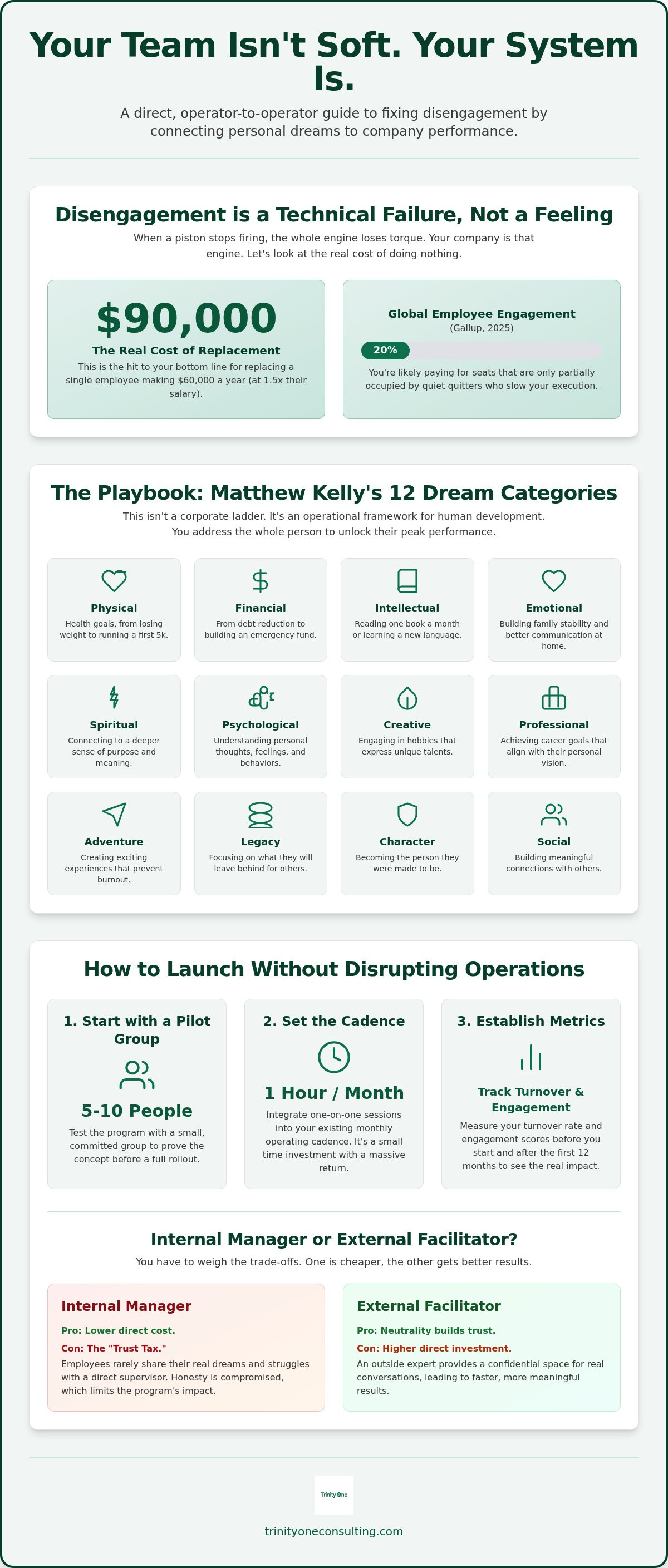
Turnover math is brutal. It includes recruitment fees, training hours, and lost momentum. Gallup reports that global employee engagement fell to 20% in 2025. This is the lowest it has been since 2020. You're likely paying for seats that are only partially occupied.
Disengaged staff are quiet quitters who slow down your execution. They do enough to avoid being fired but not enough to help you win. The price of a replacement is often 1.5 times the annual salary of the person leaving. For a $60,000 role, that's a $90,000 hit to your bottom line. You can find more details on how to manage this through a fractional dream manager approach.
Matthew Kelly founded this methodology on a core truth. A company only becomes the best version of itself to the extent its people are becoming better versions of themselves. I believe every person has a purpose, and when they find it, they work with a different kind of intensity. It's a strategic play that yields a massive return.
What are the twelve categories of Matthew Kelly's methodology?
Matthew Kelly designed these categories to map the entire human experience. It isn't a corporate ladder or a list of job descriptions. It's an operational framework for human development. When you're implementing a dream manager program, you're looking for the gaps in a person's life that prevent them from performing at their peak.
You have to address all twelve areas to see a real change in behavior. These categories serve as the playbook for every session. They include Physical, Financial, Intellectual, Emotional, Spiritual, Psychological, Creative, Professional, Adventure, Legacy, Character, and Social goals.
I believe we were all made for more than just clearing a task list. Addressing the whole person isn't soft. It's strategic. If you ignore the person, you eventually lose the employee.
Physical and financial foundations
Physical health dreams often involve weight loss or running a first 5K. Financial dreams usually focus on debt reduction and emergency savings. These are the survival metrics. If an employee is drowning in $25,000 of high-interest debt, they aren't thinking about your quarterly revenue. They're thinking about the next collection call.
Solving these stressors allows them to bring their full focus to the job. You can't expect high performance from someone who is physically or financially redlining. These two categories provide the stability needed for everything else to function.
Emotional and intellectual growth
Intellectual dreams include reading one book a month or learning a second language. Emotional dreams focus on family stability and better communication at home. Advancing these areas builds a more resilient employee. To help your team achieve this stability through better organization, you can suggest they visit IronClad Family to learn about securing their digital assets and critical family documents. A person with a stable home life and a growing mind doesn't fold when a project gets messy; they have the mental capacity to handle the friction of a growing business.
Adventure dreams keep life exciting and prevent the grind from becoming a burnout. Legacy dreams focus on what a person leaves behind, like volunteering or writing a memoir. Creative and spiritual dreams round out the twelve areas to ensure the person is growing as a whole. Implementing a dream manager program ensures that employees have a reason to stay that goes beyond the paycheck.
One case study on Hiring a Dream Manager shows how focusing on these non-work goals actually stabilizes the workforce. I've seen this play out on the field and in the office. You can't separate the player from the person. If you want to see how this fits into your current operations, you can schedule a cadence call to discuss the specifics.
Should you hire a facilitator or manage it internally?
You have two primary options when implementing a dream manager program. You can certify an internal staff member or bring in an outside expert. Internal management is cheaper on paper but carries a heavy trust tax. Employees rarely tell their boss they want to start a side business or move to a different city.
The tradeoff is between your budget and the depth of employee buy-in. An internal manager is already on the payroll. However, they lack the perceived neutrality needed to handle sensitive personal data. If you want real honesty, you usually have to look outside your four walls.
The problem with being the boss and the coach
If you sign the paycheck, you are the last person an employee will trust with their deepest fears. Most leaders find that implementing a dream manager program internally creates a conflict of interest. They fear judgment. Admitting a financial struggle or a desire for a new career path feels like putting their current job at risk (and often, it does).
You also have a business to run. You cannot spend forty hours a month coaching staff on their personal lives without your operations suffering. I've seen leaders try to do both and fail at both. It is a matter of focus and discipline that most busy operators simply cannot maintain alongside their daily duties.
A third party removes the power dynamic from the conversation. They create a safe space where an employee can admit they are overwhelmed without worrying about their next performance review. This separation is what allows the program to actually function as a retention tool.
The value of a certified professional
Certified coaches know how to handle sensitive personal topics that make a standard manager uncomfortable. They follow a proven rhythm to keep the program on track without distracting the CEO from high-level strategy. External Dream Manager facilitation ensures that the sessions actually happen every single month.
At Trinity One, we act as the objective observer. We bring the authority of a battle-tested methodology without the baggage of office politics. You spend more on the front end for an external partner, but you get the depth of employee buy-in that an internal program usually lacks. I believe that honesty is the only foundation for growth, and an outside voice makes that honesty possible.
If you choose the internal route, expect a twelve-month lead time for your staff member to reach full proficiency. They will also need to balance their existing duties with these new responsibilities. Most internal programs die because the person leading them gets pulled back into their daily tasks during a busy season.
How do you launch the program without disrupting operations?
You don't change the culture of a fifty-person shop overnight. That's a recipe for chaos and lost revenue. Implementing a dream manager program works best when you start small and scale based on results. I recommend starting with a pilot group of five to ten people. These should be your high-potential leaders or the ones most likely to buy into the vision.
This pilot group serves as your test case. You'll see the friction points early and adjust before you roll it out to the whole company. It keeps your production floor moving while you prove the methodology works. You aren't guessing. You're executing a calculated operational play that protects your current output.
Technical integration with Trinity Cadence and DreamCompass
Software is the backbone of this execution. DreamCompass provides the digital home for employee goals. It's where the data lives. Without a central hub, you're just having nice chats that get forgotten by the next Monday. Trinity Cadence ensures the people side of the business matches the machine side.
It aligns human desire with mechanical output. Real-time visibility keeps everyone accountable to their dreams. If a goal isn't tracked, it isn't real. We use these tools to ensure that personal growth isn't just a "nice to have" but a documented part of your operating system. It's about precision.
Review our DreamCompass integration options
Setting the monthly rhythm
Schedule one-on-one sessions that last forty-five minutes. This is a surgical strike. It avoids the fluff of a long-winded seminar. Forty-five minutes is enough time to review progress and set new targets without draining the day's productivity. Consistency is more important than the length of the session.
If you skip a month, you lose the momentum. The team starts to think it's just another "flavor of the month" initiative. Pick a recurring day and time to avoid scheduling chaos. If it's the third Tuesday at 2:00 PM, it stays there. The program must feel like a core part of the company engine.
It should be as non-negotiable as your payroll run or your weekly sales meeting. Integrating this into your existing monthly operating cadence is the only way it sticks. I've seen too many programs fail because they were treated as an "extra" task. When it's part of the rhythm, it becomes part of the culture.
You're building a system for people management that runs as reliably as your software. This disciplined approach ensures that your investment in people yields a measurable result in retention and performance. Faith in your team is good, but a system for their growth is better.
Measuring the impact on retention and performance
You shouldn't settle for "good vibes" as a return on your investment. Implementing a dream manager program is an operational expense that must show a clear line to your bottom line. I track results with the same discipline I used on the football field. You need hard data to know if the engine is running better.
Compare your turnover rate before and after the first year of implementing a dream manager program. If your average cost to replace a seat is $15,000, and you stop three people from quitting, you've already covered the cost of the program. I've seen companies reduce attrition by 30% or more within the first year of consistent execution. This isn't magic. It's alignment.
Measure employee engagement scores through regular surveys. Gallup reports that global employee engagement is currently at 20%, which is a record low. You want to see your internal numbers moving in the opposite direction. Look for a reduction in sick days and mental errors. A person who is physically and financially stable, as defined by Matthew Kelly, is less likely to call out or make a $5,000 mistake on a work order.
Retention as a profit center
Keeping one key employee pays for the entire program. High-level operators are expensive to find and even more expensive to train. When you lose a veteran staff member, you lose years of institutional knowledge that a new hire can't replace in a week. Stable teams move faster because they don't have to stop to explain the basics to a rookie every morning.
Your reputation as a great place to work attracts better talent. When your people actually achieve their dreams, they talk about it. Word spreads that your company is a place where people become better versions of themselves. This reduces your long-term recruitment costs and gives you a pick of the best candidates in your market.
The performance link
Part of being a top-tier employer is providing resources that help staff manage their personal lives; for example, helping parents explore Licensed Daycare Services can be a significant factor in their decision to stay and grow with your organization.
For employees who are also caring for elderly parents, providing access to resources like Tomō allows them to explore Subscription-based Intelligent Audio Care Platform for digital companionship, further reducing the personal stress that can impact workplace performance.
Personal achievement drives professional confidence. When an employee runs their first marathon or pays off $10,000 in credit card debt, their self-image changes. They start to believe they can handle bigger challenges at work. This transfer of confidence is a direct benefit of Dream Manager coaching.
People who feel supported are more loyal to the mission. They show up for more than a paycheck. They show up because they know the company is the vehicle for their personal vision. The ultimate metric is the number of dreams achieved by your staff. I believe we are called to be stewards of the people in our charge. If they are winning at home, they will fight to ensure the company wins at the office.
If you want to see how these metrics apply to your specific headcount, let's talk. Book a 30-minute Trinity One cadence call with me here.
Build a team that fights for your mission
Your company is a vehicle. If the people driving it aren't growing, the machine eventually breaks down. Implementing a dream manager program isn't about hand-holding. It's about building a team that sees their personal success as inseparable from your company's win.
We've seen that retention is a profit center. Every key staff member you keep saves you at least $15,000 in recruitment and lost momentum. Use Matthew Kelly's twelve categories to identify the personal stressors that slow down your execution. I believe we are called to lead with purpose and discipline.
Integrating these human goals into your Trinity Cadence AI operating system ensures that your engine runs at full torque. It's time to stop paying for seats and start investing in people. You get the benefit of Certified Dream Manager facilitation without the trust tax of internal coaching.
The best version of your business is waiting on the other side of this commitment. You have the playbook. Now you just need to execute the first play.
Frequently Asked Questions
How much does it cost to implement a dream manager program?
The cost varies based on whether you hire an external facilitator or certify an internal staff member. You should budget for a monthly investment per participant or an annual fee per employee. Professional coaching for implementing a dream manager program involves a higher commitment for the twelve-month term. It is a strategic operational investment in your most expensive asset.
Is the Dream Manager program a form of therapy for employees?
No, this is coaching, not clinical therapy. We focus on future goals and the tactical steps needed to achieve them. If an employee requires professional mental health support or help with complex family dynamics, we refer them to a licensed specialist like Tracy Kimberg. Our goal is to align their personal vision with their professional output to keep the business engine running at full torque.
You need a leader who possesses high emotional intelligence and the discipline to maintain the monthly cadence. An external facilitator provides neutrality and removes the power dynamic that exists between a boss and an employee. If you choose an internal person, they must be someone the team already trusts with personal information. Most companies find that a certified professional delivers the best return.
What happens if an employee's dream is to leave the company?
You should celebrate that honesty rather than fear it. If a person is going to leave, it's better to have a twelve-month lead time for a graceful transition than a two-week notice. I believe every person is created with a unique purpose that goes beyond their job title. Many employees find that achieving their dreams actually makes them more loyal to the company.
How long does it take to see results from the program?
You will likely notice a shift in team engagement within the first ninety days. However, the full impact on retention and turnover rates usually requires a twelve-month cycle to measure accurately. Consistency is the key to seeing a return on your investment. Implementing a dream manager program is a long-term play for a stable and committed workforce.
Can a small business with under twenty people use this system?
Yes, small teams often see the fastest results because the culture is more concentrated. You can start with a pilot group of five people to test the rhythm. The system scales from small shops to large corporate engines without losing its effectiveness. Every person in your company should have a clear path toward becoming a better version of themselves.
What are the twelve categories of dreams by Matthew Kelly?
Matthew Kelly defined these categories to cover the entire human experience. They provide the framework for every coaching session and include:
- Physical and Financial
- Intellectual and Emotional
- Spiritual and Psychological
- Creative and Professional
- Adventure and Legacy
- Character and Social
Addressing all twelve areas ensures the person grows as a whole. You cannot expect a person to perform at their peak if they are struggling in their personal life. Every dream matters to the engine.
Do I need special software like DreamCompass to track goals?
You do not need software to start, but tracking progress is difficult without a central hub. DreamCompass acts as the digital engine that keeps everyone accountable to their targets. Without a structured system for data, your coaching sessions risk becoming disorganized chats. Professional tools ensure the people side of your business remains as precise as your machine operations.