
Aligning Employee Goals With Company Vision means turning a company priority into work each person can own, measure, and grow through. If retention is a priority, for example, a customer support employee might review recurring complaints with their manager and test one practical fix. The goal should make clear what the company needs and what the employee can do to help.
Clear expectations matter, but a list of targets can still miss the point if employees can’t see why the work matters or how it connects to their development. Check-ins then become status reports, and blockers surface only after a goal is already off track.
I believe a company becomes the best version of itself only as its people become better versions of themselves. Goals need to serve both: tie work to company priorities, leave room to build skills, and make space to discuss barriers before they become missed outcomes. That takes a direct line from vision to team commitments, followed by regular conversations about progress and growth.
Key Takeaways
- Broad company vision guides work only when managers translate it into specific team responsibilities.
- Aligning employee goals with company vision starts with a conversation about priorities, role contribution, and meaningful growth.
- Check each goal against a current company priority, a clear owner, and visible evidence of progress.
- Use recurring check-ins to surface blockers and reset commitments when priorities change.
- If goals repeatedly lose their connection to execution, identify whether the gap is operating leadership, people development, or software support.
Why do employee goals drift away from company vision?
Goals connect to company priorities when employees understand how their work advances them. Aligning employee goals with company vision requires managers to translate broad direction into team responsibilities, then explain what each person owns. If leaders announce “improve customer retention” but don’t clarify what that means for each role, employees often default to tasks they already know how to complete.
The drift shows up in ordinary work. Teams pursue priorities that compete for the same time, employees finish tasks without knowing what changed because of them, and managers wait until year-end reviews to discover that a goal was misunderstood or blocked months earlier.
Agreement doesn’t prove alignment. An employee may say yes without understanding the outcome they’re responsible for or how their contribution connects to other people’s work. I want a manager and employee to answer two direct questions: What result are we trying to produce? What part of that result is yours to move?
What does goal misalignment look like in daily work?
Picture a company trying to make customer onboarding more consistent. The sales team is measured on closing deals and starts promising custom onboarding for each new account. The implementation team is measured on using one standard process, so it spends time adapting or correcting those promises. Both teams are working hard, but their goals pull in opposite directions.
Unclear ownership creates another failure point. Two employees might build separate versions of the same report because neither knows who owns the final one. Or both might assume someone else will fix a handoff, leaving the problem untouched. Name the owner and decision-maker in the manager conversation. If the work is understood but there isn’t enough time or authority to do it, the problem is capacity or decision rights, not communication.
Why can financial-only goals weaken commitment?
Financial measures clarify results. A revenue target, for example, gives a team a concrete outcome to track. But a number can’t represent every contribution, and a narrow target may reward activity that works against the company’s direction. If employees are measured only on new sales, they may favor quick deals even when another approach would better support long-term customer relationships.
Keep the financial measure, but define the behavior or contribution that supports it. Otherwise, an employee can hit the number while the company absorbs avoidable rework or a weaker customer experience. A useful goal states the result and how the employee’s work contributes to it.
How does aligning employee goals with company vision work without turning them into quotas?
Aligning employee goals with company vision works when a manager makes the business outcome clear and gives the employee room to decide how to contribute. Anchor the conversation in one current priority. Then connect it to work the employee can own, skills they want to build, and evidence you can both review.
An aligned goal connects a person’s work to a business priority that both the employee and manager understand.
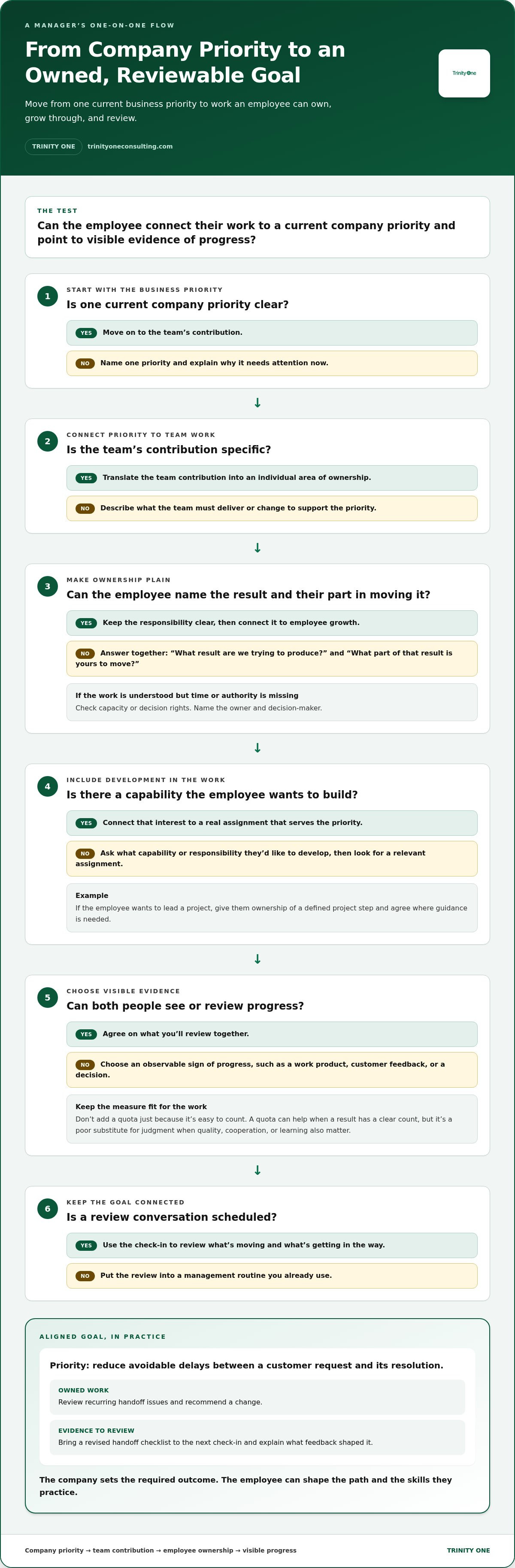
Use this sequence in a one-on-one conversation:
- Clarify the priority. “Which company outcome needs attention now, and why?” Name one priority rather than handing over a long list.
- Define the team’s contribution. “What must our team deliver or change to support it?” Describe the team’s role in plain working terms.
- Discuss individual growth. “What capability would you like to build through this work?” Look for a connection between the employee’s interest and the team’s contribution.
- Agree on evidence. “What will we see or review to know there’s progress?” Choose a work product, customer feedback, a decision, or another observable sign. Don’t add a quota just because it’s easy to count.
- Schedule a review. “When will we check what’s moving and what’s getting in the way?” Put the conversation into a management routine you already use.
The company sets the required outcome. The employee can shape the path, including the steps they take and the skills they practice. That balance preserves accountability without prescribing every action. A quota can help when a result has a clear count, but it’s a poor substitute for judgment when quality, cooperation, or learning also matter.
How do you translate company vision into role-specific goals?
Start with a current priority, such as reducing avoidable delays between a customer request and its resolution. Ask the team what part of that outcome it can influence, then define one employee’s area of ownership. A service team member might review recurring handoff issues and recommend a change. Be clear about which decisions they can make independently and which need manager approval.
Evidence should show work and movement, not just effort. The employee could bring a revised handoff checklist to the next check-in and explain what feedback shaped it. That’s observable without inventing a target. The manager’s job is to keep the link visible: how does this work support the agreed priority?
How should managers include employee growth in the conversation?
Ask what capability or responsibility the employee wants to develop, then look for a real assignment that could build it while serving the priority. If they want to lead a project, for example, give them ownership of a defined project step and agree on where you’ll provide guidance. Growth needs a real work setting, not a promise disconnected from current responsibilities.
Sometimes the employee’s aspiration won’t fit the business need at hand. Say so plainly, explain the tradeoff, and discuss another way to build that capability later. Personal development supports execution, but it doesn’t replace the outcome the role is accountable for.
How can you tell whether employee goals support the company’s actual priorities?
Check whether each goal connects to a current company priority, has a clear owner, and points to evidence of progress. That’s the practical test for aligning employee goals with company vision. A goal can sound relevant and still reward the wrong behavior if its measure captures activity instead of the outcome the company needs.
Compare each goal with the questions it should answer. These categories work together, but they serve different purposes.
| Goal type | Question it answers | Example |
|---|---|---|
| Company outcome | What result matters now? | Reduce repeat customer issues. |
| Team commitment | What will this team contribute? | Identify recurring causes and recommend a fix. |
| Employee development | What capability will the employee build? | Practice analyzing customer feedback and presenting findings. |
| Activity measure | What work was completed? | Count customer issues reviewed. |
Keep the connection visible. The company outcome gives direction, and the team commitment shows how the group will contribute. An employee’s development goal can build capability through that work, while an activity measure helps show what happened along the way.
A measurable goal can still point in the wrong direction. If the employee is judged only by the number of issues reviewed, they may move through cases quickly without identifying why customers keep reporting the same problem. The count is easy to verify, but it doesn’t prove the outcome improved.
Which measures show progress, and which only show activity?
A result describes what changed for the business, while an activity count describes what someone did. Reviewing customer issues is an activity. Fewer repeat issues is a result the company may be trying to support. The count can show whether the review work is happening, but it can’t stand alone as proof that the work helped.
Ask what decision each measure will inform. If nobody uses a number to change a priority, remove a blocker, or decide the next step, tracking it has a cost: employees spend time updating it, and managers spend time reviewing data that doesn’t guide action. Keep measures that help you make a decision.
How do you resolve a conflict between individual and company goals?
Bring the competing commitments into the open with the employee. Say, “Your current goal is taking time from the company priority we’ve agreed to support. Which work should move?” Then identify what changes, who can approve it, and what must wait. Don’t quietly add the new priority on top of the old workload.
A psychologically safe conversation makes it easier for an employee to name a conflict early. It doesn’t remove accountability. You still need a clear owner, an approved decision, and a revised commitment you can both review.
What review rhythm keeps employee goals connected to company vision?
Aligning employee goals with company vision takes regular attention, not another reporting system. Put a brief check-in inside a management rhythm you already use, such as a one-on-one or team planning meeting. The right interval depends on how quickly priorities change. The point is to catch drift while there’s still time to adjust.
A useful goal review is a decision point, not a status recital. The conversation should help you decide what continues, what needs support, and what commitment changes next.
Keep the discussion focused on four questions:
- What moved forward, and what evidence shows progress?
- What’s blocked, and which decision or resource would address it?
- Has a company priority changed enough to affect this goal?
- What’s the next concrete commitment, and who owns it?
Those questions make room for honest updates without turning each check-in into a defense of past work. If progress is slow, find out whether the cause is unclear direction, a dependency, or a decision waiting on someone else. Agree on what happens next and when you’ll revisit it.
What should a manager ask during a goal check-in?
Ask the employee to point to something that changed, not simply report that they stayed busy. A draft process, a decision made, or customer feedback can show progress, depending on the goal. If the work is stuck, ask what decision or resource would help, then name who will act on that request.
Close by checking whether the commitment still supports a current company need. If it does, keep it active. If the priority has shifted, revise the goal rather than letting the employee work toward an outcome leaders no longer need.
How can a small company keep the process manageable?
Keep only a small number of active commitments in view and record them where managers already track work. A separate form, scorecard, and meeting may create a tidy record, but each adds upkeep and can pull time away from the work being reviewed. If a note doesn’t help someone make a decision or follow through, don’t ask people to keep updating it.
Reviews still take time. A recurring conversation displaces other work, so make its purpose clear and use the time to resolve something. Don’t review every detail of every task. Focus on commitments tied to current priorities, and note the reason whenever a goal changes. That record helps distinguish a deliberate reset from an obligation that simply disappeared.
Keep the record useful to the next person who needs to act. A short note naming the decision, its owner, and the agreed follow-up can preserve context when responsibilities shift without creating another report for employees to maintain.
When should leaders add operating support to keep goals aligned?
Consider operating support when the same problems keep returning: teams hear conflicting priorities, managers miss goal reviews, or employees can’t tell who owns a decision. Those are signs that alignment depends on individual memory and spare time. If leaders don’t have the capacity to set priorities and follow through, another goal template won’t fix the operating gap.
The right support depends on what’s failing. An operating leader connects priorities to execution and clarifies ownership. A people-development practice gives employees structured attention to growth and aspirations. Software can support the cadence by making commitments and progress easier to see. Each addresses a different need, and none replaces leaders making decisions and having direct conversations.
What can an operating cadence add to goal alignment?
A shared operating cadence gives managers and employees a common place to review commitments, surface stalled work, and see who owns the next decision. Trinity Cadence provides an operating cadence, AI coaching, and visibility into execution and engagement. That visibility can support better conversations, but the tool can’t decide which priority matters most or secure follow-through on its own.
There’s a tradeoff. A system takes consistent leadership participation and upkeep. If leaders don’t use the routine or keep commitments current, it can become another place to enter information without changing decisions. An employee Dream Manager program gives employee aspirations a defined place alongside work commitments.
When can fractional operating or Dream Management support help?
Fractional COO or Integrator support can help when execution needs an operating leader to clarify priorities, ownership, and follow-through. It addresses operating gaps. It won’t replace a manager’s responsibility to set expectations with their team, and leaders still need to make and communicate decisions.
Dream Management addresses a different need. Matthew Kelly’s Dream Manager methodology treats personal aspirations as a structured people-development practice, not a substitute for accountability at work. If employees need a consistent setting to connect development with meaningful work, a fractional Dream Manager can provide that support. It takes time and participation, and it can’t make every personal aspiration fit the company’s immediate priorities.
I believe a company becomes its best version as its people become better versions of themselves. That belief has to show up in how you lead: clear outcomes, real ownership, and room for growth that supports the work.
Put the next commitment into practice
Start with one priority your team can act on this week. Make the connection between the business outcome and each person’s contribution clear, then give people a way to raise obstacles before they become missed commitments. That’s how aligning employee goals with company vision becomes part of how you lead, not another document employees complete and forget.
I bring an operator’s perspective to the conversations leaders need to have. The practical aim is to make the work matter to the company and growth matter to the person doing it.
Frequently Asked Questions
How often should managers review employee goals?
Review goals at the pace the work changes, and tie each check to a real decision point. For a long project, managers might revisit commitments during existing planning meetings and after major handoffs rather than adding a weekly meeting by default. If customer needs or company priorities shift quickly, check more often. The test is simple: can you correct course before outdated work consumes more time?
Can an employee’s goals change during the year?
Yes. A goal can change when its intended result no longer matters, role responsibilities shift, or a dependency makes the original approach impractical. In a check-in, identify what changed and agree whether the outcome or the path needs revision. Keep the reason with the updated commitment. That record helps distinguish a deliberate reset from incomplete work and prevents an employee from being judged against a target leaders have replaced.
What is the difference between employee goals and performance goals?
Employee goals describe the work or development an individual commits to, while performance goals state the results used to assess how well the role is being carried out. They can overlap, but they serve different purposes. For example, an employee may aim to learn a new reporting process, while a performance goal evaluates whether their reports help the team make timely decisions. Make both expectations clear.
Should employees set their own goals?
Employees should help shape their goals, but managers remain responsible for connecting those commitments to the work the business needs. Ask the employee to propose an approach, a skill they want to build, and a sign of progress. Then agree on the outcome together. This gives the person ownership over how they contribute without leaving company priorities to individual preference or guesswork.
How do small businesses connect personal development goals to business needs?
Use work the business already needs done as the setting for development. If an employee wants to improve their presentation skills, they might prepare and deliver a project update that helps colleagues understand a change. Agree on what capability they’ll practice and what the business needs from the work. Avoid promising a new role or assignment when there’s no clear business need to support it.
What should managers do when an employee rejects a company goal?
Ask what sits behind the objection before treating it as refusal. The employee may see a workload conflict, a customer risk, or a practical flaw in the plan. Hear the concern, explain the business reason for the goal, then clarify which outcome is required and where the employee can shape the approach. If disagreement remains, state the decision and the expected commitment plainly.
How can a company measure whether aligned goals are working?
Check for evidence at two levels: whether the company priority is advancing and whether employees can explain how their work contributes. For example, compare a project’s intended business result with completed work and the decisions that followed. If activity rises but the intended result stays flat, examine the goal or the work design. Aligning employee goals with company vision should help leaders make better choices, not simply produce more tracking.
Book a discovery call with me to discuss the operating support your company needs.