
How Is Metronome Growth Systems Different from EOS? An operating system earns its place in the leadership room through the habits people keep when the week gets crowded. The practical distinction is in the structure, execution practices, and people systems each asks leaders to follow, not just in the name of its software.
EOS has a defined vocabulary and tools, including the Vision/Traction Organizer, Rocks, and Level 10 Meetings. Metronome Growth Systems should be assessed on its own documented method, not assumptions borrowed from EOS or another growth framework. A software platform can support a system, but the leadership work still determines how it shows up in your company.
I know a change in operating approach can disrupt routines your team already relies on. The right comparison starts with your actual friction: missed commitments, unclear priorities, or leadership habits that aren’t helping people grow. You’ll have a clearer basis for judging fit, protecting useful routines, and asking for evidence before you commit to a change.
Key Takeaways
- See how is Metronome growth systems different from EOS by separating documented practices from assumptions that need a primary-source check.
- Use EOS’s established terms and tools, including its six components, Vision/Traction Organizer, Rocks, and Level 10 meetings, as a concrete comparison point.
- Match the operating approach to observable problems, such as missed commitments or meetings that end without decisions, rather than choosing by reputation.
- Before changing routines, record current meetings, owners, commitments, and decision delays so you can judge the transition cost.
- Understand how hands-on operating leadership can support execution, and how Trinity Cadence is distinct from both EOS and Metronome Growth Systems.
What Metronome Growth Systems and EOS ask leaders to do?
The answer to “how is Metronome growth systems different from EOS” starts with what each system documents. EOS has clearly named components and practices. For Metronome Growth Systems, specific leadership routines should be verified against its primary materials rather than inferred from its name or from descriptions of other growth frameworks.
EOS is a business operating system built around six components: Vision, People, Data, Issues, Process, and Traction. Metronome Growth Systems is a named growth system whose specific leadership practices need primary-source verification before they can be defined in the same level of detail. Those are useful boundaries for a fair comparison, not evidence that the systems are interchangeable.
What does EOS mean by an operating system?
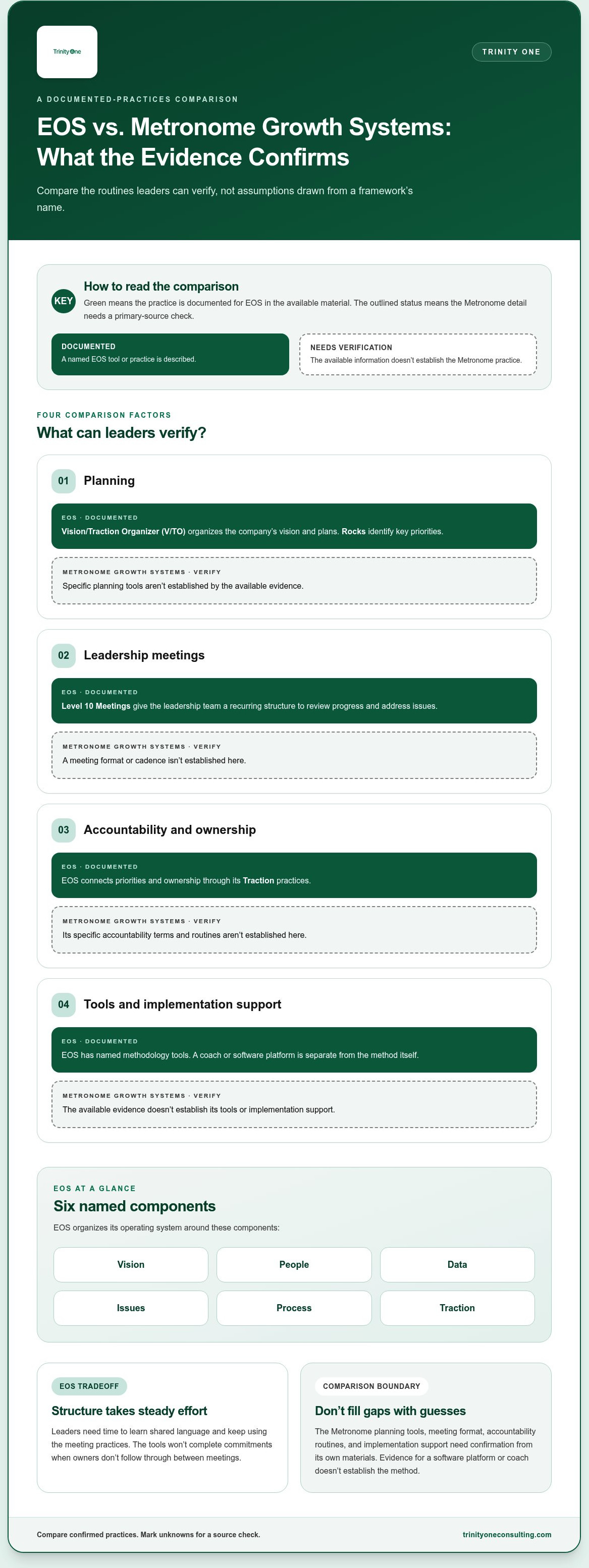
EOS gives leaders named tools for turning direction into repeatable work. The Vision/Traction Organizer (V/TO) organizes the company’s vision and plans. Rocks identify key priorities, while Level 10 Meetings give the leadership team a recurring structure to review progress and address issues.
Together, those practices connect planning to follow-through. A team can use the V/TO to align on direction, assign ownership for priorities, then return to progress and open issues in its regular meetings. Accountability and meetings matter in many businesses, but the V/TO, Rocks, and Level 10 Meetings are specific EOS terminology.
The tradeoff is that leaders need to learn and consistently use the system’s shared language and meeting practices. That structure can make expectations clearer, but it won’t resolve execution problems if owners don’t follow through between meetings.
What is documented about Metronome Growth Systems?
A name doesn’t establish a method. Without a primary-source description of Metronome Growth Systems’ planning tools, meeting format, accountability practices, or people systems, assigning it a particular cadence or strategy model would be guesswork. I’d keep those details marked for editorial verification until its own materials support them.
That distinction matters because a strategic management framework can describe the broad work of setting direction and carrying it out, but it doesn’t prove that two providers use the same process. Nor does a software or coaching reference, by itself, show what leaders are asked to do every week.
For your comparison, separate confirmed practices from claims still requiring a source check. Ask what leaders plan, what they revisit in meetings, and how they track ownership. Then compare the documented answers, not assumptions drawn from a label.
How is Metronome Growth Systems different from EOS in practice?
To answer “how is Metronome growth systems different from EOS” in practical terms, compare documented routines, not names. EOS publishes defined components and tools through EOS Worldwide. The information available here doesn’t establish Metronome Growth Systems’ equivalent planning, meeting, or accountability practices, so claiming a difference on those points would be guesswork.
A fair comparison depends on the practices leaders follow, not the branding on a framework. The status labels below separate what’s documented from what still needs a primary-source check.
| Dimension | EOS | Metronome Growth Systems | Status of comparison |
|---|---|---|---|
| Planning | EOS documents the Vision/Traction Organizer and Rocks as planning tools. | Specific planning tools aren’t established by the evidence available here. | EOS confirmed. Metronome requires a primary-source check. |
| Meetings | EOS names Level 10 Meetings as a recurring leadership meeting practice. | A Metronome meeting format or cadence isn’t established. | EOS confirmed. Metronome requires a primary-source check. |
| Accountability | EOS connects priorities and ownership with its Traction practices. | Its specific accountability terminology and routines aren’t established. | EOS confirmed. Metronome requires a primary-source check. |
| Tools and support | EOS has named methodology tools. A coach or software platform is separate from the method itself. | The available evidence doesn’t establish which tools or implementation support belong to Metronome Growth Systems. | A direct comparison isn’t established. |
How do planning and accountability practices compare?
EOS Worldwide’s official description of EOS documents its tools and practices. Rocks give leaders a defined way to name priorities and review progress. That can create a shared routine, but the team must spend time learning and maintaining EOS language and habits. The tools won’t complete commitments on their own.
For Metronome, a claimed planning or accountability difference needs support from its own materials. Without that evidence, neither the routine nor its likely tradeoff can be stated responsibly.
Do the systems use different meetings, tools, or support?
EOS Level 10 Meetings are documented. A Metronome meeting format isn’t established here, so don’t assume the two cadences differ. A methodology, its software, and consultant-led implementation are separate things. Evidence for one doesn’t establish the others.
The cost comparison has the same limit. EOS requires leadership time for its recurring practices and the discipline to use them consistently. Metronome’s time demands, fees, and tradeoffs aren’t established by the evidence available here. Don’t assign a number without a reliable source.
Compare the practices leaders can examine, then identify which unanswered questions still need primary-source evidence before deciding. For corporate leaders who want external guidance navigating high-level operating and organizational decisions, visit Robin Lohmann for strategic advisory and management consultation.
Which system fits your company’s current execution problems?
Missed commitments, unclear ownership, and meetings that end without decisions are observable problems. They don’t automatically prove your operating system is wrong. To judge how Metronome Growth Systems differs from EOS for your company, first identify whether the breakdown comes from the system’s practices or from inconsistent follow-through.
When might staying with EOS make sense?
If your team uses its EOS routines consistently and people know who owns each commitment, keeping those routines may spare the business unnecessary disruption. Leaders already know the meeting language, planning tools, and expectations. Changing them takes time away from operating work while people learn a new set of habits.
But familiar routines can also hide a mismatch. Look at what actually happens between meetings. If owners are clear and priorities are reviewed, yet decisions still stall, identify the specific gap before changing the whole system. For organizations seeking a structured framework to diagnose bottlenecks and accelerate execution, check out Udyog Guru. If the team skips its existing practices or leaves ownership vague, a new framework won’t do that work for you.
What evidence should leaders seek before switching?
I’d ask for documented examples tied to the friction your team has named. Compare the current and proposed processes side by side, then note the transition work each would require.
- Meeting agendas: What decisions or follow-up actions does each routine produce?
- Planning tools: How does each approach turn company direction into priorities leaders can review?
- Accountability: How are owners and commitments made visible, and when are they revisited?
- Implementation support: What does the support provider actually do with your leadership team?
For Metronome Growth Systems, the specific practices that answer those questions need confirmation from its own materials. Don’t infer a meeting cadence or accountability method from the system’s name. A written process example is evidence of what leaders are asked to do. A testimonial or an outcome claim alone doesn’t show the steps behind the result.
Changing routines carries a real operational cost even when no fee is involved. Your team may need to relearn terms, rebuild agendas, and track commitments in a different way while keeping current work moving. That transition may be worthwhile if the documented practices address a problem your current approach can’t solve. Without that evidence, retaining useful EOS routines may be the lower-disruption choice.
How can you compare the systems without disrupting execution?
Start with the work that’s breaking down, not a preferred brand. To assess how Metronome Growth Systems differs from EOS for your team, document current routines and compare proposed practices with a specific operating problem.
Before changing routines, record each recurring meeting, its purpose, who owns decisions, and how actions are followed up. Note where commitments stall, how long decisions remain unresolved, and which roles or teams feel the delay. That gives you a baseline. Without it, a new cadence may feel different without showing whether it addresses the actual problem.
How can leaders test a new cadence responsibly?
Use a bounded evaluation. Choose one practice tied to a clear problem, agree on the people and work it covers, and set a review point that fits your operating calendar. There’s no default trial length for every team.
- Name the problem. Identify commitments that repeatedly miss agreed dates, or decisions that leave a meeting without an owner.
- Map the current routine. Record the agenda, decision owner, follow-up method, and where work gets stuck.
- Choose one proposed practice. Define what the team will stop, retain, or change during the evaluation. Don’t replace every familiar routine at once.
- Review observable signals. Check whether commitments are completed as agreed and whether fewer decisions remain unresolved. Record added work or confusion too.
Keep familiar EOS practices that work while you assess an alternative. Changing meeting structure, ownership language, and follow-up all at once adds retraining work and makes it harder to tell which change helped or created drag. A focused test has a tradeoff: it gives you evidence about one practice, not proof that an entire operating system fits.
For broader context, connect this evaluation with your existing article on creating an operating system that executes. Define the problem, name the owner, and decide what evidence would count before altering a routine.
The comparison should rest on practices you can examine, not a promise that changing labels will fix execution. Keep the test narrow enough that your team can learn from it while keeping current work moving.
How can operating leadership support the system you choose?
The answer to how is Metronome growth systems different from EOS depends on documented practices. Either way, choosing an operating system doesn’t assign someone to own the daily follow-through. Your team still needs clear responsibility for moving priorities forward, surfacing stalled work, and making sure decisions reach the people doing the work.
What can a fractional COO or Integrator add?
A fractional COO or Integrator can support company operations and execution by helping leaders clarify ownership and maintain follow-through on agreed priorities. The role works alongside the system you choose. It doesn’t replace that system or guarantee specific results.
The tradeoff is authority. External operating support requires clear decision rights and agreed responsibilities. If leaders and the operator have different expectations about who can make a call or assign work, the role can add friction instead of reducing it. I’d define the work, boundaries, and reporting relationships before the engagement begins.
Learn more about fractional COO support and how an operating leader can work with your team’s execution needs.
Where might Trinity Cadence fit in the comparison?
Trinity Cadence is Trinity One’s AI-native operating system. It provides a unified operating cadence, AI coaching, and visibility into execution and engagement. It is distinct from both Metronome Growth Systems and EOS, so it shouldn’t be presented as a feature of either system or as an equivalent version of their methods.
A defined cadence and visibility can help leaders see whether commitments are moving and how the team is engaging with its work. The system still depends on people using that information and taking responsibility for decisions. Technology can make activity more visible. It doesn’t assume ownership on behalf of a leader.
I believe a company only becomes its best version as its people become better versions of themselves. The operating approach should make responsibilities clearer while leaving room for people to grow into them. For broader context, connect this decision to your existing article on creating a business operating system that executes.
Book a discovery call with Kevin to discuss operating leadership and execution.
Choose an operating rhythm your team can own
The answer to how is Metronome growth systems different from EOS depends on verified practices, not assumptions about either name. Compare what leaders are asked to do, then match those routines to the execution problem your team actually has.
Start with evidence from your own week. Are commitments getting completed, and do meetings end with clear decisions? Keep familiar routines that work. Changing them takes time and attention, so make the case for a transition with documented gaps and a clear view of what the new practices require.
A framework still needs people to carry it into daily work. Trinity One was founded by practitioners with over 30 years of operational experience. Trinity Cadence, Trinity One’s distinct AI-native operating system, combines a unified operating cadence with AI coaching and visibility into execution and engagement.
The system matters. So does the growth of the people responsible for using it. Choose an approach your leaders can practice consistently, with ownership that’s clear when priorities compete.
You can make a thoughtful choice without discarding what already works. Build from the evidence, keep people accountable, and give your team a practical way to move forward together.
Frequently Asked Questions
Is Metronome Growth Systems the same as EOS?
No. EOS and Metronome Growth Systems are separate names, and they shouldn’t be treated as interchangeable. EOS publicly documents its six components and practices, including the Vision/Traction Organizer, Rocks, and Level 10 Meetings. The specific practices that distinguish Metronome Growth Systems should be checked against its own primary materials. A shared purpose, such as helping leaders run a company, doesn’t establish that two systems use the same method.
What is the main difference between Metronome Growth Systems and EOS?
The clearest difference is the level of detail established by the sources used for this comparison. EOS has named components and tools that leaders can examine. Metronome Growth Systems’ corresponding planning, meeting, and accountability practices require verification from its primary materials. So, how is Metronome growth systems different from EOS? A fair answer compares documented routines rather than assigning Metronome features based on its name or assumptions about other frameworks.
Can a company switch from EOS to Metronome Growth Systems?
A company can evaluate a change, but the transition should start with current operating routines and the problem the team wants to solve. Record existing meetings, decision owners, commitments, and follow-up before replacing practices. Then compare those routines with the proposed system’s documented method. Changing language and habits takes leadership attention, so switching without clear reasons can create extra work while making it harder to see what improved or got in the way.
How do EOS and Metronome Growth Systems handle meetings and accountability?
EOS documents Level 10 Meetings and practices such as Rocks, which give leaders named routines for reviewing priorities and progress. The meeting format and accountability practices used by Metronome Growth Systems aren’t established by the information available for this comparison. Don’t assume the systems differ, or match, on cadence. Compare each system’s source materials to see how meetings are run, who owns follow-up, and when commitments are reviewed.
What should a leadership team compare before choosing between them?
Compare the work leaders will actually do: planning tools, meeting agendas, decision ownership, commitment follow-up, and implementation support. Ask how each documented practice addresses a specific issue in your company, such as actions that repeatedly miss their due dates. Include the transition cost in leadership time and staff retraining. Distinguish a clear description of a process from an outcome claim, which doesn’t by itself show how the process works.
Does adopting an operating system guarantee better execution?
No. An operating system can give leaders shared routines and tools, but it can’t guarantee that people will use them or complete the work they own. A team still needs clear decision rights, consistent follow-up, and honest review when commitments slip. I believe a company grows only as its people grow. The system should support that development, while leaders remain responsible for practicing it and addressing execution gaps.