
A recognition program can reach every remote employee and still miss the person doing the work. Employee retention through dream management begins when you recognize a specific contribution and make room to understand what the employee wants to build beyond the job. That connection can support loyalty, but it can't guarantee someone will stay.
Remote wins are easy to overlook when managers see progress mainly through scheduled calls and project dashboards. Generic rewards can feel arbitrary, too. I believe recognition carries more weight when it names what someone did and reflects what matters to them, without implying a promotion or funding you haven't approved.
Matthew Kelly’s Dream Manager methodology gives managers a structure for recurring conversations about employees’ aspirations across twelve areas of life. You can pair those conversations with timely, work-specific recognition, then identify support you can genuinely provide. The practice needs to fit your team’s routines and your budget. Keep it consistent, notice who gets recognized, and ask employees whether the recognition feels meaningful. That gives you a grounded way to support people’s goals while checking whether the practice helps them feel seen.
Key Takeaways
- Choose recognition methods that fit your team’s routines, budget, and communication preferences, while accounting for the time each one takes to maintain.
- Use employee retention through dream management as one part of a wider retention effort, not a substitute for fair working conditions or sound management.
- Ask employees how they prefer to be recognized, then apply those preferences consistently across the team.
- Connect recognition with personal goals by identifying practical support you can offer without promising outcomes you can’t control.
- Review whether your practice helps employees feel valued, and adjust it when the process becomes burdensome or uneven.
How can employee retention through dream management begin with recognition?
Employee retention through dream management can begin when you recognize a person’s specific contribution and make space to understand what they want to achieve. That can help remote employees feel seen and build trust, but it can’t compensate for unfair pay, unmanageable workloads, poor management, or limited development. Recognition is a signal. The working conditions behind it still matter.
Be specific. Instead of thanking someone for “great work,” name the action and its effect: “Your handoff notes let the next shift resolve the client issue without repeating the investigation.” That tells an employee you noticed the work, even if you weren’t online when it happened. A public message may suit one person. Another may prefer a private note.
Employee retention covers the broader effort to keep people at work, including factors such as working arrangements and development, as described in this employee retention overview. Recognition can support that effort. It can’t repair a role that keeps expanding without added capacity or a manager who ignores concerns.
What does Dream Management mean at work?
Dream Management is a structured way to help employees name personal aspirations and identify practical next steps, without promising the employer will fund every goal. Matthew Kelly developed the Dream Manager methodology and its twelve dream categories. They are physical, emotional, intellectual, spiritual, psychological, material, professional, financial, creative, adventure, legacy, and character.
At work, recurring conversations give an employee room to talk about an aspiration and consider a next step they can take. A Dream Manager can help keep that conversation focused, while the employer decides what support is appropriate and affordable. For example, an employee pursuing a professional goal might benefit from a relevant work assignment, but that possibility should be discussed rather than promised.
The distinction matters. Personal support doesn’t mean the company pays for every course, trip, or project. Dream Management adds a human development practice to the organization. It doesn’t replace clear expectations, fair treatment, or sound management. You can learn about Trinity One’s Dream Manager program as a structured way to support these conversations.
Why can remote employees feel overlooked?
Asynchronous work can hide the effort behind a finished task. A manager may see a completed report in a shared folder without seeing the careful review, coordination, or late correction that made it usable. The output is visible. The contribution behind it may not be.
Picture a project review where the team discusses a launch milestone, but the person who reconciled conflicting feedback across several time zones isn’t mentioned because their work happened in messages and document comments. Naming that contribution in the meeting, or thanking them privately afterward, makes the recognition concrete. It also gives the manager a better view of how work actually gets done.
That attention connects with the business case for empathy in leadership: understanding an employee’s circumstances helps you respond to the person, not only the task list. I see recognition as a management habit that takes observation and follow-through. It costs time, and it’s bad at fixing structural problems on its own. Start by noticing the work your team’s tools record but your meetings leave unsaid.
Which recognition programs for remote employees can managers use?
Choose a practice your managers can sustain, then match it to the contribution and the employee’s preferences. A message in a project update takes little extra time when it names a specific action. A points-based reward system needs administration and a budget, and it can make recognition feel transactional if points matter more than the work.
These approaches serve different purposes. None will suit every employee or correct a team culture where recognition is uneven.
Which team-wide recognition practices work remotely?
Use public recognition to make useful contributions visible, and set clear limits so appreciation stays tied to work rather than popularity. Public praise can reach teammates who weren’t part of a project, but some employees prefer not to be singled out. Ask about that preference instead of assuming an audience feels like a reward.
- Specific praise in a project update: Name a completed contribution and its effect, such as how an accurate handoff prevented a task from being reopened. It takes a manager a few minutes to write, but it can’t capture work the manager hasn’t observed.
- Recognition in a team meeting: Briefly credit a person for a deliverable or decision so others understand what good work looked like. This costs meeting time and may put someone on the spot, so keep praise optional and specific.
- Peer appreciation: Give teammates a shared channel or regular agenda slot to acknowledge help they’ve received. Set a norm that recognition describes an action, not a person’s popularity. Without that guardrail, the same visible colleagues can collect attention while quiet contributors go unmentioned.
When should recognition be private and personal?
A private message or one-to-one conversation works when an employee prefers individual thanks, or when the contribution involves sensitive judgment that shouldn’t be discussed in a group. Connect the acknowledgement to its effect: “Your review caught the mismatch before we sent the file to the client.” This takes attention from the manager, and it won’t give the wider team visibility into the contribution.
Personal development support can carry recognition beyond the completed task. Ask what goal the employee wants to work toward, then discuss a practical next step you can support, such as relevant project experience or time to explore a work-related skill. Be direct about limits. A conversation doesn’t commit the company to paying for a course or changing someone’s role.
Dream-focused conversations are distinct from routine praise. A Dream Manager can help an employee discuss aspirations and identify next steps, while everyday recognition continues to acknowledge work as it happens. That distinction keeps goal support from turning into an occasional reward or a promise of company funding. For practical guidance on setting up that work, see the Dream Manager program implementation guide.
Employee retention through dream management depends on a practice people can trust. Keep the workload of each method visible, check whether recognition is reaching different employees, and change the approach when its administration outweighs its value.
Why can recognition fail to improve employee retention?
Recognition can make a person feel appreciated. It can’t make an unreasonable workload manageable or turn poor management into good management. Employee retention through dream management can support a stronger relationship between people and the company, but it won’t offset unfair treatment or unresolved problems in someone’s role.
A reward program also has operating costs. Managers spend time noticing contributions and writing acknowledgements. Someone has to administer nominations or points, and tangible rewards require budget. Those costs may be reasonable, but the practice is a poor use of time if leaders keep the process running while ignoring employees’ concerns about workload, compensation, or development.
Recognition shows appreciation. Retention data shows who stayed, not why. Don’t treat a rise in recognition messages as proof that fewer people will leave. The two measures answer different questions.
What makes a recognition program feel hollow?
Generic praise can sound disconnected from the work. “Great job” gives an employee little evidence that the manager understands what they did or why it mattered. Worse, public praise loses credibility when daily decisions contradict it, such as applauding a team for meeting a deadline while continuing to assign urgent work without adjusting priorities.
Frequency alone doesn’t fix the problem. If a manager has to fill a weekly recognition quota, the task can become another box to check. Employees notice when recognition arrives on schedule but leaders don’t follow through on the issues raised in one-to-ones. Keep the practice small enough to maintain, and make each acknowledgement truthful.
How should leaders set realistic expectations?
Retention reflects more than recognition. People’s decisions are shaped by how work is managed, whether expectations are sustainable, how compensation is handled, and whether they can develop. A program can contribute to a better employee experience. It can’t isolate or control every reason someone stays or leaves.
Set a baseline before changing the practice. Review existing retention data, then ask employees specific questions about whether recognition feels timely, fair, and meaningful. Repeat those checks after the practice has been in place. If feedback improves while departures do not, don’t declare the program a retention success. Examine other conditions and consider whether the recognition practice is reaching the people it was meant to reach.
Be careful with cause and effect. If retention changes after a new program begins, that timing alone doesn’t prove the program caused the change. Other decisions or workplace conditions may have shifted at the same time. Track what you changed and what employees report, then treat the results as evidence to discuss, not a victory claim.
Growing teams should also watch for burnout. Recognition can acknowledge extra effort, but praise for repeated late nights may normalize a workload that needs to change. The article on preventing employee burnout in a fast-growing company addresses that pressure directly. Managers should use what they hear from employees to make practical adjustments, not simply send another thank-you message.
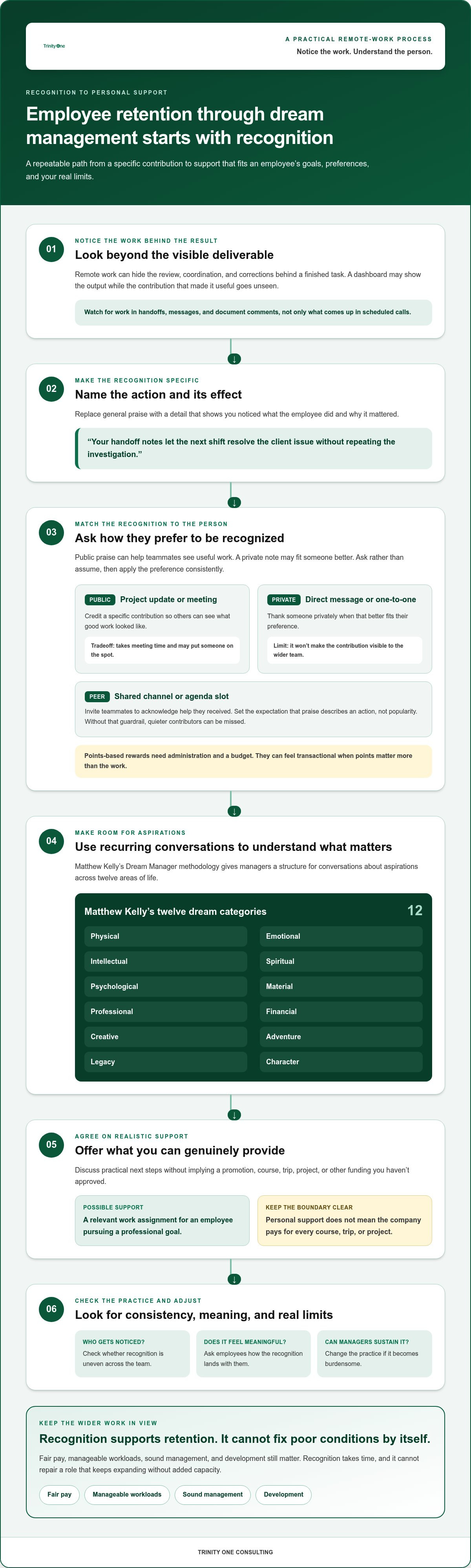
How do you build a remote recognition practice employees can trust?
A trustworthy practice is simple enough to repeat and specific enough to feel genuine. Set a clear process: notice a contribution, learn how the employee prefers to be recognized, then follow through consistently. If managers only recognize work they see in live meetings, remote employees whose contributions happen asynchronously may get fewer chances to be noticed.
How can managers make recognition specific and fair?
Name the action and its effect. “You kept the handoff clear, so the next person could continue without asking the client to repeat details” is more useful than “Great work.” The first acknowledges a real contribution. It also gives the employee a clear picture of what the manager values.
Fairness requires shared criteria, not identical praise for identical work. Agree on the contributions worth recognizing, such as completing a responsibility reliably or sharing information that helps another team member do their job. Review who gets acknowledged and whether remote work patterns make some people’s efforts less visible. The cost is a little manager attention. The tradeoff is worth considering, but a checklist alone can’t judge the context behind an employee’s work.
Ask about preferences without asking for private details. You might say, “Would you rather I recognize this kind of work in the team update or send you a private note?” Let employees choose public acknowledgement, private thanks, peer appreciation, or goal support. They shouldn’t have to share personal information to receive fair recognition.
How can leaders connect recognition with employee goals?
Start with the employee’s definition of progress. Ask what they want to work toward and whether they’d like to discuss a practical next step. Don’t assume a promotion, course, or new assignment is the answer. The employee may prefer to identify a small action they can take without changing their role.
Agree on a step that fits the person’s available time and responsibilities. If an employee wants to develop a skill relevant to current work, you might discuss whether an upcoming assignment offers a chance to practice it. Be clear about limits: a conversation isn’t a commitment to pay for training, change someone’s job, or provide time the team can’t spare. Goal support loses credibility if managers offer more than they can deliver.
Keep the cadence manageable. Managers can recognize meaningful contributions as they happen, then use an existing one-to-one conversation to ask whether the approach is working. Avoid creating a separate reporting ritual unless the team needs it. A tracking system can help reveal uneven patterns, but it also adds administrative work and can turn genuine appreciation into recorded activity.
Review employee feedback alongside retention indicators, such as departures over time, and note other changes that may affect those measures. If employees say they feel more noticed, that’s useful feedback. It doesn’t prove recognition caused a change in retention. Employee retention through dream management is a practice to assess and adjust, not an outcome you can guarantee.
Put the recognition norm where managers and employees can refer to it, such as in the team’s working agreement. Keep it brief: what contributions merit acknowledgement, how employees can state their preferences, and how managers will check whether the approach is working. That small written commitment makes the practice easier to apply consistently without adding a new meeting.
How can Dream Management connect recognition with employee retention?
Dream Management can connect recognition with retention by pairing acknowledgement of completed work with structured conversations about employees’ aspirations. Recognition focuses on contributions. A Dream Manager conversation gives an employee room to consider what they want to work toward and what practical progress might look like. Neither practice can guarantee that someone will stay.
These conversations work best alongside responsible management. If an employee raises a concern about workload or an unmet commitment, the next step is to address it directly, not redirect the discussion to personal goals. Dream Management can support the relationship between employees and the company, but it can’t replace fair working conditions or sound decisions.
What can a Dream Manager contribute?
A Dream Manager helps employees reflect on personal aspirations, clarify what progress means to them, and consider a next step. The employee chooses the goal and remains responsible for pursuing it. The manager can listen and discuss appropriate workplace support, without promising a promotion, funding, or a particular result.
For example, an employee may want to develop a skill that connects to their current responsibilities. A Dream Manager can help the employee identify a practical step, then the manager can discuss whether a suitable work opportunity exists. That keeps the conversation grounded in an option the organization can actually consider.
Clear boundaries matter. Participation shouldn’t require an employee to disclose personal details, and a goal conversation shouldn’t become a performance review in disguise. Trinity One’s Fractional Dream Manager service supports organizations that want structured Dream Management and coaching.
How can leaders start without overpromising?
Before beginning, explain that participation is voluntary and that workplace support depends on what the organization can reasonably offer. Set a recurring cadence that fits existing schedules. Conversations held too far apart can lose continuity, while overly frequent check-ins can feel like another reporting task.
After an employee identifies a goal, agree on a next step and who owns it. If the goal involves building a work-related skill, that step could be a discussion about an upcoming responsibility that offers relevant experience. Keep commitments narrow and realistic. Don’t imply the company will provide money, time, or opportunities it hasn’t agreed to make available.
Trinity One also offers Dream Manager coaching, and DreamCompass is a software offering associated with Dream Management. The software can support the practice, but it doesn’t replace attentive conversations or follow-through from leaders. Used with care, employee retention through dream management can make personal growth part of how your company supports its people.
Make recognition a management habit your team can sustain
Employee retention through dream management starts with a decision you can make this week: recognize work clearly, then make room for honest conversations about what employees hope to achieve. Keep the practice small enough to repeat. A thoughtful, consistent habit carries more weight than a program that fades when managers get busy.
I’ve spent more than 30 years in operational roles, and I’ve seen how execution depends on people having room to grow. Trinity One offers Dream Management facilitation and Dream Manager coaching to help organizations put those conversations into practice. The work supports personal progress, but it doesn’t replace fair conditions or promise that an employee will stay.
Start with one manager and a clear commitment to follow through. Listen, agree on a practical next step, and make recognition reflect real contributions. You can build from there, at a pace your team can maintain.
Frequently Asked Questions
Can employee recognition improve retention?
Yes, recognition can support retention when employees see that their contributions matter, but it can’t guarantee they’ll stay. If a remote employee resolves a recurring handoff problem, acknowledge that specific impact and ask whether the change made their work easier. Then consider that feedback alongside workload, compensation, management, flexibility, and growth opportunities. One positive response is useful, but it doesn’t establish that recognition caused an employee to remain.
What are effective recognition programs for remote employees?
Effective approaches include manager acknowledgement in project records, peer appreciation, and private conversations about development. For example, a project lead can note who clarified a decision and what that helped the team complete. Peer recognition works best when employees describe concrete actions rather than nominate the most visible colleague. Choose a format the team will use consistently, then adjust it if employees find the process distracting or impersonal.
How does Dream Management support employee retention?
Dream Management gives employees a structured setting to discuss personal aspirations and consider practical progress. Matthew Kelly developed the methodology, including its twelve dream categories. A Dream Manager might help an employee identify a next step toward a goal, while leaving the choice and effort with the employee. Employee retention through dream management can be part of a wider people-support practice, but it can’t promise that an employee will stay.
Is public recognition better than private recognition?
Neither format is automatically better. Public thanks can show colleagues what contribution helped a project, while a private note may feel more comfortable to someone who dislikes attention. Ask employees for their preferences during an ordinary check-in, and let them change that preference over time. For example, someone may welcome team acknowledgement for a completed project but prefer private feedback about an individual development step.
How often should managers recognize remote employees?
There’s no single schedule that fits every team. A useful standard is to acknowledge work close enough to its completion that the reason for the thanks is clear. Managers can include recognition in existing project updates or one-to-ones rather than creating a new weekly form. If the practice starts taking time away from meaningful conversations, simplify it and ask employees what they’d keep.
Can a Dream Manager promise that employees will stay?
No. A Dream Manager can support an employee’s reflection and progress, but the decision to remain belongs to the employee. A goal conversation also can’t resolve concerns about pay, workload, management, or opportunity by itself. Keep participation voluntary, explain what workplace support is possible, and avoid tying personal disclosures to performance decisions. The value is in offering thoughtful support, not securing a particular employment outcome.
How can a company measure whether recognition is helping?
Ask employees for concrete feedback, such as whether recent acknowledgement accurately reflected their work and reached them in a useful way. Review that feedback alongside retention indicators over time, and record other changes that could affect results, such as a shift in workload or management. A before-and-after comparison can show timing, not prove cause. Use the findings to adjust the practice, especially if some teams or roles remain less visible.