
Paying for a leader's time is the fastest way to stall your company's growth. You need outcomes, not a timesheet. In 2026, fractional COO pricing models range from $4,000 to $20,000 per month depending on whether you're buying a few hours of advice or a full operational rebuild. Choosing the wrong model often leads to paying for seat time while your best people quit because they lack a clear vision.
You're likely tired of seeing operational drag eat your margins while you're stuck in the weeds of daily meetings. It's frustrating. You watch high-performing staff drift away because the engine of your business feels broken. You want a clear budget for leadership that actually gets results. I believe we're called to be good stewards of the people we lead, and that starts with clear expectations.
I will break down the actual costs and trade-offs of different fractional COO pricing models so you can stop guessing and start scaling. We'll look at hourly rates and monthly retainers. I'll show you how to budget for a system that integrates AI and human performance to give you your time back. It's time to focus on growth.
Key Takeaways
- Compare the primary fractional COO pricing models to see why retainers usually beat hourly billing for long-term growth and stability.
- Evaluate the specific criteria that determine your monthly investment so you aren't overpaying for simple advisory tasks.
- See how the Trinity Cadence AI-native operating system reduces the manual administrative work that typically inflates fractional leadership costs.
- Understand why operational discipline fails without the Dream Management methodology developed by Matthew Kelly to keep your staff aligned with your vision.
- Identify the hidden costs of operational drag and learn when to use equity grants to protect your company's cash flow.
What are the standard fractional COO pricing models?
A Fractional executive isn't just a consultant who hands you a deck and walks away. They're an operator who steps directly into the engine room of your business. Because of that, fractional COO pricing models vary based on how much of the heavy lifting they're doing for you. You'll find everything from billable minutes to long-term equity stakes.
Hourly rates and advisory fees
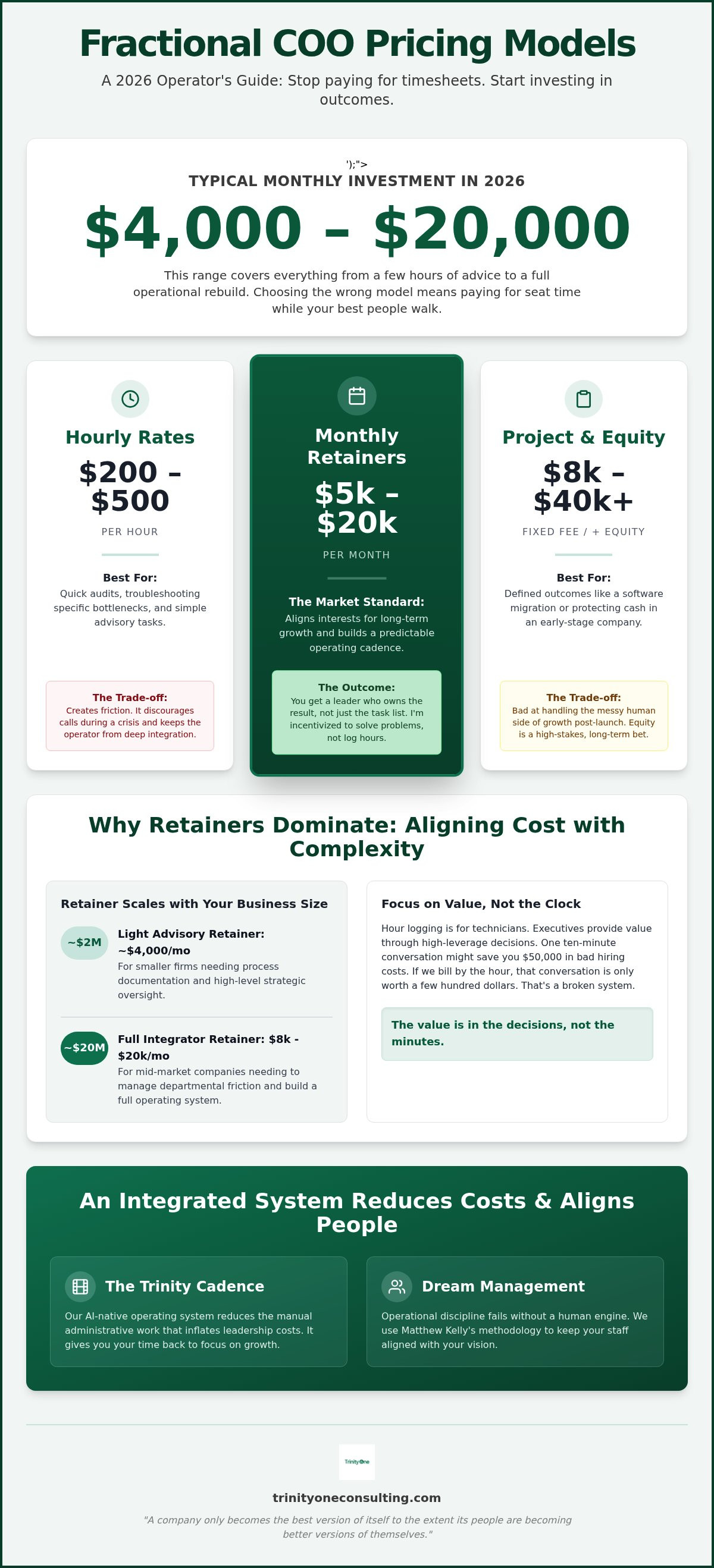
Expect to pay between $200 and $500 per hour for high-level operations talent in 2026. This model is useful if you just need an audit of your current tech stack or a quick troubleshooting session for a specific bottleneck. It's clean. You pay for what you use.
But there's a trade-off. Hourly billing creates a natural friction between speed and quality. If I'm billing you by the hour, you might hesitate to call me when a crisis hits because you're watching the clock. It lacks the deep integration a Visionary truly needs to feel supported. It's hard to build a culture when you're worried about the meter running.
Monthly retainer structures
Most operators prefer a flat monthly fee for a set scope of work. These retainers typically range from $5,000 to $20,000 per month. The price depends on how many days a week they're in your business. It builds a predictable operating cadence for your business engine. You can see how this works in practice with our fractional COO services.
This model aligns our interests. I'm not incentivized to work slow. I'm incentivized to get your systems running so well that the business doesn't need me to babysit every meeting. It's about outcomes. You get a leader who owns the result, not just the task list.
Fixed-fee projects and equity
Sometimes you just need a specific operational outcome. A fixed-fee project, like an operational rebuild or a software migration, might cost between $8,000 and $40,000. It's great for defined starts and finishes. However, it's bad at handling the messy human side of growth that happens after the new system launches.
Early-stage companies often use equity to protect cash flow. You might offer a lower retainer plus a small percentage of the company. This ensures your COO is fully bought into the long-term vision. It's a high-stakes move. Only do this if you're certain they can grow the pie enough to make their slice worth it. My faith tells me that real commitment requires skin in the game.
Why does monthly retainer pricing dominate the market?
Monthly retainers are the standard for fractional COO pricing models because they provide a fixed cost for the Visionary CEO while focusing the operator on outcomes. You stop worrying about every five-minute phone call. I've seen businesses waste thousands by hiring hourly contractors who drag their feet to hit a billable target.
Retainers align with your company's pulse. I step into your weekly leadership meeting and own the follow-through. You aren't just buying my time. You're buying the ability to sleep at night knowing the engine is running.
Pricing by revenue tier
A $2M firm has different needs than a $20M organization. Complexity grows as you add heads. If you have five employees, you need someone to help you document a few processes. If you have fifty, you need a full-scale Integrator to manage departmental friction. These Benchmarks by Revenue Tier show that as your revenue climbs, the depth of the COO's involvement must increase too.
Smaller firms often start with a light advisory retainer. This might cost $4,000 per month for a few hours of strategic oversight. Larger mid-market companies often see retainers between $8,000 and $20,000. At this level, I'm not just giving advice. I'm building the Trinity Cadence to ensure your people are actually becoming better versions of themselves as taught by Matthew Kelly.
The day-rate vs hour-log debate
Operators think in terms of output and execution. I don't care how many minutes a task takes. I care if the task moved the needle. Charging by the day or a flat retainer ensures the COO is fully present in your business. You want them thinking about your problems while they're driving, not just when they're sitting at a desk.
Hour logging is for technicians. It's for the person fixing your website or filing your taxes. Executives provide value through high-leverage decisions. One ten-minute conversation might save you $50,000 in bad hiring costs. If we bill by the hour, that conversation is only worth a few hundred dollars. That's a broken system.
Focus on the value of the decisions made. I've helped leaders cut a standard 60-minute staff meeting down to a 15-minute stand-up. That's 45 minutes of recovered time for every person in the room. You can't measure that impact with a stopwatch. My faith reminds me that we're here to serve people, and you can't serve a team if you're only looking at a clock. If you're ready to stop watching the clock and start seeing results, let's discuss your operating cadence.
How do project-based fees and launch sprints work?
Project-based fees offer a fixed price for a specific operational outcome. This is one of the most effective fractional COO pricing models for businesses that have a broken engine but aren't ready for a permanent leadership seat. You pay for a result. You don't pay for the operator's learning curve.
Fixed-scope projects in 2026 typically cost between $8,000 and $40,000. It's a significant upfront investment. The trade-off is clarity. You get a specialist to rebuild a specific circuit in your business without the commitment of a long-term contract. This approach is bad for ongoing culture building, but it's excellent for aggressive bottleneck removal.
I often see CEOs use this model when they've hit a plateau. They know the current systems won't support another $1M in revenue. A project allows us to rip out the old wiring and install something that actually works. It's about execution over theory.
Rapid launch sprint methodology
This demand for execution-focused partnership extends beyond operations into the creative space; for example, Indigo Collective Group provides the strategic leadership and hands-on execution businesses need to ensure their marketing scales with the same precision as their backend systems.
Launch Sprints focus on high-impact operational fixes within a 30 to 90 day window. This is the fastest way to clean up a messy business engine. You're paying for the speed of execution and deep, specialized knowledge. I use these to set the foundation before we ever discuss moving to a monthly retainer.
In a sprint, we don't talk about five-year plans. We talk about what's killing your margins today. If your leadership meetings are running two hours and achieving nothing, a sprint can cut that time by 75% in a single month. We install the discipline first. The growth follows naturally.
AI implementation and ROI mapping
As that growth follows, ensuring your client relations scale alongside your internal efficiency is vital; nlightencx provides the strategic insights needed to help businesses retain and expand their client base during periods of rapid scaling.
Modern projects must include a technical component to stay competitive. If you need specialized guidance on aligning your tech stack with your business goals, you can explore Fractional CTO options from Top7 to complement your operational strategy. Mapping the ROI of AI tools prevents you from wasting money on software your team will never use. Setting fixed fees for AI deployment provides a clear ceiling on your costs. It stops the scope creep that usually happens with new tech.
ROI mapping is the direct logical link between a new piece of technology and the actual profit it generates for your firm. It ensures you aren't just buying shiny toys. We look at the specific hours saved in client onboarding or the reduction in manual data entry. If the software doesn't make your people better versions of themselves, it has no place in your business.
I believe we are called to be good stewards of our resources. That means every dollar spent on a project must have a clear path to a return. Once the sprint is over, the transition to ongoing support feels natural. You've seen the power of discipline, and you won't want to go back to the chaos.
When you analyze fractional COO pricing models, you're usually scanning the monthly retainer. That is a mistake. The real cost of your business isn't what you pay a leader; it's the money you're already losing through operational drag, indecision, or inefficient asset use—which is why many companies explore Fleet Management through Alliance Fleet Solutions to recover lost margins.
Chaos is more expensive than any fee I could charge. Calculate the math on ten high-performing employees wasting five hours a week because of bad meetings or unclear goals. At a $50 hourly rate, that's $2,500 a week or $130,000 a year literally vanishing. You're already paying for a COO. You're just paying it to the friction tax instead of an operator.
Bad systems lead to high turnover. Recruiting fees for a single executive can easily top $40,000. When people don't see a path to their own growth, they leave. This is why we use the Dream Manager methodology created by Matthew Kelly to ensure your staff's personal dreams align with company goals. It protects your bottom line from the $100,000 cost of replacing a key manager.
You can learn more about when to hire a fractional executive to stop this bleed.
Equity and performance bonuses
Startups often use 0.5 percent to 2 percent equity to attract top-tier operators. This protects your cash flow today but costs you dearly if you exit for $100M. Performance bonuses should be tied to EBITDA or specific growth targets. These align the Integrator with your long term vision.
Clear targets prevent resentment. Always put these agreements in writing to avoid future friction. I've seen too many handshakes turn into lawsuits three years later. Clarity is kindness in business.
Fractional versus full-time leadership
A full-time COO in 2026 costs between $280,000 and $550,000. That's a massive burden for a $5M company. The trade-off is focus. A fractional leader isn't there 40 hours a week. They won't be at every happy hour or spontaneous brainstorming session. You're trading quantity of hours for quality of decision-making.
My faith tells me that honest weights and measures matter. I'll be blunt. If you need someone to manage the office coffee order, hire an office manager, not a fractional COO. You're paying for a strategic architect. Don't waste that investment on low-level tasks; instead, ensure your leadership team is positioned as industry authorities, starting with the LinkedIn optimization techniques taught by Leaders Social.
Most fractional COO pricing models leave you with a leader but no tools. You get a smart person in a chair, but they spend half their time building spreadsheets from scratch. At Trinity One, I've unified the machine and the human. We provide the Trinity Cadence AI-native operating system alongside the leadership. This ensures that every dollar you spend on operations actually moves the needle on profit. You stop paying for discovery and start paying for execution.
The Trinity Cadence AI operating system
We provide the software engine as part of the engagement. Trinity Cadence creates a unified rhythm for your team that most consultants ignore. AI coaching provides real-time visibility into execution without you having to sit in five-hour status meetings. This reduces the total hours needed for manual management. I don't check boxes. I lead. We've seen this system cut meeting times by 60% in the first 90 days.
Dream Management facilitation
I use Matthew Kelly’s methodology to coach your people through the twelve dream categories. We link personal dreams to professional performance. This is a retention strategy that drives ROI. It is not soft. When your staff knows you care about their life outside the office, they don't look for the exit when a recruiter calls. I believe every person is a child of God with a unique purpose, and our business is the vehicle to help them reach it.
This approach fixes the vision alignment pain that kills most scaling firms. If your top salesperson wants to buy their first home, we help them map the performance needed to get there. The company wins because they stay. The employee wins because they grow. It is a closed loop of human performance that traditional fractional COO pricing models completely miss.
I work 1-on-1 with the Visionary CEO to keep you out of the weeds. You need a peer who has been in the trenches of corporate operations and coached on the football field. We focus on strategic growth while the Trinity Cadence handles the daily execution. This is how we ensure the business becomes the best version of itself. It is about building an engine that runs without you needing to turn the key every morning.
Book a 30-minute Trinity One cadence call with me to discuss your operational engine: 30 minute trinity one cadence call with kevin patrick
Stop Guessing and Start Scaling Your Business Engine
Choosing from the various fractional COO pricing models is a strategic decision that dictates how fast your business engine can run. You now understand the trade-offs between hourly advisory fees and the outcome-focused stability of a monthly retainer. It's about finding the right leadership structure for your current revenue and complexity.
I'm here to help you move past the chaos of operational drag. My approach integrates the Trinity Cadence AI-native operating system with the Dream Manager methodology created by Matthew Kelly. This ensures your technical systems and your human team are perfectly aligned.
You deserve a business that doesn't require you to be in the weeds every single day. We can build a culture where your people become better versions of themselves while driving your profit higher. I believe we are called to be faithful stewards of the talents and people we lead. I'm ready to help you install that discipline.
Let's get to work on your vision.
Frequently Asked Questions
How much does a fractional COO cost per month in 2026?
A fractional COO typically costs between $4,000 and $15,000 per month in 2026. For most small businesses, the common range is $6,000 to $10,000 for roughly 10 to 15 hours of work each week. If you require a deep integrator for two full days a week, expect that investment to climb toward $22,000. It is an investment in your business engine that prevents the friction tax from eating your profit.
What is the difference between a fractional COO and a consultant?
What is the difference between a fractional COO and a consultant?
A consultant gives you a map, but a fractional COO drives the car. Consultants often focus on specific audits or decks that gather dust on a digital shelf. An operator steps into your meetings and owns the execution of your strategy. This mirrors how specialized firms like Crucial Hospitality take full operational ownership of hospitality assets to drive results. I don't just tell you what is broken. I fix the wiring and lead your people toward the vision. It is the difference between advice and ownership.
Equity is common in early stage startups but less frequent in established mid market firms. You might offer 0.5 percent to 2 percent to attract high level talent if your cash flow is tight. This aligns the operator's long term interests with your exit goals. However, most fractional COO pricing models rely on cash retainers to ensure the business can support the leadership seat today. Skin in the game matters, but so does payroll.
How many hours a week does a fractional COO work?
Most engagements range from 5 to 15 hours per week depending on your company's complexity. A lighter advisory role might only require one morning of deep focus. A full Integrator role usually takes two days of presence to manage a team of fifty people. We focus on high leverage decisions rather than just logging time. One hour of the right leadership can save your team forty hours of wasted effort.
Is a fractional COO cheaper than a full time hire?
Yes, a fractional COO is usually 60% to 75% cheaper than a full time executive. A full time hire in 2026 costs between $280,000 and $550,000 when you include benefits, taxes, and equity. You gain the same decades of experience for a fraction of that total compensation. It is a logical choice for firms between $2M and $10M in revenue that need discipline but cannot justify a $400,000 salary yet.
What pricing model is best for a small business under $5M?
A monthly retainer is the best choice for businesses in this range. It provides predictable costs while allowing the operator to integrate into your weekly rhythm. You want someone who knows your staff and your systems, not an hourly contractor who only talks to you when the clock is running. This model ensures the Trinity Cadence is installed correctly so your team stays aligned with your goals. Fractional COO pricing models built on retainers prioritize results.
Can a fractional COO help with AI implementation costs?
An operator reduces AI costs by mapping the ROI of tools before you buy them. Many CEOs waste thousands on software they never use. I help you choose the right engine for your business and ensure your team actually adopts it. We focus on tools that reduce manual tasks by at least 20%. This prevents the shiny object spend that usually kills an operations budget. We make sure the machine serves the people.
What should be included in a fractional COO retainer agreement?
Your agreement must include a clear scope of work, meeting cadences, and specific KPIs for success. Define exactly which teams the COO will manage and how often they will report to the CEO. It should also outline any performance bonuses tied to EBITDA growth. Clarity is kindness. Setting these expectations early prevents the resentment that often happens when a Visionary and an Integrator are not on the same page.