
You can't hire your way out of a broken system. Fractional chief operating officer services give you the executive leadership to install AI-native operations and scale your business without the $300,000 cost of a full-time hire. I've spent 30 years in the trenches as an operator. I know that growth usually creates a mess before it creates a profit.
You likely feel the friction in every meeting. Deadlines slip while you're busy putting out fires. The chaos is expensive. You need a consistent operating cadence, not another expensive head in a swivel chair. Scaling requires a system that works when you aren't in the room.
I'll show you how to integrate elite leadership with the Trinity Cadence system to reclaim your personal freedom. You'll see how to connect your vision to your team's execution. We're building a high-performance engine that runs on logic and human purpose. This is how you scale without losing your sanity.
Key Takeaways
- Stop trying to be the visionary and the operator at the same time. Learn how an Integrator translates your big ideas into a business engine that runs without you.
- Discover why 2026 fractional chief operating officer services must include AI implementation to keep your overhead low and your speed high.
- Compare the $300,000 cost of a full-time executive against a retainer model that focuses on hitting specific targets.
- Identify your operational ceiling and find a leader who can install a consistent cadence across your entire team.
- See how the Trinity Cadence system aligns human performance with technology to create a culture that actually executes your plan.
What Are Fractional Chief Operating Officer Services?
Operational leadership isn't a luxury for the Fortune 500. It's a requirement for any business trying to grow past its founder. What Are Fractional Chief Operating Officer Services? At the core, it's high-level leadership delivered on a retainer or project basis. You aren't hiring a pair of hands. You're hiring a brain that has already solved the problems you're currently facing.
The core function of this role is simple. I translate the CEO's vision into a repeatable business engine. Most founders have plenty of ideas. They lack the systems to make those ideas happen without their constant involvement. A fractional COO builds the factory while you focus on the product. We create the blueprints that turn a chaotic startup into a professional organization.
Don't confuse this with consulting. A consultant gives you a slide deck and leaves. A project manager tracks a single timeline. A fractional COO is an architect who designs and operates the entire system. I own the outcomes, not just the tasks. The fractional COO acts as the Integrator who bridges the gap between strategy and execution.
This approach is bad at one thing: quick fixes for fundamental product flaws. If your product doesn't work, better operations will only help you fail faster. But if you have a winning product and a losing process, this is the fix. It's about installing a leader who knows how to connect the human team to the technical workflow.
Fractional COO vs. Interim COO: Choosing Your Speed
The difference between these two roles comes down to the horizon. An interim COO is a short-term fix. They step in during a crisis or after a sudden departure to keep the lights on. It's high-intensity work that usually ends when a permanent hire is found. You're paying for stability during a transition.
Fractional chief operating officer services focus on long-term partnership. We build systems for steady growth. If your goal for 2026 is to double your headcount or hit $10 million in revenue, you need an architect, not a placeholder. You need someone who stays until the engine is humming. We provide the leadership you need without the $300,000 salary and equity drain of a full-time hire.
The Integrator Role in the Modern Business Engine
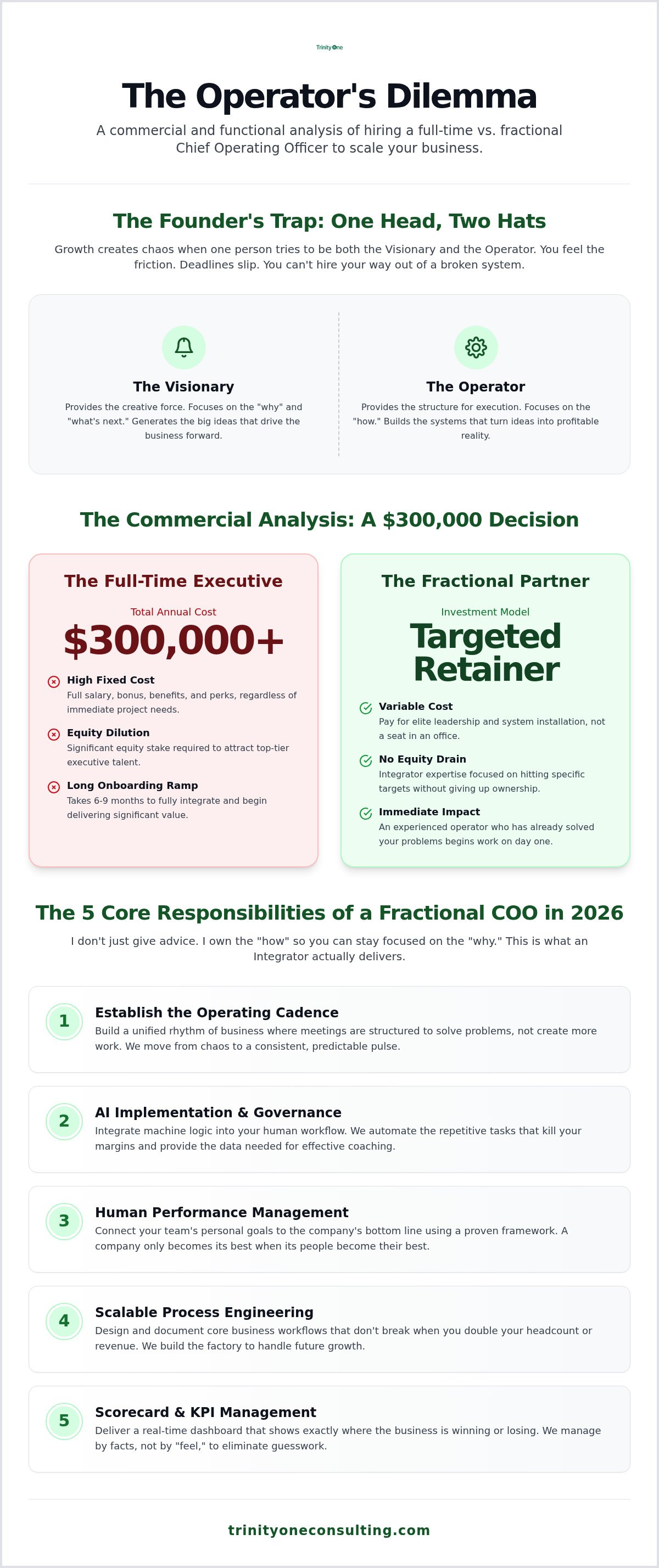
Every Visionary CEO needs an Integrator to maintain operational sanity. The Visionary provides the creative force. The Integrator provides the structure to keep that force from tearing the company apart. Without this balance, your company is just a collection of good intentions and missed deadlines.
I call this the Physics of Leadership. Creative energy creates friction. Without a system to absorb that friction, your team burns out. You can find more details on how this works in The Fractional Integrator: Engineering Your Business Engine for 2026. We align the human element with the technical workflow to ensure the engine doesn't overheat during a sprint. It's about moving from chaos to a consistent cadence.
The 5 Key Responsibilities of a Fractional COO in 2026
I don't show up to your office to give advice. I show up to take over the engine room. When you invest in fractional chief operating officer services, you're buying a specific set of outcomes that keep the business from stalling. My job is to own the "how" so you can stay focused on the "why." This involves five core pillars of execution.
- Establishing the Operating Cadence: I build a unified rhythm of business where meetings solve problems instead of creating them.
- AI Implementation and Governance: We integrate machine logic into your human workflow to handle the repetitive tasks that kill your margins.
- Human Performance Management: I link your team's personal goals to the company's bottom line using a proven framework.
- Process Engineering: We build workflows that don't break when you double your headcount.
- Scorecard and KPI Management: I provide the dashboard that shows exactly where the business is winning or losing in real time.
If you're tired of guessing which parts of your business are actually profitable, let's talk about building your scorecard. I've spent 30 years seeing what happens when leaders manage by "feel" instead of by facts. It's a recipe for burnout and wasted cash.
Establishing an AI-Native Operating Cadence
The old way of manual tracking is dead. In 2026, I use Trinity Cadence to provide a unified view of both machine and human output. This isn't about micro-managing. It's about having the stats to coach your team effectively. When I can see real-time data on project velocity and AI tool adoption, I can make executive decisions in minutes that used to take weeks of meetings.
Human Capital: Beyond Traditional HR
A company only becomes the best version of itself when its people are becoming better versions of themselves. That's why I implement the Dream Management Program. This methodology, created by Matthew Kelly, focuses on the twelve dream categories to drive retention and engagement. Your employees aren't just line items on a P&L. They are the fuel for your operational engine. When their personal dreams align with their work, you get a level of execution that money can't buy.
I've seen this work in locker rooms and boardrooms alike. As a former football coach, I know that if the player doesn't believe in the path, the play will fail. We use DreamCompass to keep this process structured and private. It's about building a high-performance culture that values the individual as much as the output.
Fractional COO Cost vs. ROI: A Commercial Analysis
Hiring a full-time COO in 2026 is a massive commitment. You're looking at a $215,000 base salary. By the time you add equity, benefits, and the search fee, you've spent $300,000 just to get a body in the chair. That's a lot of capital to tie up before you've even fixed a single broken process. Most small businesses don't need a $300,000 executive 40 hours a week. They need an expert 10 hours a week to run the engine.
Fractional chief operating officer services provide a different math. You pay a retainer that fits your current revenue and focuses on specific outcomes. If your current team of ten is only 60% effective because of bad workflows, you're lighting money on fire every payday. I help you stop the leak. We measure success by the reduction in operational drag and the recovery of your time as a founder.
The real danger is the Operational Ceiling. This is the point where your personal output can't keep up with the business's potential. If you're stuck at $2 million in revenue because you're busy managing the inbox, the cost of inaction is the $3 million you aren't making. You aren't just saving on a salary. You're buying the ability to scale past your own limitations.
The ROI of Operational Visibility
Visibility is the antidote to meeting fatigue. When we centralize your data through Trinity Cadence, we stop the endless status updates. You'll see exactly who is doing what and how the AI tools are performing. This reduces wasted labor by ensuring everyone is working on the right priority. AI-driven execution coaching helps your team hit their targets without you having to breathe down their necks. It's about moving from managing people to managing the system.
Investment Structures: Retainers and Sprints
I offer two ways to engage. Retainer-based leadership provides long-term stability and ongoing systems building. This is for the founder who wants a partner to run the day-to-day operations indefinitely. For those who need a faster fix, I use Launch Sprints. These are project-based engagements for rapid AI deployment or specific workflow setups. You can learn more about which path fits your needs in this 2026 Scaling Guide. Both models prioritize execution over theory.
How to Evaluate and Hire the Right Fractional COO
Don't hire a resume. Hire a solution to the friction you feel every morning. When you look for fractional chief operating officer services, you're looking for someone to break through your operational ceiling. This is the point where your personal output is the bottleneck for your company's growth. I've seen $5 million companies stay stuck for years because the founder is the only one who knows how to fix a customer complaint or approve a refund.
Step one is identifying that ceiling. You'll know you've hit it when you can't work more hours but the revenue won't budge. Step two is assessing tech-fluency. In 2026, an operator who doesn't understand how to deploy an AI agent to handle your Level 1 support is a dinosaur. You need someone who sees technology as a force multiplier for your human team.
Step three is cultural and visionary alignment. They need to speak the language of your "Why." If you're building a company to fund your local community and they only care about exit multiples, it'll fail. Step four is a methodology check. I use Trinity Cadence because a leader without a system is just a high-priced babysitter. Finally, step five is the 90-day roadmap. Execution starts on day one. I'll help you set your first three quarterly priorities to ensure we're moving the needle immediately.
Questions to Ask Potential Fractional Leaders
You need to know how they actually work. Ask them how they integrate machine operations with people management. If they can't explain how AI changes their daily workflow, they aren't ready for 2026. Ask about their specific methodology for establishing an operating cadence. You're looking for a rhythm, not just a list of meetings. Finally, ask how they measure employee engagement during a scaling phase. I use the Dream Manager methodology, created by Matthew Kelly, to ensure the team stays connected to the mission as we grow.
Vetting for AI Readiness
There's a big difference between being AI-curious and being AI-native. An AI-curious leader has a ChatGPT account. An AI-native leader has already mapped the ROI for every new technology deployment in your stack. Your COO must be your primary AI advocate. They should be looking for ways to replace manual data entry with automated logic so your people can focus on higher-value work. If they can't show you how AI reduces your cost per acquisition or increases your fulfillment speed, they're just chasing a trend.
Integrating the Trinity One Operating System
Leadership isn't about personality. It's about the engine you run. My fractional chief operating officer services aren't just a part-time hire. They are the installation of a proprietary machine called Trinity Cadence. We don't just talk about growth. We build the infrastructure that produces it.
Trinity Cadence is an AI-native operating system designed for the 2026 business environment. It provides real-time visibility into your team's execution and machine performance. Most founders operate in a fog of war where they only see problems after they become expensive. I clear that fog by connecting your technical workflows to a consistent rhythm of business. This platform supports my work even when I'm not in your office.
The human element is the second half of the equation. I use the Dream Management methodology created by Matthew Kelly. This process focuses on the twelve dream categories to ensure your people are winning personally while they win professionally. A company only becomes the best version of itself to the extent its people are becoming better versions of themselves. We use the DreamCompass app to keep this work private and focused. I believe every person has a purpose, and your business should serve that purpose.
The Trinity Cadence Framework
This framework is about visibility and coaching. We use AI to monitor stats and provide feedback to your team before projects stall. It removes the need for you to be the constant source of motivation or correction. You can see more about how this works through Fractional COO Services from Trinity One. The system acts as the guardrails for your growth while I act as the pilot.
Launching Your Operational Transformation
We start with a Rapid Launch Sprint. I don't believe in six-month discovery phases or endless consulting reports. We set the foundation in weeks. This sprint moves you from founder-led chaos to a growth model led by systems. It's a blunt transition. You'll have to stop doing everything yourself. You lose the total control of a micromanager but you gain the freedom of a true CEO. We build a high-performance engine that runs on logic and human purpose. It's time to stop fighting your business and start leading it.
Ready to see if your business is prepared for an AI-native operating system? Book a discovery call to evaluate your operational readiness.
Build the Engine Your Vision Deserves
I've spent 30 years in the trenches. I know that growth is painful when your systems aren't ready. Scaling isn't about working more hours. It's about installing the right engine and the right leader to run it. Fractional chief operating officer services give you a battle-tested operator who understands both AI-native workflows and human purpose.
We use the AI-native Trinity Cadence platform to give you total visibility into your team's output. My team includes certified Dream Management facilitators who use Matthew Kelly's methodology to ensure your people are growing alongside the company. This isn't about abstract concepts. It's about building a culture that wins because every individual is invested in the outcome.
You don't have to stay stuck at your current revenue ceiling. I've coached teams from the locker room to the boardroom. The logic is the same. Align the talent, install the system, and execute with discipline. I bring three decades of executive operational experience to help you bridge the gap between where you are and where you want to be.
Your vision deserves a business engine that can actually keep up. Let's get to work.
Common Questions About Fractional Operations
How many hours a week does a fractional COO typically work?
A fractional COO typically works between 10 and 15 hours per week. This depends on the complexity of your team and the speed of your scaling goals. Some weeks require more focus during a Launch Sprint, while others settle into a steady rhythm of management. You aren't paying for a person to sit at a desk for 40 hours. You're paying for the results they produce in a fraction of that time.
Is a fractional COO the same as a business consultant?
No. A consultant tells you what is wrong and hands you a report. I take the wheel and drive the business. Fractional chief operating officer services are about ownership and execution, not just advice. I own the outcomes of your operations and manage the people who do the work. If the system breaks, it's my job to fix it, not just point at it.
What size company benefits most from fractional chief operating officer services?
Companies with 10 to 50 employees or revenue between $2 million and $20 million see the most impact. This is the stage where founder-led chaos starts to break the business. You need a system-led approach to get past this ceiling. I help you transition from a business that relies on your personal heroics to one that runs on a repeatable engine.
Can a fractional COO manage my existing leadership team?
Yes. I function as the Integrator to lead your department heads. My job is to ensure they hit their quarterly priorities and stay aligned with your vision. I also use the Dream Manager methodology, created by Matthew Kelly, to keep your team engaged and focused on their personal growth. This ensures your people are becoming better versions of themselves as the company grows.
How long does a typical fractional COO engagement last?
Most partnerships last between 12 and 18 months. Some founders keep me on a long-term retainer to maintain the operating cadence as they scale. Others use me to build the system and then help hire their full-time replacement once the revenue supports a $300,000 salary. We define the exit strategy based on your specific 2026 growth targets.
What is the difference between an Integrator and a COO?
An Integrator is the operating role that focuses on harmonizing the major functions of the business. While a COO is a title, the Integrator is the person who balances the Visionary CEO. It is about the specific relationship between the idea-generator and the executor. I act as the glue that holds the various departments together while you focus on the big picture.
How does AI change the role of a COO in 2026?
AI moves the role from manual tracking to real-time coaching. I use Trinity Cadence to see execution gaps as they happen. We don't wait for a weekly meeting to find out a project is behind. The system flags the friction immediately. This allows me to spend less time on data entry and more time on high-level strategy and human development.
What results should I expect in the first 90 days of hiring a fractional COO?
You should have a clear accountability structure and a functioning weekly scorecard. We will establish a consistent meeting rhythm and set your first quarterly priorities. Most importantly, you will feel the weight of daily operational decisions start to shift away from your desk. You'll gain the visibility needed to see exactly where your cash and labor are going.