
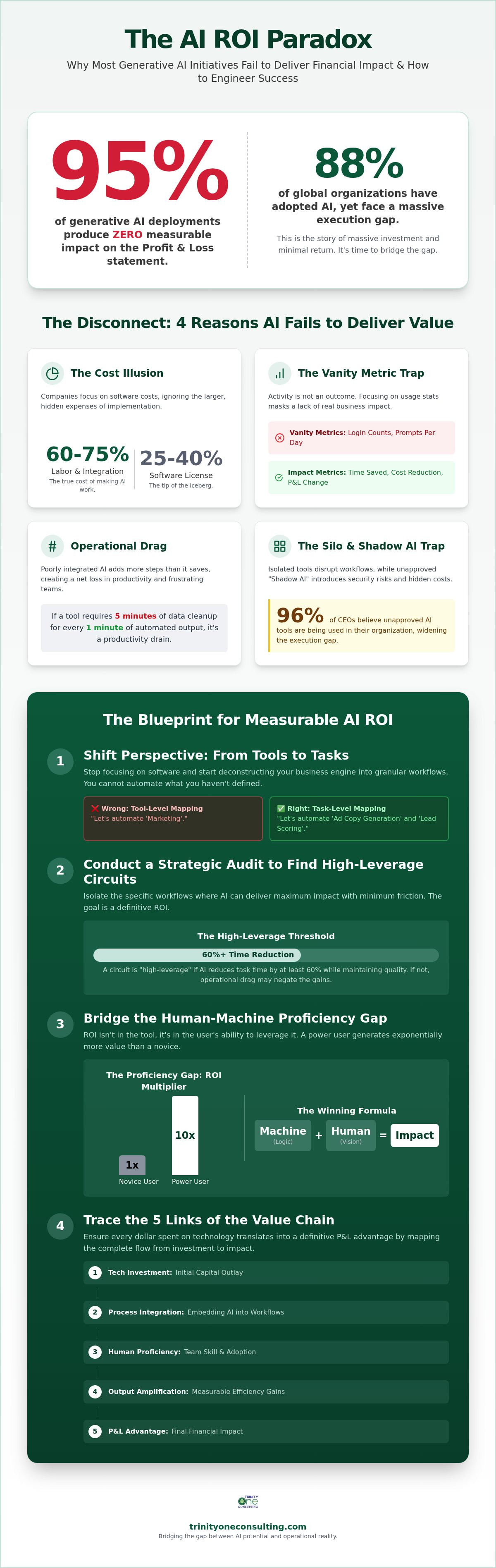
Ninety-five percent of generative AI deployments have produced zero measurable impact on the profit and loss statement. It's a staggering failure rate that transforms strategic innovation into an expensive science project. You've likely felt this friction firsthand. The CFO demands proof of value while your team battles AI fatigue and the operational drag of poorly integrated tools. You don't need more software. You need an engine that actually runs.
Effective AI ROI mapping for companies requires moving past vanity metrics to architect a precise roadmap for financial impact. This article provides the blueprint to bridge the gap between technical potential and operational reality. We'll show you how to identify high-leverage AI circuits that align machine efficiency with human performance. We'll examine the specific metrics that convince skeptical executives and the strategic frameworks that turn ambiguous pilots into a unified, high-output system. It's time to stop experimenting and start executing.
Key Takeaways
- Identify the critical gap between software adoption and financial impact. Shift your focus from vanity metrics to measurable outcomes within your business engine.
- Master the precision of AI ROI mapping for companies. Isolate high-leverage circuits where machine speed directly fuels human performance.
- Trace the five links of the value chain. Ensure every dollar spent on technology translates into a definitive P&L advantage.
- Conduct a strategic audit of your operational engine. Identify high-volume, low-complexity tasks primed for immediate AI substitution.
- Bridge the execution gap. Integrate your AI roadmap into a rigorous operational cadence overseen by a fractional integrator.
The AI ROI Paradox: Why Most Implementations Stall
The numbers tell a story of massive investment and minimal impact. In 2026, AI adoption has reached 88% across global organizations. Yet, a staggering 95% of generative AI deployments have failed to produce a measurable impact on the profit and loss statement. This is the AI ROI Paradox. Companies are pouring capital into the engine but forgetting to install the transmission. They have technical power without operational movement.
Activity is not an outcome. High login counts and "prompts per day" are vanity metrics. They mask the underlying reality of an engine that's idling. True success requires a rigorous approach to Return on Investment (ROI) that accounts for the total cost of ownership. This includes the 60% to 75% of budgets typically consumed by labor and integration rather than the software itself. Without AI ROI mapping for companies, leaders are essentially flying blind through a storm of hype.
The "Silo Trap" further complicates the landscape. Deploying a tool in isolation creates friction. It disrupts established workflows. It forces employees to toggle between disparate systems. 2026 is the year of "Show Me the Money" for AI budgets. The era of experimental play is over. Boards now demand a clear line of sight from the initial spend to the final margin.
The Friction Points of Unmapped AI
Operational drag occurs when AI adds more steps than it saves. If a tool requires five minutes of data cleanup for every one minute of automated output, it's a net loss. This friction is often compounded by Shadow AI. With 96% of CEOs believing unapproved tools are being used in their organizations, the security risks and hidden costs are mounting. There is a widening execution gap between high-level AI strategy and the reality of daily huddles. Mapping the circuitry is the only way to close it.
The Need for an Operational Architect
A CIO can install the software, but they cannot map the ROI alone. That requires an Integrator. This role acts as a strategic architect, aligning machine logic with the company's existing operating cadence. It's about moving from "experimental" tools to "native" operations. Every AI circuit must be integrated into the human workflow. This ensures that technical efficiency fuels human purpose rather than replacing it. Execution is the priority. Theory is the enemy.
Mapping the Circuitry: Identifying High-Leverage AI Workflows
View your business as an engine. It is a collection of integrated circuits. Each circuit represents a specific workflow. If the circuit is broken, the engine loses power. Most leaders focus on tool-level mapping. They buy a subscription and expect a miracle. This approach ignores the plumbing. Real AI ROI mapping for companies starts at the task-level. You must identify where the machine adds speed and where the human provides the strategic spark. The machine handles the logic; the human provides the vision.
Precision is the antidote to ambiguity. You cannot automate what you haven't defined. The goal is to isolate circuits where technical efficiency meets strategic value. If you map a low-value task, you simply do the wrong things faster. The ROI is found in the handoff. You must map the interface between human intuition and machine processing. This is where the engine either accelerates or stalls.
The Task-Level Audit
Deconstruct your workflows. Break them into granular, repeatable tasks. Don't look at "Marketing" as a whole. Look at "Ad Copy Generation" or "Lead Scoring." Calculate the time-to-value for each specific augmentation. A high-leverage circuit is a process where AI reduces time by at least 60% while maintaining quality. If it doesn't hit this threshold, the operational drag of managing the tool might outweigh the gains. Research into firm-level productivity, such as the NBER Working Paper on AI adoption, suggests that the impact on efficiency varies wildly based on how deeply these tools are integrated into core tasks. Integration is everything.
Human-Machine Alignment
The ROI is in the proficiency. This is where the Proficiency Gap appears. A power user generates 10x the ROI of a novice using the same tool. Why? They understand the machine logic. They know how to feed the output back into the operational cadence. This isn't just about software; it's about personal growth. If your team lacks the proficiency to use the circuit, the engine stalls. This is where professional AI implementation becomes the bridge between potential and performance. AI coaching closes the adoption circuit. It turns technical capability into a native operating habit. Alignment is the fuel for execution.
Beyond Productivity: Measuring the Five Links of the Value Chain
Measurement is a sequence. It is a linear circuit that requires every link to remain intact. Most organizations focus on the input (Spend) and the final result (Outcome). They ignore the connective tissue in between. This gap is where value leaks out of the system. To achieve measurable AI ROI mapping for companies, you must track the entire chain: Spend, Adoption, Proficiency, Productivity, and Outcome.
Organizations often skip the middle three links. They buy licenses (Spend) and wait for the revenue to climb (Outcome). When it doesn't, they blame the technology. The failure usually lies in the Proficiency link. Software provides the potential. Proficiency provides the performance. You can buy the most advanced engine in the world; if the driver cannot shift gears, the car stays in the garage. Research from McKinsey indicates that only 6% of companies attribute 5% or more of their EBIT to AI. These leaders don't just buy tools. They architect the human-machine interface.
Proficiency is your biggest ROI lever. It is the difference between a novice using a chatbot and an expert architecting an agentic workflow. High-performing teams focus on coaching over software accumulation. They treat AI as a native operating habit rather than an external add-on.
Quantitative vs. Qualitative Signals
Telemetry tracks the machine. You must monitor token spend and adoption depth to ensure the "engine" is actually firing. If adoption is low, your circuit is broken. However, quantitative data only tells half the story. Qualitative signals like employee engagement are leading indicators of long-term ROI. When employees feel empowered rather than replaced, adoption scales. Utilizing tools like Dream Management facilitation helps align personal vision with corporate efficiency. An improving Employee Net Promoter Score (eNPS) often precedes a spike in AI-driven productivity. Happy humans build better machine circuits.
What the CFO Needs to See
The CFO demands hard numbers. You must present actual labor cost reduction and revenue acceleration. For marketing teams that rigorously track ROI, 60% report a return of at least 2x on their AI investment according to Jasper. But don't ignore the soft ROI. Retention and reduced burnout are massive financial wins. The cost of replacing a high-level executive far exceeds the cost of an AI implementation. Finally, highlight the Opportunity Cost. In a landscape where 88% of organizations are already using AI, the cost of not mapping your workflows is the cost of falling behind a more efficient competitor. Stagnation is a line item you cannot afford.
The Strategic Audit: A Step-by-Step AI ROI Mapping Framework
Mapping is not a theory. It is an engineering requirement. To move from ambiguous pilots to measurable impact, you need a repeatable framework. This is the strategic audit. It aligns your technical investments with your human output. It turns a collection of tools into a unified engine. Execution is the only metric that matters. Follow these five steps to architect your impact.
- Step 1: Identify your core operational engine. Look at your existing management cycles. Focus on your regular operational meetings where key decisions are made and work is executed. This is where the work happens. This is where the friction lives.
- Step 2: Audit high-volume, low-complexity tasks. These are candidates for substitution. Replace the human effort with machine logic. If a task is repeatable and rules-based, the machine should own it.
- Step 3: Audit low-volume, high-complexity tasks. These are candidates for augmentation. Provide the human with a technical exoskeleton. AI shouldn't replace the expert; it should accelerate their decision-making.
- Step 4: Design the New Cadence. AI alters your weekly huddles. The conversation moves from "What did you do?" to "What did the machine produce, and how did you refine it?"
- Step 5: Establish telemetry. You need a baseline. Track the data before and after the implementation. Without a starting point, your ROI is just a guess.
Prioritizing Your AI Sprints
Precision requires focus. Use the ROI Matrix to plot Impact against Ease of Implementation. Long-term pilot programs are where budgets go to die. An estimated 80% to 95% of AI projects fail to deliver their promised return. Speed is your defense. Launch Sprints allow you to map and deploy a circuit in weeks, not quarters. Select your first three circuits based on immediate financial lift. Build momentum through small, decisive wins. To begin this process for your organization, you can schedule an AI implementation audit to identify your highest-leverage opportunities.
Building the ROI Dashboard
You cannot manage what you do not see. Integrate your AI metrics directly into your strategy execution software. This provides real-time visibility into both machine operations and human performance. A functional dashboard for AI ROI mapping for companies must track token efficiency alongside labor savings. It creates a feedback loop for continuous refinement. If a circuit underperforms, you see it immediately. You adjust the logic. You re-align the human. The engine stays in tune.
Executing the Map: Integrating AI into Your Operational Cadence
Mapping is theory. Execution is the engine. A blueprint without a builder is just paper. To realize the full potential of AI ROI mapping for companies, you must integrate the findings into your daily operational cadence. This is the difference between a one-time pilot and a permanent competitive advantage. You aren't just installing software. You are rewiring the way your organization breathes.
A Fractional Integrator serves as the architect of this transition. They ensure the AI map is followed with clinical precision. They bridge the execution gap between high-level strategy and tactical output. By installing the Trinity Cadence, they provide an AI-native operating system that synchronizes machine logic with human performance. This isn't a technical layer. It is a fundamental shift in how you manage time, talent, and technology. The engine requires a unified OS to function at peak efficiency.
Human engagement is the fuel for this engine. If your team feels threatened by the machine, the circuit will break. This is why Dream Management facilitation is critical. It aligns the efficiency gains of AI with the personal aspirations of your employees. When the machine handles the mundane, the human is free to pursue their vision. ROI increases when the team sees AI as a partner in their personal growth rather than a replacement for their labor. Loyalty is the ultimate lubricant for a high-performance system.
Unified Machine and People Operations
Bridging the execution gap requires more than a dashboard. It requires AI-driven coaching. 1-on-1 coaching sessions focus on maximizing individual proficiency within the new circuits. You must ensure every AI workflow supports both professional output and personal development. If the machine creates more work for the human, the system has failed. Proficiency is a personal journey. Mastery is the destination. When every team member understands their role in the human-machine interface, the engine runs silently and powerfully.
From Mapping to Mastery
The final shift is cultural. You must move from "using AI" to being an AI-native organization. This requires viewing continuous ROI mapping as a core business competency. The landscape changes weekly. Your circuits must evolve with it. Stagnation is a mechanical failure. Mastery is the result of a relentless pursuit of alignment. It is time to stop dreaming about efficiency and start architecting it. Schedule a Launch Sprint to map your AI ROI and begin your transition to a high-output, AI-native future. Execution is the only path forward.
Architecting the High-Output Engine
The era of AI experimentation is over. The era of execution has arrived. Effective AI ROI mapping for companies transforms technical potential into a measurable P&L advantage. You've learned to audit your circuits and track the five links of the value chain. Now, you must bridge the execution gap. Precision is the antidote to ambiguity. You don't need more tools; you need a transmission for the power you already have. Alignment is the fuel for sustainable growth.
Trinity One provides the battle-tested expertise to lead this transition. Our Fractional Integrator expertise ensures your team doesn't just adopt tools, but masters them. Through the AI-native Trinity Cadence operating system and our proprietary Rapid Launch Sprints, we help you achieve immediate traction. We align machine logic with human purpose to create a unified, high-performance system. This is about more than software. It is about personal growth and operational mastery. Your engine is ready for the next level.
Architect your future with a custom AI ROI map from Trinity One. It's time to engage the gears and drive your organization forward.
Frequently Asked Questions
What is the biggest mistake companies make in AI ROI mapping?
The biggest failure is prioritizing vanity metrics over operational outcomes. Leaders often track login frequency or prompt volume instead of P&L impact. This creates an engine that makes noise but lacks movement. Successful AI ROI mapping for companies starts with the financial result and works backward to the specific technical circuit. If you don't define the outcome first, you're just automating friction.
How long does it take to see measurable ROI after mapping workflows?
You should see measurable traction within 30 to 90 days. Short-term wins are critical for maintaining executive buy-in and team momentum. Rapid Launch Sprints are designed to map and deploy high-leverage circuits quickly. This prevents the operational drag of long-term pilots that fail to reach the execution phase. Speed is a requirement for a functional engine.
Can we map AI ROI if our current data is unorganized?
You can and should start mapping immediately. Unorganized data is a friction point, but it shouldn't stall the architecting process. Mapping defines which specific data sets are essential for the engine. This allows you to focus cleanup efforts on the circuits that produce the highest strategic value. Don't clean data you don't intend to use.
What is the difference between AI productivity and AI ROI?
Productivity is a technical metric; ROI is a financial reality. Productivity measures the speed of the circuit. ROI measures the profit generated by that speed. If increased productivity doesn't lead to revenue growth or labor cost reduction, the circuit is broken. Mapping ensures that machine efficiency translates directly into margin.
How does a Fractional Integrator help with AI implementation?
A Fractional Integrator serves as the builder for your AI roadmap. They integrate machine logic into your daily human cadence. They ensure the Trinity Cadence operating system is followed with precision. This bridges the execution gap between software potential and organizational performance. They keep the engine in tune while you focus on vision.
Should we measure AI ROI at the tool level or the task level?
Measure at the task level. Tool-level tracking is a deceptive vanity exercise. Task-level mapping identifies the specific handoffs between human intuition and machine logic. This precision allows you to isolate and optimize the circuits that provide a 60% reduction in time. You manage the task to master the tool.
What role does employee engagement play in AI ROI calculations?
Engagement is the lubricant for the entire system. Without it, the engine seizes. Frameworks like Dream Management align personal vision with technical efficiency. When employees see AI as a tool for their own growth rather than a threat to their role, adoption rates and proficiency levels skyrocket. Human buy-in is the fuel for machine ROI.
How much should we budget for AI ROI mapping vs. software licenses?
Allocate significantly more for implementation than for subscriptions. Labor and integration costs often represent 60% to 75% of the total project budget. Licenses are just the parts; AI ROI mapping for companies is the assembly. An unmapped license is a net loss. Invest in the architecting of the system to ensure the parts actually work.