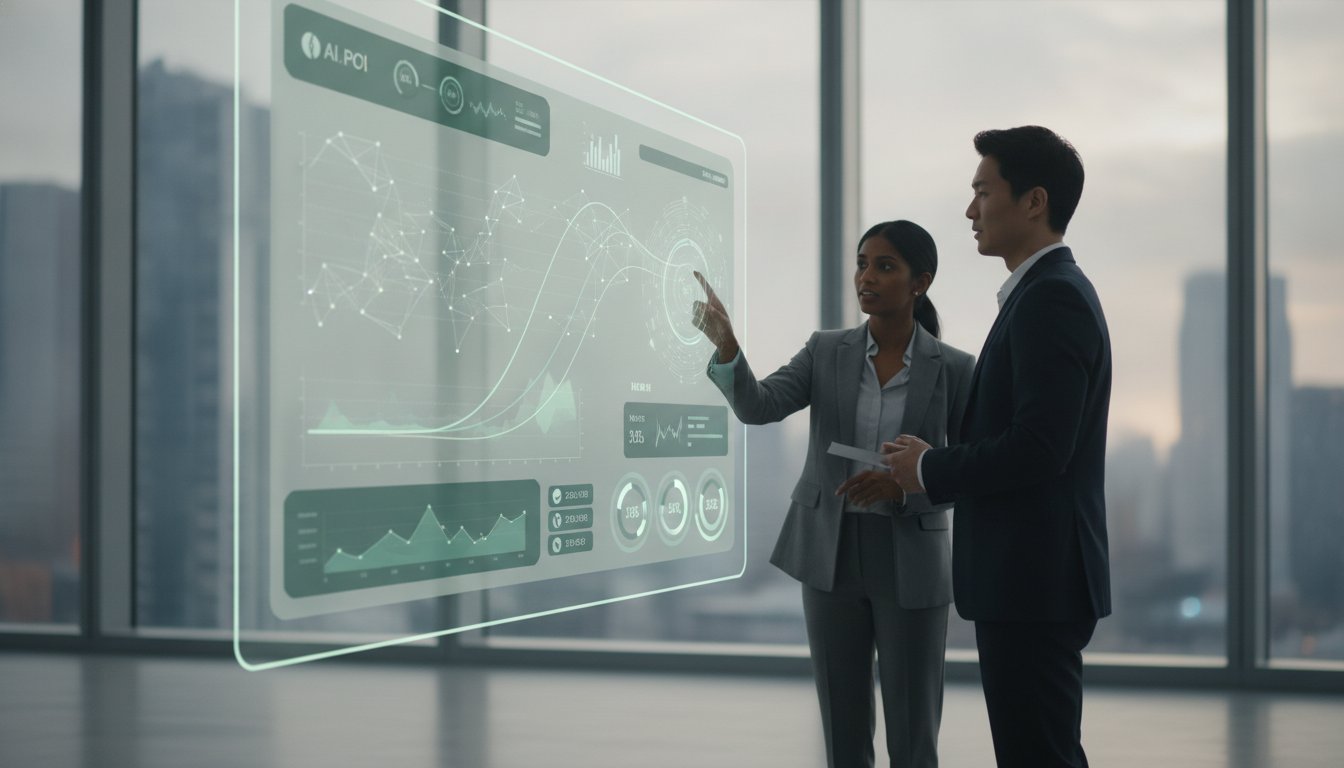
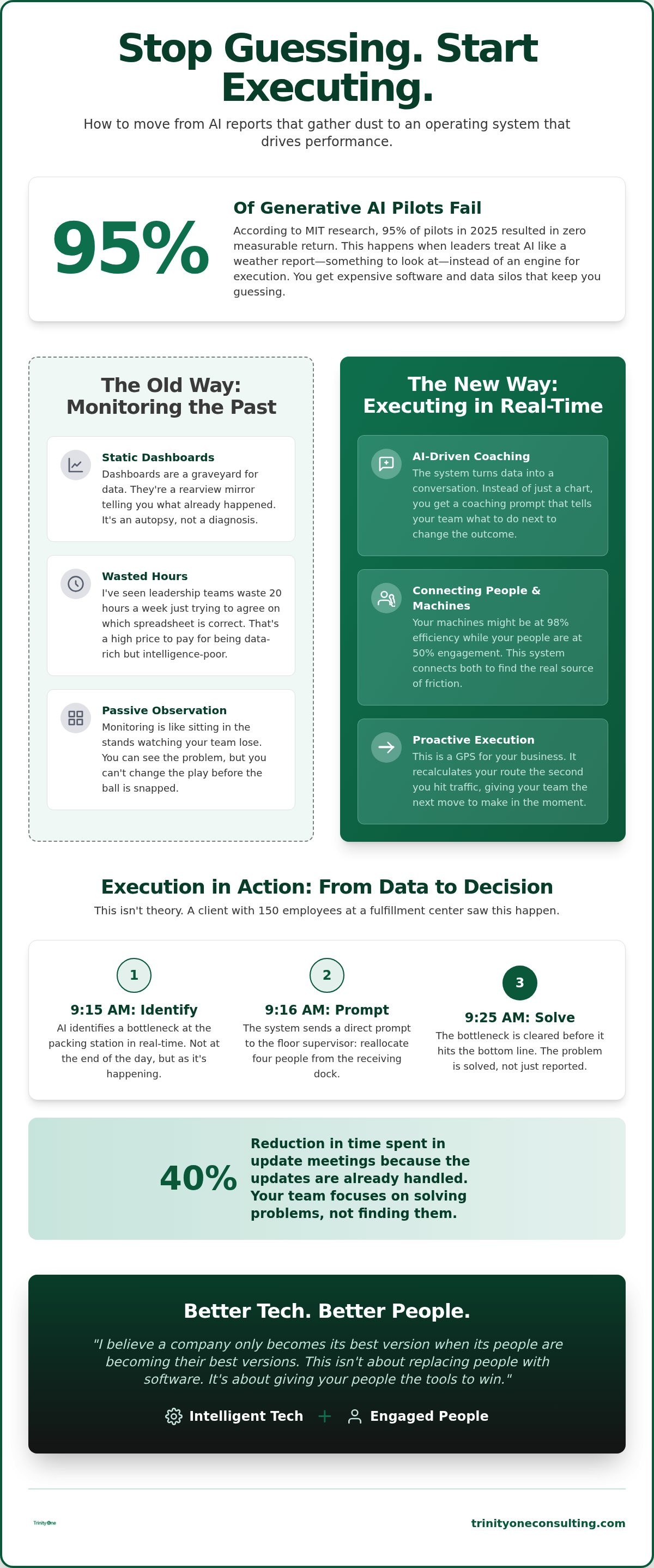
I've seen the data showing 95% of generative AI pilots resulted in zero measurable return in 2025 according to MIT research. This happens because leaders treat AI for operational intelligence like a weather report instead of an engine for execution. You end up with expensive software and data silos. They keep you guessing.
I know it's frustrating when a broken cadence makes meetings feel like a waste of time. You're looking at machine output that ignores how your people are performing. You need the truth without digging through ten dashboards. It's exhausting.
I'll show you how to integrate AI into your operating system to drive human performance and execution. You'll learn to build a path to becoming an AI-native organization. I believe a company only becomes its best version when its people are becoming their best versions. Better tech. Better people.
We'll look at the steps to align your tech with your talent to increase retention and ROI. I'll explain how to get a clear view of your operation without the usual consultant talk. Let's get to work.
Key Takeaways
- Integrate real-time data into your daily leadership decisions to move from monitoring the past to directing the future.
- Most leaders fail with AI for operational intelligence because they forget that people must actually use the tools to generate ROI.
- I'll show you how to move beyond static spreadsheets by receiving AI-driven coaching prompts that focus on your most important KPIs.
- Establish a daily rhythm where AI identifies headline issues so your meetings focus on solving problems instead of finding them.
- Using Trinity Cadence allows you to align your technology with Matthew Kelly's Dream Manager methodology to drive employee retention.
What is the real cost of ignoring AI for operational intelligence?
AI for operational intelligence is the integration of real-time data into your daily leadership decisions to drive execution. If you ignore this in 2026, you're essentially trying to run a modern factory with a stopwatch and a clipboard. You lose hours to manual reporting and days to delayed decisions that cost you money.
Traditional monitoring only tells you what happened in the past. It's an autopsy. AI tells you what to do next to change the outcome. I've seen leadership teams waste 20 hours a week just trying to agree on which spreadsheet is correct. That's a high price to pay for being data-driven without being intelligent.
Defining intelligence in a machine-first world
True intelligence requires a feedback loop between data and action. It's not a static dashboard that people look at once a week. Static business intelligence is a rearview mirror. Dynamic operational intelligence is the GPS that recalculates your route the second you hit traffic.
I want you to think of your business as an engine. In a machine-first world, that engine needs to self-correct. If a production line slows down, the system shouldn't just record the failure. It should prompt the floor manager with a specific solution. This creates a business that learns and adapts without you having to micromanage every moving part.
The difference between monitoring and execution
Monitoring is passive observation. It's like sitting in the stands and watching your team lose. Execution is the active alignment of your team around a specific goal. You can have all the data in the world, but if your people don't know how to act on it, you're just watching a train wreck in slow motion.
Think about a football coach on the sidelines. He doesn't wait for the Monday morning film to see that the defense is stacking the box. He uses real-time data from his spotters to change the play before the ball is snapped. AI gives you that headset for your business. It identifies the headline issues so your team can pivot in the moment.
When you align your machine data with human performance, you stop guessing. You start executing. If you have the data but lack the integrator to act on it, a fractional COO can bridge that gap. This isn't about replacing your people with software. It's about giving your people the tools to become the best versions of themselves through clear, actionable feedback.
How does an AI-native operating system change your daily execution?
Most leaders spend their mornings hunting for facts. They open three spreadsheets and a CRM just to figure out what happened yesterday. By the time they find the problem, it's already lunch. AI for operational intelligence changes the starting line. Instead of hunting for data, you're responding to it.
I want you to imagine a world where you don't look at charts to find the truth. The truth finds you. An AI-native operating system acts like a digital integrator. It sifts through the noise of your machine data and highlights the three things that actually matter for today's execution. You stop being a detective and start being a leader.
Moving from static dashboards to real-time coaching
Dashboards are a graveyard for data. They're where numbers go to die. Most people look at them, nod, and then go back to doing exactly what they were doing before. AI coaching prompts turn that data into a conversation between the integrator and the team. It's a shift from passive observation to active direction.
I saw this happen with a client running a fulfillment center with 150 employees. The manager didn't notice a bottleneck at the packing station until the afternoon shift change. The AI identified the lag at 9:15 AM. It sent a prompt to the floor supervisor to reallocate four people from the receiving dock. The bottleneck was cleared before it hit the bottom line. This shift reduces the time spent in update meetings by at least 40 percent because the updates are already handled.
Connecting machine data to people management
Your machines might be at 98 percent efficiency while your people are at 50 percent engagement. That's a ticking time bomb. An AI-native operating system like Trinity Cadence creates a unified view of your machine operations and your people. It finds the correlation between technical friction and human burnout. This is the core of real execution.
Maybe that high-efficiency machine is actually driving your best operator to quit. The noise levels or the physical strain might be too high. AI sees the pattern of increased sick days or turnover in that specific department. It alerts the leadership team before the talent walks out the door. You can book a cadence call to discuss how to spot these patterns in your own shop.
You need someone to manage these signals and turn them into a rhythm. A fractional COO manages this system so you don't have to. They act as the integrator who turns these AI prompts into human action. This ensures your technology and your people are moving in the same direction at the same speed.
Why do most AI implementations fail to drive actual ROI?
AI for operational intelligence often fails because leaders treat it like an IT project instead of a leadership project. I'll be blunt. If your people don't use the tools, your investment is dead on arrival. Most implementations die because they ignore the human element.
Data without a cadence is just noise that creates more work for your staff. I've watched teams get buried under new dashboards while their actual execution stalls. You can find a deeper breakdown on how to measure the actual ROI of AI implementation in your business to see where the money usually leaks out.
The high price of ignoring employee buy-in
If your team fears AI will replace them, they will sabotage the data. They won't do it maliciously. They'll just stop caring about the inputs or find ways to bypass the system. I've seen this happen in shops with 50 people and corporations with 5,000.
I use the Dream Manager methodology by Matthew Kelly to prevent this friction. We build a culture where AI helps employees achieve their personal goals. We use the 12 dream categories from Matthew Kelly as a framework for engagement. When your team sees that better data leads to a better life, they'll protect the system.
Why data without a cadence is just noise
You can have all the operational intelligence in the world, but it dies without a meeting rhythm. Most leaders think more data means they can meet less. It's actually the opposite. More data requires a tighter operating cadence, not a looser one.
The tradeoff is simple. You spend more time on the right things and zero time on the wrong ones. Trinity Cadence automates the huddle so you don't waste time on updates. We focus on solving the headline issues that the AI identified five minutes ago. A company only becomes the best version of itself to the extent its people are becoming better versions of themselves.
What does a unified operating cadence look like with AI?
I've sat through enough 90-minute status meetings to know they're where productivity goes to die. AI for operational intelligence replaces that waste with a high-speed feedback loop. You aren't just looking at data. You're living in a system that directs your attention where it's needed most.
Establishing this unified cadence follows a specific sequence. If you miss a step, the engine stalls. I've broken it down into five direct actions:
- Step 1: Align your machine data with your core KPIs in a single platform. If you have to check three different apps to see if you're winning, you've already lost.
- Step 2: Establish a daily and weekly rhythm where AI identifies the headline issues. These are the red items that need immediate action.
- Step 3: Use AI coaching to prep your team before they walk into the huddle. They should know their numbers and their fixes before the clock starts.
- Step 4: Track both execution scores and engagement scores in real time. Machine efficiency is useless if your people are ready to quit.
- Step 5: Adjust the play based on the AI-native operating system's suggestions. This turns your business into a self-correcting engine.
Establishing your rhythm of business
A rhythm is not just a calendar invite. It is a predictable cycle of execution and feedback that your team can trust. If the meeting time changes every week, the culture breaks. Predictability creates the space for high performance.
You need a system that functions without you. This is why a fractional COO is often the missing piece. They build the engine so you can drive it. This ensures the tech and the talent stay in sync every single day.
Automating the huddle
AI should summarize the red items so you skip the status updates entirely. Most meetings are just people reading spreadsheets to each other. That's a waste of payroll. If I'm paying an executive salary, I don't want them reading a report. I want them solving a problem.
I've watched meetings drop from 90 minutes to 15 minutes because of this automation. The team walks in, looks at the AI-generated headline, and starts solving. We don't ask what happened. We ask how do we fix this. This shift alone can save a mid-market company hundreds of thousands of dollars in lost management time.
How can Trinity Cadence bridge the gap between data and human performance?
Trinity Cadence is the only AI-native operating system that includes Dream Management to support AI for operational intelligence. I've spent 30 years in the trenches of leadership. I know that data is just noise without human will. You can't separate the machine from the person running it.
We use DreamCompass software to track personal and professional alignment. It gives you a unified view of machine output and people performance in one place. You stop guessing why a certain shift is lagging. The data tells you if it's a mechanical friction or a human burnout issue.
A company only becomes the best version of itself to the extent its people are becoming better versions of themselves. I believe that's a universal truth. You can see the human side of this engine in the Dream Manager program.
Integrating the Dream Manager methodology
Tracking employee dreams leads to better operational execution. This methodology isn't soft. It is a calculated approach to human performance. When an employee sees their personal goals listed in the system, their perspective shifts.
They aren't working for you anymore. They are working for their own future. I had a production manager who wanted to pay off $10,000 in debt. We used the 12 dream categories from Matthew Kelly to build a plan.
His productivity soared because he wasn't stressed about money anymore. He stayed with the company for five years instead of jumping for a small raise elsewhere. That is the ROI of human alignment.
Taking the next step with a Fractional Integrator
Technology is only half the battle. You can buy the best AI for operational intelligence and still fail if nobody is steering the ship. A Fractional Integrator from Trinity One runs the system so you can stay in your Visionary role.
They act as the bridge between your machine data and your people. They ensure the AI prompts turn into human action. This is how you scale without the operational chaos. Chaos happens when the Visionary is stuck in the weeds of software logic.
An integrator keeps the engine tuned so you can focus on the horizon. I believe God put us here to do great work together through service and discipline. It's a binary choice. Either you run the system, or the system runs you.
Build an engine that runs without you
AI for operational intelligence is far more than a technical upgrade. It's a direct shift in how you lead your team and manage your machines. You need an engine that self-corrects.
Most organizations fail because they forget the human element. By connecting machine performance to Matthew Kelly's Dream Manager methodology, you build a culture that protects the data. People only give their best when they know the company cares about their best versions.
I want you to stop being a detective in your own business. Use an AI-native operating system to automate the noise and focus on real execution. This is how you grow without losing your mind or your talent.
I believe we are called to do great work that serves others. It's a binary choice. You can keep guessing or you can start leading.
Frequently Asked Questions
What is the difference between AI for operational intelligence and standard business intelligence?
Standard business intelligence tells you that you crashed the car last week. AI for operational intelligence tells you to turn the wheel right now to avoid the ditch. I see too many leaders acting like historians instead of operators. They wait for a monthly report that's essentially an autopsy. You need a system that functions like a live GPS for your execution. It identifies headline issues in the moment so you can change the play.
How much does it cost to implement an AI-native operating system?
Implementation costs vary based on your scale. A pilot program typically runs between $15,000 and $250,000 according to 2026 research. Small businesses often spend between $18,000 and $50,000 annually on these systems. You must account for ongoing maintenance. Annual run costs add 15 to 25 percent of the initial build cost. Total cost of ownership over three years is often triple the initial quote. I'll always be honest about the price of execution.
Do I need to hire a full-time CTO to manage AI for operational intelligence?
You don't need a full-time CTO to manage this system. A fractional integrator can run the technical side while keeping your people aligned. I've found that most small to mid-market companies aren't ready for a six-figure technical executive. They need an operator who understands how to connect machine data to human performance. We build the engine and then show your team how to drive it. It's about execution, not just software logic.
Can AI for operational intelligence help with employee retention?
AI for operational intelligence identifies the friction points that lead to burnout before your talent walks out the door. It tracks the correlation between technical lag and employee frustration. We use these signals to trigger Dream Management conversations. When you help people achieve their personal goals using the twelve dream categories by Matthew Kelly, they stay. Retention is a byproduct of showing your team that you value their growth as much as their output.
What happens if my current team is resistant to using AI tools?
Resistance is almost always rooted in fear. If your team thinks AI is there to replace them, they'll sabotage the data every time. I address this by making the technology a tool for their personal success. We use DreamCompass to show them how better efficiency leads to more time for their own dreams. When the machine helps them win, they stop fighting the machine. It's about loyalty and human purpose.
How does Trinity Cadence integrate with my existing EOS or scaling up framework?
Trinity Cadence acts as the digital engine for your existing framework. It doesn't replace the principles of EOS or Scaling Up. It just automates the data collection and the huddle rhythm. I've seen too many companies get stuck in manual reporting that slows down their weekly meetings. We replace that lag with real-time visibility. Your meetings become shorter and more aggressive because the AI has already identified the headline issues for you to solve.
Is AI for operational intelligence only for large manufacturing companies?
This technology is not reserved for the giants. In 2026, 88 percent of organizations use AI in at least one function. I've implemented these systems in service companies with 30 employees and manufacturing shops with 300. The cost of entry has dropped significantly. SMBs now spend an average of $18,000 to $50,000 a year to stay competitive. If you have a process and a team, you can benefit from a unified view of your operations.
What is the first step to becoming an AI-native organization in 2026?
The first step is fixing your data quality. Gartner predicts that 60 percent of AI projects will be abandoned through 2026 because of poor data. You can't build an intelligent engine on a broken foundation. Beyond data quality, infrastructure security is essential; CyberOne provides the managed detection and response needed to keep your AI-native systems resilient. I start by auditing your current reporting to see where the silos are. We identify the core KPIs that actually drive your profit. Once the data is clean, we can build the cadence that turns that data into real-world execution.