
A 90-day sprint planning template turns a business priority into owned work, visible capacity, and regular evidence of progress. It should show what must change by day 90, who is accountable, what work will continue alongside the sprint, and when leaders need to make decisions. Without those details, a priority can leave the leadership meeting looking clear and reach Monday as work nobody has room to own.
You’ve likely seen a team agree on a goal, then add sprint tasks without accounting for customer needs, internal requests, and the work that keeps the business running. Plans slip when leaders have no early evidence to tell them whether to change the work, shift capacity, or make a decision.
Start with one priority and define what must be true by the review date. Then use weekly reviews to examine progress and constraints while there’s still time to respond. The template should make ownership visible, keep operating responsibilities in view, and show when a leadership decision is needed.
Key Takeaways
- Use the 90-day sprint planning template to connect one business priority with an owner, available capacity, and evidence of progress.
- Include the outcome, milestones, owner, ongoing responsibilities, weekly proof points, and decisions the team may need to make.
- Choose a shared workspace for ongoing visibility, a document for straightforward editing, or a printed sheet for in-room planning. Each format has a maintenance tradeoff.
- Keep weekly reviews focused on evidence, constraints, decisions, and the person responsible for the next action.
- Consider fractional COO or Integrator support when sprint ownership and follow-through still lack a clear operating lead.
Why use a 90-day sprint planning template for a business priority?
A 90-day sprint plan gives one business priority a defined period, an accountable owner, and scheduled reviews. A 90-day sprint planning template helps you state the intended result, record the work already on people’s plates, and decide how the team will judge progress. That keeps focused work visible alongside the daily responsibilities that keep service operations running.
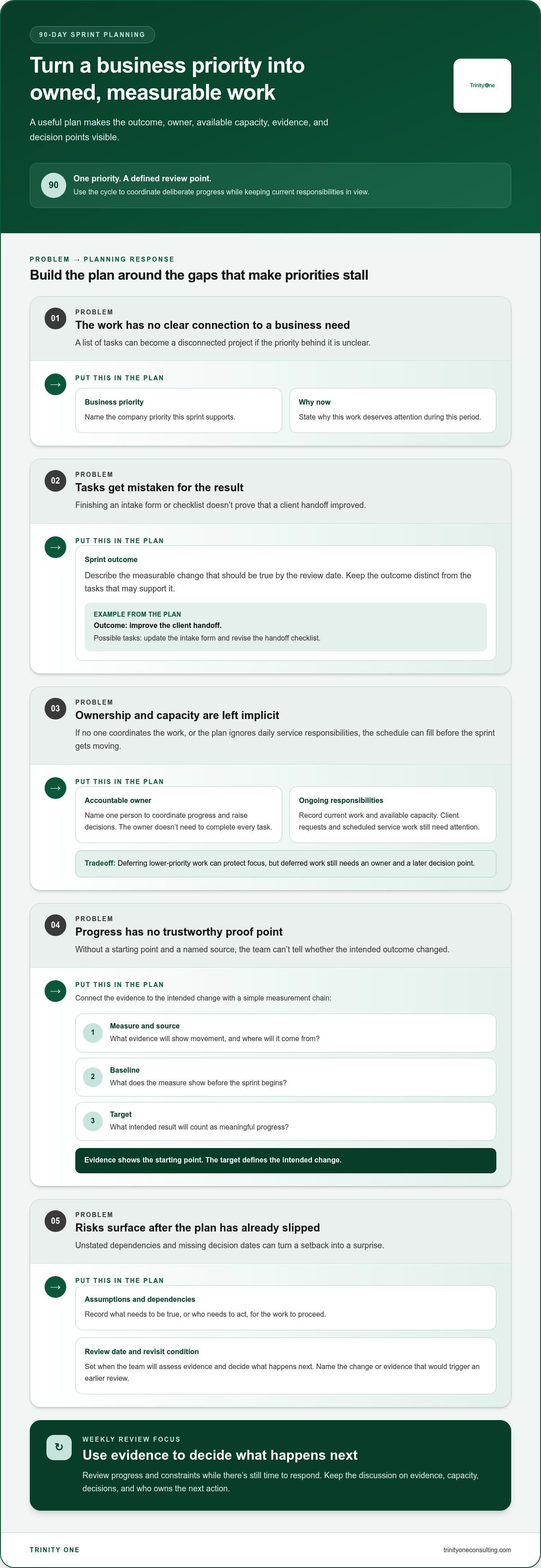
A priority needs a result, not a pile of tasks. “Improve the client handoff” describes a desired outcome. “Update the intake form” and “revise the handoff checklist” are tasks that may support it, but completing them doesn’t prove the handoff improved. The outcome tells the team what change matters. Tasks describe work along the way.
What makes a sprint different from a quarterly goal?
A quarterly goal names a result the business needs. Routine work keeps current operations moving, such as responding to client requests or completing scheduled service work. Both matter, and both use people’s time. A sprint assigns a defined period to deliberate progress on the priority, with an owner responsible for coordinating the work and reporting evidence the team can verify.
That distinction matters in service operations. If the priority is to reduce avoidable rework during client onboarding, the team still has to deliver for current clients. The sprint can focus on diagnosing the handoff and testing a change, while routine delivery remains part of capacity decisions. A plan that ignores ongoing work can look ambitious on paper and fail as soon as the schedule fills.
The tradeoff is real. Focus improves when leaders defer lower-priority work, but deferred work still needs an owner and a later decision point. Otherwise, “not now” becomes “nobody’s job,” and the team inherits a backlog of forgotten commitments.
When is a 90-day sprint a useful planning window?
This window can suit work that’s specific enough to advance and broad enough to need coordination across roles. For example, introducing a revised client intake process may involve reviewing the current handoff, agreeing on new steps, and observing how the change works in live operations. Those are possible stages, not a promise that the work will take exactly 90 days.
A fixed review point gives leaders a moment to assess evidence and decide whether to continue, adjust, or stop. It doesn’t make 90 days the right period for every priority. Work with a shorter deadline may need a shorter cycle. A priority that depends on conditions outside your team’s control may need a different review schedule.
Keep the terminology straight. A business sprint is a planning approach, not a formal Scrum Sprint. In software development, Scrum Sprints are timeboxed periods of one month or less, as described in Understanding Sprints in Software Development. A 90-day business cycle borrows the focus and review discipline, not the formal Scrum definition. For launch-focused work, Trinity One’s Rapid Launch Sprint guide is a relevant next reference.
What should a 90-day sprint planning template include?
A useful 90-day sprint planning template connects a business priority to an outcome, an accountable owner, a way to measure change, and a review date. Each field should help the team make a decision. If a field doesn’t change what you’ll do, monitor, or reconsider, it may be clutter.
Use this copy-ready structure. Fill in the blanks with your team’s facts, not hoped-for results.
Which fields belong at the top of the template?
- Business priority: [Which company priority does this sprint support?] This keeps the work tied to a business need instead of a disconnected project.
- Sprint outcome: [What measurable change should be true by the review date?] This helps the team define success beyond completing tasks.
- Accountable owner: [Who coordinates progress and raises decisions?] One named owner makes it clear who carries the work forward.
- Why now: [What makes this priority worth attention during this period?] This helps leaders weigh it against other work competing for the same people.
- Measure and source: [What evidence will show movement, and where will it come from?] Naming the source lets the team judge whether the evidence is available and trustworthy.
- Baseline: [What does that measure show before the sprint begins?] Without a starting point, the team can’t tell whether the outcome changed.
- Target: [What intended result will count as meaningful progress?] Comparing the target with the baseline helps leaders decide whether the plan is working.
- Review date: [When will the team assess the evidence and decide what happens next?] This prevents the outcome from becoming an open-ended commitment.
- Assumptions and dependencies: [What needs to be true, or who needs to act, for this work to proceed?] These entries reveal risks that could change the plan.
- Revisit condition: [What change or evidence would trigger an earlier review?] This gives the team a reason to raise a decision before a missed target becomes a surprise.
A useful sprint outcome is a measurable change with an accountable owner. The owner coordinates the work but doesn’t necessarily complete every task. The measure, baseline, target, and review date form a working chain: evidence shows the starting point, the target defines the intended change, and the review date sets when leaders will decide whether to continue or adjust. The Agile Alliance on Sprint Planning also describes planning as a team activity that clarifies the work and its intended result.
How should the template break the outcome into work?
Use milestone fields for meaningful points of progress, not every small task. A long task inventory takes time to maintain and can make activity look like evidence of an outcome.
- Milestone: [What progress point moves the outcome forward?]
- Owner and due date: [Who owns this milestone, and when is it due?]
- Completion evidence: [What will show that the milestone is complete?]
- Operating capacity: [What recurring work must the team continue, and who covers it?]
Capacity belongs in the template because sprint work uses time that may already be committed to service delivery. If the team can’t name what continues, leaders can’t make an honest tradeoff between the priority and routine operations.
Which 90-day sprint template format fits your team?
Choose the simplest format your team will keep current. A 90-day sprint planning template can live in a shared digital workspace, a document, or on paper. Choose based on who needs to update it and how the team will use it to make decisions.
| Format | Visibility | Editing | Review use | Likely tradeoff |
|---|---|---|---|---|
| Shared digital workspace | Owners can see the current plan from different locations. | Multiple people can update progress between reviews. | Useful when leaders need a current view before a meeting. | Requires someone to maintain fields and keep updates relevant. |
| Simple document | Everyone with the document can review the same plan. | Easy to revise in one place, though edits may need coordination. | Works for a team that discusses progress together. | Can become outdated if owners don't update it between meetings. |
| Printed planning sheet | Visible to people in the room or near the posted plan. | Changes require someone to update the sheet. | Good for a live planning conversation or an in-person review. | Harder to keep current when work or ownership changes. |
None of these formats can fix unclear ownership or a missing review rhythm. A polished workspace still leaves the team guessing if no one knows who updates progress, when leaders review it, or which evidence calls for a decision. Agree on those operating rules first. Then pick the format that supports them.
When does a shared digital template make sense?
A shared digital workspace fits when owners need to update progress between review meetings, especially if leaders aren't working from one shared location. Keep the fields tied to decisions, such as whether a milestone is on track or needs a change in support. Every added field has an upkeep cost. If the team never uses it to decide what happens next, remove it.
More tracking doesn't automatically create better oversight. A detailed tracker can take time to maintain and may produce rows of updates without a clear decision process. Start with the information the team reviews, then add a field only when it answers a recurring question or prompts action.
When is a simple document or printed plan enough?
A document or printed sheet can work when a small team can review one visible plan together and update it without confusion. The tradeoff is weaker visibility between reviews. When several owners need separate updates, or leaders need a current view before the next meeting, a static plan may depend on one person to gather changes and circulate them.
If the sprint plan is becoming part of a wider execution system, connect it to the rhythm leaders already use to review company priorities. A broader operating system can bring sprint updates into those existing decisions. Don't add another tracker unless it solves a real visibility problem.
How do you run the sprint after filling in the template?
A 90-day sprint planning template earns its place through the weekly review, where evidence leads to a decision and someone leaves owning the next action. Keep the sequence consistent. Separate progress updates from problem solving so the meeting doesn’t turn into a round of vague status reports.
- Inspect evidence. Compare each owner’s evidence with the agreed milestone, not with a general impression of progress.
- Surface constraints. Name what is blocking or delaying the work, then identify who will resolve it or raise it to a leader.
- Make a decision. Decide whether the plan stays as written or needs a change to scope, timing, or assigned capacity.
- Record ownership. Write down the next commitment, its owner, and when the team will review it again.
A milestone without evidence can’t show whether the sprint is on track. Evidence might be a completed review, a documented decision, or a recorded result against the measure. Agree on what counts before the review, so nobody has to argue from memory.
What should a weekly sprint review cover?
Ask each owner to report the evidence tied to their milestone and identify any new constraint. Keep progress reporting brief. If a problem needs discussion, capture it and move into problem solving after each owner has reported. This prevents one difficult issue from consuming the full meeting while other owners’ work goes unreviewed.
Check workload directly. Ask whether the assigned work still fits alongside ongoing service responsibilities and whether the person has the support needed to complete it. End by recording a clear next commitment for each decision, with an owner and the next review point. A meeting without those records creates more interpretation work later.
What should leaders do when the plan slips?
First, identify why. A temporary obstacle may need help or escalation. A changed assumption may call for a revised approach. An unrealistic workload calls for an honest capacity decision, not an instruction to work faster.
Then choose whether to adjust scope, timing, or assigned capacity, and record the reason. Before adding work or moving a deadline, consider what the change asks of the people carrying it and which existing responsibility will be affected. Protecting the outcome matters. So does keeping the plan workable for the team.
When should you get operating support for a 90-day sprint?
You can run a 90-day sprint planning template yourself when one person can own the work, leaders make decisions on time, and weekly reviews lead to clear next steps. Operating support is worth considering when the priority keeps slipping between departments, nobody has authority to resolve constraints, or the team can’t make room for sprint work alongside client delivery.
A plan can be clear and still lack an operating owner. If leaders agree on the outcome but no one coordinates decisions, checks capacity, or follows up on stalled commitments, the gap isn’t another field in the template. The gap is leadership attention applied to execution.
What can a fractional COO contribute to sprint execution?
A fractional COO or Integrator provides operational leadership that connects company priorities with the work teams carry out. That can include clarifying who owns a decision, bringing unresolved constraints to the right leaders, and keeping the review rhythm tied to operating priorities. Clear ownership gives the team a person to turn to when execution gets stuck.
Trinity One’s fractional COO and Integrator support connects sprint commitments with company operations and follow-through. The tradeoff is that operating support adds another leadership role and requires the team to bring real issues into the open. It can’t replace clear decisions from company leaders or create capacity that the business hasn’t made available.
Trinity Cadence connects sprint reviews with a broader operating cadence, including AI coaching and real-time visibility into execution and engagement. That wider view helps leaders see whether work is moving and how people are experiencing their commitments. It’s useful when sprint reviews need to connect with the company’s recurring operating conversations instead of running as a separate meeting.
How can a sprint connect business results with people?
A sprint assigns work to people, so its plan should account for their ability to do that work alongside existing responsibilities. If the same person owns a milestone and handles time-sensitive client work, leaders need to recognize the collision before it becomes a missed commitment. Ask what needs to change so the work is achievable.
I believe a company becomes the best version of itself only as its people become better versions of themselves. A review should examine more than task completion. Leaders can ask what someone has learned, where they need a decision, and whether the commitment still fits their role and workload. Progress at work depends on people having the clarity and room to grow through it.
Use the template on your own when ownership and follow-through are already clear. Bring in operating leadership when those responsibilities keep landing back on you or remain unclaimed across the team. The 30-minute Trinity One Cadence Call with Kevin Patrick is available here.
How can you put the next priority into motion?
Before your next planning meeting, choose one priority that’s been waiting for focused attention. Use the 90-day sprint planning template to turn it into a commitment your team can examine, adjust, and learn from as the work unfolds.
Start with an honest capacity conversation. People need to know what the priority asks of them and what work will remain on their plates. That clarity helps you set commitments the team can keep and gives leaders a chance to address competing demands before they become missed promises.
I believe the quality of execution depends on the people doing the work. A sprint should help your team make progress and build the judgment to handle challenges with more clarity. Give the plan room to change when evidence calls for it, and keep the next decision visible to the people responsible for acting on it.
You don’t need a perfect plan to begin. You need a clear commitment and the willingness to review what’s happening.
Frequently Asked Questions
Can a 90-day sprint start at any point in the year?
Yes, a team can begin a sprint whenever a priority needs focused attention. For example, a service business might start after approving a new client workflow rather than waiting for the next calendar quarter. Choose a date based on when owners and needed information are available. Put each review date on calendars at kickoff, then check existing launches, staffing plans, and client commitments before assigning work.
How many goals should a 90-day sprint have?
There’s no fixed number that works for every team. Start by writing one clear outcome, then check whether the supporting projects can be owned and reviewed alongside ongoing responsibilities. If several projects need the same person’s attention, decide which can move forward without creating a conflict. The right scope is the work your team can advance while maintaining the service commitments already on its schedule.
What happens if a team misses a 90-day sprint milestone?
A missed milestone should prompt a decision, not a quiet change to the deadline. Ask the owner to record what the evidence shows and identify the cause, such as a delayed input or an assumption that no longer holds. Then decide whether scope, timing, or capacity needs adjustment. Keep the conversation on the work and its conditions, so the team can address the cause without turning the review into a search for blame.
Is a 90-day sprint the same as a quarterly plan?
Not necessarily. The periods may line up on your calendar, but the plan’s purpose matters more than its label. A sprint focuses attention on a defined outcome and the work needed to advance it. A quarterly plan may also hold broader operating commitments, such as ongoing service responsibilities. If you use both, make clear which commitments belong to the sprint and which remain part of regular operations.
Can a small team use a 90-day sprint planning template?
Yes. A small team can use a compact 90-day sprint planning template, provided it names an accountable owner and shows how existing client work will continue. If the same person handles service delivery and sprint tasks, make that conflict visible before work begins. Remove fields that don’t support a decision. A template can clarify choices, but it can’t create capacity, so leaders still need to decide what work will wait.
How often should a team review a 90-day sprint plan?
Set recurring reviews at a pace that fits the work and how often owners can provide meaningful evidence. A fast-changing client handoff may need closer attention than a milestone waiting on a scheduled input. At each review, check what has changed since the last discussion and whether a leader’s decision is needed. If evidence is stable, avoid meetings that repeat the same update without changing the next action.
Book a 30-minute Trinity One Cadence Call with Kevin Patrick to discuss operating support for your sprint.